
Instagram Click-to-DM ads are paid Meta ads with a Send Message call-to-action that drops the click into a one-to-one Instagram Direct conversation instead of a landing page. For ecommerce brands selling products that need pre-purchase questions answered (sizing, fit, materials, custom orders), the format converts because the DM thread absorbs objections a static landing page cannot. An automated DM sequence then qualifies, recommends, and closes.
You spend $400 on a Reel ad. The link-out version sends 1,200 people to a product page. Two-thirds bounce because the page does not answer their actual question, which is “will this fit my body type?” or “do you ship to Spain?” or “is this in stock in olive green?” A Click-to-DM ad sends the same 1,200 people into a thread where automation answers all three in 4 seconds, and the buyers who would have left now have a path to checkout.
This guide covers how Click-to-DM ads work, when they outperform link-out ads, the DM sequence structure that closes sales, the tools that run the automation, and the mistakes that turn a promising format into wasted ad spend.
Key Takeaways
- Click-to-DM ads route paid clicks into Instagram DMs, not a landing page. Meta calls them “ads that click to message” (facebook.com/business, May 2026).
- The format wins when products need pre-purchase Q&A. Sizing, fit, customization, shipping, and stock questions kill landing-page conversion but resolve in 30 seconds inside a DM.
- The DM sequence is the actual conversion engine. The ad just opens the thread. Brands that drop a product link as the first DM see the same conversion rate as link-out ads.
- Agencies report 2-3x lift over link-out ads in conversion rate (heyy.io, May 2026). Treat that as a directional benchmark, not a guaranteed result. Meta does not publish a Click-to-DM-specific benchmark.
- The 24-hour Standard Messaging Window applies. Each new user message resets it. The Human Agent tag extends it to 7 days for follow-up (developers.facebook.com, May 2026).
- Click-to-DM is not a fit for every product. Low-AOV impulse SKUs that need no Q&A still convert better on link-out ads. High-consideration products with questions are the sweet spot.

What Are Instagram Click-to-DM Ads?
Click-to-DM ads are Meta’s term for any paid placement where the call-to-action button reads Send Message and the click opens a conversation thread instead of a webpage. Inside Meta Ads Manager the placement is grouped under “ads that click to message” and routes to one of three destinations: Messenger, Instagram Direct, or WhatsApp (facebook.com/business/ads/click-to-message-ads, May 2026).
The Instagram Direct variant is the one ecommerce brands use for Instagram-native traffic. Partner documentation also calls it Click-to-Instagram-Direct (respond.io, May 2026). The format works in Feed, Reels, Stories, and Explore placements with Send Message swapped in as the CTA.
Mechanics:
- A user sees the ad on Instagram.
- They tap Send Message.
- The native Instagram Direct thread opens with a prefilled message (the ad copy or a custom welcome).
- The brand’s automation tool detects the new thread and starts a scripted DM sequence.
- The thread continues like any other DM until the user buys, abandons, or asks something the bot escalates to a human.
The user never leaves Instagram. No external pixel, no landing page, no checkout-page-load anxiety until the brand drops the checkout link inside the thread.
Why Click-to-DM Beats Link-Out Ads for Some Ecommerce Products
The economics of the format come down to one variable: how many of your buyers ask a question before they decide. That question volume is also what decides your wider ecommerce chat marketing setup.
For a $19 phone case in three colors, very few buyers have questions. The landing page handles it. Click-to-DM is overhead.
For a $120 cashmere sweater in seven sizes and four colors, almost every buyer has a question: fit, weight, care, return policy. A landing page lists the answers in fine print, and most buyers do not read fine print. They bounce, message a friend, and forget. A Click-to-DM ad puts the answer in front of them in 4 seconds.
The shift in conversion rate comes from three places:
- Latency drop. A landing page takes 2-4 seconds to load on mobile and another 8-15 seconds for the buyer to scan and find the answer to their question. A DM bot replies in under 2 seconds with the exact answer scripted to the trigger word.
- Friction collapse. Checkout abandonment averages 70%+ for ecommerce on mobile. A DM thread can deliver a one-tap checkout link after qualification, skipping the cart-page step entirely.
- Re-engagement window. A landing-page bounce is gone. A DM thread stays open. The brand can follow up the next day with a reminder inside the 24-hour Standard Messaging Window.
heyy.io, a click-to-chat agency, reports 2-3x conversion lift versus link-out ads across their client portfolio (heyy.io/blog/click-to-chat-ads, May 2026). bot.space reports a similar range with up to 10% conversion on well-optimized campaigns (bot.space, May 2026). Both are agency-aggregated numbers, not Meta-published benchmarks. Use them as directional, not as guaranteed lift.
The format does not lift everything equally. AOV, product complexity, and audience temperature determine the size of the gain.
The Click-to-DM Conversion Math
A worked example, using verified Instagram ad cost benchmarks for context.
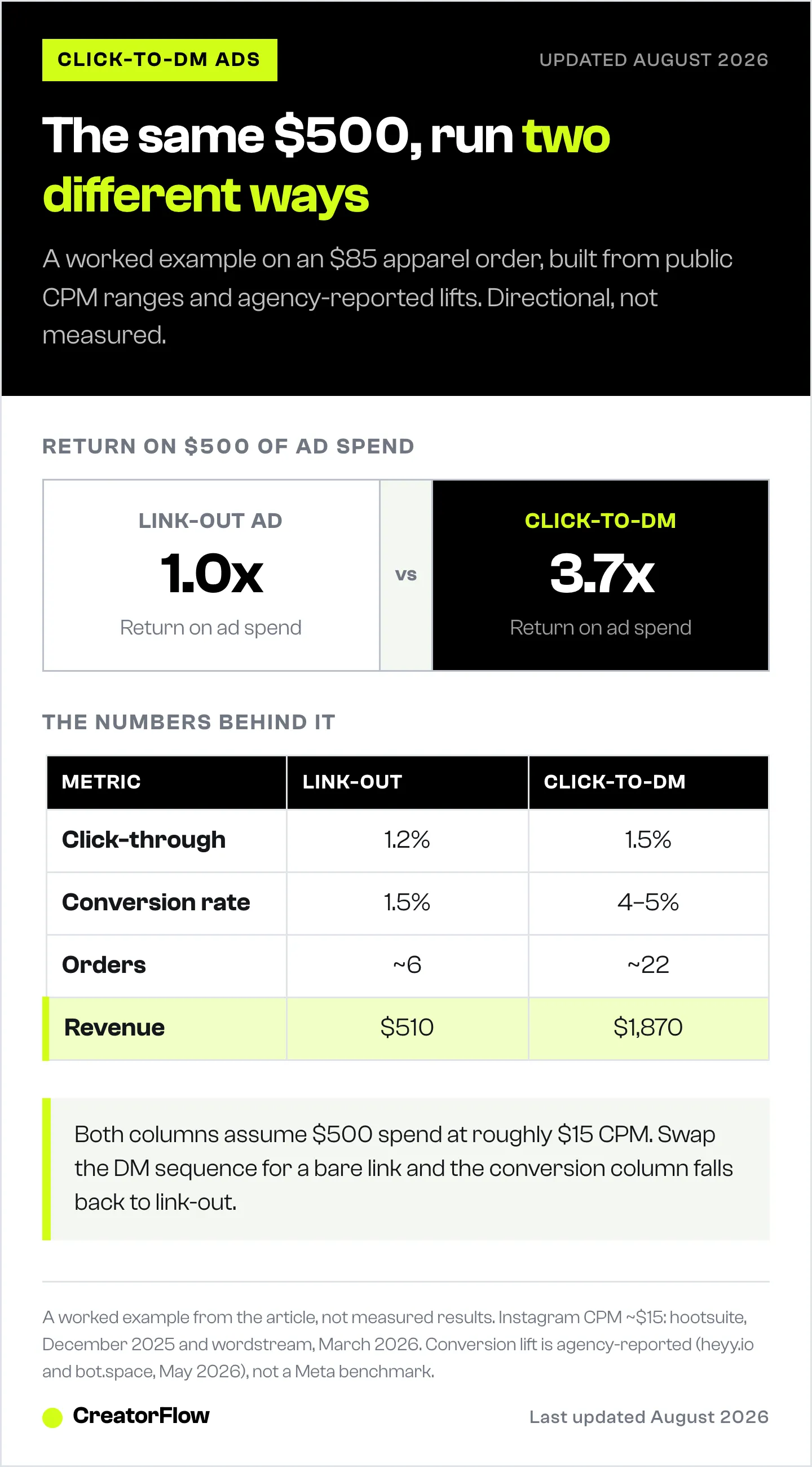
Scenario: Apparel brand, $85 AOV, sweater drop, mobile-first audience.
| Metric | Link-Out Ad | Click-to-DM Ad |
|---|---|---|
| Ad spend | $500 | $500 |
| Average IG CPM | ~$15 (hootsuite, Dec 2025) | ~$15 (same) |
| Impressions | ~33,000 | ~33,000 |
| Click-through to landing page / DM | 1.2% / ~395 clicks | 1.5% / ~495 clicks |
| Cost per click | ~$1.27 | ~$1.01 |
| Conversion rate | 1.5% (typical apparel LP) | 4-5% (DM with qualification) |
| Orders | ~6 | ~22 |
| Revenue at $85 AOV | $510 | $1,870 |
| ROAS | 1.0x | 3.7x |
The CTR lift comes from Send Message reading as a lower-commitment ask than Shop Now. The conversion-rate lift comes from the qualification + Q&A loop replacing the landing-page bounce.
The numbers above are directional, built from public Instagram CPM ranges (wordstream.com, March 2026; admanage.ai, May 2026) and agency-reported conversion lifts. Your brand will land somewhere on this curve based on product fit, audience, and DM script quality. If your DM script is a single product link with no qualification, the conversion-rate column collapses back to the link-out number and the format loses its edge.
Setting Up the DM Sequence Behind the Ad
The ad is the easy part. The DM sequence is the conversion engine and the place most brands underinvest. A Click-to-DM ad with a one-message bot is just a more expensive way to drop a product link.
Five-step sequence that ecommerce brands run:
1. Trigger and welcome. When the thread opens, fire a welcome message in under 2 seconds. Acknowledge the ad, name the product, ask one qualifying question. Example: “Hey! Saw you tapped on the Olive Stretch Sweater. Quick one before I send the link, what’s your usual size?”
2. Qualify. One question, max two. The qualifying answer determines what the bot sends next. Sizing, color, intent, location for shipping. Do not run a 7-question quiz, drop-off rates spike past question two.
3. Recommend. Based on the qualifying answer, send the product variant link, an alternative if out of stock, or a sizing chart. Use Instagram’s product mention tags inside the DM where supported, the in-app preview converts better than a raw URL.
4. Close. Send the checkout link. Add one trust element (returns policy, shipping time, recent buyer review). Do not pile on three. The point is to remove the last friction, not to keep selling.
5. Follow up. If no purchase in 6-12 hours, fire a reminder inside the 24-hour Standard Messaging Window. After 24 hours, you need the Human Agent tag (extends to 7 days) or a re-engagement ad to message again (developers.facebook.com, May 2026).
The pattern that works: Trigger → Qualify (1 question) → Recommend → Close → Follow-up.
The pattern that fails: Trigger → Link.
Tools That Run Click-to-DM Automation
Three tools cover most of the ecommerce Click-to-DM market in 2026. Each fits a different brand size.
CreatorFlow
Best for solo founders and small DTC brands running a focused Instagram funnel. Flat-rate pricing means the cost does not climb with audience size: Free includes 500 DMs/month and 1 workspace, Pro is $15/month with 5,000 DMs and the follow gate / email gate / geo analytics, Growth is $30/month with 10,000 DMs and 5 workspaces (creatorflow.so, May 2026). Built on Meta’s official Instagram API as an approved Tech Provider. Setup runs under 5 minutes for a basic Click-to-DM flow.
Best fit: under 25,000 monthly DM volume, Instagram-only funnel, founders who want flat-rate pricing.
ManyChat
Multi-platform automation that covers Instagram, Messenger, WhatsApp, SMS, TikTok, Telegram, and email in one builder. Pricing scales with contact count post-March 2026 restructure: Free 25 contacts, Essential $17/month for 250 contacts and 2 channels, Pro $39/month for 2,500 contacts and 3 channels, Business $99/month for 7,500 contacts with all channels and 5 seats, Advanced $199/month for 25,000 contacts. Annual billing drops those to $14, $29, $69, and $139 per month (manychat.com/pricing, July 2026). Click-to-Message ad automation is supported across all paid tiers.
Best fit: brands running ads across multiple channels, agencies, growth past 25,000 contacts.
LinkDM
Instagram-focused automation with a flat $19/month Pro plan covering up to 25,000 DMs and a 7-day trial (linkdm.com/pricing, July 2026). Includes an explicit Advertising Automation feature for auto-replying to ad and post comments, plus story mention and story reply triggers (linkdm.com, July 2026).
Best fit: brands wanting a flat rate at higher DM volume than CreatorFlow Pro, Instagram-only stack, established usage (LinkDM reports 50,000+ creators, brands, and agencies).
The choice between the three usually comes down to scope (multi-channel needs ManyChat) and pricing model (flat-rate buyers pick CreatorFlow or LinkDM, contact-tier buyers pick ManyChat).
Common Click-to-DM Mistakes That Kill Conversion
The format is unforgiving when set up poorly because each ad click costs the same as a link-out click but fails harder when the DM script is weak. Five mistakes that show up in audits:
1. The “link drop” first message. The bot opens with the checkout URL. No qualification, no acknowledgement of the ad, no question. Conversion rate collapses to link-out levels and the brand wonders why the format is hyped.
2. Too many qualifying questions. Three or more questions before the recommendation, drop-off rates climb past 40% by question three. Limit to one or two.
3. No follow-up sequence. The first 12 hours after the ad click are the highest-intent window. A brand without a follow-up DM scheduled inside the 24-hour window leaves orders on the table.
4. Trying to message past the 24-hour window without the right tag. Meta’s policy on standard messaging is hard. Outside the window, promotional content gets the message blocked or the account flagged. Use the Human Agent tag (7 days) for a real human reply, or a paid re-engagement ad for promotional follow-up.
5. Mismatched ad creative and DM tone. The ad reads as a polished branded ad and the DM opens with “hey friend, what’s up?” The tone-shift breaks trust. Match the DM voice to the ad creative.
For more on rate-limit specifics and what triggers Instagram pacing, see our Instagram API rate limits guide.
When to Use Link-Out Ads Instead
Click-to-DM is not the right format for every ecommerce brand. Cases where link-out ads still win:
- Low AOV with no questions. A $9 phone charger that comes in one variant. The DM overhead does not pay for itself.
- High-volume retargeting. When the goal is to show 100,000 cart-abandoners a single creative and push them back to checkout, link-out is faster and cheaper to scale.
- Pixel-dependent attribution stacks. Brands running advanced attribution that requires landing-page pixel events lose data when traffic stays inside Meta. Hybrid setups can solve this, but it adds complexity.
- Subscription products with a multi-step signup. Subscription checkout flows do not collapse cleanly into a DM. Send the click to the dedicated landing page.
- Wholesale or B2B with complex pricing. A DM bot cannot quote bulk discounts dynamically. A landing form or rep follow-up handles it better.
Most ecommerce stacks end up running both. Click-to-DM ads for product launches and high-consideration SKUs, link-out ads for retargeting and impulse buys.
For brands setting up the comment-trigger version of this funnel rather than the paid-ad version, see our comment-to-DM automation setup guide.
Building the Full Funnel
A complete ecommerce Instagram funnel layers Click-to-DM ads on top of organic comment-to-DM automation. Both feed the same DM sequence and the same buyer database.
The structure most brands run:
- Organic top of funnel. Reels and Feed posts with comment-to-DM keywords (“DROP”, “PRICE”) that trigger automation for warm followers.
- Paid acquisition. Click-to-DM ads to cold audiences and lookalikes, routed to the same DM sequence.
- Email capture inside the DM. The email gate qualifies the lead before sending the product link, building an owned list. CreatorFlow Pro and LinkDM Pro both support this. ManyChat handles it on Pro+ tiers.
- Retargeting. Anyone who messaged but did not buy gets re-engaged with a follow-up DM (inside the 24-hour window) and a retargeted Click-to-DM ad afterward.
- Lifecycle. Buyers move to email or SMS for post-purchase nurture.
The DM is the central conversion node. Ads, organic posts, story mentions, and comments all feed into it.
For the broader funnel architecture, see our Instagram sales funnel complete guide and the best Instagram DM automation tools comparison.
FAQ
How much do Instagram Click-to-DM ads cost?
There is no separate Click-to-DM CPM. The format runs on standard Instagram ad infrastructure, so cost follows your audience and creative. Public benchmarks for Instagram in 2026 sit at around $15 CPM and $1.31 average CPC (hootsuite, Dec 2025), with Q1 2026 retail CPA in the $13-$17 range (admanage.ai, May 2026). Click-to-DM ads typically see slightly higher CTR (Send Message reads lower-commitment than Shop Now) and lower CPA when the DM sequence is built well.
What is the difference between Click-to-DM and Click-to-Messenger ads?
Both are sub-types of Meta’s “ads that click to message” format. Click-to-Instagram-Direct routes the click into an Instagram Direct thread. Click-to-Messenger routes into a Facebook Messenger thread. Click-to-WhatsApp is the third variant. Choice depends on where your audience already messages. Instagram-native ecom brands typically pick Click-to-Instagram-Direct (facebook.com/business, May 2026).
Can I run Click-to-DM ads without a chatbot tool?
Technically yes. The native Instagram Direct thread will open and you can reply manually. In practice, manual replies break the format. The conversion advantage comes from sub-2-second response time, which only an automation tool delivers. Without one, you are paying ad rates for a slower email response.
What is the best DM automation tool for Click-to-DM ads?
It depends on volume and channel mix. CreatorFlow ($15-$30/month flat rate) fits Instagram-only brands under 25,000 monthly DMs. LinkDM ($19/month) fits flat-rate buyers wanting higher DM caps. ManyChat ($17-$199/month tiered) fits brands running across Instagram, WhatsApp, SMS, and Messenger or scaling past 25,000 contacts. All three integrate with Meta’s official Click-to-Message ad infrastructure.
Do Click-to-DM ads work for high-ticket ecommerce?
Yes, often better than for low-ticket. High-ticket products generate the most pre-purchase questions, which is exactly what the DM thread resolves. Brands selling custom goods, made-to-order, or considered purchases (jewelry, apparel, furniture, fitness gear) tend to see the largest conversion lift versus link-out ads. Industry guidance from 2026 marketing publications confirms the DM-conversation funnel suits high-AOV products that require pre-purchase Q&A (admetrics.io, May 2026).
Does the 24-hour messaging window apply to Click-to-DM ads?
Yes. When a user clicks the ad and sends the prefilled message, Meta’s Standard Messaging Window opens for 24 hours. Inside that window, the brand can send promotional content. Each new user message resets the timer. After 24 hours, promotional content is blocked unless the brand uses the Human Agent tag (extends to 7 days for human-led replies) or runs a paid re-engagement message ad (developers.facebook.com, May 2026).
Can I retarget people who messaged me from a Click-to-DM ad?
Yes. Meta lets you build a Custom Audience of users who messaged your business, including those routed in from Click-to-DM ads. Use that audience to layer follow-up Click-to-DM creatives or standard retargeting ads. This is one of the most underused steps in the format. Most brands run the ad once and never retarget the messaged-but-did-not-buy segment.
Click-to-DM ad format, ManyChat tiers, LinkDM tiers, Instagram CPM benchmarks, and Meta messaging-window rules verified May 2026 from facebook.com/business, developers.facebook.com, manychat.com/pricing, linkdm.com/pricing, hootsuite.com, and admanage.ai. Conversion-lift figures from heyy.io and bot.space are agency-aggregated, not Meta-published. Individual results vary.


