
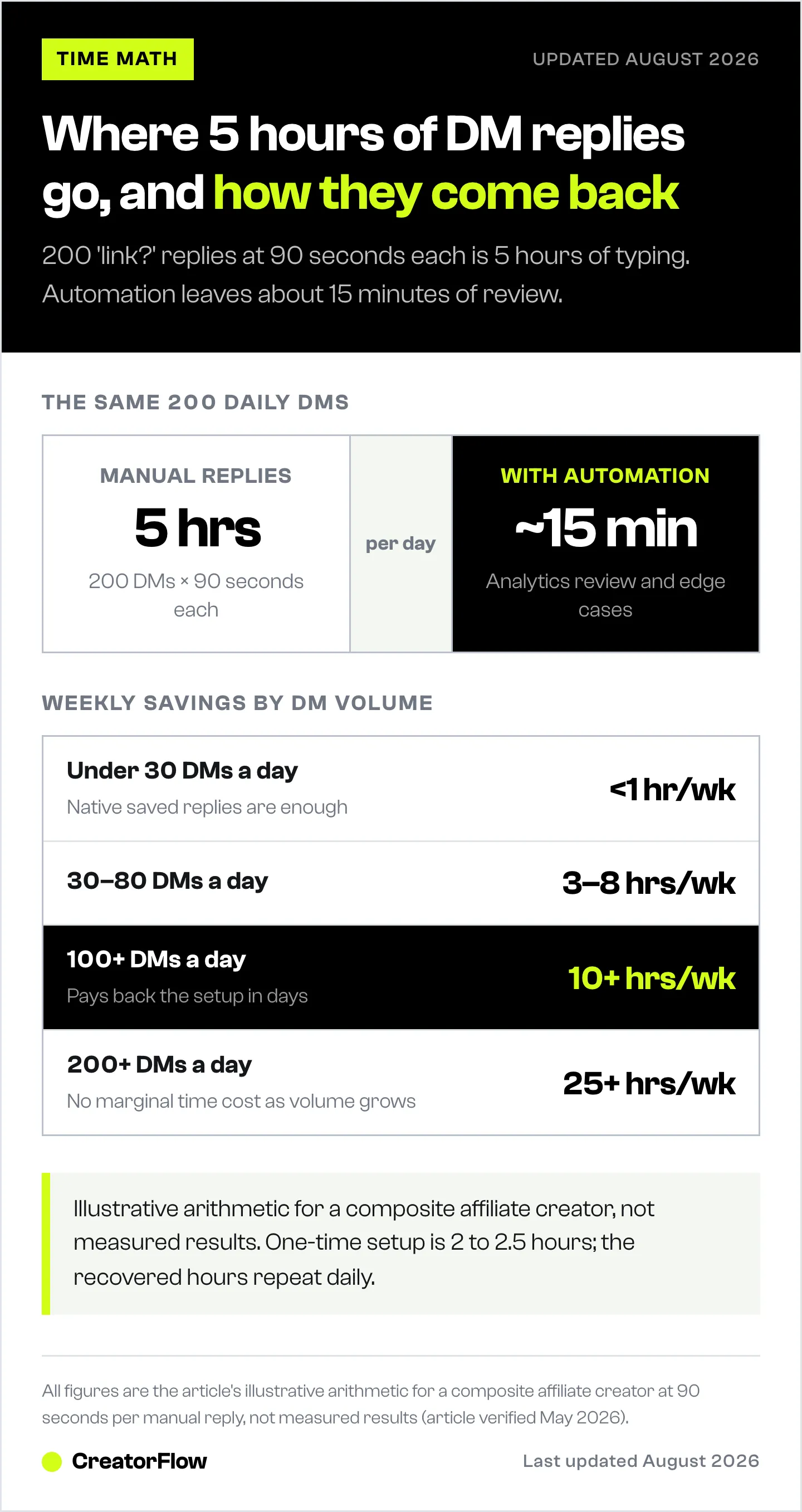
Instagram DM automation saves affiliate creators 10 to 20 hours per week. The math is straightforward: 200 manual DM replies a day at 90 seconds each is 5 hours of typing. Automation drops that to about 15 minutes of reviewing analytics and approving templates. The savings come from one-time template setup, not from typing faster, which is why the recovered time is permanent rather than marginal.
You wake up to 187 unread DMs. Most are some version of “link?” or “where from?” You make coffee. You start typing. By 11 a.m. you have replied to 84 of them. The rest will sit until tomorrow, by which point the buyers have already swiped past your post and bought something else. The 84 you did answer? You were on autopilot, paste-and-send, no analytics, no segmentation, no email capture. That is the affiliate creator’s daily tax.
This guide walks through the actual time math behind Instagram DM automation for affiliate creators, what a representative day looks like before and after CreatorFlow is set up, and the parts of the workflow that genuinely move the clock versus the parts that look like savings but are not. The numbers below are illustrative, not pulled from a single named creator. They are arithmetic anyone can verify.
Key Takeaways
- Where the hours actually go: A creator handling 200 DMs per day at 90 seconds each spends 5 hours typing. Automation removes the typing entirely, leaving roughly 15 minutes of analytics review per day.
- The setup is the cost: Most of the savings come after a one-time investment of 60 to 90 minutes building templates and triggers. The hour you spend on day one is the hour that pays back every day after.
- Volume changes the math: Below 30 DMs a day, automation saves under an hour a week. Above 100 DMs a day, the gain is 10+ hours a week and continues to scale because automated volume has no marginal time cost.
- Speed compounds revenue: Automated replies arrive in 1 to 8 seconds. Manual replies arrive 2 to 6 hours later, by which point buying intent has decayed roughly 50 percent per hour for impulse purchases.
- The ~200 DMs/hour pacing is not a bottleneck for most affiliate creators: Most automation tools (including CreatorFlow) pace sends at roughly 200 DMs per hour as a behavioral safety convention. Meta’s actual published rate limits are per-second (100/sec for text and links on the Instagram Login path). At 16 hours a day of trigger eligibility, paced sends still reach roughly 3,200 DMs, well above what most creators with under 250K followers receive.
- Time savings only count if you reinvest them: Hours recovered from DMs go to creating more posts, filming Reels, building an email list, or sleeping. Time saved that vanishes into Instagram scrolling does not move revenue.

The math: where 4 hours of DMs actually go
Every manual DM has the same five steps: open the conversation, find the right affiliate link, copy it, paste it with a short personalized line, send. On a good day with a clean tab system, that is 45 seconds per DM. On a normal day with two open browsers and a screaming notification feed, it is 90 seconds.
A mid-sized affiliate creator with 50,000 to 100,000 followers, posting 3 to 4 Reels and 1 to 2 carousels per week, typically receives:
| Daily activity | DMs generated |
|---|---|
| Comments on Reels asking “link?” / “where from?“ | 80 to 150 |
| Story replies asking about products | 30 to 60 |
| Direct DMs asking about prices, sizing, discount codes | 20 to 40 |
| Cold pitches, irrelevant messages, brand inquiries | 10 to 20 |
| Total daily DM load | 140 to 270 |
At 90 seconds per reply, 200 DMs is exactly 5 hours. That is half an entire workday before any content is created, before any analytics are reviewed, before any new ideas hit the page.
The hidden cost is not just the 5 hours. It is what those 5 hours displace. Most affiliate creators report manual DM management eating their highest-energy morning window, which is the same window they would otherwise use for filming or writing.
A representative day before automation
Below is an illustrative weekday for a composite Amazon affiliate creator with 65K followers, three trigger-style Reels live, and an average of 180 daily DM requests. This is not a single named creator. Every number is verifiable arithmetic.
7:00 a.m. Wake up. Check Instagram. 142 unread DMs from overnight. Open a coffee.
7:30 a.m. to 9:30 a.m. Reply to 60 DMs. Most are “link please” on the dress Reel from Tuesday. Copy Amazon link, paste, add a sizing note, send. After 60 DMs the typing fatigue is real. Stop to eat.
9:30 a.m. to 10:00 a.m. Breakfast and a scroll break that drifts into 35 minutes of competitor research that is functionally just scrolling.
10:00 a.m. to 12:30 p.m. Reply to another 70 DMs. Take 3 follow-ups from yesterday. By the time the queue clears, lunch is overdue.
12:30 p.m. to 1:30 p.m. Lunch. Try to film a Reel. Get distracted by another wave of DMs notifications. Film 14 seconds, give up.
1:30 p.m. to 3:00 p.m. Reply to the remaining 50 DMs from this morning. Clear the inbox to “only the ones from yesterday” status. Feel temporary relief.
3:00 p.m. to 5:00 p.m. Try to actually create content. Filming attempts are interrupted by the next wave of DMs from a Reel that started picking up at lunch.
Daily total: 5 hours typing DMs. Roughly 15 percent of typed replies actually get a click because the average response delay is 3 to 5 hours, and Instagram’s 24-hour messaging window is already half spent. The other 85 percent went cold.
The same day after CreatorFlow is set up
Same creator, same 180 DM volume, same content schedule. CreatorFlow has been live for two weeks. Templates are dialed in. Trigger keywords on each Reel are tuned to the comment patterns the creator’s audience actually uses.
7:00 a.m. Wake up. Check Instagram analytics. 142 DMs were already sent overnight by automation, in under 8 seconds each. Click-through rate on last night’s two new Reels is 14 percent. Open a coffee.
7:15 a.m. to 7:30 a.m. Review the CreatorFlow dashboard. See which Reel triggered the most DMs (the dress one, again). Notice 3 manual messages that need a human reply — a brand inquiry, a sizing question that the template did not cover, and a refund question. Reply to those 3.
7:30 a.m. to 12:00 p.m. Film 4 Reels for the rest of the week. No interruptions. Inbox stays clean because automation handled the morning wave the moment posts were active.
12:00 p.m. to 12:30 p.m. Eat. Check analytics. 47 emails captured by the Email Gate flow overnight, exported to ConvertKit on Sunday’s CSV sync.
12:30 p.m. to 4:30 p.m. Edit the morning’s Reels. Schedule them. Write captions with the trigger keywords baked in. Brief outreach replies for the brand inquiries that came in this morning.
4:30 p.m. to 5:00 p.m. Final dashboard check. Write one new template variation for a keyword that keeps showing up in the comments.
Daily total: 30 to 45 minutes inside CreatorFlow. The rest of the day is content production, brand work, or rest.
The savings are not “instead of typing 200 DMs, type 20.” The savings are the entire morning block returning to its highest-value use. That is where the 10 to 20 hours per week comes from.
What actually saves time (and what does not)
Not every part of automation is equally time-saving. The honest breakdown:
Genuine time savings, ranked by impact:
- Comment-to-DM templates that fire on every post. This is the single biggest hour saver. Set once, runs on every Reel and carousel that uses the trigger keyword.
- Story reply triggers. Story replies are private and feel personal, and most creators reply to all of them manually. Automating them is a clean 30 to 60 minutes a day back.
- Keyword DMs. Auto-replies to inbound DMs for words like “price,” “info,” “discount” remove the second-largest manual category.
- Email capture inside the DM flow. This is not just a time saver; it builds an owned asset that reduces dependence on Instagram’s reach. See the comment-to-DM setup walkthrough for how the flow is wired.
What does not save as much time as people expect:
- Daily template tweaking. New creators sometimes spend 20 minutes a day editing templates. After the first two weeks, leave the templates alone unless analytics flag a problem.
- Watching automation analytics in real time. Resist this. Analytics are best reviewed once a day, not refreshed every hour.
- Building 18 separate triggers. Most creators need 4 to 7 triggers, total. Beyond that, maintenance overhead eats the savings.
The setup cost: hours you spend once
Time savings on day 30 are not free on day 1. The realistic setup investment for an affiliate creator:
| Setup task | First-time investment |
|---|---|
| Connecting Instagram Business account to CreatorFlow via OAuth | 5 minutes |
| Building the first comment-to-DM template (one trigger, one message) | 15 to 20 minutes |
| Building 4 to 6 additional templates for primary product categories | 45 to 60 minutes |
| Setting up Email Gate copy and link to email tool | 15 to 20 minutes |
| Reviewing first day’s analytics and adjusting | 30 minutes |
| Total setup | 2 to 2.5 hours |
If you are saving 5 hours a day after setup, that 2.5-hour investment pays back inside the first day of running. The risk is not setup time. The risk is over-engineering the setup — spending 8 hours building 14 triggers when 5 would have done it.
For a step-by-step build that respects this principle, see the Amazon affiliate DM setup.
When automation does not save time
Automation is not the right answer for every creator. The honest cases where it underperforms:
- Under 30 DMs per day. At low volume, the setup time is not amortized. Manual replies with saved-reply templates inside Instagram’s native interface are sufficient.
- Audiences that expect 1-on-1 conversation. Premium coaches, therapists, and high-touch consultants whose offer depends on conversational nuance lose more in feel than they gain in time.
- Content that has no clear trigger pattern. If your content does not generate predictable comment patterns, automation reduces to a generic “thanks for commenting!” auto-reply, which converts worse than no reply at all.
- Creators not willing to refine templates. Templates degrade. If you set them once and never touch them again, click-through rates drop. The minimum maintenance is one 15-minute review per week.
For creators stuck on the manual side, the manual vs automated breakdown lays out the decision math in more detail.
How to measure your Instagram DM automation time savings
Most creators overestimate their manual DM time before measuring and underestimate their actual time savings after switching. To know your real number:
Before automation:
- Pick 3 normal posting days in a row.
- Time-box every DM session with a phone timer.
- Count DMs sent in each session. Multiply through.
After automation:
- Use CreatorFlow’s analytics to count automated DMs sent.
- Track time spent inside the dashboard with the same timer method.
- Subtract the second number from the first.
Most affiliate creators measuring this for the first time discover the savings are larger than expected, because the displaced cost was not just the typing time but the context-switch cost of constantly checking the inbox. That second number rarely shows up in self-estimates. That hidden cost is also what drives exhaustion: here is how to build a DM system that prevents creator burnout.
The compounding return
Time saved on DMs is not just rest. For affiliate creators, the highest-return reinvestment of recovered hours is content production, because content is what creates the next wave of DMs. The flywheel:
- Save 3 hours a day on DM management
- Reinvest 2 of those hours into 3 more Reels per week
- More Reels = more triggered comments = more automated DMs
- Automation cost is flat ($15/month for Pro), so volume scales without time cost
This is the same logic underneath the 5-stage scaling framework for affiliate marketing, where the manual ceiling is the constraint that automation removes. For concrete examples of the flywheel in practice, see how influencers use CreatorFlow across affiliate links, email capture, and call bookings.
One more compounding layer: creators who recommend CreatorFlow after using it can join the affiliate program, which pays 30% of every payment a referral makes for their first 12 months.
FAQ
How much time does Instagram DM automation actually save?
For an affiliate creator handling 100+ DMs a day, automation typically saves 10 to 20 hours per week. The exact number depends on starting DM volume, manual reply speed, and how many distinct templates the creator builds. Below 30 DMs per day, the savings are marginal. Above 200 DMs per day, the savings exceed 25 hours per week.
Is DM automation worth it for small affiliate creators?
Below 30 DMs per day, automation saves under an hour per week and probably is not worth the setup time. Between 30 and 80 DMs per day, automation saves 3 to 8 hours per week, which is enough to justify a $15/month flat-rate tool but not enough to justify hours of fine-tuning. Above 80 DMs per day, automation pays back in days.
How long does it take to set up CreatorFlow for affiliate links?
A first-time setup with one trigger takes about 5 minutes. A complete setup with 5 to 7 templates, Email Gate, and analytics review takes 2 to 2.5 hours. The full setup is rarely necessary on day one — most creators ship the first trigger in 5 minutes and add more templates over the first week.
Can I automate Amazon affiliate DMs without breaking Amazon’s TOS?
Yes. Amazon Associates’ terms restrict where you display affiliate links, not how you deliver them. Sending an Amazon affiliate link inside an Instagram DM that the recipient explicitly triggered (by commenting a keyword on your post) is compliant. Mass-blasting affiliate links to people who did not opt in is not.
Do automated DMs feel robotic to followers?
Only if the templates are written like marketing copy. Well-written automation reads like a friendly note from the creator. The bigger giveaway is response time — if every reply arrives in 3 seconds 24/7, careful followers will notice. Adding a 30 to 90 second delay variance and writing templates in your normal voice solves both problems.
What is the minimum DM volume where automation pays off?
Roughly 50 DMs per day. At that volume, manual handling takes 60 to 75 minutes daily, which is enough that automation’s 2-hour setup pays back in two days. Below 30 DMs per day, manual handling with Instagram’s native saved replies is faster end-to-end.
How does the 24-hour Instagram messaging window affect time savings?
Meta’s Instagram Graph API only allows automated DMs to users who interacted with you in the last 24 hours (Meta for Developers, May 2026). For affiliate creators this is not a constraint, because the trigger event (a comment, a Story reply, an inbound DM) opens the window. The window only matters for follow-up automation, where it caps how late a nurture sequence can fire.
The Meta API rate limit and 24-hour messaging window numbers cited above were verified at developers.facebook.com as of May 2026. The day-in-the-life math is illustrative arithmetic for a composite affiliate creator, not numbers from a single named creator. Individual results vary with audience size, content cadence, and template quality.


