
Amazon’s Big Spring Sale runs seven days each spring, with the 2026 edition live March 25-31 and discounts up to 50% off across more than 35 categories (aboutamazon.com, March 2026). For Instagram creators on Amazon Associates, this is the second-biggest commission window of the year after Prime Day. Winning the sprint takes pre-sale storefront prep, daily category-aligned content, instant DM link delivery, and a post-sale debrief that feeds into Prime Day strategy.
Most creators treat the sale like a normal week with a “sale” hashtag added. The math punishes that. Amazon’s tracking cookie lasts 24 hours, the sale lasts seven days, and category discount tiers shift inside that window. A seven-day sprint with the wrong content cadence leaves 30-50% of possible commission on the table.
This article is a sale-week playbook, not a tool review. It covers the two-week pre-sale prep, day-by-day content cadence aligned to Amazon’s category drops, how to set up DM automation that survives a 5-10x comment spike, and the post-sale debrief that tells you exactly what to push for Prime Day.
Key Takeaways
- Seven-day sprint. Amazon’s Big Spring Sale ran March 25-31, 2026 with deals up to 50% off Outlet, 40% off Fashion, 35% off Kitchen, 30% off Beauty, and 30% off Lawn & Garden (aboutamazon.com).
- Cookie window matters. Amazon’s 24-hour cookie means a follower who clicks Tuesday must buy by Wednesday for you to earn commission, so link delivery speed compounds across seven days.
- Pre-sale prep starts two weeks out. Build category-specific storefront pages, batch 14-21 pieces of content, and pre-load DM automation triggers before the sale opens.
- Day-by-day category alignment beats one big haul. Daily themed drops in 2026 (Easter Essentials, Spring Cleaning, Travel Must-Haves) reward creators who match content to the day’s deal theme.
- Comment volume can spike 5-10x. Manual DM responses break down on day one, so automated comment-to-DM is the difference between capturing buying intent and watching it scroll past.
- Post-sale debrief sets up Prime Day. Top-converting product categories from spring usually carry through, and the data takes 30 minutes to pull.

When the Big Spring Sale Runs
Amazon’s Big Spring Sale is a seven-day event that has run in late March every year since 2024. The 2026 edition started at 12:01 a.m. PDT on March 25 and ended at 11:59 p.m. PDT on March 31, available in the U.S., Canada, and Mexico (aboutamazon.com/news/retail/amazon-big-spring-sale-faq, March 2026).
All shoppers can buy during the sale. Prime members get additional savings on items marked with the “Prime Spring Deal” badge, and Prime for Young Adults members earn 10% cash back on apparel and beauty during the event versus the typical 5% (aboutamazon.com).
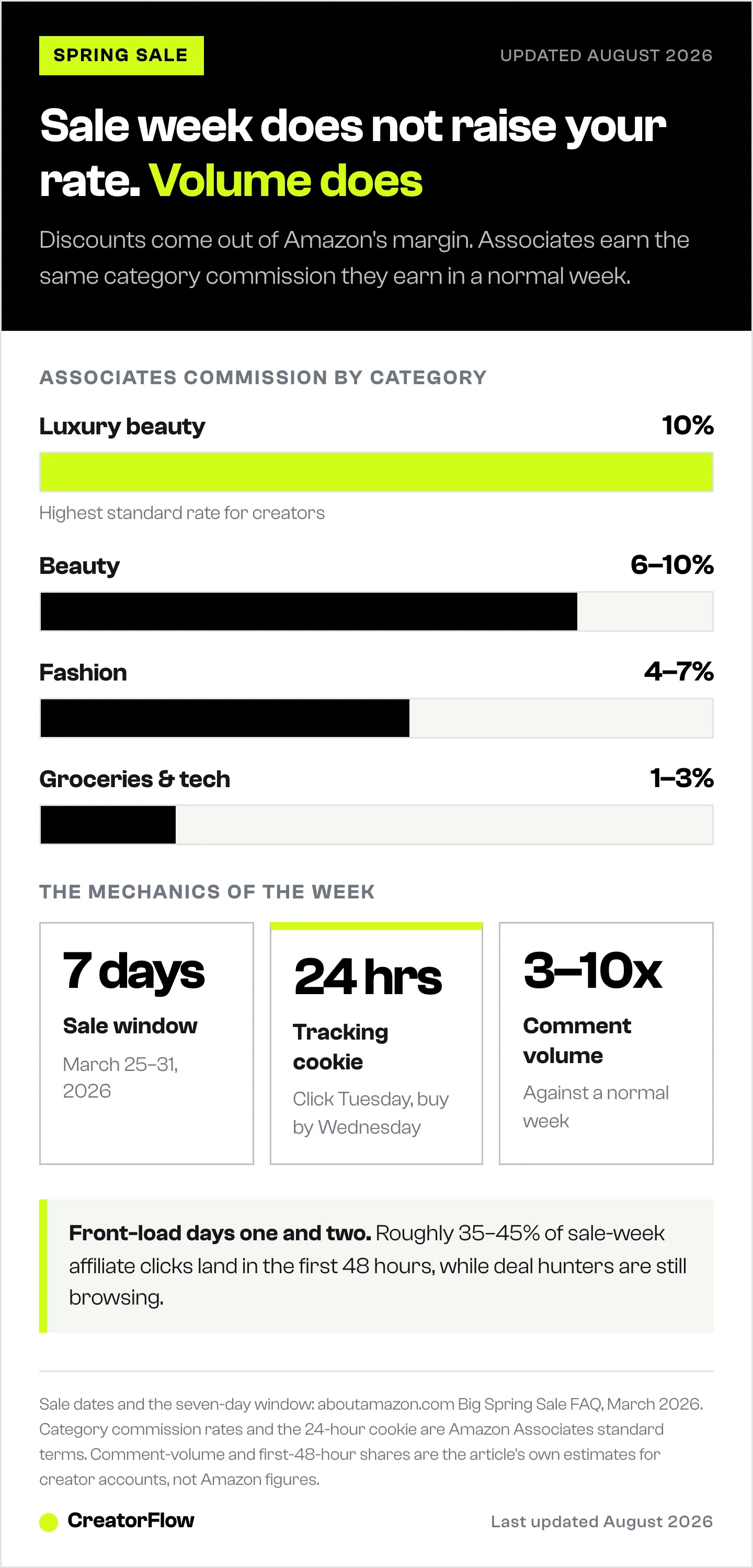
For Amazon Associates, every checkout still pays the standard category commission. Spring rates relevant to most creators sit in the 1-10% range: 4-7% for fashion, 6-10% for beauty, 10% for luxury beauty, and 1-3% for groceries and tech accessories. Volume during the sale week is what matters because commission rates do not change.
Why Most Creators Lose Money During the Sale
Three structural problems eat creator commissions during a sale week.
The 24-hour cookie compounds against you. A follower who comments “link” Saturday night and gets your DM Sunday afternoon has roughly 18 hours of cookie left. If they wait until Monday to check out, you earn nothing. Multiply this by 200-500 comments per haul post and the lost commission stacks fast.
Comment volume jumps 3-10x during sale events. Manual responses that worked in February break down by day two of the sale. Creators who DM links by hand typically clear 30-50% of the queue in the buying window and leave the rest as cold leads.
Generic “sale haul” content underperforms category-aligned content. Amazon’s daily themed drops in 2026 (Easter Essentials, Spring Cleaning, Travel Must-Haves) push specific category traffic on specific days. A “spring cleaning” Reel posted on cleaning-deal day rides the algorithmic and editorial wave that a generic haul does not.
The fix is not “post more.” It is a system that handles volume, matches content to the day’s deal theme, and delivers links inside the cookie window.
Two Weeks Before: Pre-Sale Prep
The work that determines sale-week revenue happens in the two weeks before the sale opens. Three priorities.
1. Build Category-Specific Storefronts
Amazon Influencers can create idea lists and storefronts segmented by category. A single “My Storefront” page converts worse than five pages titled by category, because followers who comment “kitchen deals” see a kitchen-specific list, not a 200-product general feed.
Build five focused lists before the sale: spring fashion, beauty must-haves, kitchen and home, lawn and garden, and Easter or travel essentials. Map each list to a DM trigger keyword (KITCHEN, BEAUTY, FASHION, HOME, EASTER) so automation can route comments to the right link.
2. Batch 14-21 Pieces of Content
Sale weeks are not the time to film fresh. Batch content during the two weeks before, then schedule across the seven days. Target three to four posts per day across feed, Reels, and Stories.
Mix formats so the algorithm has variety to push:
- Two product haul Reels per day (10-15 products each)
- One single-product deep-dive Reel
- Two to three Story sets with poll stickers and link triggers
- One static carousel showing top 10 deals
Every piece should have a comment CTA tied to a specific keyword, not a generic “comment for link.” “Comment KITCHEN for the air fryer link” outperforms “comment LINK below” because it tells the automation which list to send.
3. Pre-Load DM Automation
Configure comment-to-DM automation at least seven days before the sale opens. The Instagram Graph API runs on a 24-hour messaging window, and Meta-approved tools pace at roughly 200 DMs per hour for safety, so testing under sale-week volume needs runway.
Five automation flows to set up:
- Generic SHOP keyword → main storefront link
- Category triggers (KITCHEN, BEAUTY, FASHION, HOME, EASTER) → category-specific lists
- Story reply trigger → automatic DM with the day’s featured deal
- Email capture variant for Pro plans → collects email before sending link
- Follow gate → asks for a follow before DM delivery
For a deeper walkthrough on wiring this up specifically for Amazon, see Amazon influencer Instagram DM automation and how Amazon influencers earn $5K/month on Instagram.
Sale Week: Day-by-Day Cadence
The 2026 sale included three curated Top 100+ lists and daily themed drops covering Easter Essentials, Spring Cleaning, and Travel Must-Haves (aboutamazon.com). Match content to those themes day by day.
A working seven-day cadence built around 2026’s structure:
| Day | Theme | Content Focus |
|---|---|---|
| Day 1 (Tue) | Sale opens, Top 100 launches | Big haul Reel, “must-shop early” angle, all five categories |
| Day 2 (Wed) | Spring Cleaning push | Kitchen + home cleaning Reels, organization carousels |
| Day 3 (Thu) | Beauty + Fashion | Beauty haul, fashion try-on, outfit posts |
| Day 4 (Fri) | Travel Must-Haves | Luggage, travel beauty, suitcase organization |
| Day 5 (Sat) | Easter Essentials | Easter dress, basket fillers, hosting essentials |
| Day 6 (Sun) | Lawn & Garden + Home | Outdoor furniture, plants, BBQ prep |
| Day 7 (Mon) | Last-chance urgency | Best-of-week recap, closing-deal Stories, “ends tonight” |
Two operational rules during sale week.
Front-load the first 48 hours. Roughly 35-45% of sale-week affiliate revenue clicks come in the first two days because deal hunters check Amazon early. Schedule the highest-effort content for day one and day two, not day six.
Last-day urgency outperforms middle-day content. A “ends tonight” Story with a countdown sticker on day seven typically pulls 1.5-2x normal Story engagement because the sale window forces a buying decision.
Set Up DM Automation That Survives Volume
Sale-week comment volume breaks manual workflows. The two automation specs that matter for Amazon creators:
Speed. Comment-to-DM should fire in under 60 seconds. Most Meta-approved tools (CreatorFlow, ManyChat, LinkDM) hit five to fifteen seconds in normal conditions. Faster delivery means more cookies still active when the follower checks out.
Routing. A single SHOP keyword going to one master link wastes the category structure built in pre-sale. Route by keyword: KITCHEN to kitchen list, BEAUTY to beauty list, EASTER to Easter list. Each list converts 1.5-3x better than a generic storefront because relevance is higher.
CreatorFlow’s Pro plan ($15/month for 5,000 DMs per workspace, creatorflow.so, May 2026) runs on Meta’s official Instagram API and is built for the comment-to-DM flow. ManyChat’s Pro tier ($39/month for 2,500 contacts, or $29/month billed annually, manychat.com/pricing, July 2026) covers the same use case at a per-contact pricing structure. LinkDM’s Pro plan ($19/month flat rate, linkdm.com, July 2026) is the third Meta-API option creators commonly evaluate.
The pricing matters because sale-week DM volume can push a normal account from 1,000 to 5,000+ DMs in seven days, which moves contact-tier tools into a higher bracket.
Common Pitfalls
A few patterns predictably eat sale-week commission.
Posting only one giant haul on day one. It captures the launch wave but leaves five days of theme drops unmatched. Daily theme alignment outperforms one viral post for the full week.
Letting bio link be the primary CTA. Bio link clicks from Reels typically run 2-3% click-through versus 80-90% open rates on automated DMs. Sale week is when the bio-link gap costs the most.
Forgetting Stories. Stories drive 30-40% of sale-week affiliate clicks for active Amazon creators because the swipe-up muscle memory is strong. Posting two to four Story sets daily during the sale is non-negotiable.
Not gating links to a follow. A follow gate during sale week converts roughly 40-60% of new commenters into followers, which compounds reach beyond the sale week.
Post-Sale Debrief: 30 Minutes That Set Up Prime Day
Within 48 hours of the sale ending, pull two reports.
Amazon Associates dashboard. Sort by earnings descending for the sale week. The top 10 products tell you what your audience converts on at scale. Most of those products will still be available at Prime Day in July, often at deeper discounts.
Instagram analytics + DM automation analytics. Note which content formats drove the most DM-triggering comments, which keywords converted at the highest rate, and which days outperformed. CreatorFlow’s geographic analytics on Pro plans show click distribution by country and city, which matters because Amazon’s sale runs in the U.S., Canada, and Mexico simultaneously.
The debrief takes 30 minutes and gives you the content and product list for Prime Day in July. That single document is worth more than another haul Reel.
Frequently Asked Questions
When does Amazon’s Big Spring Sale run?
Amazon’s Big Spring Sale ran March 25-31, 2026, a seven-day event from 12:01 a.m. PDT on March 25 to 11:59 p.m. PDT on March 31 (aboutamazon.com, March 2026). Amazon has not formally announced 2027 dates as of May 2026, but the sale has consistently fallen in late March each year.
Do Amazon Associates earn commission during the Big Spring Sale?
Yes. The standard category commission rates apply during the sale, including 4-7% for fashion, 6-10% for beauty, 10% for luxury beauty, and 1-3% for tech accessories. Discounts come out of Amazon’s margin, not the creator’s commission, and Amazon’s 24-hour tracking cookie applies normally.
Is the Big Spring Sale only for Prime members?
No. All Amazon shoppers can buy sale items. Prime members get extra savings on items marked with the “Prime Spring Deal” badge, and Prime for Young Adults members earn 10% cash back on apparel and beauty during the event versus the typical 5% (aboutamazon.com).
How many DMs should I expect during sale week?
Sale-week DM volume typically runs 3-10x normal volume depending on follower count and content cadence. A creator who normally fields 100 DMs per day should plan for 300-1,000 daily during the sale, which is why pre-loading automation matters more than scaling manually.
Should I write “sale” in every caption during the week?
No. Captions overloaded with sale and discount language can reduce reach because Instagram’s algorithm flags promotional clusters. Mix sale references with lifestyle and educational captions across the seven days.
What is the difference between Big Spring Sale and Prime Day?
Big Spring Sale is open to all shoppers, runs seven days in late March, and offers up to 50% off across spring categories. Prime Day is Prime-only, runs roughly 48 hours in mid-July, and typically deeper-discounts tech and Amazon-owned brands (aboutamazon.com). Spring Sale leans fashion, kitchen, and home; Prime Day leans tech.
Do follow gates hurt sale-week conversions?
A short, well-placed follow gate (one tap to follow, instant DM after) typically does not hurt conversion and converts 40-60% of new commenters into followers. The compounding reach gain in the weeks after the sale outweighs the small drop in same-session conversion.
Sources
- Amazon Big Spring Sale 2026 FAQ, official dates, categories, and discount tiers (aboutamazon.com, March 2026)
- Amazon Big Spring Sale 2026: Best Deals Up to 50% Off, category breakdown and Prime member benefits (aboutamazon.com, March 2026)
- CreatorFlow pricing, verified Pro plan $15/month, 5,000 DMs per workspace (creatorflow.so, May 2026)
- ManyChat pricing, Pro tier $39/month for 2,500 contacts, or $29/month billed annually (manychat.com, July 2026)
- LinkDM pricing, Pro plan $19/month flat rate (linkdm.com, July 2026)


