
The Amazon Influencer Program is an extension of Amazon Associates for social creators. Amazon accepts applications from YouTube, Instagram, Facebook, and TikTok accounts, and publishes no follower minimum, reviewing follower count alongside engagement. Approved creators get a storefront at amazon.com/shop/handle. The standard cookie is 24 hours, extending to 89 days when a shopper adds the item to their cart.
Nearly every guide to this program repeats the same warning: never put Amazon affiliate links in DMs or email. That advice was correct once. It is not correct now. The current Operating Agreement, updated October 15, 2025, explicitly permits Special Links in direct messages, provided the recipient asked for them.
That single clause changes how an Instagram creator should run this program, so this guide quotes it in full rather than paraphrasing.
Key Takeaways
- No published follower minimum: Amazon says it looks at follower count “in addition to other engagement metrics,” and publishes no numeric threshold anywhere.
- Instagram and Facebook applicants need a business account: This is a stated requirement, not a suggestion.
- DMs are permitted when solicited: The Operating Agreement allows Special Links in email, SMS, and direct messaging from your social accounts, gated on the recipient having opted in.
- The cart window is 89 days, not 90: The agreement says 89. The 180-day figure people quote is a separate shipment and payment deadline, not an attribution window.
- Onsite and offsite rates are different tables: Shoppable video commissions run far below the standard affiliate rates, often by half or more.
- You are legally the “Sender”: For CAN-SPAM and TCPA purposes, Amazon puts that liability on you, and can demand written certification that you complied.
- Payouts run about 60 days behind: Commission pays roughly 60 days after the end of the month it was earned, with a $10 direct-deposit threshold.
Influencer Program vs Amazon Associates
These are not competing programs. Amazon states that the Influencer Program “is an extension to the existing online Associates program for qualifying social media influencers,” with similar reporting and account management.
You can be in both. Amazon’s own FAQ answers this directly: the Influencer Program opens access to additional tools and is designed for sending traffic from social platforms using a vanity URL.
Legally, Influencers hold Associates accounts and are bound by the same Operating Agreement plus an additional Influencer Program Policy. If you are a brand or a media company rather than a creator, Amazon steers you to the standard Associates program instead.
For the full side-by-side, including both commission tables and the eligibility bars, see Amazon Associates vs the Influencer Program.
Amazon Influencer Program Requirements
Amazon accepts applications from creators with a YouTube, Instagram, Facebook, or TikTok account. If you apply with Instagram or Facebook, you are required to use a business account.
On follower counts, Amazon publishes no threshold. Its exact language: “When reviewing your application, we look at the number of followers you have in addition to other engagement metrics.” The contract language is deliberately vague too, referring only to “Amazon qualitative and quantitative thresholds” that are never specified.
Anyone quoting you a hard minimum for this program is guessing. Engagement rate and content quality plainly carry weight, which is why small accounts with strong engagement get approved and large dormant ones sometimes do not.
Registration also requires granting Amazon access to data about your social presences. Standard exclusions apply for sexually explicit, violent, hateful, or illegal content, content directed at children under 13, and any handle or domain containing an Amazon trademark.
Amazon does not publish an approval timeframe for Influencer applications. Ignore any specific number you see quoted.
What you get after approval
A storefront with a vanity URL at amazon.com/shop/handle, which you can promote verbally since it is readable out loud. Amazon may also surface your storefront content to shoppers browsing Amazon.
Read the fine print on the storefront: contractually it is Amazon’s “Influencer Page,” and Amazon reserves all rights over its content, appearance, functionality, and URL, including the right to place ads on it without compensating you.
Commission Rates: Two Tables, Very Different Numbers
Amazon runs two separate commission structures, and conflating them produces badly wrong revenue forecasts.
Offsite rates apply when you send traffic from Instagram, YouTube, or elsewhere to Amazon. Onsite rates apply to shoppable videos and photos hosted on Amazon itself, and they are materially lower. Selected 2026 US rates:
| Category | Offsite rate | Onsite rate |
|---|---|---|
| Luxury Beauty | 10% | 4% |
| Physical books | 4.5% | 0.5% |
| Kitchen | 4.5% | 1.25% |
| Apparel | 4% | 1% |
| Home | 3% | 3% |
| Sports | 3% | 1.25% |
| Toys | 3% | 0.5% |
| Grocery | 1% | 0.5% |
| All other categories | 4% | 1% |
Offsite also pays 4.5% on automotive, 4% on jewelry and Amazon devices, 3% on beauty and pets, 2.5% on PC components, 2% on televisions, and 1% on health and personal care. Gift cards, alcohol, and vehicles pay zero. Onsite pays 1.25% on health and 1% on shoes and headphones.
Onsite commissions also require registration with a separate Store ID and only pay on “Direct Qualifying Purchases,” meaning the same product variant featured in your content, not the customer’s wider basket.
For how these rates translate into monthly income at different follower counts, see our breakdown of how Amazon influencers scale Instagram commissions.
The Cookie Window, Correctly Stated
The standard session is 24 hours. It ends at whichever comes first: 24 hours elapsing, the customer placing an order, or the customer clicking a different Associate’s link.
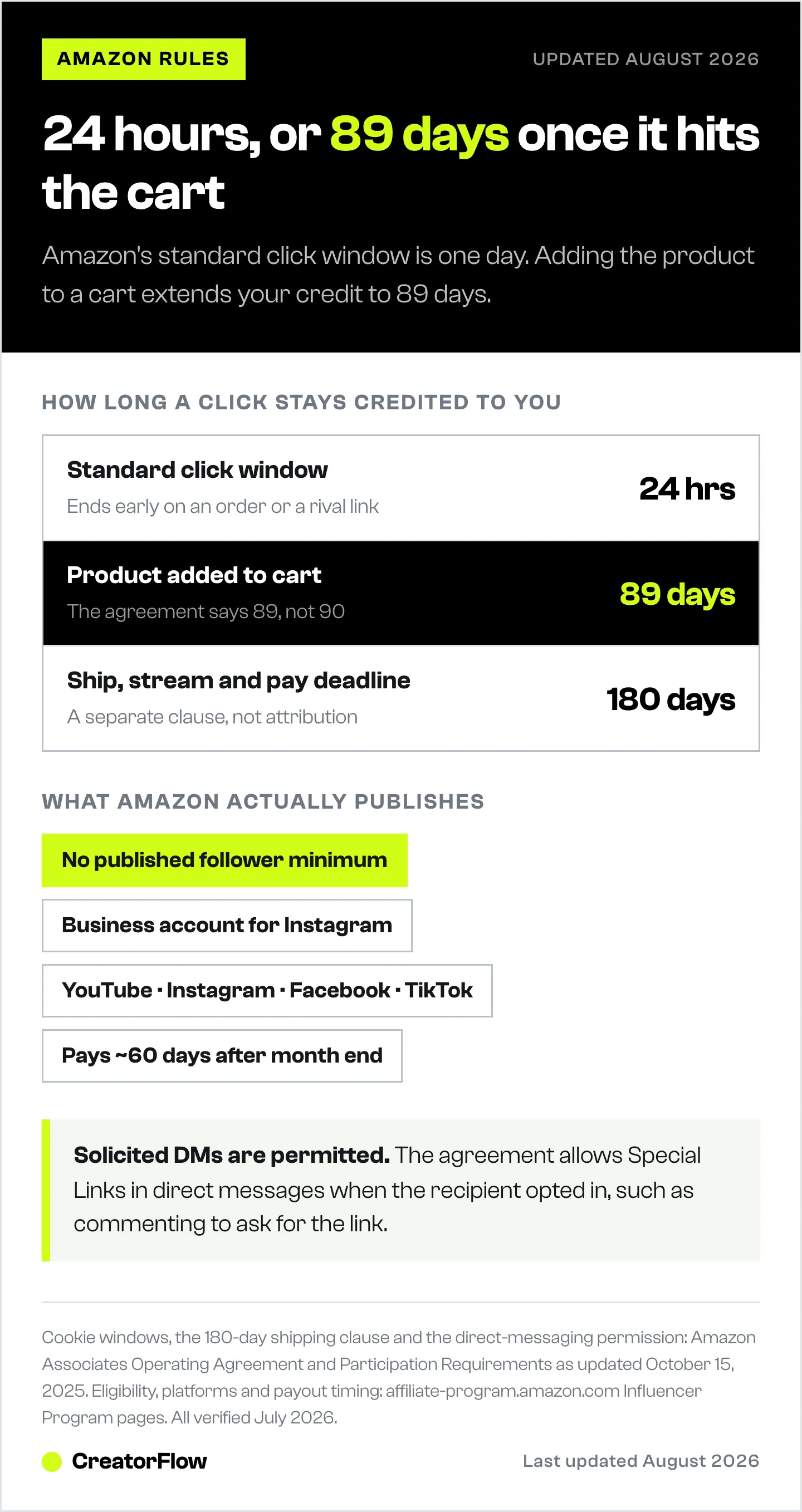
If the customer adds your product to their cart, the window extends to 89 days, not 90. The agreement text says 89, and the number is quoted wrong almost everywhere.
The 180-day figure floating around is a different clause entirely. It is the deadline by which the product must be shipped, streamed, or downloaded and paid for. It is not an attribution window and does not extend your credit.
What the Operating Agreement Says About DMs
This is the section worth reading twice. From the Associates Program Participation Requirements, section 4:
“You will not engage in any Promotional Activities in any offline manner… You may include Special Links in emails, SMS and direct messaging from your social media Sites; provided, that such communications are solicited (i.e., opted into by the receiving customer) and are otherwise in compliance with the Agreement, the Trademark Guidelines, and the Amazon Brand Usage Guidelines.”
Three things follow from that.
Solicited is the whole test. A follower who comments a keyword on your post to request a link has opted in about as clearly as anyone can on Instagram. They took an action to ask. An unsolicited blast to your follower list has not, and would breach the agreement.
You carry the legal liability. The same section states that for applicable marketing laws, including CAN-SPAM and the TCPA, you are the “Sender” of each communication containing Special Links. That is not a formality. It is Amazon assigning the regulatory exposure to you.
Amazon can audit you. On request, you must provide sample materials and written certification that you complied. Failure to certify is a stated material breach.
Offline promotion remains banned outright: printed material, ebooks, mailings, and oral solicitation.
The other rules people break
No cloaking. You may not cloak, hide, spoof, or otherwise obscure the URL of the site containing your Special Links, including through redirecting links, such that Amazon cannot determine where the click came from.
Link shorteners are conditionally allowed. The rule is narrower than most people think: you may not use a shortener “in a manner that makes it unclear that you are linking to an Amazon Site.” Obscuring the destination is the violation, not shortening as such. Related reading: how Amazon deep links work on Instagram.
No self-purchases. You cannot buy through your own links, or ask friends, relatives, employees, or business contacts to.
Required disclosure. You must state clearly and prominently: “As an Amazon Associate I earn from qualifying purchases.” Amazon deems a violation of this a material breach. On social specifically, Amazon accepts short disclosures like “(paid link)”, “#ad”, or “#CommissionsEarned”, placed near the link where people will actually see it.
That aligns with the FTC’s guidance, which says disclosures are likely to be missed if they appear only on a profile page or behind a “more” click, and rejects vague terms like “sp”, “spon”, “collab”, or “ambassador”. Our guide to FTC affiliate disclosure rules on Instagram covers placement in detail.
One thing worth flagging because guides assert it confidently: nothing in the current Participation Requirements prohibits sharing links in private or closed groups. That prohibition is not in the policy text.
Amazon is one option among several. For the wider set, see affiliate programs for Instagram compared.
The Practical Setup for Instagram
Put the pieces together and a specific workflow falls out of the rules rather than around them.
Instagram gives you one clickable link, in your bio. Captions, Reels, and comments are not clickable. The standard workaround is sending everyone to a bio link, which loses most of the people who asked and leaves you at a 24-hour cookie with a shopper who has to find the product again.
A keyword-triggered DM inverts that. The follower comments to request the link, which establishes the opt-in the agreement requires, and the product link arrives while they are still on the post. They land on the exact product rather than hunting your storefront, which matters because adding to cart is what extends your window from 24 hours to 89 days.
CreatorFlow runs this on Instagram through Meta’s official API at $15/month flat with no per-contact pricing, and setup takes about five minutes. For the full walkthrough, see Instagram DM automation for Amazon influencers.
Keep three things true and you stay inside the rules: the person asked, your disclosure sits on the public post where the ask happened, and your link goes to Amazon without anything obscuring the destination.
If you are diversifying beyond Amazon, Walmart Creator’s 14-day attribution window is a notably different structure worth comparing.
For a version of this tailored to Amazon affiliates, see CreatorFlow for Amazon affiliates.
FAQ
How many followers do you need for the Amazon Influencer Program?
Amazon publishes no minimum. It states that it reviews follower count “in addition to other engagement metrics,” without naming a threshold. Engagement quality carries real weight, which is why smaller accounts with active audiences get approved while larger inactive ones sometimes do not.
Can you be in Amazon Associates and the Influencer Program at the same time?
Yes. Amazon confirms this directly. The Influencer Program is an extension of Associates that adds a storefront and a vanity URL for social traffic. Influencers hold Associates accounts and are bound by the same Operating Agreement.
Can you share Amazon affiliate links in Instagram DMs?
Yes, if the recipient opted in. The Operating Agreement permits Special Links in email, SMS, and direct messaging from your social accounts, provided the communications are solicited. A follower who comments a keyword to request the link has opted in. Unsolicited mass DMs have not, and would breach the agreement. You are also legally the “Sender” for CAN-SPAM and TCPA purposes.
How long is the Amazon affiliate cookie?
24 hours from the click, ending earlier if the customer orders or clicks another Associate’s link. If the customer adds the product to their cart, the window extends to 89 days. The 180-day figure often cited is a separate shipping and payment deadline, not an attribution window.
Does the 3-sales-in-180-days rule apply to the Influencer Program?
Amazon publishes the rule as an Associates account requirement: refer three qualifying sales within 180 days of applying or the application can be withdrawn, with no reinstatement. Amazon publishes no Influencer-specific carve-out or confirmation, so treat it as unresolved rather than assuming either way.
When does Amazon pay Influencer commissions?
Approximately 60 days after the end of the calendar month in which they were earned. The direct deposit threshold is $10 with no fee, the Amazon gift certificate threshold is $10 with no fee, and checks require $100 with a $15 processing fee deducted. Anything below threshold rolls into the next month.
What social platforms qualify for the Amazon Influencer Program?
YouTube, Instagram, Facebook, and TikTok. Instagram and Facebook applicants are required to use a business account rather than a personal one.
Requirements, rates, and policy language verified from affiliate-program.amazon.com (Influencer Program pages, Program Policies, and Operating Agreement as updated October 15, 2025), associates.amazon.com commission rate tables, and ftc.gov endorsement guidance as of July 2026. Commission rates apply to the US program and change periodically. Individual results vary.