
The highest paying influencer niches are finance and business. Instagram finance creators command $40 to $80 CPM, two to three times the platform baseline, and finance affiliate offers pay a $52 median bounty per funded account. Digital products and courses pay the highest commission rate at 35%. Beauty and fashion attract the most brand deals but sit mid-table on rate and last on engagement.
You picked beauty because every “top niches” list put beauty near the top. Two years in you have 34,000 followers, a 1.19% engagement rate, and brands quoting $150 for a Reel plus 12% on a $28 serum. A personal finance creator with 9,000 followers gets quoted $400 for the same deliverable and $52 per funded account on top.
Popularity lists rank niches by how much content gets posted in them. Few rank them by what they pay. This guide ranks the highest paying influencer niches on three sourced datasets: sponsored post CPM by niche, median affiliate commission by vertical, and engagement rate by niche. Use it to work out what one follower is worth in each niche before you spend two years building the audience.
Key Takeaways
- Finance pays the most per impression: $40 to $80 CPM on Instagram against a $12 to $30 baseline for food and beverage (nowadays.media, June 2026)
- Digital products pay the most per sale: 35% median commission with a 60-day cookie, against 8.4% and 14 days for general ecommerce (digitalapplied.com, April 2026)
- Popular and profitable are different lists: beauty and fashion draw the most brand budget yet post the two lowest engagement rates of 15 tracked niches, at 1.19% and 1.24%
- Commission rate beats follower count: the same audience driving the same sales volume earns roughly $368 a month on Amazon’s 3.5% and about $3,675 a month on a 35% digital product
- Cookie windows quietly set your ceiling: Amazon Associates expires in 24 hours, fashion in 14 days, SaaS in 90 days, so how fast you deliver a link changes what you keep
- Bottom line: pick the niche where your audience already has buying intent, then check its commission rate and cookie window before you check its follower ceiling
What Makes an Influencer Niche Pay Well
Four variables set what a niche pays: the CPM brands will pay to reach that audience, the commission rate offers in that category pay per sale, the cookie window that decides how long a click keeps earning, and the click-to-sale conversion rate. A niche can lead on one and trail on the others. Finance leads on CPM and conversion. Digital products lead on commission and cookie length.
Here is what each variable does to your income:
- CPM is what a brand pays per 1,000 people reached. It sets your sponsored post rate. Brands pay more where the customer is worth more, which is why a banking app outbids a snack brand for the same 10,000 impressions.
- Commission rate is the share of a sale you keep. This is the single biggest lever for creators under 50,000 followers, because affiliate income does not require a brand to pick you.
- Cookie window is how long after a click you still get credit. A 24-hour window means the person has to buy today. A 90-day window means you get paid for a decision made three months later.
- Click-to-sale conversion is the share of clicks that turn into purchases. Finance converts at 3.8% on funded accounts. Fashion converts at 0.6%.
Two niches can quote the same CPM and still land far apart on what you keep, once the other three variables settle.
Highest Paying Influencer Niches, Ranked
The table below joins three separate datasets. CPM figures come from an analysis of $17M in placed influencer spend (nowadays.media, June 2026). Commission and cookie figures are network medians aggregated across Awin, Impact, PartnerStack, ShareASale and CJ Affiliate (digitalapplied.com, April 2026). Engagement rates come from an analysis of 63M Instagram posts across 600K+ accounts, covered in our engagement rate benchmarks by niche.
| Niche | Instagram CPM | Median commission | Cookie window | Avg. engagement |
|---|---|---|---|---|
| Finance and business | $40–$80 | $52 per funded account | 30 days | 1.34% |
| Beauty and skincare | $20–$50 | 12% | 30 days | 1.19% |
| Fashion and apparel | $18–$45 | 10% | 14 days | 1.24% |
| Travel | $15–$40 | 4.2% | 30 days | 1.83% |
| Fitness and wellness | $15–$35 | 11% (supplements) | 30 days | 1.75% |
| Food and beverage | $12–$30 | 8.4% (cross-vertical) | 14 days | 1.55% |
| Technology and gaming | $8–$18 | 5.5% / 6.5% | 14–30 days | 1.31% |
Three categories pay well without a published Instagram CPM, because creators there sell their own offer or promote software rather than waiting for brand deals:
| Category | Median commission | Top quartile | Cookie window | Click-to-sale |
|---|---|---|---|---|
| Digital products and courses | 35% | 50% | 60 days | 2.4% |
| SaaS, recurring year one | 22.5% | 30% | 90 days | 8.2% trial to paid |
| B2B services, per qualified lead | $187 flat | $420 flat | 90 days | 0.7% |
Those three rows are the reason so many creators end up teaching, coaching or reviewing software regardless of where they started. The commission math is four to ten times better than physical goods, and it does not depend on a brand approving you first.
Sponsored Post CPM by Niche
Brand deal rates track how much the end customer is worth, not how entertaining the content is. Finance and crypto sit at $40 to $80 CPM on Instagram, a premium of 100% to 200% over the platform average. Beauty and skincare run $20 to $50. Technology and gaming run $8 to $18, a 20% to 40% discount, because a gaming audience is harder to convert into a direct purchase (nowadays.media, June 2026).
A second dataset lands in the same order with slightly higher absolute numbers: finance at $50 to $120+, parenting at $30 to $65, travel at $25 to $70, beauty at $25 to $60, fashion at $20 to $55, fitness at $20 to $50, food at $20 to $45 (stan.store, 2026). The two sources disagree on the exact dollar figure and agree completely on the ranking.
For context on the absolute numbers, the average sponsored post across all platforms and niches went for $220 in 2026. By platform, average listed rates were Twitch $398, YouTube $311, Instagram $214, Amazon $193, TikTok $182 and UGC $180. Brands paid an average of $193 for an Instagram collaboration against the $214 posted rate, so most negotiations end about 10% below asking (collabstr.com, 2026).
Read that against the CPM table and the gap becomes concrete. A $214 average is what a general creator gets. A finance creator with the same reach is pricing off a CPM two to three times higher.
Affiliate Commission Rates by Niche
For anyone under 50,000 followers, this table matters more than the CPM one. Brand deals need a brand to choose you. Affiliate income needs only a link and someone who wants it.
| Vertical | Median commission | Top quartile | Cookie | Click-to-sale |
|---|---|---|---|---|
| Digital products / courses | 35.0% | 50.0% | 60 days | 2.4% |
| SaaS (recurring, year 1) | 22.5% | 30.0% | 90 days | 8.2% |
| Beauty / cosmetics | 12.0% | 18.0% | 30 days | 1.6% |
| Health / wellness supplements | 11.0% | 20.0% | 30 days | 1.8% |
| Fashion / apparel | 10.0% | 15.0% | 14 days | 0.6% |
| Home and garden | 9.5% | 14.0% | 30 days | 1.2% |
| Pet supplies | 9.0% | 13.0% | 30 days | 1.5% |
| Ecommerce (cross-vertical) | 8.4% | 12.0% | 14 days | 1.4% |
| Sporting goods | 7.5% | 11.0% | 30 days | 1.1% |
| Gaming | 6.5% | 12.0% | 30 days | 2.1% |
| Electronics / consumer tech | 5.5% | 8.0% | 14 days | 0.9% |
| Travel / hospitality | 4.2% | 7.0% | 30 days | 0.8% |
| Amazon Associates (general) | 3.5% | 10.0% | 24 hours | 0.5% |
Source: network medians aggregated from Awin Power 100, Impact 2026 Partnership Benchmark Report, PartnerStack, ShareASale and CJ Affiliate Q1 2026 (digitalapplied.com, April 2026).
Two rows deserve a second look.
Travel is the trap. It has the third-best engagement rate of any niche at 1.83% and the worst commission rate on the board at 4.2%, with a 0.8% click-to-sale. Travel content gets watched, saved and shared. It rarely gets bought from on the same day.
Amazon is the volume game. A 3.5% median and a 24-hour cookie means a $30 product pays you about $1.05, and only if the person buys today. It works because Amazon converts anything else in the cart too. If Amazon is your main income line, see how much LTK creators make by follower tier for what that volume looks like at each audience size.
For programs that accept small accounts across these verticals, see our comparison of affiliate programs that accept micro-influencers.
Why the Most Popular Niches Are Not the Best Paid
Beauty and fashion dominate every “biggest niches” list and post the two lowest engagement rates of 15 tracked niches: 1.19% for makeup and beauty, 1.24% for fashion and apparel. Pets lead engagement at 2.00% and pay a 9% commission. Finance sits at 1.34% engagement and commands the highest CPM on the platform.
Popularity, engagement and pay are three different rankings, and they barely overlap.
The explanation is competition on both sides. Beauty and fashion have the largest brand budgets, so they also have the most creators chasing those budgets. Supply catches up with demand and the per-creator rate flattens. Finance has a smaller creator pool, tighter compliance requirements and a customer worth several hundred dollars, so the rate stays high.
This is why the niche you pick and the content pillars you build under it matter more than the size of the category. A defined niche pre-qualifies the audience. Someone following a skincare account for oily acne-prone skin is a warmer buyer than someone following a general beauty account, even though the second account is ten times larger.
What a Niche Pays per 1,000 Followers
Here is the calculation that reframes the whole decision.
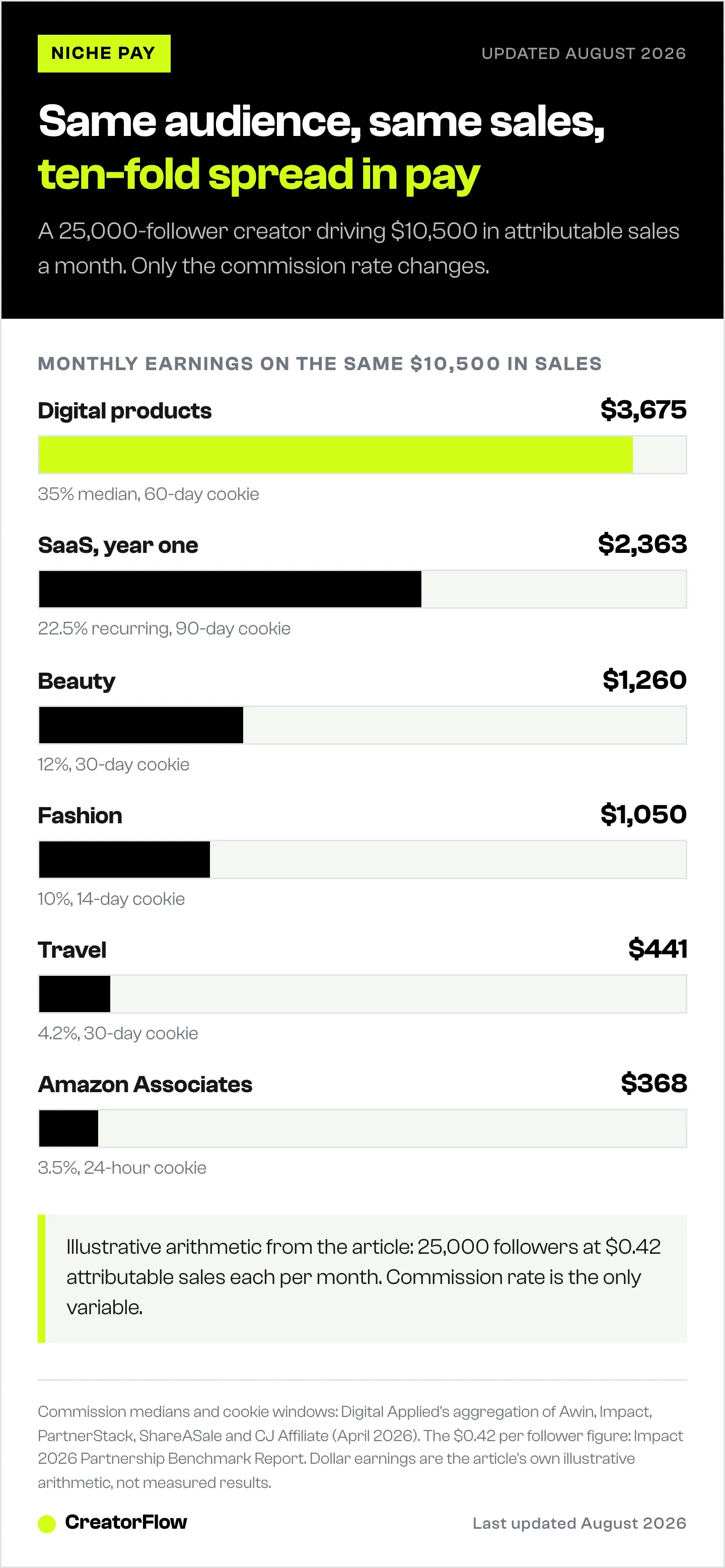
Creators with 10,000 to 100,000 followers generate about $0.42 in attributable affiliate revenue per follower per month, against $0.11 for traditional content and display affiliates on a comparable basis (Impact 2026 Partnership Benchmark Report, cited by digitalapplied.com, April 2026). That figure is attributable sales value, not your commission.
Take a 25,000-follower creator. At $0.42 per follower per month, that audience drives roughly $10,500 in attributable sales. The figure is a blended average across niches, so holding it constant isolates one variable: the commission rate.
| Niche of the offer | Commission | Monthly earnings on $10,500 in sales |
|---|---|---|
| Digital products and courses | 35% | $3,675 |
| SaaS, year one | 22.5% | $2,363 |
| Beauty | 12% | $1,260 |
| Fashion | 10% | $1,050 |
| Ecommerce, general | 8.4% | $882 |
| Travel | 4.2% | $441 |
| Amazon Associates | 3.5% | $368 |
Same creator. Same audience. Same volume of sales driven. A ten-fold spread in take-home pay, decided entirely by which category the link points at.
This is the single most useful thing in the article, so treat it as the working assumption rather than a promise: the $0.42 blended figure will run higher in high-intent niches and lower in entertainment niches, and your own number depends on how often you make an offer. The point stands regardless of the exact input. What you promote sets your income more than how many people follow you.
How to Choose Between Two Niches That Both Pay
Run these four checks in order. Stop at the first one that rules a niche out.
- Can you make an offer without feeling like a salesperson? Finance pays best and requires you to talk about money constantly. If that content drains you, the rate is irrelevant because you will stop posting.
- Does the category have offers with a 30-day cookie or longer? A 14-day window like fashion or a 24-hour window like Amazon needs volume and same-day intent. A 60 to 90-day window like courses or software forgives a slow buyer.
- Is there a recurring or high-ticket offer in it? A 22.5% recurring SaaS commission pays every month from one referral. A 10% fashion commission pays once.
- Can you name three specific products your audience already buys? If you cannot, the audience is not commercial yet, whatever the CPM table says.
If you are still at the start of this decision, our framework for choosing your creator niche on Instagram covers the validation steps before the money math. For realistic income figures at small audience sizes, see what creators with 1K to 10K followers earn.
Two more notes worth having. Fashion still works as an entry niche despite the 10% and 14-day cookie, because the volume of link requests is high and the buying cycle is short; the fashion influencer playbook covers that path. And a low-CPM niche with a high-ticket offer often beats a high-CPM niche with none: gaming pays $8 to $18 CPM, and a gaming creator selling a $200 coaching package needs a handful of buyers to pass a beauty creator on 12%.
These rankings assume a human creator. For a synthetic persona the constraint is different, and AI influencer niches works through which categories survive it.
Getting Paid in a High-Paying Niche
Picking the right niche sets your ceiling. Delivery decides how close you get to it.
Every table above assumes the link reaches the person while they still want it. That assumption breaks in the comments. Someone watches your Reel, comments “link?”, and waits. If you reply four hours later, you have burned a sixth of an Amazon Associates cookie window before the click even happens. On a 14-day fashion window the delay costs less, and it still costs the sale to whoever answered first.
This is where comment-to-DM automation carries its weight. Set a trigger word, and the moment someone comments it, CreatorFlow sends your link straight to their DMs. The Follow Gate asks for a follow before the link goes out. The Email Gate collects the address, so a $0.42-per-follower audience also becomes a list you own. Link tracking and geographic analytics show which posts and which countries drive the clicks, which is how you find out whether your niche pays the way the benchmark says it does.
For the full setup, see the Instagram DM automation guide. CreatorFlow starts free and runs $15 a month on Pro, flat, whatever your audience size.
FAQ
Which influencer niche makes the most money?
Finance and business, measured per impression. Instagram finance creators command $40 to $80 CPM against a $12 to $30 baseline for food and beverage (nowadays.media, June 2026), and finance affiliate offers pay a $52 median bounty per funded account with a 3.8% click-to-funded conversion. Measured per sale, digital products and courses lead at a 35% median commission.
Do smaller niches pay more per follower?
Often, yes. A narrow niche pre-qualifies the audience, so a higher share of followers are buyers rather than watchers. Accounts under 10,000 followers also see engagement rates two to three times the published niche averages. The trade-off is a smaller total audience, so the strategy only works if the offer in that niche carries a decent commission or price.
Is beauty still a good niche to start in?
Beauty pays a 12% median commission with a 30-day cookie and a 1.6% click-to-sale, which is above the 8.4% ecommerce median on all three counts. The pressure is competition: beauty posts the lowest engagement rate of 15 tracked niches at 1.19%. Starting in a beauty sub-niche such as sensitive skin, fragrance or hair texture avoids the crowded middle.
How much does a micro-influencer earn per post?
Micro creators between 10,000 and 100,000 followers are typically quoted $150 to $500 for an Instagram feed post and $300 to $800 for a Reel, with rates rising in high-CPM niches. The average Instagram collaboration paid $193 across all sizes and niches in 2026, against an average posted rate of $214 (collabstr.com, 2026).
Can you make money in a niche with low engagement?
Yes, and finance is the proof. It sits below the platform average at 1.34% engagement and still commands the highest CPM and the highest per-lead affiliate payouts. Engagement rate measures attention. Commission rate and customer value measure what that attention is worth. Brands pay for the second one.
Does the cookie window really change what I earn?
It changes who gets credited. Amazon Associates expires 24 hours after the click, so anyone who thinks it over until tomorrow buys without you. Fashion runs 14 days, beauty and supplements 30, courses 60, SaaS 90. Two offers at the same commission rate pay differently once the buying cycle is longer than the window.
Should I switch niches if mine pays badly?
Change the offer before you change the niche. Most low-paying niches have a high-paying adjacent offer: a travel creator at 4.2% can sell a $40 itinerary at 100% margin, a pet creator at 9% can sell a training course at 35%. Rebuilding an audience costs a year. Adding a better-paying offer to the audience you have costs a week.
Rate, commission and engagement figures verified from nowadays.media (June 2026), collabstr.com (2026), stan.store (2026), shopify.com (June 2026) and Digital Applied’s aggregation of Awin, Impact, PartnerStack, ShareASale and CJ Affiliate network data (April 2026), as of August 2026. Earnings models in this article are illustrative calculations from those published benchmarks. Individual results vary.


