
Instagram content pillars are 3-5 core topic categories you consistently post about to attract a specific audience. They work because Instagram’s algorithm evaluates your last 9-12 posts to categorize your niche (Hootsuite, April 2026). Scattered content confuses the algorithm and attracts random followers. Pillar-based content tells it exactly who to show your posts to, and creators report cutting content planning time by 50-60% after implementing them.
Most creators post whatever they feel like. Their audience fills up with lurkers who never buy. A fitness coach posting sunset photos attracts sunset lovers, not coaching clients. The same clarity problem shows up offline, where a client who cannot describe who you help never makes the introduction. The problem isn’t content quality. It’s that content without a structure attracts the wrong people.
This guide walks you through a 3-step framework: define your ideal client, build content pillars around their needs, and generate months of topic ideas that attract buyers.
Key Takeaways
- 3-5 pillars is the sweet spot: Fewer than 3 doesn’t cover enough ground; more than 5 dilutes your focus and confuses the algorithm
- The 3-pillar framework: Attract (discovery content, 30-40% of posts), Educate (authority content, 30-40%), and Connect (trust content, 20-30%)
- Algorithm categorization window: Instagram evaluates your last 9-12 posts to determine your niche, so consistent pillar-based posting reshapes your reach in 2-3 weeks (Hootsuite, April 2026)
- Nano-influencers outperform: Accounts under 10K followers average 5.2% engagement rates vs. 2.3% for larger accounts, proving pillars work at any size (InfluenceFlow, April 2026)
- Planning speed: Content planning time drops 50-60% after implementing pillars because you’re choosing from defined categories, not starting from scratch daily
- Bottom line: Define your ideal client persona first, build 3 content pillars around their needs, then pair each post with a keyword CTA and DM automation to convert followers into leads

What Are Instagram Content Pillars?
Content pillars are 3-5 core topic categories you consistently post about. They act as the structural foundation of your Instagram strategy.
Think of them as buckets. Every post you create falls into one bucket. Each bucket serves a specific purpose in moving your ideal client from stranger to follower to paying customer.
Without pillars, your content is scattered. You post a motivational quote Monday, a product promo Tuesday, a meme Wednesday. Your audience can’t figure out what you’re about. The Instagram algorithm can’t either.
Instagram’s algorithm evaluates your last 9-12 posts to categorize your niche (Hootsuite, April 2026). Scattered content confuses the algorithm. Pillar-based content tells it exactly who to show your posts to.
Why Content Pillars Work Better Than Random Posting
Random posting feels productive. It isn’t.
Here’s what happens when you post without pillars:
- The algorithm doesn’t know who to show your content to
- You attract a mixed audience that never converts
- You burn out trying to come up with ideas from scratch every day
- Your profile feels inconsistent to new visitors
Pillar-based content solves all four problems.
The algorithm rewards consistency. When your posts cluster around 3-5 topics, Instagram categorizes you clearly. It shows your content to people who engage with those topics. That means more reach to the right people.
Your audience self-selects. A fitness coach posting about meal prep, workout routines, and client transformations attracts people interested in fitness coaching. Not random followers.
Content creation gets faster. You’re not starting from zero every day. You pick a pillar, pick a topic, create the post. Creators report cutting their content planning time by 50-60% after implementing pillars.
Your profile tells a clear story. When someone lands on your profile, your last 9 posts should make it obvious what you do and who you help. Pillars guarantee this consistency.
Step 1: Define Your Ideal Client (Get Specific)
This is where most creators fail. They define their audience as “women 25-35 who like fitness.” That’s too broad to be useful.
Your ideal client profile needs to be specific enough that you could spot this person at a coffee shop. For foundational guidance on picking your focus area, read our guide on how to choose your creator niche on Instagram. Here’s how to build one.
Demographics That Matter
Start with the basics, then go deeper:
- Age range: Narrow it to 5-8 years (e.g., 27-34, not 20-45)
- Location: City or region, not “worldwide”
- Income level: What can they afford? This determines your pricing language
- Job/career stage: Corporate employee, freelancer, business owner?
- Family status: Single, married, kids? This affects their available time and priorities
Psychographics That Drive Decisions
Demographics tell you who they are. Psychographics tell you what makes them buy:
- Pain points: What’s frustrating them right now?
- Goals: What does success look like for them in 6-12 months?
- Objections: What stops them from investing in a solution?
- Information sources: Where do they learn? Podcasts, YouTube, Instagram, Reddit?
- Purchase triggers: What event or realization makes them finally take action?
Where They Hang Out (Online and Offline)
This is the secret sauce. Knowing where your ideal client spends time tells you:
- What content formats they prefer (Reels watchers vs. carousel readers)
- What language and references resonate with them
- What other accounts they follow (and what content those accounts post)
- What local spots, events, or communities they’re part of
Example Persona: Online Fitness Coach
Here’s a completed persona for a fitness coach targeting young professionals:
| Attribute | Details |
|---|---|
| Age | 26-33 |
| Location | Austin, TX metro area |
| Income | $55K-$85K/year |
| Career | Tech industry, hybrid/remote work |
| Status | Single or in a relationship, no kids |
| Pain point | Gained 15-20 lbs since going remote, lost gym routine |
| Goal | Feel confident again, build sustainable fitness habits |
| Objection | ”I’ve tried apps and YouTube workouts. They don’t stick.” |
| Trigger | A friend’s transformation photo, upcoming vacation, annual physical |
| Instagram behavior | Scrolls Reels during lunch, saves workout posts, follows 3-5 fitness accounts |
| Hangs out at | Coffee shops (Houndstooth, Fleet), hiking trails (Barton Creek), co-working spaces |
| Follows accounts about | Meal prep, home workouts, productivity, Austin food scene |
This level of detail changes everything. Now you know this person watches Reels during lunch (so create 30-60 second Reels). They save workout posts (so make saveable carousel routines). They follow Austin food accounts (so reference local spots they’ll recognize).
Step 2: Choose Your Content Pillars (The 3-Pillar Framework)
Now that you know exactly who you’re targeting, build your pillars around a framework with three jobs:
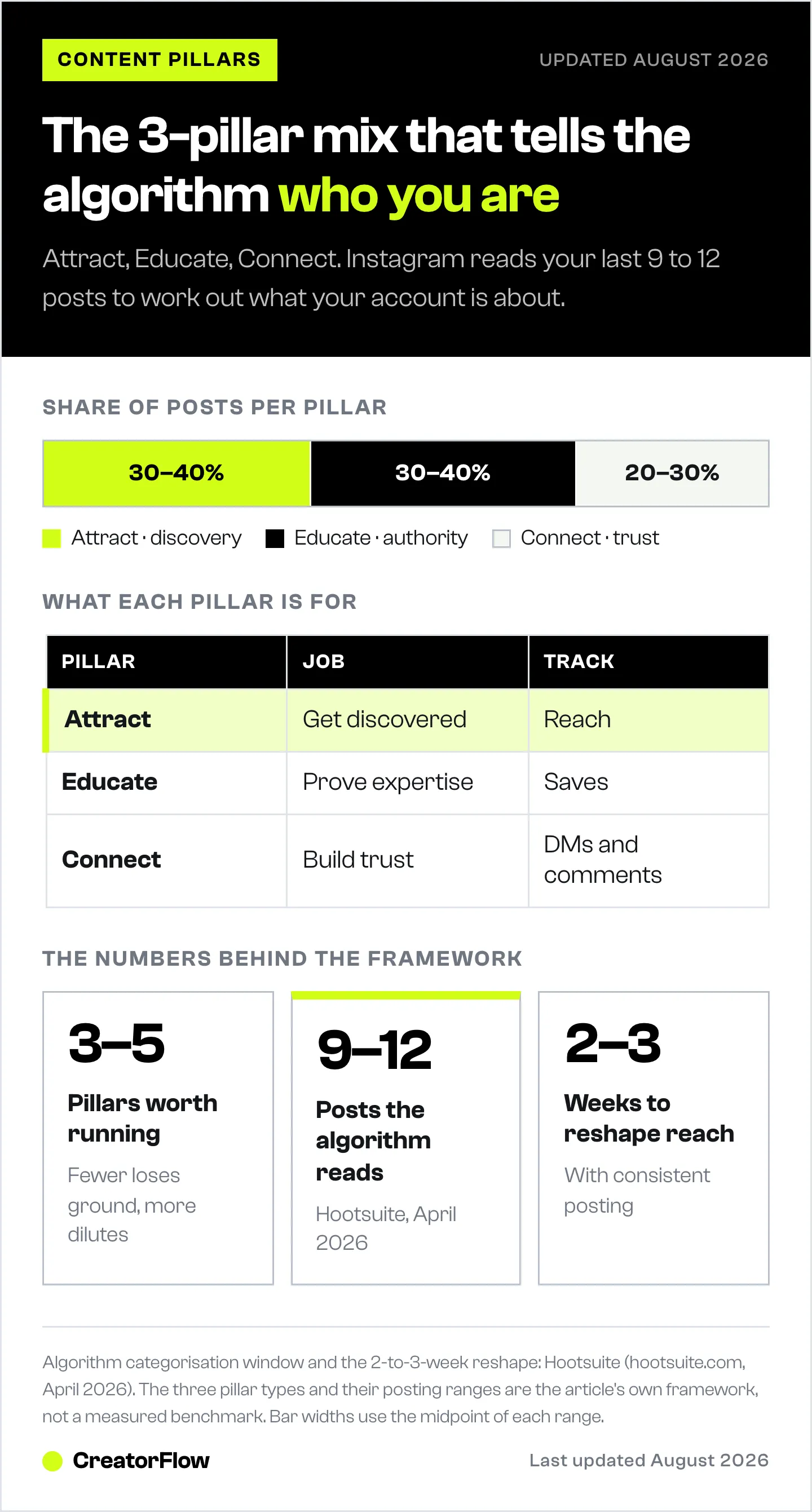
- Attract - Get discovered by new people
- Educate - Show your expertise and build authority
- Connect - Build trust and relatability
Every pillar should map to one of these three jobs. Some pillars can serve double duty.
Pillar Type 1: Attraction Content (Discovery)
This is top-of-funnel content designed to reach people who don’t follow you yet. It gets shares, saves, and sends.
Characteristics:
- Broad appeal within your niche
- Highly shareable and saveable
- Often location-specific, trend-based, or culturally relevant
- Optimized for Instagram search and Explore page
Examples by niche:
| Niche | Attraction Pillar | Example Topics |
|---|---|---|
| Fitness coach | Local wellness culture | ”5 best hiking trails in Austin for a weekend reset” |
| Business coach | Entrepreneurship trends | ”3 business mistakes I see every week on Instagram” |
| Real estate agent | Local neighborhood guides | ”Best neighborhoods in Tampa for first-time buyers” |
| Nutritionist | Food trends | ”What I actually eat in a day (registered dietitian)“ |
| Photographer | Visual inspiration | ”Hidden photo spots in [your city] most people miss” |
Attraction content works because it hooks people through shared interests. They follow you for the Austin hiking content. Then they see your workout Reels. Then they realize you’re a fitness coach who gets their lifestyle.
Pillar Type 2: Education Content (Authority)
This is middle-of-funnel content that proves you know what you’re talking about. It positions you as the expert.
Characteristics:
- Teaches something specific and actionable
- Addresses pain points your ideal client has
- Uses your professional expertise
- Often formatted as how-tos, tips, or myth-busting
Examples by niche:
| Niche | Education Pillar | Example Topics |
|---|---|---|
| Fitness coach | Home workout science | ”Why 20-minute workouts build more muscle than 60-minute sessions” |
| Business coach | Revenue strategies | ”How I booked 12 clients in 30 days using Instagram DMs” |
| Real estate agent | First-time buyer education | ”The step-by-step first-time homebuyer process (no jargon)“ |
| Nutritionist | Nutrition myths | ”3 ‘healthy’ foods that are actually stalling your progress” |
| Photographer | Photography tips | ”Camera settings for golden hour portraits (exact numbers)” |
Education content builds authority. When your ideal client sees you teaching something they’ve been struggling with, they start thinking: “This person gets it. Maybe I should work with them.”
Pillar Type 3: Connection Content (Trust)
This is bottom-of-funnel content that makes people feel like they know you. It turns followers into fans and fans into clients.
Characteristics:
- Personal and authentic
- Shows your personality, values, and behind-the-scenes
- Makes you relatable, not just an expert
- Builds the emotional trust needed to buy
Examples by niche:
| Niche | Connection Pillar | Example Topics |
|---|---|---|
| Fitness coach | Personal journey | ”My own weight gain story (and what I did about it)“ |
| Business coach | Behind the scenes | ”What my Monday actually looks like (the unsexy truth)“ |
| Real estate agent | Client stories | ”Tour of the first home I helped a couple buy” |
| Nutritionist | Real meals | ”My ‘imperfect’ Saturday meals (yes, I ate pizza)“ |
| Photographer | Creative process | ”How I edited this photo from RAW to final (full process)” |
Instagram head Adam Mosseri declared 2026 the “Year of Raw Content,” with the algorithm prioritizing authenticity over production quality (Don Creative Group, April 2026). Connection content is more powerful than ever.
How Many Pillars Do You Need?
3 pillars minimum, 5 pillars maximum.
- 3 pillars: One for each job (Attract, Educate, Connect). Clean and focused.
- 4-5 pillars: Split one category into two. For example, a fitness coach might have two Education pillars: “Home Workouts” and “Nutrition Tips.”
More than 5 dilutes your focus. Fewer than 3 doesn’t cover enough ground.
Pillar Ratio for Your Feed
Not all pillars deserve equal posting frequency. Here’s the ratio that works:
| Pillar Type | Frequency | Why |
|---|---|---|
| Attraction | 30-40% of posts | Drives new followers and reach |
| Education | 30-40% of posts | Builds authority and saves |
| Connection | 20-30% of posts | Deepens trust, drives DMs |
Adjust based on your goal. Growing your audience? Lean into Attraction. Converting followers to clients? Lean into Education and Connection.
Step 3: Generate Topic Ideas Under Each Pillar
With your persona and pillars defined, topic ideas practically generate themselves. Here’s how.
The Persona-Pillar Matrix
Take your ideal client’s interests, pain points, and hangout spots. Cross-reference them with your pillars.
Example: Fitness Coach Targeting Austin Tech Workers
Attraction Pillar (Austin Lifestyle):
- Best spots in Austin for outdoor workouts (Barton Creek, Town Lake)
- Weekend reset: a fitness-friendly Austin day trip
- 5 Austin coffee shops with the best protein options
- Dog-friendly hiking trails that double as a workout
- Austin’s best healthy meal prep delivery services
Education Pillar (Remote Worker Fitness):
- 15-minute desk break workout for remote workers
- How to build a home gym for under $200
- The “lunch break workout” that changed my clients’ results
- Why sitting 8 hours kills your progress (and the fix)
- Meal prep Sunday: a week of high-protein lunches in 90 minutes
Connection Pillar (Personal Brand):
- How I went from desk job to full-time fitness coach
- A day in my life as an Austin fitness coach
- Client spotlight: Sarah’s 12-week transformation
- My honest review of the supplements I take
- What I eat on a “bad” week (keeping it real)
The Keyword Check
Before finalizing topics, run each one through an Instagram search:
- Open Instagram Search
- Type the topic as a keyword
- Check if posts appear for that term
- Note the top accounts and post formats
If people are searching for it and competitors are posting about it, the topic is validated. If nobody’s posting about it, it might be too niche or you’ve found an untapped opportunity.
Content Format Mapping
Different topics work better in different formats. Match your topics to the right format:
| Format | Best For | Engagement Type |
|---|---|---|
| Reels (30-60s) | Attraction content, trending topics | Reach + shares |
| Carousels (5-10 slides) | Education content, step-by-step | Saves + shares |
| Single image + caption | Connection content, stories | Comments + DMs |
| Stories | Behind-the-scenes, polls, Q&A | DMs + engagement |
Reels generate 36% more reach than carousels, but carousels earn 12% more engagement (Buffer, State of Social Media Engagement 2026). Use both strategically.
Creators who post Reels regularly gain followers 25% faster than non-Reels creators (Outfame, April 2026). Lead with Reels for growth, carousels for authority.
Putting It All Together: Your Content Calendar
Here’s a sample week using the 3-pillar framework for our fitness coach example:
| Day | Pillar | Topic | Format |
|---|---|---|---|
| Monday | Education | ”15-minute desk break workout” | Reel |
| Tuesday | Attraction | ”Best outdoor workout spots in Austin” | Carousel |
| Wednesday | Connection | ”What I eat on a busy Wednesday” | Stories |
| Thursday | Education | ”Why 20-min workouts beat 60-min sessions” | Carousel |
| Friday | Attraction | ”Weekend fitness-friendly Austin guide” | Reel |
| Saturday | Connection | ”Client transformation spotlight” | Single post |
| Sunday | Education | ”Meal prep Sunday walkthrough” | Reel |
Notice the ratio: 3 Education, 2 Attraction, 2 Connection. Adjust based on your current priority (growth vs. conversion). If you haven’t set a goal and posting system yet, start with our guide to building an Instagram content plan, then layer this calendar on top.
How to Turn Pillar Content Into Leads
Great content attracts the right audience. But attraction alone doesn’t pay the bills. You need a system to convert followers into leads and clients.
The Content-to-DM Pipeline
The most effective conversion path on Instagram in 2026:
- Post pillar content that resonates with your ideal client
- Include a call-to-action that triggers a DM conversation
- Automate the DM response with a link, resource, or booking calendar
- Follow up within the 24-hour messaging window
Example CTA: “Comment ‘PLAN’ and I’ll DM you my free 4-week workout plan for remote workers.”
This works because DM shares are the strongest algorithm signal for reaching new audiences (Sprout Social, April 2026). Every DM conversation boosts your reach while moving a prospect closer to buying.
Automating the Follow-Up
Manually responding to every comment and DM doesn’t scale. When your pillar content starts working, you might get 50-200 comments per post requesting your resource.
DM automation tools like CreatorFlow handle this automatically. See our Instagram DM automation complete guide for setup instructions. When someone comments your trigger keyword, CreatorFlow sends them a personalized DM with your link, freebie, or booking calendar in under 10 seconds.
This creates a smooth experience: your content attracts the right person, your CTA prompts them to engage, and automation delivers the value instantly. For the full conversion architecture, see our Instagram sales funnel complete guide. You stay focused on creating content instead of copy-pasting links all day.
CreatorFlow uses Meta’s official Instagram Graph API, which keeps it fully compliant with Instagram’s policies, so ban risk stays minimal. Setup takes under 5 minutes.
Pricing (as of May 2026):
- Free plan: $0/month, 500 DMs
- Pro plan: $15/month flat rate, 5,000 DMs
- Growth plan: $30/month flat rate, 10,000 DMs
Start your free CreatorFlow trial
Common Content Pillar Mistakes
Mistake 1: Pillars Too Broad
“Fitness” is not a pillar. “15-minute home workouts for remote workers” is a pillar. The more specific your pillar, the more targeted your audience.
Mistake 2: All Education, No Connection
Creators who only post tips and tutorials come across as textbooks. Mix in personal stories and behind-the-scenes content. People buy from people they trust, not accounts that feel like Wikipedia.
Mistake 3: Ignoring Attraction Content
If you only post for your existing audience, you won’t grow. Attraction content brings new eyeballs. Without it, you’re preaching to the same followers forever.
Mistake 4: Copying Someone Else’s Pillars
Your pillars need to match YOUR ideal client persona. A New York fitness coach and an Austin fitness coach should have different Attraction pillars, even if their Education pillars overlap.
Mistake 5: Never Revisiting Your Pillars
Review your pillars quarterly. Your ideal client evolves. Your business evolves. What worked 6 months ago might need adjusting.
FAQ
How many content pillars should I have on Instagram?
Start with 3 content pillars, one for each purpose: Attract (discovery), Educate (authority), and Connect (trust). You can expand to 4-5 as your strategy matures, but more than 5 dilutes your focus and confuses the algorithm.
What’s the difference between content pillars and content categories?
Content pillars are strategic. Each one serves a specific business purpose (attract new followers, build authority, or create trust). Categories are organizational. You might have 10 categories of content, but only 3-5 pillars that drive results.
How often should I post from each content pillar?
Aim for 30-40% Attraction content, 30-40% Education content, and 20-30% Connection content. If you’re focused on growth, lean into Attraction. If you’re focused on conversions, lean into Education and Connection.
Do content pillars work for small accounts?
Content pillars work especially well for small accounts. Nano-influencers (under 10K followers) average 5.2% engagement rates compared to 2.3% for accounts with larger followings (InfluenceFlow, April 2026). Smaller accounts with focused pillars build highly engaged communities faster.
How do I know if my content pillars are working?
Track three metrics per pillar: reach (for Attraction), saves (for Education), and DMs/comments (for Connection). If a pillar underperforms for 4-6 weeks, adjust the topics or swap it out entirely.
Can I change my content pillars?
Yes. Instagram’s algorithm evaluates your last 9-12 posts, so you can shift your niche focus in 2-3 weeks of consistent posting (Hootsuite, April 2026). Don’t change all pillars at once. Swap one, measure results, then adjust.
Related reading:
- Instagram Hooks: 50 Templates That Stop the Scroll
- How to Get More Comments on Instagram: 12 Proven Strategies
- How to Choose Your Creator Niche on Instagram
- Comment-to-DM Automation Setup Guide
- DM Funnel Complete Guide
Sources:
- Hootsuite, “Instagram Algorithm 2026,” hootsuite.com/blog/instagram-algorithm (accessed April 12, 2026)
- Buffer, “State of Social Media Engagement 2026,” buffer.com/resources/state-of-social-media-engagement-2026 (accessed April 12, 2026)
- Sprout Social, “Instagram Algorithm 2026,” sproutsocial.com/insights/instagram-algorithm (accessed April 12, 2026)
- InfluenceFlow, “Instagram Engagement Rate Benchmark 2026,” influenceflow.io (accessed April 12, 2026)
- Outfame, “Instagram Growth Statistics,” outfame.com/blog/instagram-growth-statistics (accessed April 12, 2026)
- Don Creative Group, “Instagram’s Raw Content Revolution,” doncreativegroup.com (accessed April 12, 2026)
- Semrush/InfluenceFlow, “Content Strategy Guide 2026,” influenceflow.io (accessed April 12, 2026)
CreatorFlow is a product of CreatorFlow Labs, S.L. Instagram is a trademark of Meta Platforms, Inc. Information accurate as of May 2026.


