
Amazon Associates and the Amazon Influencer Program pay the same commission rates on links you send to Amazon from Instagram. The Influencer Program adds a storefront and lets Amazon place your videos on product pages, but that Amazon-hosted content pays from a separate, lower rate table. Associates is the easier application to complete. Most working creators end up in both.
Almost every guide to Amazon Associates vs the Amazon Influencer Program compares the two on how hard they are to join. That is the least useful axis. Both applications are free, both take minutes, and one program is an extension of the other. What actually changes your income is which of Amazon’s two commission tables your sales land on, and almost nobody publishes both.
This guide puts the numbers next to each other. Eligibility rules for each program, the offsite and onsite rate tables straight from Amazon’s rate cards, what the storefront is genuinely worth, and how to decide which one to apply for first.
Key Takeaways
- Same links, same rates: Both programs pay Amazon’s standard commission table on traffic you send from Instagram. Kitchen 4.5%, apparel 4%, home and beauty and toys 3%, luxury beauty 10% (affiliate-program.amazon.com, August 2026).
- The storefront pays from a different table: Content Amazon hosts and displays earns onsite rates instead. Kitchen drops from 4.5% to 1.25%, apparel from 4% to 1%, physical books from 4.5% to 0.5%.
- Associates has a numeric bar, the Influencer Program does not: Amazon asks Associates applicants for “in most cases, at least 500” organic followers and publishes no follower figure at all for the Influencer Program.
- The 180-day sales rule is an Associates rule: Amazon reviews an Associates application only after three qualifying sales in the first 180 days. Personal orders do not count.
- Onsite earnings need three approved videos: Sign-up for onsite commissions opens once you have uploaded three videos that clear content moderation.
- You are not choosing one: The Influencer Program sits inside Associates. Apply to Associates, apply to the Influencer Program, and route the traffic you control to the higher-paying table.
What Is the Difference Between an Amazon Associate and an Amazon Influencer?
An Amazon Associate is anyone approved to create trackable Amazon links from a website, app, or supported social account. An Amazon Influencer is an Associate who also passed a social-account review and received a storefront at amazon.com/shop/handle. Every Influencer is an Associate. Most Associates are not Influencers. The link-building tools are identical in both.
The confusion comes from how the two programs are usually described. Associates gets framed as “the blogger program” and the Influencer Program as “the creator program,” which suggests they are alternatives. They are layers. The Influencer Program adds a shop page, adds a route for your video to appear on Amazon product detail pages, and adds nothing at all to the rate you earn when a follower taps a link you sent them.
One claim to discard before you go further: several comparison posts state that Influencers can only share their storefront URL. That is not true. Influencers hold Associates accounts and build the same product-level Special Links as everyone else. For the full rule set covering both, see our breakdown of the Amazon Influencer Program requirements.
Which Amazon Program Pays More?
Neither, on the traffic you send. Amazon pays one standard rate for a qualifying purchase that follows a click from your link, and it does not check which program badge you hold. The difference appears only on content Amazon hosts itself, which earns from a second table Amazon calls onsite commission income. Those rates are materially lower in most categories.
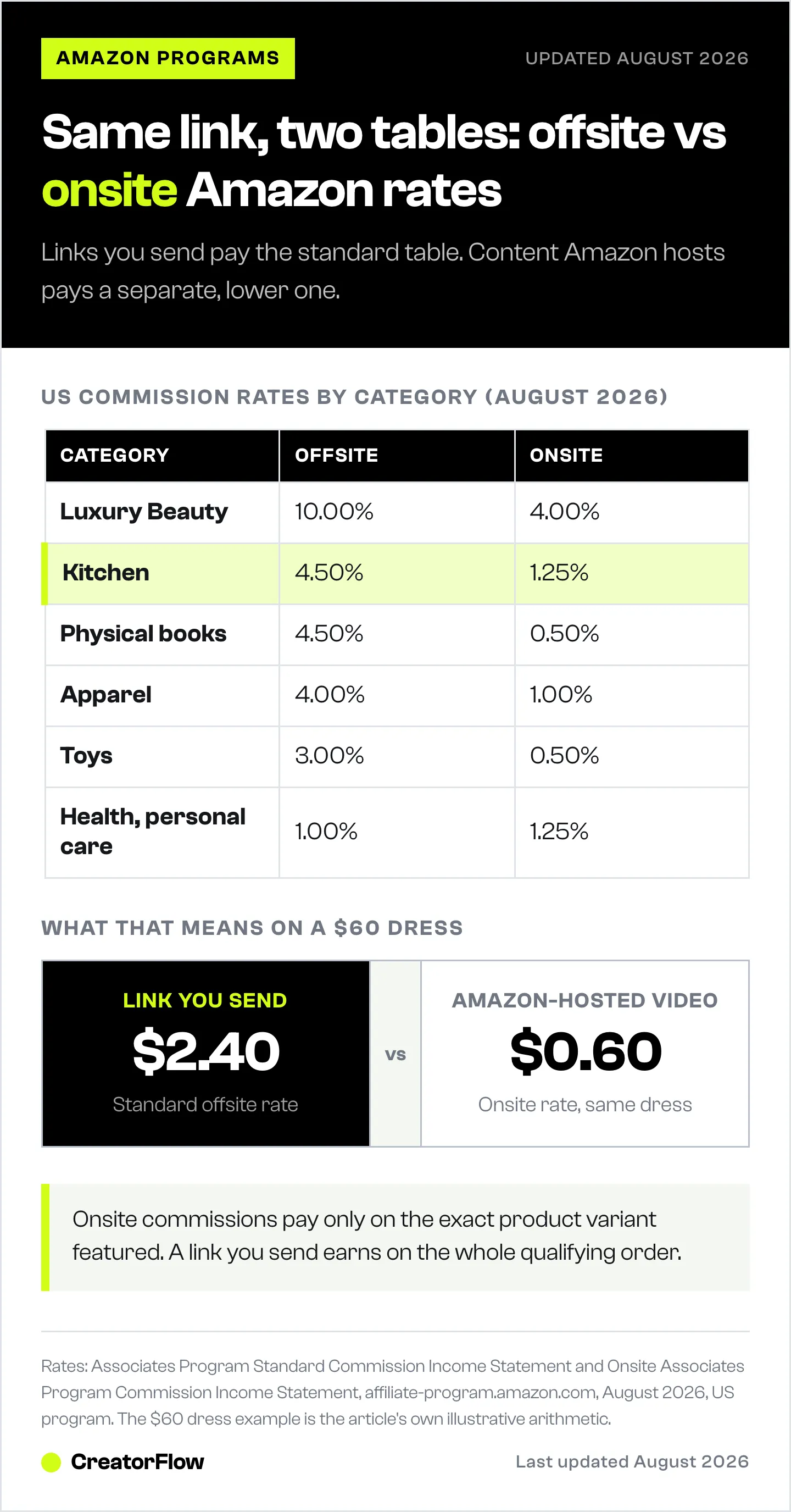
Here are both tables next to each other, for the categories creators post about most:
| Product category | Offsite rate (links you send) | Onsite rate (Amazon-hosted content) |
|---|---|---|
| Luxury Beauty | 10.00% | 4.00% |
| Physical books | 4.50% | 0.50% |
| Kitchen | 4.50% | 1.25% |
| Automotive | 4.50% | 1.25% |
| Apparel, shoes, watches, jewelry, handbags | 4.00% | 1.00% |
| Home, furniture, lawn and garden, pets | 3.00% | 3.00% |
| Beauty | 3.00% | 2.00% |
| Tools | 3.00% | 1.75% |
| Sports | 3.00% | 1.25% |
| Headphones | 3.00% | 1.00% |
| Toys | 3.00% | 0.50% |
| Outdoors | 3.00% | 0.75% |
| Health and personal care | 1.00% | 1.25% |
| All other categories | 4.00% | 1.00% |
Sources: Associates Program Standard Commission Income Statement and Onsite Associates Program Commission Income Statement (affiliate-program.amazon.com, August 2026). Rates apply to the US program.
Read the fashion row and the kitchen row twice. A $60 dress sold through a link you sent pays $2.40. The same dress sold through your video sitting on Amazon’s product page pays $0.60. Health and personal care is the one category where the onsite rate is higher, and it is a 0.25 point difference on a 1% base.
Onsite commissions carry a second restriction that the headline rate hides. They pay only on a Direct Qualifying Purchase, meaning the same product variant featured in your content, rather than everything the shopper puts in their basket during the session. A link you send earns on the whole qualifying order. That gap widens the real distance between the two tables well past what the percentages show.
There is a third table. Amazon pays higher onsite rates on Creator Ads placements, roughly double Table A in most categories, with luxury beauty at 5%, kitchen at 2.25% and apparel at 2%. It is worth knowing the table exists, but it applies to a placement Amazon controls, not to anything you can direct traffic toward.
What the Amazon Storefront Actually Gets You
The storefront is a curation and credibility asset, not a rate upgrade. It gives you one readable URL you can say out loud in a Reel, a place to group products into lists, and a shop page that keeps working after a post falls out of the feed. Amazon can also surface your storefront content to shoppers already browsing the site, which is genuinely incremental traffic you did not have to earn.
What it does not do is raise your commission, and it introduces a routing problem that costs money. A follower who asks for one product and lands on a page with forty has to find it again. Every extra step between the question and the product page is a step where the sale leaks.
The practical read: promote the storefront when your recommendation is a category or a collection, and send the product link when your recommendation is a single item. Our guide to what Amazon influencers earn per month on Instagram breaks down how that split plays out across a posting schedule.
Eligibility: What Each Application Requires
Amazon publishes different bars for the two programs, and only one of them contains a number.
| Amazon Associates | Amazon Influencer Program | |
|---|---|---|
| Who it is for | Bloggers, publishers, app owners, creators | Creators whose main platform is social |
| You apply with | A website, mobile app, Alexa skill, or supported social account | A connected social profile |
| Accepted platforms | Facebook open groups and fan pages, Instagram, X (listed as Twitter), YouTube, TikTok, Twitch.tv | YouTube, Instagram, Facebook, TikTok |
| Follower guidance | ”A substantive number of organic followers/likes (in most cases, at least 500)“ | No published figure |
| Account type | Public, with posts and follower counts visible to non-followers | Instagram and Facebook applicants must use a business account |
| Content bar | Robust original content, “a good rule of thumb is at least 10 posts” | Amazon reviews the connected profile |
| Full review trigger | At least three qualifying sales within the first 180 days | Amazon reviews at application |
| What approval gives you | Trackable Special Links | Trackable Special Links plus a storefront at amazon.com/shop/handle |
Sources: Application Review Process (affiliate-program.amazon.com, August 2026) and the Amazon Influencer Program sign-up FAQ (affiliate-program.amazon.com, August 2026).
Two details in that table decide most outcomes. Personal orders do not count toward the three qualifying sales, so buying through your own link to clear the bar fails and breaches the agreement at the same time. And a private Instagram account, or one with a hidden follower count, is not eligible for the Associates route regardless of size.
If you want onsite earnings on top of storefront curation, that is a third gate. Sign-up for onsite commissions opens after you have uploaded three videos that pass content moderation (amazon.com Influencer FAQs, August 2026).
The Follower Minimum Nobody Can Source
Comparison posts routinely state that the Amazon Influencer Program requires 1,000 or 5,000 followers. Amazon has never published either figure. The sign-up FAQ says only: “When reviewing your application, we look at the number of followers you have in addition to other engagement metrics.”
That phrasing puts follower count and engagement in the same sentence without ranking them, which is why accounts in the low thousands with active comment sections get approved while much larger dormant accounts get declined. Anyone quoting a hard threshold for this program is inferring it from their own approval.
The 500-follower figure is real, but it belongs to the other program. It appears in Amazon’s Associates application review page as guidance for applicants using a social account, and it is written as “in most cases,” not as a hard floor.
Which One Should You Apply For?
Apply to Associates first if you are starting from zero, because the bar is documented and the review is mechanical: publish real content, get three sales, pass. You control every input. The one thing to plan for is the 180-day clock, which starts at signup, not at your first post.
Apply to the Influencer Program first if social is already your main platform and you have a business account with an engaged audience. The review happens at application rather than after six months of selling, so you find out quickly, and approval hands you the storefront immediately.
Apply to both if you post product content regularly, which is the honest answer for most Instagram creators. The programs share one account system and one operating agreement, and holding both costs nothing.
Then make the decision that moves the number. Amazon’s higher table pays on traffic you send. So the question worth optimizing is not which program you joined, but how reliably a follower who asks for a product ends up on that product’s page with your tag attached.
Getting the Link to the Follower Who Asked
Instagram gives you one clickable link, in your bio. Captions, Reels and comments are not clickable. So the follower who comments “where is the pan from” gets sent to a bio link, then a storefront, then a search box, and a share of them never arrive. That is the exact leak between the offsite table and nothing at all.
Amazon’s own policy points to the fix. The Associates Program Participation Requirements state:
“You may include Special Links in emails, SMS and direct messaging from your social media Sites; provided, that such communications are solicited (i.e., opted into by the receiving customer) and are otherwise in compliance with the Agreement, the Trademark Guidelines, and the Amazon Brand Usage Guidelines.”
A follower who comments a keyword to request a link has opted in, clearly and on the record. An unsolicited blast to your follower list has not. Amazon also names you the “Sender” for CAN-SPAM and TCPA purposes, so the opt-in is yours to be able to demonstrate (affiliate-program.amazon.com Program Policies, August 2026).
That is the workflow a keyword-triggered DM produces. Someone comments to ask, the product link arrives while they are still on the post, and they land on the item rather than hunting a shop page. CreatorFlow runs this on Instagram through Meta’s official API at $15 per month flat, with click tracking and geographic analytics on every link you send, and setup takes about five minutes. CreatorFlow is a Meta Tech Provider (since December 2025). The full walkthrough is in Instagram DM automation for Amazon influencers, and there is a product overview at CreatorFlow for Amazon affiliates.
Three things keep that setup inside the rules: the person asked, your disclosure sits on the public post where the asking happened, and the link goes to Amazon with nothing obscuring the destination. Placement rules for the disclosure are covered in our guide to FTC affiliate disclosure on Instagram, and the behaviour of Amazon URLs inside Instagram’s in-app browser is covered in Amazon deep links for Instagram affiliates.
FAQ
Do Amazon Influencers earn more than Amazon Associates?
Not on the same sale. Both programs pay Amazon’s standard commission table when a shopper buys after clicking a link you shared. Influencers can earn additional commission from content Amazon hosts on its own site, but that content pays from a separate onsite table with lower rates in almost every category, and only on the exact product variant featured.
Can Amazon Influencers link to individual products, or only their storefront?
Individual products. Influencers hold Associates accounts and create the same product-level Special Links. The storefront is an extra surface, not a restriction, and sending a follower straight to the product page is generally the higher-converting move.
How many followers do you need for the Amazon Influencer Program?
Amazon publishes no number for the Influencer Program and says it reviews follower count alongside other engagement metrics. The widely quoted 1,000 and 5,000 figures do not come from Amazon. The 500-follower guidance that does exist applies to Amazon Associates applicants using a social account.
Does the three-sales-in-180-days rule apply to the Influencer Program?
Amazon publishes it as an Associates account requirement: the application is reviewed once you have driven at least three qualifying sales in the first 180 days, and personal orders do not count. Amazon publishes no Influencer-specific exemption, so treat it as unresolved rather than assuming it does not apply.
Which Amazon program should you apply for first?
Apply to Associates first if you are building from a website or a small account, because the requirements are documented and the outcome is in your hands. Apply to the Influencer Program first if social is already your main platform and you hold a business account, because the review happens at application instead of after six months.
Is the Amazon Influencer Program worth joining if you do not make videos?
The storefront alone is still useful as a readable URL and a curated shop page you can point audiences toward between posts. The onsite video earnings are the part that requires video, and they need three moderation-approved uploads before onsite commission sign-up opens.
Can you be in Amazon Associates and the Influencer Program at the same time?
Yes. The Influencer Program is an extension of Associates rather than a separate scheme, so approved Influencers hold Associates accounts and operate under the same agreement. Joining one does not exclude you from the other.
Program requirements, commission tables and policy language verified from affiliate-program.amazon.com (Application Review Process, Influencer Program sign-up FAQ, Program Policies, Standard Commission Income Statement and Onsite Associates Program Commission Income Statement) and amazon.com Influencer FAQs as of August 2026. Rates apply to the US program and change periodically. Individual results vary.


