
Affiliate programs for Instagram fall into three groups: open programs with no follower minimum (Mavely, Amazon Associates, CreatorFlow), application-based creator platforms (LTK, ShopMy, MagicLinks), and large networks (impact.com, CJ, Awin). Commission runs from 1% on Amazon groceries to 30% recurring on software. The program matters less than whether its link reaches the follower who asked for it.
Most comparison lists rank these programs by commission rate and brand count. That ranking answers the wrong question. You can be approved for a 25% program with 7,000 retailers and still earn nothing, because Instagram gives you one clickable link in your bio and nothing clickable in the place where people ask: the comments.
This guide compares 11 programs on the terms that decide Instagram earnings — what they pay, who they accept, what it takes to get paid out, and how far their link can travel on a platform built to keep people inside the app. Prices and terms were verified in August 2026.
Key Takeaways
- Three tiers of access: Mavely, Amazon Associates, and the CreatorFlow Affiliate Program take creators at any size. LTK, ShopMy, and MagicLinks require an application. impact.com, CJ, and Awin require approval brand by brand.
- Commission range is wide and category-driven: Amazon pays 1% on groceries and 10% on luxury beauty (shopify.com, 2026). Software programs pay 20% to 30% recurring, which compounds where a one-time product sale does not.
- Instagram relaunched native affiliate tagging in March 2026, letting creators tag up to 30 products per Reel, but only for products inside Meta’s commerce catalogue and only in Reels (affiversemedia.com, 2026).
- Two list staples have changed status: Shopify Collabs is not accepting new creator signups (shopify.com, 2026), and Rakuten Advertising moved its tracking onto impact.com’s platform under an April 2026 alliance (prnewswire.com, April 2026).
- Payout minimums decide when you see money: $25 at Shopify Collabs and CreatorFlow, $20 at Awin, $50 at CJ and Rakuten. A 25% commission you never withdraw is worth less than a 10% one you do.
- The bottleneck is delivery, not enrolment: no affiliate program on this list produces a clickable link inside an Instagram comment, which is where buying intent shows up most often.
What Changed for Instagram Affiliates in 2026
Instagram returned to native affiliate commerce in late March 2026, roughly three years after shutting down its first attempt. Instagram head Adam Mosseri announced that creators can tag affiliate products directly in Reels and earn commission on resulting purchases. At Shoptalk Spring, Meta’s Nicola Mendelsohn said “the era of link in bio is finally over” (affiversemedia.com, 2026).
The mechanics are more limited than that line suggests. Creators can tag up to 30 products per Reel, and the products have to exist inside Meta’s commerce catalogue. The initial rollout launched with Amazon in the US and Shopee in parts of Asia. Brands connect existing programs through impact.com, Rakuten, or Shopify Collabs rather than rebuilding tracking (affiversemedia.com, 2026).
Two things follow from that. Tagging only works in Reels, so Stories, carousels, and static posts still depend on a link you place yourself. And it only works for catalogue products, so a large share of what creators promote — courses, software, small DTC brands, anything outside a connected retail partner — stays outside the system.
The other 2026 change matters for anyone reading an older list. On April 28, 2026, Rakuten International and impact.com announced a strategic alliance. No equity changed hands and it is not a merger. Rakuten Advertising moved its merchants and publishers onto impact.com’s platform for contracting, tracking, and payments, while keeping managed services and Rakuten Rewards (prnewswire.com, April 2026). Lists that still present Rakuten and impact.com as two independent tracking choices are describing the market as it was before that date.
How to Judge an Affiliate Program for Instagram
Commission rate is the number every list leads with and the number that decides the least. Four filters matter more, in this order.
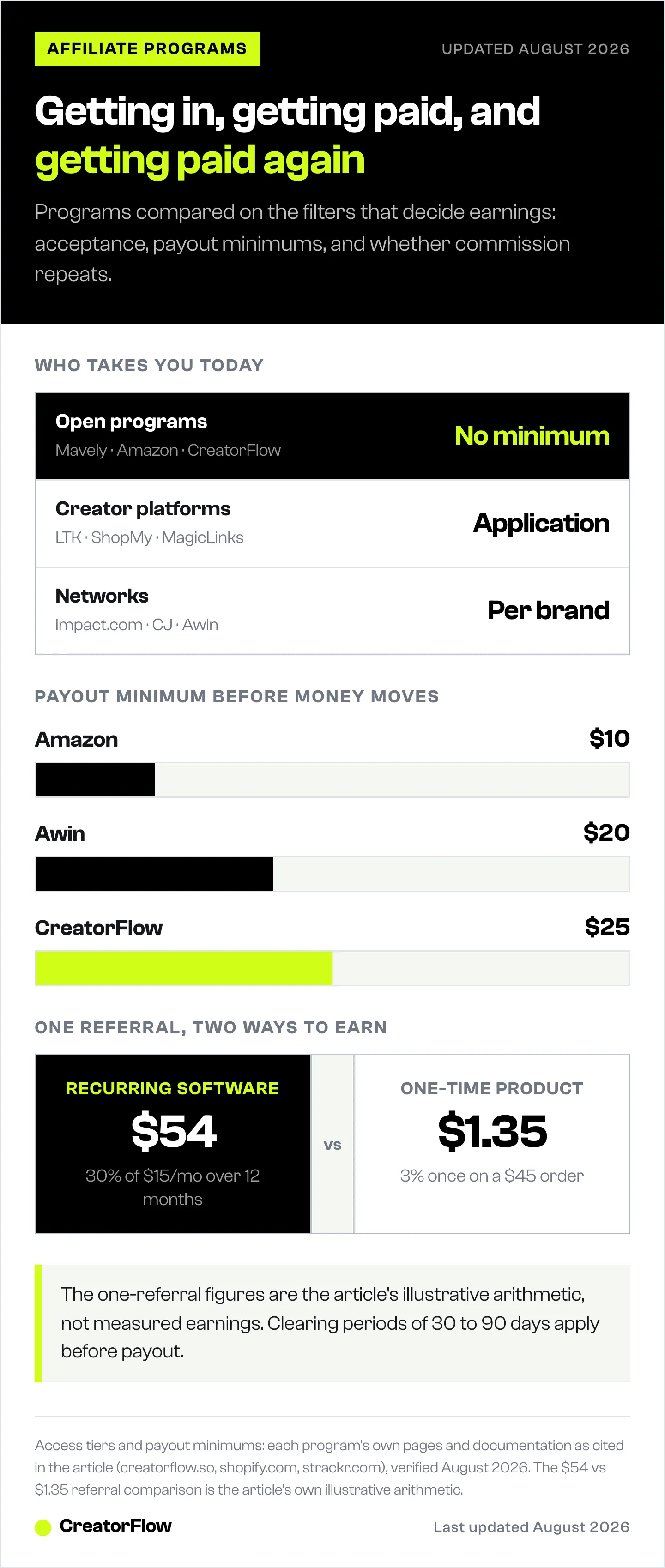
Can you get in? An open program you joined today beats a 25% program still reviewing your application. Acceptance is the first gate and the one most guides gloss over.
Can you get paid out? Payout minimums range from $20 to $50 across these programs, and clearing periods run 30 to 90 days. On a $4 average commission, a $50 threshold means 13 sales before any money moves.
Does the link reach your audience? This is the filter nobody applies. Instagram allows clickable links in your bio, in Story link stickers, and inside DMs. Captions, Reels comments, and post comments do not carry clickable links. A program whose only delivery route is a storefront URL reaches people who visit your profile. It does not reach the person who commented asking for the link.
Does it pay once or repeatedly? A product sale pays once. A software subscription referral can pay every month the customer stays. At the same headline percentage, the second is worth several times the first.
One clarification on lists you may have read: some “best affiliate programs for Instagram” roundups include influencer campaign-management platforms at or near the top. Those tools help brands and agencies recruit and pay creators. They are not programs a creator joins to earn commission, and they belong in a different comparison.
Affiliate Programs for Instagram, Compared
| Program | Commission | Follower minimum | Payout minimum | Best for |
|---|---|---|---|---|
| Mavely | Varies by retailer, plus boosts | None | Varies | Any creator starting today |
| Amazon Associates | 1% to 10% by category | None | $10 | Broad product recommendations |
| CreatorFlow | 30% recurring for 12 months | None | $25 | Creators whose audience runs Instagram |
| ShopMy | Varies by merchant | None stated | Varies | Curation-led beauty and style |
| LTK | Varies by retailer | 5,000 outside US/CA | Varies | Fashion, beauty, home |
| MagicLinks | Varies by retailer | Application-based | Varies | High-frequency video creators |
| impact.com | Set by each brand | Application-based | Varies by brand | Direct brand relationships |
| CJ | Set by each advertiser | Application-based | $50 | Established publishers |
| Rakuten Advertising | Set by each advertiser | Application-based | $50 | Premium retail brands |
| Awin | Set by each brand | $5 refundable deposit | $20 | International audiences |
| Shopify Collabs | Set by each merchant | 1,000, signups paused | $25 | DTC brand partnerships |
Sources: program pages and documentation for each platform, verified August 2026. Commission figures set by individual brands vary too widely to state as a single range.
Programs With No Follower Minimum
These accept creators regardless of audience size, which makes them the right first move for anyone not already approved somewhere.
Mavely
Mavely is the lowest-friction entry point on this list. There is no fee and no application: sign up, verify your account, and start generating links (joinmavely.com, 2026). The platform reports more than 120,000 creators who drove $1.5 billion in sales for brand partners over a 12-month period (prnewswire.com, 2025).
Its Boosts feature surfaces temporary commission increases and lets creators stack retailer and brand rates, with access open to all creators rather than a top tier (prnewswire.com, 2025). For a creator with no approvals yet, that combination of open access and variable upside is hard to beat.
Best for creators who want to start this week and sort out positioning later.
Amazon Associates and the Amazon Influencer Program
Amazon solves the trust problem that kills early affiliate attempts. Followers already have accounts, saved cards, and shipping addresses, so the checkout step does not need selling.
Commission runs 1% to 10% depending on category, with luxury beauty at the top and groceries and health at the bottom (shopify.com, 2026). Amazon also pays fixed bounties in the $3 to $30 range when referrals sign up for services like Prime or Audible (shopify.com, 2026). The Influencer Program adds a storefront, which gives you a single bio-link destination that holds every recommendation you have made.
Which of the two to apply for, and what each one actually pays, is broken down in Amazon Associates vs the Influencer Program.
The category spread is the reason to join and the reason not to depend on it alone. Broad-interest accounts covering home, gadgets, and everyday finds get more usable coverage from Amazon than from any niche platform. Creators in higher-commission verticals usually run Amazon alongside a second program rather than as their only one.
CreatorFlow Affiliate Program
The CreatorFlow Affiliate Program pays 30% of every payment a referral makes for their first 12 months. On monthly plans that is $4.50 per month for Pro and $9 per month for Growth. On annual plans it is $43.20 and $86.40 paid at once (creatorflow.so, August 2026).
There is no follower minimum and no exclusivity. Approval is based on audience fit, so it suits creators, coaches, and marketers whose audience runs Instagram. Payouts go out monthly by PayPal in the first 10 days of the month once your balance passes $25, with a 40-day clearing period after the customer’s payment. The cookie window is 60 days on first-click attribution, meaning the referral stays yours if you made the introduction (creatorflow.so, August 2026).
One detail matters more on Instagram than anywhere else. Affiliates get a personal promo code giving 20% off a referral’s first payment, and that code tracks without a link click (creatorflow.so, August 2026). You can put it in a caption, say it in a Reel, or type it in a comment reply — all the places Instagram refuses to make clickable. Full terms are in the CreatorFlow Affiliate Program announcement.
Best for creators whose audience is trying to grow on Instagram, where a recurring subscription referral compounds against a one-time product sale.
ShopMy
ShopMy is a storefront-first platform aimed at creators whose audience buys from curation rather than from a single product demo. Setup is quick, and it has been accepting creators across following sizes rather than gating on audience number (lucismorsels.com, 2026).
It runs a tier system. Creators start at Enthusiast with storefront access and more than 50,000 merchant partners, then move to Ambassador at 30 to 70 points and Trendsetter at 70 to 85 points, which adds brand chat, gifting requests, and priority on opportunities (lucismorsels.com, 2026). Points come from clicks, consistent link creation, responsiveness to brands, and referrals.
The opportunities board is the part worth weighing. It puts affiliate commission and paid collaboration in one place, which suits creators who do not want those tracked in separate systems.
Best for stylists, beauty, and home creators whose followers save recommendations and buy later.
Programs That Require an Application
LTK
LTK is the established platform for fashion, beauty, home, and lifestyle. It reports more than 250,000 creators, 7,000 retailers, and 1 million brands, and runs a consumer shopping app that gives your recommendations a second discovery surface beyond Instagram (company.shopltk.com, 2026).
Entry is by application. LTK looks for a public social profile, an engaged following, and regular content featuring products, and states that its ideal applicant posts daily. Applicants outside the US and Canada need a minimum of 5,000 followers; US and Canada applications are assessed without a published numeric floor (company.shopltk.com, 2026).
Best for creators in lifestyle retail whose content is already visual and recommendation-led.
MagicLinks
MagicLinks is built around video creators who publish and link often. It reports 38,000 creators in its network, more than 5,000 brands, and $12.3 billion in sales driven, and it runs a mobile app for generating links and checking revenue away from a desk (magiclinks.com, 2026).
It also runs a benefit unusual in this category: qualifying creators receive a monthly stipend toward personal health insurance, assessed annually on earnings from September 1 to August 31 (magiclinks.com, 2026).
Best for creators publishing high-frequency video where link creation speed is a daily constraint.
Affiliate Networks With Thousands of Brands
Networks trade convenience for reach. You apply to the network, then apply again to individual brands, and commission is set by each advertiser rather than the network.
impact.com is free for publishers and consolidates earnings across every brand program into a single payout, which makes thresholds easier to clear than managing ten separate brand portals. Payouts go by direct transfer, BACS, or PayPal, after a locking period typically running 30 to 90 days depending on the brand’s return policy (impact.com and ecommerceparadise.com, 2026). Following the April 2026 alliance, it is also where Rakuten Advertising’s tracking now lives.
CJ carries more than 2,800 advertisers across retail, tech, and DTC. Payment runs net 30 on the 20th or 28th of the month, once the closed commission balance clears a $50 minimum, via direct deposit, check, or Payoneer (strackr.com, 2026). Approval is advertiser by advertiser, which rewards patience over speed.
Rakuten Advertising keeps its managed services, program strategy, and Rakuten Rewards cash-back platform, with tracking now running on impact.com (prnewswire.com, April 2026). Its publisher payouts historically require a $50 minimum commission balance, paid the week after advertisers settle monthly invoices (shopify.com, 2026).
Awin gives access to more than 30,000 brands including international advertisers, and now includes ShareASale. Joining involves a $5 refundable deposit and a compliance verification step. The payment threshold is $20, paid by bank transfer, international wire, or ACH, with cookie windows typically around 30 days but varying by brand (shopify.com, 2026). The $20 threshold is the lowest of the big networks.
Shopify Collabs connects creators directly with Shopify merchants, which suits creators who prefer tighter brand alignment over a large catalogue. Note its current status before planning around it: Shopify states that Collabs is not accepting new creator signups at this time, though merchants can still invite creators directly by email (shopify.com, 2026). When open, requirements are 1,000 followers on one platform, a verified profile, and residency in the US, Canada, or UK, with payouts twice monthly at a $25 minimum (skailama.com, 2026).
The Gap Every Program on This List Shares
Join all 11 and you still have the same delivery problem, because it belongs to Instagram rather than to any program.
Someone watches your Reel. They want the product. They comment “link?” because that is the single easiest action available to them. Instagram does not make links in comments clickable, so your options are to reply telling them to visit your bio, or to DM each one by hand.
Both leak. Sending people to your bio moves them from one specific product to a storefront holding forty, and asks them to find the thing they wanted. Manual DMs work until the volume climbs, and a reply that arrives four hours later reaches someone who has moved on.
Comment-to-DM automation closes that gap. A follower comments your keyword and a tool sends the affiliate link to their DMs within seconds — to the one Instagram surface where links are clickable and attention is undivided. This is program-agnostic. It carries a Mavely SmartLink, an Amazon storefront link, an LTK post, or a promo code equally well, because it moves the link rather than the affiliation.
CreatorFlow Free covers 500 automated DMs per month. Pro at $15 flat per month adds the Follow Gate and Email Gate, so a link request also earns you a follow or an email address you keep (creatorflow.so, August 2026). The arithmetic is simple: at a $4 average commission, capturing 30 extra sales a month returns $120 against a $15 tool.
For the full setup, see how comment-to-DM automation works end to end. For how automated DM links compare against Instagram’s native tagging, see product tags and DM links side by side.
How to Pick Your First Two Programs
Two programs is the right number to start. One gives you no fallback when a category pays badly; five splits your attention and none of them reaches its payout threshold.
Pick one for coverage. This is the program that has a link for whatever you happen to mention. Mavely or Amazon Associates, depending on whether you want open access with variable rates or the deepest catalogue with published ones.
Pick one for your niche. This is where the higher rates live. Fashion, beauty, or home points to LTK or ShopMy. Beauty curation points to ShopMy. Software, tools, and creator-economy audiences point to recurring programs, where 30% for 12 months outperforms 3% once.
Then fix delivery before adding a third. Getting your existing link to every person who asks returns more than a fourth program you check twice a month.
Two more things worth settling early. Disclose affiliate relationships on every post that carries a link — the requirements are in Instagram affiliate disclosure and FTC rules. And place your links deliberately across bio, Stories, and DMs rather than defaulting to bio alone; all five affiliate link placements on Instagram covers what each one is good for.
For the mechanics of running affiliate content on Instagram once your programs are chosen, see Instagram affiliate marketing.
If you are under 10,000 followers and acceptance is your main blocker, the companion guide ranking affiliate programs by follower minimum sorts the same market by who will approve you today.
FAQ
Which affiliate program is best for Instagram beginners?
Mavely and Amazon Associates are the two most common starting points. Mavely has no application, no fee, and no follower minimum, so you can generate links the day you sign up (joinmavely.com, 2026). Amazon has the deepest catalogue and published commission rates of 1% to 10% by category (shopify.com, 2026). Most beginners run both, using Amazon for breadth and Mavely for rates.
Can you do affiliate marketing on Instagram without followers?
Yes. Mavely, Amazon Associates, and the CreatorFlow Affiliate Program all state no follower minimum. ShopMy has been accepting creators across following sizes. The practical floor is engagement rather than follower count: 500 followers who ask you for links convert better than 20,000 who scroll past.
Does Instagram have its own affiliate program?
Yes, as of late March 2026. Instagram relaunched native affiliate commerce, letting creators tag up to 30 products per Reel and earn commission on purchases. It works only for products inside Meta’s commerce catalogue, launched with Amazon in the US and Shopee in parts of Asia, and is rolling out by market (affiversemedia.com, 2026). Products outside the catalogue still need your own affiliate link.
How many affiliate programs should I join?
Start with two: one broad-coverage program and one matched to your niche. Payout minimums are the reason not to spread wider. At a $50 threshold and a $4 average commission, splitting sales across five programs can mean none of them pays out in a given month, while the same volume through two would clear both.
Do affiliate links work in Instagram captions?
Captions do not carry clickable links. Text pasted into a caption appears as plain text that people would have to retype. Clickable links on Instagram live in your bio, in Story link stickers, and inside DMs. This is why promo codes are useful on Instagram: a code works when it is read rather than clicked.
How much do Instagram affiliates earn?
Earnings vary too widely for a meaningful average, because commission rate, product price, and audience intent each swing the result several-fold. The mechanical drivers are worth more than a benchmark: commission percentage, order value, the share of link requests you answer, and whether commissions repeat. A 30% recurring program paying $4.50 monthly for 12 months returns $54 from one referral, against roughly $1.35 from a single $45 Amazon home purchase at 3%.
Can you put affiliate links in Instagram comments?
Links in comments are not clickable, so pasting one there earns little. The workable route is comment-to-DM automation: the follower comments a keyword, and the link arrives in their DMs where it is clickable, usually within seconds.
Program terms, commission rates, and payout thresholds verified from each platform’s own documentation and public pricing pages as of August 2026. Commission rates set by individual brands and advertisers change frequently — check the program dashboard before relying on a specific figure. Individual results vary.


