
Instagram affiliate marketing means earning commission by recommending products to your followers and getting paid when they buy. On Instagram, income depends less on the commission rate than on two things: how reliably a clickable link reaches the person who asked for it, and how many times a single referral pays you. Programs that score well on both beat higher-rate programs that score badly.
You post a Reel wearing a jacket. Forty people comment “link?” Instagram does not make links clickable in captions or comments, so those forty requests sit in a queue you answer by hand, hours later, one at a time. Amazon’s tracking cookie lasts 24 hours. Most of that window is spent before your first reply goes out.
Every guide on this topic ranks programs by commission percentage. That number is the last thing to check, not the first. This guide covers how Instagram affiliate marketing works in 2026, the two numbers that decide what you earn, how the main programs score on both, and how to build a delivery system that runs while you sleep.
Key Takeaways
- Two variables set your income: the share of link requests that receive a clickable link, and the number of times one referral pays you. Commission rate is a multiplier on both, not a substitute.
- Your cookie window sets your required reply speed. Amazon Associates runs a 24-hour cookie (getaawp.com, January 2026). A 60-day window forgives a slow reply; a 24-hour one does not.
- Promo codes are the only affiliate mechanism that survives a caption. A code tracks with no click anywhere in the chain, so it works in captions, comments, and spoken audio where links cannot.
- Instagram added native affiliate tagging in Reels in April 2026, up to 30 products per Reel, live first in the US, Brazil, India, Indonesia, and Thailand (Drapers, April 2026).
- One-time programs pay once per buyer; recurring programs pay monthly. A 4% one-time commission and a 30% twelve-month commission are not comparable numbers.
- FTC disclosure is not optional. The maximum civil penalty sits at $53,088 per violation as of 2026 (16 CFR 1.98).
How Instagram Affiliate Marketing Works
You join a program, receive a tracking link or code, recommend a product, and earn a percentage when someone buys through your link. The program handles checkout, fulfilment, and payment. You supply the recommendation and the audience.
What makes Instagram different from a blog or a YouTube description box is where a link is allowed to be clickable. Instagram gives you a small number of clickable surfaces and a large number of surfaces where a URL renders as dead text. Feed captions and comments fall in the second group. So the commission you earn is capped by a distribution problem before it is ever affected by the rate.
Instagram closed part of that gap in April 2026. Adam Mosseri announced native affiliate tagging for Reels: creators tap “Add Products” in the share sheet, paste a product URL or search a brand’s verified catalogue, and tag up to 30 items per Reel. Viewers tap a tag and complete the purchase on the retailer’s app or site. Tagged Reels also appear in Instagram’s Partnership Ads Hub, where brands can run them as paid ads. The rollout started in the US, Brazil, India, Indonesia, and Thailand, with more markets to follow (Drapers, April 2026).
That helps cold discovery. It does nothing for the forty people who commented “link?” on a post that has no product tag, which is still where most creator affiliate demand shows up. For the full placement map, see every place an affiliate link can go on Instagram.
What Decides Instagram Affiliate Income
Two numbers govern the result. Write them down before you compare a single commission rate.
Number one: delivery rate. Of the people who ask you for a link, what percentage receive a clickable one while they still want it? Manual replies to a busy comment section land somewhere between 30% and 60% in practice, because comments scroll away, notifications collapse, and you sleep. Automated delivery lands close to 100% because the trigger fires on every matching comment.
Number two: payout months. How many separate payments does one referral generate? Product affiliate programs pay once per purchase. Subscription software programs pay every month the customer stays, for a defined window.
The arithmetic runs like this:
Income = askers x delivery rate x conversion rate x commission x payout months
Two creators can join the same program with the same audience and earn five times apart on delivery rate alone. Raising a 4% commission to 5% moves the result by a quarter. Raising delivery from 40% to 95% more than doubles it. Adding payout months multiplies it again.
So the ranking worth building is “highest commission among programs I can deliver on Instagram, weighted by how many times each referral pays.”
The Main Programs, Re-Sorted by Delivery and Durability
The same programs that appear on every listicle, re-sorted by the two numbers above.
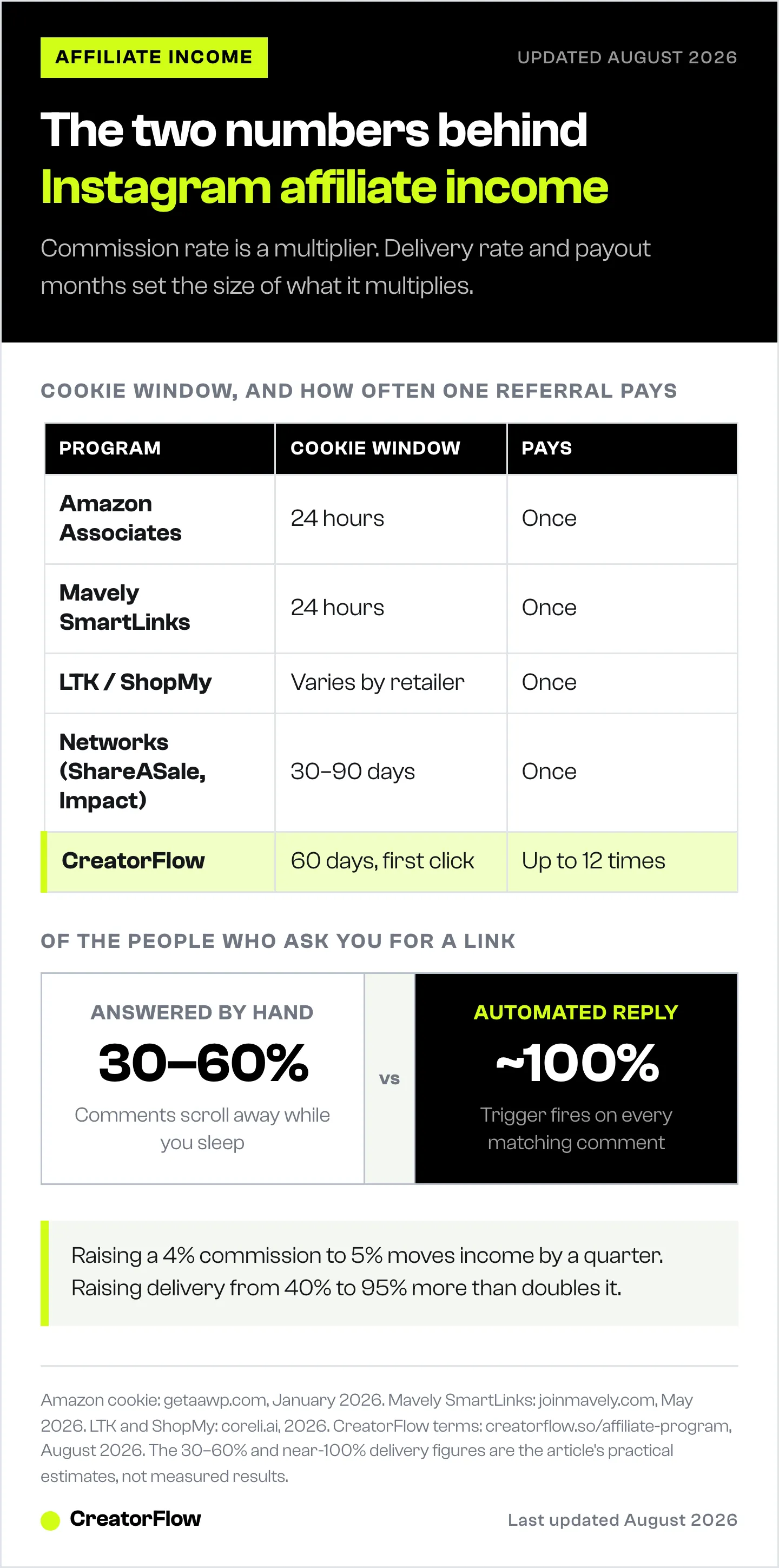
| Program | Commission | Cookie window | Pays per referral | Delivery fit on Instagram |
|---|---|---|---|---|
| Amazon Associates | 1-20% by category; 20% Amazon Games, 10% Luxury Beauty, most 1-4.5% | 24 hours | Once | Needs a click. Short window punishes slow replies |
| LTK | Roughly 5-25%, average near 16% | Varies by retailer | Once | App-first. Needs a click, and often an app open |
| ShopMy | Roughly 10-30% by brand | Varies by brand | Once | Web link. Needs a click, no app required |
| Mavely | Up to 30% on SmartLinks | 24 hours | Once | Needs a click. Short window, wide brand mix |
| Networks (ShareASale, Impact, CJ) | Merchant-set | Commonly 30-90 days | Once | Needs a click. Long windows forgive slow delivery |
| Recurring software, e.g. CreatorFlow | 30% for 12 months | 60 days, first click | Up to 12 times | Link or promo code. A code needs no click at all |
Sources: Amazon rates and cookie (getaawp.com, January 2026; shopify.com, 2026). LTK and ShopMy rates, enrolment, and payout cadence (coreli.ai, 2026). Mavely SmartLink rates and window (joinmavely.com, May 2026). CreatorFlow program terms verified at creatorflow.so/affiliate-program, August 2026.
Read the right column first. Amazon pays the lowest headline rate on the list and still earns real money for high-volume creators, because buyer trust converts. Sorted by rate alone, the recurring software row looks like an outlier at 30%. Sorted by the two numbers, it is the only row that pays more than once and the only row with a delivery method that survives a caption.
For a deeper split on the shopping platforms specifically, LTK, ShopMy, Mavely and Amazon payouts sit side by side with per-niche recommendations. If your account is under 10,000 followers, start with the programs that accept small accounts.
Why Your Cookie Window Sets Your Reply Speed
A cookie window is the time between a click and a purchase during which you still get credit. It is usually treated as a footnote. On Instagram it is the single most useful number for deciding how you deliver links.
Amazon’s standard window is 24 hours from the click, with items added to a cart held for 90 days (helpingmerchants.com, 2026). Mavely runs 24 hours on SmartLinks. Network programs commonly sit at 30 to 90 days depending on the merchant.
The practical rule: the shorter the window, the more of your income depends on automated delivery.
On a 24-hour program, a reply that arrives six hours after the comment has burned a quarter of the window before the buyer has even seen the link. On a 60-day program, that same six-hour delay costs almost nothing in attribution terms, though it still costs you the buyer’s attention.
So if your main program is Amazon or Mavely, delivery speed accounts for most of the variance in your monthly total. Comment-to-DM automation sends the link within seconds of the comment, which puts the buyer inside the window with the full 24 hours in front of them.
Promo Codes Are the Only Affiliate Link That Survives a Caption
Here is the mechanism no rate-ranked list mentions. Instagram does not render URLs in captions or comments as clickable. A tracking link posted there is dead text that a follower would have to retype. A promo code has no such problem.
A code works in a caption. It works in a comment. It works when you say it out loud in a Reel. It works in a Story that expires. It survives a screenshot and a repost. And when the customer redeems it at checkout, the sale attributes to you with no link click anywhere in the chain.
This inverts the usual advice. On a blog you optimise the link. On Instagram, a code-based program gives you clickable-equivalent coverage on surfaces where no link can function, which raises the first of the two numbers without any change to your content.
Not every program issues personal codes. When you are evaluating one, ask whether it does before you ask what the rate is. Commission rates also sit near the bottom of the earnings table for site owners, as our guide on monetizing a blog beyond affiliate links shows.
A Recurring Example: The CreatorFlow Affiliate Program
CreatorFlow runs the pattern described above: a flat rate that repeats, plus a personal code that tracks with no click. It is worth walking through as a worked example because the numbers are public and fixed.
Affiliates earn 30% of every payment a referred customer makes during their first 12 months, on every paid plan. The rate does not change with volume, and there is no tier to negotiate.
| Plan your referral picks | They pay | You earn per payment | Over the 12-month window |
|---|---|---|---|
| Pro Monthly | $15/month | $4.50 | Up to $54 |
| Pro Annual | $144/year | $43.20 | $43.20, paid at once |
| Growth Monthly | $30/month | $9.00 | Up to $108 |
| Growth Annual | $288/year | $86.40 | $86.40, paid at once |
Tracking runs on a 60-day first-click cookie, and referrals stay linked to you permanently once they sign up. Payouts go out via PayPal in the first 10 days of each month, with a $25 minimum and a 40-day clearing period after the customer’s payment. Applications are reviewed manually on audience fit rather than follower count, with no minimum audience size and no exclusivity requirement (creatorflow.so/affiliate-program, August 2026).
Run it through the two numbers. Payout months: up to 12, against one for every product program in the table. Delivery: a tracking link for Stories and bio, plus a personal code that gives new customers 20% off their first payment and works in the surfaces where links cannot.
Set against a $35 Amazon order at 4%, one Growth Annual referral is worth the same as roughly 62 Amazon sales. The trade is honest in both directions: product commissions arrive faster and convert at higher rates because the buyer already wanted a jacket, while software commissions are slower to earn and repeat once earned. Most creators who do this well run both.
Earn 30% of every payment, for 12 months
Flat 30% on every paid plan, monthly PayPal payouts, and a personal code that gives your audience 20% off their first payment. Application takes about two minutes.
Join the Affiliate ProgramReviewed manually · No follower minimum · $25 payout minimum
Full terms, including the fine print most programs bury, are in the CreatorFlow Affiliate Program announcement. The recurring affiliate income math covers how this kind of income compounds across a first year.
How to Disclose Affiliate Content on Instagram
Disclosure is a legal requirement, not a courtesy. The FTC’s Endorsement Guides (16 CFR Part 255) were last revised in July 2023 and cover any material connection between you and the brand, including free product.
The maximum civil penalty for the relevant FTC Act provisions is $53,088 per violation as of 2026. No inflation adjustment was applied for calendar year 2026, so the 2025 figure carried forward (16 CFR 1.98; Federal Register, July 2026). Each non-compliant post counts separately.
What compliance looks like in practice:
- Put the disclosure where the recommendation is, not at the end of a hashtag block
- Use plain wording: “#ad”, “paid partnership”, or “this contains affiliate links”
- Disclose in the DM too, not only on the public post
- Say it out loud in a Reel as well as writing it on screen, since audio-first viewers miss overlay text
- Disclose gifted product on the same terms as paid product
The full rules, plus copy-paste wording for each Instagram surface, are in the guide to FTC disclosure rules for Instagram affiliates.
Build the System in One Afternoon
A working setup, in order:
- Pick two programs, not eight. One product program matched to your niche, one recurring program you genuinely use. More than two splits your content and your reporting.
- Check the cookie window on both. Anything at 24 hours means you automate delivery before you post again.
- Set a trigger keyword per offer. One keyword, one link. “JACKET” sends the jacket. “TOOL” sends the software. Mixed keywords produce mixed reporting.
- Automate the reply. Connect an Instagram Business or Creator account to a tool that uses Meta’s official Instagram API, set the keyword, and write the DM once. CreatorFlow is a Meta Tech Provider (since December 2025), starts free with 500 DMs per month, and runs $15/month on Pro.
- Put the code in the caption and the link in the DM. The code catches everyone who never comments. The DM catches everyone who does.
- Disclose on both surfaces.
- Read the split after two weeks. Compare link clicks against code redemptions. Whichever mechanism carries more of your revenue tells you where to put the next call to action.
The point of the sequence is to fix the first number before touching the second. Delivery is the variable you control completely, today, without a single brand approving anything.
FAQ
How much can you make with Instagram affiliate marketing?
Earnings vary far too widely for a single figure to be useful, and most published numbers come from creators with a reason to quote their best month. A more reliable way to estimate: count the link requests you receive in a normal week, multiply by the share you currently answer, then by a 1-5% purchase rate, then by your commission and the number of months it pays. That gives you a number based on your own audience rather than someone else’s.
Do you need 1,000 followers to do affiliate marketing on Instagram?
No. Amazon Associates, Mavely, and ShopMy all accept creators without a large following, and Story link stickers have been available to every account since Instagram replaced swipe-up in late 2021. Instagram’s native Reels product tagging does carry its own eligibility requirements, so that specific feature may not appear on a new account yet. Everything else is open.
Can you put affiliate links in Instagram captions?
No. URLs in feed captions and comments render as plain text and are not tappable. Your working options are a promo code in the caption, a link in your bio, a Story link sticker, a Reels product tag where available, or automated DM delivery when someone comments a keyword.
What is the best affiliate program for Instagram?
The one whose links you can deliver fastest to the people asking, in a category your audience already buys. For high-volume physical products, Amazon Associates converts well despite low rates. For fashion and beauty, LTK and ShopMy pay considerably more per sale. For income that repeats, a recurring software program pays across 12 months instead of once.
Do you have to disclose affiliate links on Instagram?
Yes, on every post and in every DM that carries one. The FTC requires clear disclosure of any material connection, and the maximum civil penalty stands at $53,088 per violation as of 2026 (16 CFR 1.98). Disclosure must be visible near the recommendation rather than buried below a hashtag block.
How do affiliate links work in Instagram Reels?
Tap “Add Products” on the Reel share screen, then paste a product URL or search a brand’s verified Meta catalogue. You can tag up to 30 products per Reel. Viewers tap a tag and buy on the retailer’s site, and you earn the commission on the sale. The feature rolled out from April 2026 in the US, Brazil, India, Indonesia, and Thailand (Drapers, April 2026). If the option is missing from your share sheet, it has not reached your account yet.
Is recurring commission better than one-time commission?
They solve different problems. One-time product commissions arrive quickly and convert at higher rates because the buyer already wanted the product. Recurring commissions take longer to earn and then repeat every month the customer stays subscribed. A creator building a stable monthly floor wants some of both, which is why the payout-months column belongs next to the rate column in any comparison.
Turn Link Requests Into Delivered Links
Every affiliate program on the list pays the same whether a link arrives in three seconds or three hours. The difference in what you take home comes almost entirely from how many of the people who asked received something they could tap.
CreatorFlow sets a keyword once and sends the link, the code, or both, every time someone comments it. It runs on Meta’s official Instagram API, connects in a few minutes, and tracks every click so you can see which posts drive the revenue.
Program terms verified from affiliate-program.amazon.com via getaawp.com and shopify.com, coreli.ai, joinmavely.com, and creatorflow.so/affiliate-program, accessed August 2026. Instagram Reels affiliate tagging details from Drapers, April 2026. FTC penalty figure from 16 CFR 1.98 and the Federal Register, July 2026. Commission rates and platform terms change frequently. Verify on each program’s site before committing. Individual results vary.


