
An affiliate link is a special URL that carries a unique tracking ID tied to your account. When someone clicks it and buys, the merchant credits the sale to you and pays a commission. The link works through a tracking cookie and an attribution window, so you get paid for purchases made within a set time after the click, even if the buyer leaves and comes back.
You see creators dropping “link in bio” and “use my code” everywhere, and you know they are earning from it. But the mechanics stay fuzzy. How does a store know the sale came from you? How long do you have to get credit? What happens if someone returns the product? Without those answers, affiliate income feels like a black box you are locked out of.
This guide breaks down what affiliate links are, how the tracking actually works, how to get your first ones, where they perform best, and the FTC disclosure rules you cannot skip. It is written for creators starting from zero, not marketers who already speak the jargon.
Key Takeaways
- What it is: An affiliate link is a normal product URL with your unique tracking ID attached, so the merchant can credit sales back to you and pay a commission.
- How tracking works: A click drops a cookie on the buyer’s device. If they purchase within the attribution window, you earn. Amazon’s window is 24 hours after the click (affiliate-program.amazon.com, 2026).
- Commissions vary widely: Amazon pays 1% to 20% depending on the product category, while other programs and networks set their own rates (affiliate-program.amazon.com, 2026).
- Disclosure is mandatory: The FTC requires you to clearly disclose your material connection. An affiliate link by itself is not enough — you need plain language like “I earn a commission” (ftc.gov, 2026).
- It is a real market: U.S. affiliate marketing spend has climbed to roughly $9.56 billion, and 57% of marketers are increasing their affiliate investment (firstpromoter.com / fintelconnect.com, 2026).
- Delivery beats placement: The hard part is not making the link, it is getting it in front of buyers at the moment they ask. On Instagram, that means sending it the second someone comments or DMs.

What Is an Affiliate Link?
An affiliate link is a destination URL with a unique identifier added to it. That identifier is yours alone. It tells the merchant’s system which affiliate sent the visitor, so any resulting sale gets attributed to your account.
Think of a normal product page URL. An affiliate version of that same URL has extra text appended, often a tag or ID parameter. The product the buyer sees is identical. The price they pay is identical. The only difference is the invisible label that says “this visitor came from you.”
That label is what makes the whole model work. It lets a brand reward thousands of creators for sales without tracking any of them manually. You promote, the link records, the brand pays.
How Do Affiliate Links Work?
The flow has four steps: click, cookie, window, commission.
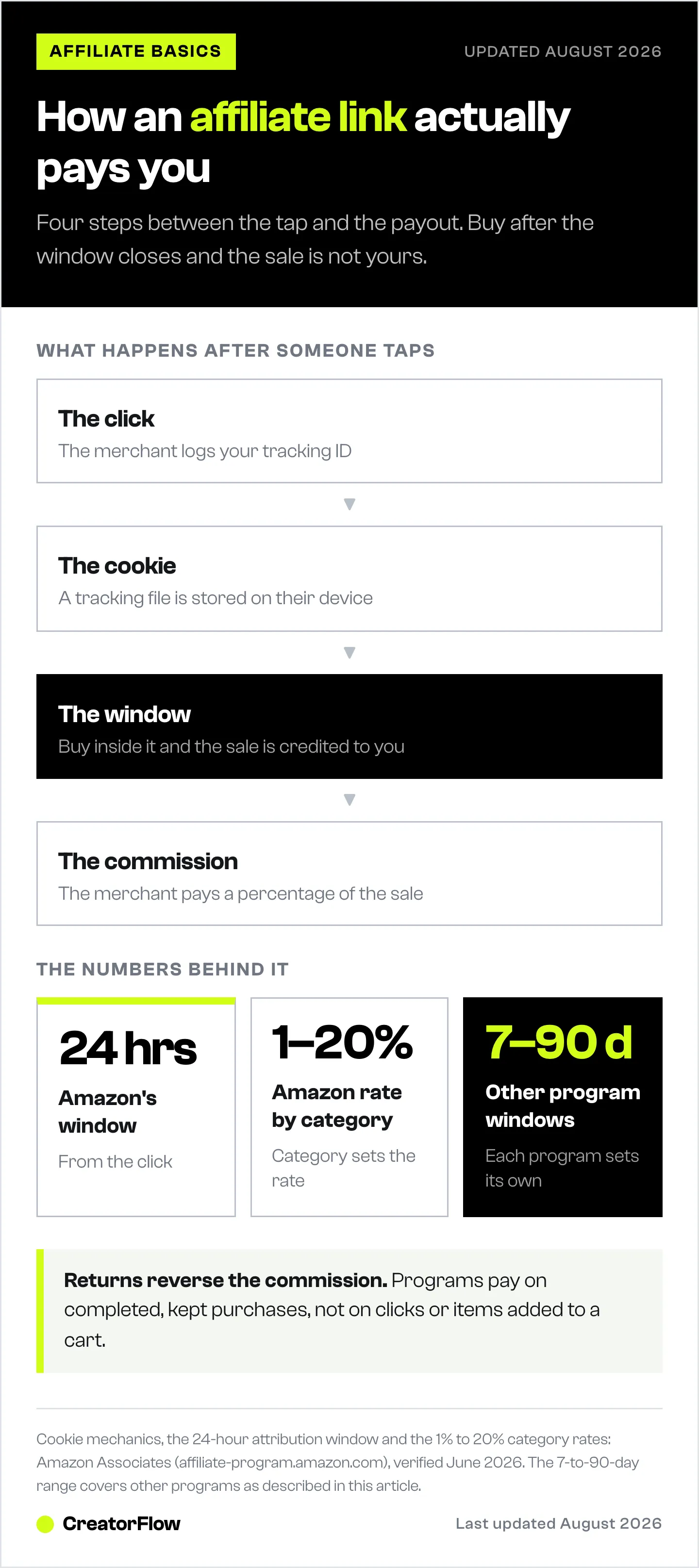
- The click. A follower taps your affiliate link. The merchant logs that the visit came from your tracking ID.
- The cookie. A small tracking file is stored on the buyer’s browser or device. It remembers you sent them.
- The attribution window. The cookie lasts a set period. Buy inside that window and you get credit. Amazon’s window is 24 hours, so a purchase made within a day of the click counts toward your commission (affiliate-program.amazon.com, 2026). Other programs run windows of 7, 30, or even 90 days.
- The commission. When the qualifying purchase completes, the merchant records the sale and pays you a percentage. Amazon’s rates run from 1% to 20% by category (affiliate-program.amazon.com, 2026), and other networks set their own.
One detail catches new creators off guard: if the buyer returns the product, the commission is reversed. You earn on completed, kept purchases, not on clicks or added-to-cart items.
How to Get Your First Affiliate Links
There are two routes, and most creators use both. For the full four-step walkthrough across Instagram, TikTok, and Pinterest, see how to create affiliate links for social media.
Join individual brand programs. Many companies run their own affiliate program. You apply directly, get approved, and pull links from their dashboard. Amazon Associates is the most common starting point because almost everything is on Amazon.
Join an affiliate network. Networks bundle hundreds of brands under one login, so you generate links for many merchants in one place and get a single payout. If you are weighing networks, the breakdown of ClickBank, Impact, and PartnerStack for creators compares how they handle approval, payouts, and link generation.
Check the tools you already pay for. Software subscriptions often run their own programs, and they pay differently: a share of every payment the customer makes rather than a one-time fee. The honest math of recurring affiliate income explains how those commissions compound.
The basic steps once you are in:
- Pick a program or network and get approved.
- Choose the specific product and grab its destination URL.
- Generate your tracked link, add any SubID or UTM tag for your own reporting, then click it yourself to confirm it lands on the right page.
You do not need a huge following to start. Most programs approve creators with small, engaged audiences. The guide for affiliate micro-influencers covers what actually matters at smaller follower counts.
Where Affiliate Links Perform Best
The link is the same everywhere. The conversion is not. Each channel has a different best-use.
| Channel | How affiliate links work there | Best for |
|---|---|---|
| Instagram Stories | Link sticker taps straight to the product | Time-sensitive deals, daily picks |
| Instagram Reels and posts | Drive to bio or trigger a DM with the link | Reaching new buyers, demand spikes |
| Link in bio | One hub for current top links | Followers who hunt for a product later |
| YouTube | Links in description, called out on screen | High-consideration buys, reviews |
| Blog and Pinterest | Contextual links inside content | Evergreen, search-driven traffic |
| Direct links to subscribers who already trust you | Highest-intent, repeat buyers |
On Instagram the friction is real: you cannot put a clickable link in a feed caption. That is why creators say “comment a word” or “DM me” and then send the link privately. For the placement mechanics, see how to add affiliate links on Instagram. And if you’re weighing a storefront hub against DM delivery, the Stan Store vs CreatorFlow comparison for affiliate creators breaks down when each model wins.
Affiliate Link Disclosure: The FTC Rules You Cannot Skip
This is the part most beginners get wrong, and it carries real legal risk. The FTC requires anyone with a “material connection” to a brand to disclose it clearly and conspicuously (ftc.gov, 2026). Earning a commission is a material connection.
What the FTC expects:
- Use plain language. “I earn a commission from purchases” or a clear “#ad” placed where people will actually see it.
- Make it hard to miss. Disclosure buried at the end of a caption or hidden behind “more” does not count.
- Know that the link alone is not enough. The FTC has stated that an affiliate link by itself is not adequate disclosure of the relationship (ftc.gov, 2026).
The brands you partner with also expect compliance. Skipping disclosure can get you removed from a program and put the brand at risk too. The deeper rules for creators live in the Instagram affiliate disclosure and FTC guide.
How to Track and Improve Affiliate Earnings
Once links are live, your job shifts to reading the data.
- Watch the dashboard. Every program shows clicks, conversions, and commissions. Conversions matter more than clicks.
- Add your own tags. UTM parameters and SubIDs let you label links by post, platform, or campaign so you know which content actually sells.
- Find your winners. When one product or one post converts, make more of it. Affiliate income compounds when you double down on what works instead of spreading thin.
If clicks are high but sales are low, the problem is usually mismatch: the audience that clicked did not want that product. If clicks are low, the problem is delivery, which is where most Instagram creators leak money.
Delivering Affiliate Links on Instagram Without the Manual Grind
Here is the gap. A Reel takes off, 200 people comment “link please,” and you cannot DM 200 people fast enough. By the time you reply, the buying impulse is gone and the cookie window with it.
CreatorFlow closes that gap. Set a keyword like “shop” or “link,” and the moment someone comments it or DMs you, they get your affiliate link automatically, in seconds. You can gate it behind a follow, capture their email first, and track which posts drive the most clicks by country. The link is delivered while intent is highest, not hours later. For content built to trigger those requests, see Instagram content ideas that generate leads, and for the full setup, the Instagram DM automation guide.
Which program you make the link with matters too: Instagram affiliate income depends on delivery and payout duration, not the headline rate.
Making the link is step one. Getting it to a buyer the instant they ask is what turns affiliate links into income.
FAQ
How do I know if a link is an affiliate link?
Look at the URL. Affiliate links usually carry extra parameters such as a tag, ref, or ID after the product address, or they run through a known network domain. Many also pass through a short link or redirect. On a creator’s post, a disclosure like “#ad” or “commissions earned” is the clearest sign.
Do I need a large following to start using affiliate links?
No. Most affiliate programs and networks approve creators regardless of size, and some are built specifically for micro and nano creators. A small, engaged audience that trusts your recommendations often converts better than a large, passive one. Engagement and relevance matter more than raw follower count.
How much money can creators realistically earn from affiliate links?
It varies enormously by niche, traffic, and commission rate. Early on, many creators earn small, irregular amounts while they learn what their audience buys. Earnings grow as you identify winning products and improve delivery. Affiliate income compounds, so consistency over months matters more than any single post.
Are affiliate links allowed on Instagram, Pinterest, and YouTube?
Yes, all three allow affiliate links when you follow their rules and disclose properly. Instagram does not allow clickable links in feed captions, so creators use Story link stickers, link in bio, or DM delivery. Pinterest and YouTube allow direct links in pins and descriptions. Always add a clear disclosure.
What happens to my commission if someone returns a product?
The commission is reversed. Affiliate programs pay on completed, kept purchases, so a refund or return removes the credited sale from your earnings. This is why measured affiliate income can dip after a big sales day if some of those orders come back.
What is an attribution window?
The attribution window is how long after a click you can still earn credit for a purchase. Amazon uses a 24-hour window, while many other programs offer 7, 30, or 90 days. A longer window means more chances to earn from a single click, since the buyer can leave and return later and you still get credited. Where the link opens matters too: an Amazon deep link that opens the app keeps the shopper logged in, while Instagram’s in-app browser can land them logged out.
Affiliate mechanics, commission rates, and the 24-hour cookie verified from Amazon Associates (affiliate-program.amazon.com); disclosure rules from the FTC (ftc.gov); market figures from firstpromoter.com and fintelconnect.com, as of June 2026. Individual results vary.


