
An Amazon deep link is a URL that opens a product inside the Amazon mobile app instead of a browser tab, where the shopper is already signed in with saved payment and address. For Instagram affiliates this matters because links tapped inside Instagram open in its in-app browser, where the shopper is often logged out. Deep links cut that friction, but they do not carry your Amazon associate tag on their own.
You posted the haul, the comment-to-DM automation fired in seconds, the follower tapped your link. Then Instagram opened its own browser tab, Amazon loaded logged-out, the cart prompted for a sign-in, and your follower bounced before adding anything. The link worked. The environment it opened in did not.
This guide explains what an Amazon deep link actually is, why the in-app browser leaks Amazon commissions, what Amazon does and does not document about app links, and how to send Amazon affiliate links on Instagram in a way that converts and stays inside the Associates rules.
Key Takeaways
- What an Amazon deep link is: A URL formatted to open a product directly in the Amazon shopping app rather than a mobile-web tab, so the shopper lands logged in with saved payment
- The Instagram problem: Links tapped inside Instagram open in its in-app browser, where sessions and cookies do not reliably persist and shoppers often arrive logged out
- The documentation gap: Amazon does not publish an official shopping-app deep link for affiliates. The scheme creators copy comes from link-tooling blogs, not Amazon (short.io, June 2026)
- The tag catch: A raw app deep link does not carry your associate tag by itself, and Amazon does not document how the tag tracks once inside the app. Always attach your tag and verify the click
- The compliance line: Amazon allows shorteners and redirects only when they do not hide that the destination is Amazon. Cloaking the URL violates the Operating Agreement (Amazon Associates, June 2026)
- The reliable setup: Send a clean, tagged Amazon URL through your Instagram DM automation. The device hands the link to the installed app, your tag stays visible, and the click stays attributable

What Is an Amazon Deep Link?
An Amazon deep link is a URL that routes a shopper straight into the Amazon mobile app at a specific product page, instead of opening that page in a web browser. On a phone with the Amazon app installed, the operating system hands the link to the app, where the shopper is signed in, payment is saved, and the address autofills. The result is a shorter path from “I want this” to a placed order.
The conversion logic is the same one every affiliate platform relies on. A logged-in app shopper with one-tap checkout finishes more orders than a logged-out mobile-web shopper who has to dismiss a cookie banner, sign in, and re-enter a card. The deep link is the technical handoff that puts the shopper in the better environment. It is the same mechanic behind how LTK app deeplinks behave when they route a shopper into a retailer’s native app. If you are still setting up your links, the guide to creating affiliate links for social media covers generation and tracking first.
Why Instagram’s In-App Browser Costs Amazon Affiliates Sales
When a follower taps any link inside Instagram, Instagram opens it in its own embedded browser rather than Safari or Chrome. That webview does not reliably persist cookies and login sessions the way a native app or the default browser does. A shopper who is permanently logged into the Amazon app can still land logged out inside Instagram’s browser, facing a sign-in wall before they can buy.
Three friction points stack up in that webview:
- Sign-in wall. Saved Amazon credentials in the app do not carry into Instagram’s browser session, so the shopper is prompted to log in again.
- No saved payment or address. Mobile browsers do not autofill Amazon’s checkout the way the app does. Re-entering a card on a phone is where intent dies.
- A ticking clock. Amazon’s affiliate attribution runs on a 24-hour click window. Every extra step inside a clumsy browser session burns the goodwill that started when the follower tapped.
There is no clean public figure for exactly how much purchase volume the in-app browser costs, and any single percentage you see quoted usually comes from a vendor selling the fix. The honest claim is the mechanism, not a number: the native app keeps the shopper logged in with saved payment, and the in-app browser does not. That gap is real even without a headline statistic attached to it. For the broader picture of why instant link delivery beats bio links, see how to automate Amazon affiliate link delivery in DMs.
The Amazon Deep Link Format, and What Amazon Actually Documents
The scheme creators copy to force the Amazon app open looks like this:
com.amazon.mobile.shopping.web://amazon.com/dp/B01N05APQY/
The string after “/dp/” is the ASIN, Amazon’s product ID, which you find in any standard product URL. Tapped on a device with the Amazon app installed, this custom scheme tells the operating system to open the app at that product. This format is documented by link-tooling blogs, not by Amazon (short.io, June 2026).
Here is the part most write-ups skip. Amazon’s own developer page titled “deep link to the Amazon client” is about the Amazon Appstore, the app distribution store for Android and Fire devices. Its schemes, like “amzn://apps/android”, send a user to an app’s install page. They have nothing to do with opening a product in the shopping app, and none of them carry an associate tag. If you went looking for an official Amazon affiliate deep link spec, that page is not it, and no equivalent first-party page exists.
So the working scheme is real, but it is community knowledge, not a supported Amazon feature. That distinction changes how much you should rely on it, which is the next problem.
The Catch: Deep Links Don’t Carry Your Associate Tag
A commission only pays if Amazon can read your associate tag on the click. The raw app scheme above contains no tag. You have to append it yourself, the same way you would on a normal product URL, so the tag rides along as a parameter. Even then, Amazon does not publish any guidance confirming that a custom-scheme link reliably passes your tag into the app’s tracking once the handoff happens.
That is the real risk, and it is worth stating plainly. You can build a link that opens the app beautifully and still lose the attribution if the tag does not survive the jump. Amazon’s Operating Agreement explicitly excludes purchases that are “not correctly tracked” from commission (Amazon Associates, June 2026). An untracked sale is a gift to Amazon, not income to you.
The practical takeaway: never assume a deep link tracks. Tap-test it from your own phone, complete a small order, and confirm the click and the order show up in your Associates reporting before you push the link to thousands of followers. If you are fuzzy on how the tag turns a tap into a payout, the explainer on how affiliate links track a sale covers the mechanics.
What Amazon’s Rules Say About Links, Shorteners, and Cloaking
This is the section that protects your account, so it leads with the rule itself.
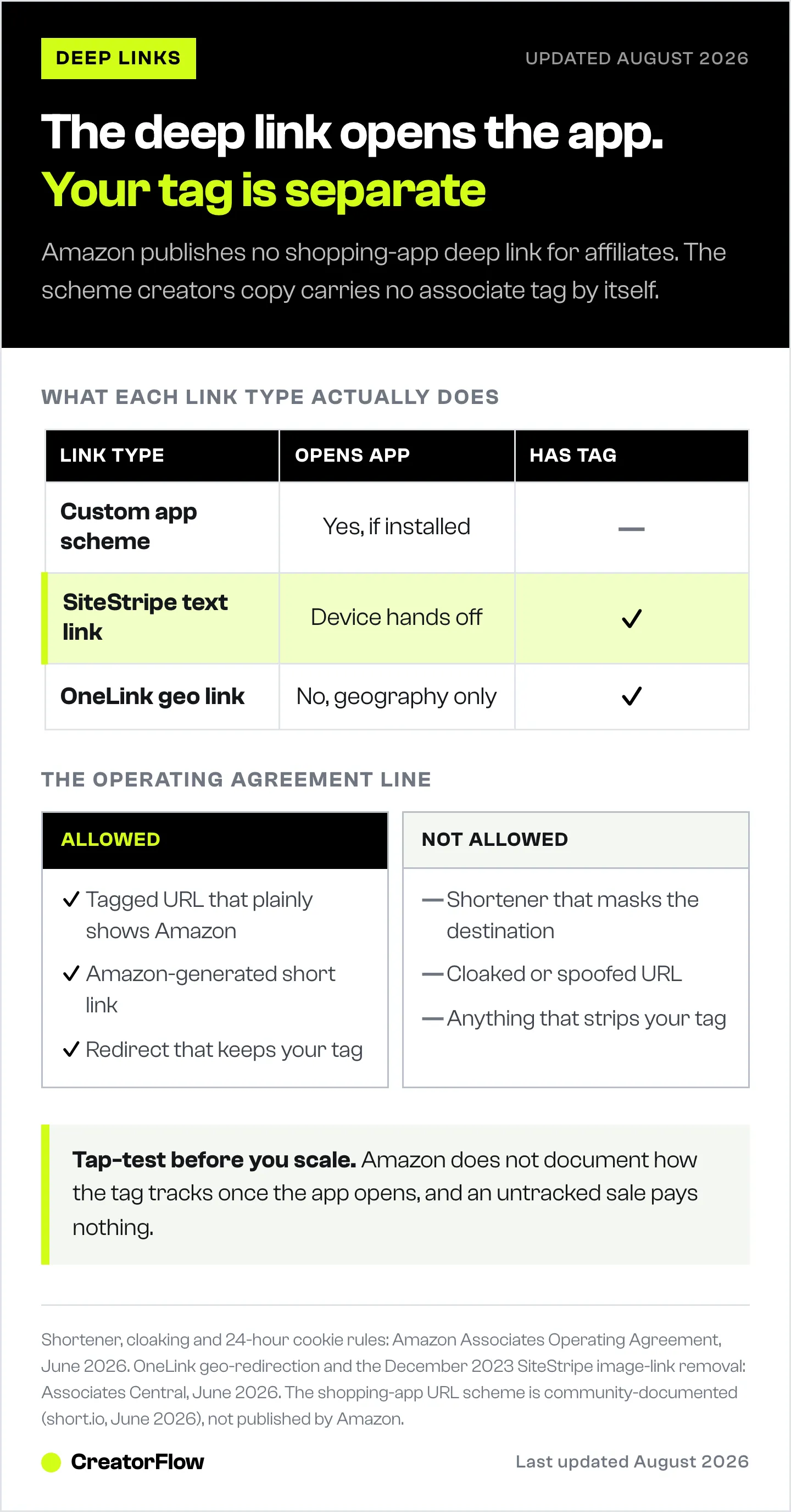
Amazon does not ban link shorteners or redirects outright. It bans them when they hide that the destination is Amazon, or when they stop Amazon from seeing where the click came from. The Operating Agreement says you will not “use a link shortening service … in a manner that makes it unclear that you are linking to an Amazon Site,” and you will not “cloak, hide, spoof, or otherwise obscure the URL” of the site containing your links (Amazon Associates, June 2026).
For a deep-linking workflow, that draws a clear line:
- Allowed: A tagged Amazon URL, an Amazon-generated short link, or a redirect that plainly resolves to Amazon and keeps your tag intact.
- Not allowed: A generic shortener that masks the Amazon destination, strips your tag, or makes the referring source unreadable to Amazon.
The other hard number to design around is the cookie. Amazon Associates uses a 24-hour click window. Attribution begins when the follower clicks your tagged link and ends when 24 hours pass or they place an order, whichever comes first (Amazon Associates, June 2026). A perfectly built deep link that arrives a day late still earns nothing, which is why delivery speed matters as much as link format.
OneLink Is Not an App Deep Link
Many creators reach for Amazon OneLink expecting it to solve the app handoff. It does not. OneLink is Amazon’s free geo-redirection tool. It sends an international visitor to their local Amazon store with your tag attached, so a UK follower lands on amazon.co.uk instead of amazon.com (Amazon Associates, June 2026).
That is a genuinely useful feature if your Instagram audience spans countries, because it stops you from losing commissions on traffic outside the US. But it solves a different problem. OneLink handles geography, not the browser-versus-app environment. Use it to localize, and treat app handoff as a separate concern.
The Reliable Way to Send Amazon Links on Instagram
Given that the custom scheme is undocumented and the tag handling is unverified, the dependable play for Instagram affiliates is not hand-coding URL schemes. It is delivering a clean, tagged Amazon link through your DM automation and letting the device do the handoff.
Here is the workflow that holds up:
- Grab the tagged product URL from your Amazon Associates tools (more on SiteStripe below). Confirm your tag is on it.
- Deliver it in the DM, not the feed. When the auto-reply lands a tappable link in the follower’s inbox, on most phones with the app installed the tap hands off to the Amazon app through the operating system’s own link routing.
- Send the raw URL, not a markdown wrapper. Instagram DMs do not render markdown, so a wrapped link shows up as broken characters. Paste the plain tagged URL.
- Keep the destination obviously Amazon. This satisfies the anti-cloaking rule and tells the follower exactly where they are going, which lifts trust and clicks at once.
- Move fast. The 24-hour window starts at the click, so the sooner the link arrives after the comment, the more of that window you keep.
This is where comment-to-DM automation earns its place. CreatorFlow delivers your tagged Amazon link the moment a follower comments your trigger word, so the link reaches them while intent is hot and the cookie clock has barely started. The setup is the same flow covered in the comment-to-DM automation guide, pointed at Amazon links. If your goal is to scale your Amazon commissions on Instagram across many posts, automating the delivery is what makes the deep-link advantage repeatable rather than a one-off trick. The payoff is biggest during sale events, when comment volume spikes: see the Prime Day Instagram strategy for creators and the Big Spring Sale creator playbook for event-specific plans.
Where Your Amazon Links Come From: SiteStripe
SiteStripe is Amazon’s in-browser bar for generating tagged affiliate links while you browse the store. It produces standard tagged product text links. It does not generate the “com.amazon.mobile.shopping.web” app scheme, so a SiteStripe link opens in whatever browser the tap happens in, including Instagram’s webview.
One change to know: on December 1, 2023, Amazon removed the “Image” and “Text+Image” link types from SiteStripe, leaving the Text link as the way to generate product links (Amazon Associates, June 2026). For DM delivery this is fine, because a clean text URL is exactly what you want to paste into an automated reply. SiteStripe gives you the tagged link. Your DM automation and the device handle the app handoff.
There is a page built specifically for Amazon affiliates that walks through the setup end to end: CreatorFlow for Amazon affiliates.
FAQ
What is an Amazon deep link?
An Amazon deep link is a URL that opens a specific product inside the Amazon mobile app instead of a web browser. On a phone with the app installed, the operating system routes the link to the app, where the shopper is already signed in with saved payment and shipping details. The benefit is a faster checkout, because the shopper skips the sign-in and payment-entry steps that a logged-out mobile-web session forces on them.
Do Amazon deep links keep my associate tag?
Not by themselves. The raw app scheme contains no tag, so you must append your associate tag the same way you would on a normal product URL. Even then, Amazon does not officially document how the tag tracks once the link opens the app, so you should tap-test the link and confirm the click registers in your Associates reporting before relying on it. An untracked sale earns no commission.
Why do my Amazon links open in Instagram’s browser instead of the app?
Because any link tapped inside Instagram opens in Instagram’s own in-app browser rather than the default phone browser or the app. That webview does not reliably carry your follower’s Amazon login session, so they can land logged out and face a sign-in wall. A product link delivered in a DM is more likely to hand off cleanly to the installed app than one opened deep inside the Instagram feed.
Are Amazon deep links allowed by the Associates program?
The link format itself is not prohibited, but Amazon’s rules govern how you deliver it. You cannot cloak or obscure the Amazon destination, and you cannot use a shortener that hides that the link goes to Amazon or strips your tag (Amazon Associates, June 2026). A tagged, plainly-Amazon URL sent in a DM stays on the right side of the Operating Agreement. A masked redirect does not.
Can I use a link shortener with Amazon affiliate links?
Only if it does not obscure the destination. Amazon’s Operating Agreement bans shorteners used “in a manner that makes it unclear that you are linking to an Amazon Site,” and bans redirects that hide the referring source (Amazon Associates, June 2026). A shortener that visibly resolves to Amazon and preserves your tag is acceptable. A generic cloaking link is a policy risk to your account.
How long is the Amazon affiliate cookie?
Amazon Associates uses a 24-hour click window. Attribution begins when the follower clicks your tagged link and ends when 24 hours pass or they place an order, whichever comes first (Amazon Associates, June 2026). If the item is added to cart within that window, the cart-based attribution can extend, but the base click window is one day. This is why fast DM delivery matters so much for Amazon links.
Is OneLink the same as an Amazon deep link?
No. OneLink is Amazon’s geo-redirection tool that sends international visitors to their local Amazon store with your tag attached (Amazon Associates, June 2026). It solves geography, not the browser-versus-app environment. You would use OneLink to localize traffic across countries and still handle the app handoff separately through clean link delivery.
Does SiteStripe create app deep links?
No. SiteStripe generates standard tagged product text links that open in whatever browser the tap happens in. It does not produce the custom app scheme. That is fine for Instagram DM delivery, because a clean tagged text URL is exactly what you want to paste into an automated reply, and the device handles the app handoff when the follower has the Amazon app installed.
Amazon deep link behavior, Associates policy, the 24-hour cookie window, and SiteStripe changes verified from Amazon’s Operating Agreement, Associates Central, and developer.amazon.com as of June 2026. The shopping-app URL scheme is community-documented, not officially published by Amazon. Individual results vary.