
Recurring affiliate income means you earn a commission every time a customer you referred pays, not once at signup. Subscription software is where the model is standard: SaaS programs commonly pay 20% to 30% of each payment for a set window or for the customer’s lifetime (program roundups on partners.livechat.com and supademo.com, July 2026). One good recommendation can pay you monthly for a year.
Compare that to the deal most creators know best. A brand pays you once for a post, the post decays in 48 hours, and next month you start from zero. Recommending a tool your audience uses every day inverts that: the post can decay, and the income keeps arriving as long as the customer stays subscribed.
This guide explains the mechanics without the passive-income theater: how recurring differs from one-time commissions, why software companies pay this way, the three-variable formula that decides what you earn, what a realistic first month looks like, and one worked example with real published numbers.
Key Takeaways
- Recurring commissions pay on every payment; one-time commissions pay once. The per-event amount is usually smaller, but it stacks as referrals accumulate.
- Software pays recurring because subscriptions retain. The company only profits if the customer stays, so it can afford to keep paying the person who brought them.
- The formula is price x rate x months paid. Every recurring program’s value reduces to those three numbers, plus how long customers stay.
- A realistic first month is one or two referrals, sometimes zero. Recurring income compounds from a slow start; anyone promising otherwise is selling something.
- CreatorFlow’s program pays 30% of every payment for 12 months on every paid plan, which works out to $4.50 to $86.40 per referral payment.
- Skip recurring programs if you need money this week. Commissions clear on a delay and build over quarters, not days.
One-Time Commissions vs Recurring Affiliate Income
A one-time commission pays a fixed amount or percentage when a referred customer completes a qualifying purchase, and nothing afterward. A recurring commission pays a percentage of every payment the customer makes, either for a defined window such as 12 or 24 months or for the customer’s lifetime. The distinction decides the shape of your income: one-time restarts at zero every month, recurring stacks.
| One-time commission | Recurring commission | |
|---|---|---|
| When you earn | Once, at the qualifying sale | Every payment inside the earning window |
| Typical products | Physical goods, retail platforms | Subscription software, memberships |
| Per-event size | Often larger up front | Smaller per payment, compounds over months |
| Income shape | Resets to zero each month | Builds as referrals accumulate |
| Best fit | High-volume product content | Trusted recommendations of tools people keep |
Shopping platforms for creators mostly sit in the one-time column; if that side interests you, the affiliate platform payout comparison for creators covers how those payouts work. This guide stays on the recurring side.
Why Subscription Software Pays Recurring
A subscription business earns its money over time, so a customer who stays for a year is worth 12 payments, not one. Sharing a fixed percentage of each payment lets the company pay affiliates out of revenue that has already arrived, which is why recurring rates can sit at 20% to 30% without the program losing money.
The incentive alignment is the part creators should care about. A one-time program pays the same whether the customer stays or churns in week two, so it rewards volume over honesty. A recurring program pays you only while the customer keeps paying, so the program and the affiliate both want the same thing: referrals who genuinely need the product. Recommending the wrong tool to the wrong audience earns you nothing either way.
The Math That Matters: Price x Rate x Months
Every recurring program reduces to three numbers. Take a generic example: a $20/month tool paying 25% for 12 months. One referral is $5/month, up to $60 across the window. Five referrals who stay subscribed are $25/month by the time the fifth lands, and $300 across their windows. The numbers are unglamorous at the start and grow linearly with every referral you add.
Two honest corrections to that arithmetic. Customers cancel, so your real income lands below the ceiling the formula suggests; treat the full-window figure as the maximum, not the expectation. And annual plans change the shape: a customer who pays $240 up front hands you the full commission in one event instead of twelve small ones, which matters when programs have payout minimums.
What a Realistic First Month Looks Like
Most affiliates start by sharing with a small audience, and one or two referrals in the first month is a normal result. Zero is common too, especially if your first placement is a single post rather than a permanent spot like a bio link or newsletter footer. This is not failure; it is how the model starts for almost everyone.
The compounding is the point. The referral you land in month one is still paying you in month eight, and the referrals from months two and three stack on top. A creator who lands two referrals a month is not earning two referrals’ worth of income by month six; they are earning from roughly a dozen active subscriptions at once. Brand-deal income never does that.
The failure mode is quitting in week three because the dashboard shows $9. Judge a recurring program at month six, not day twenty.
A Worked Example: The CreatorFlow Affiliate Program
CreatorFlow, an Instagram DM automation tool used by 20,000+ creators and brands, launched its affiliate program in July 2026 with published flat terms: 30% of every payment a referral makes during their first 12 months, on every paid plan. Per payment, that is $4.50 on Pro Monthly ($15/month), $9 on Growth Monthly ($30/month), $43.20 on Pro Annual ($144/year), and $86.40 on Growth Annual ($288/year).
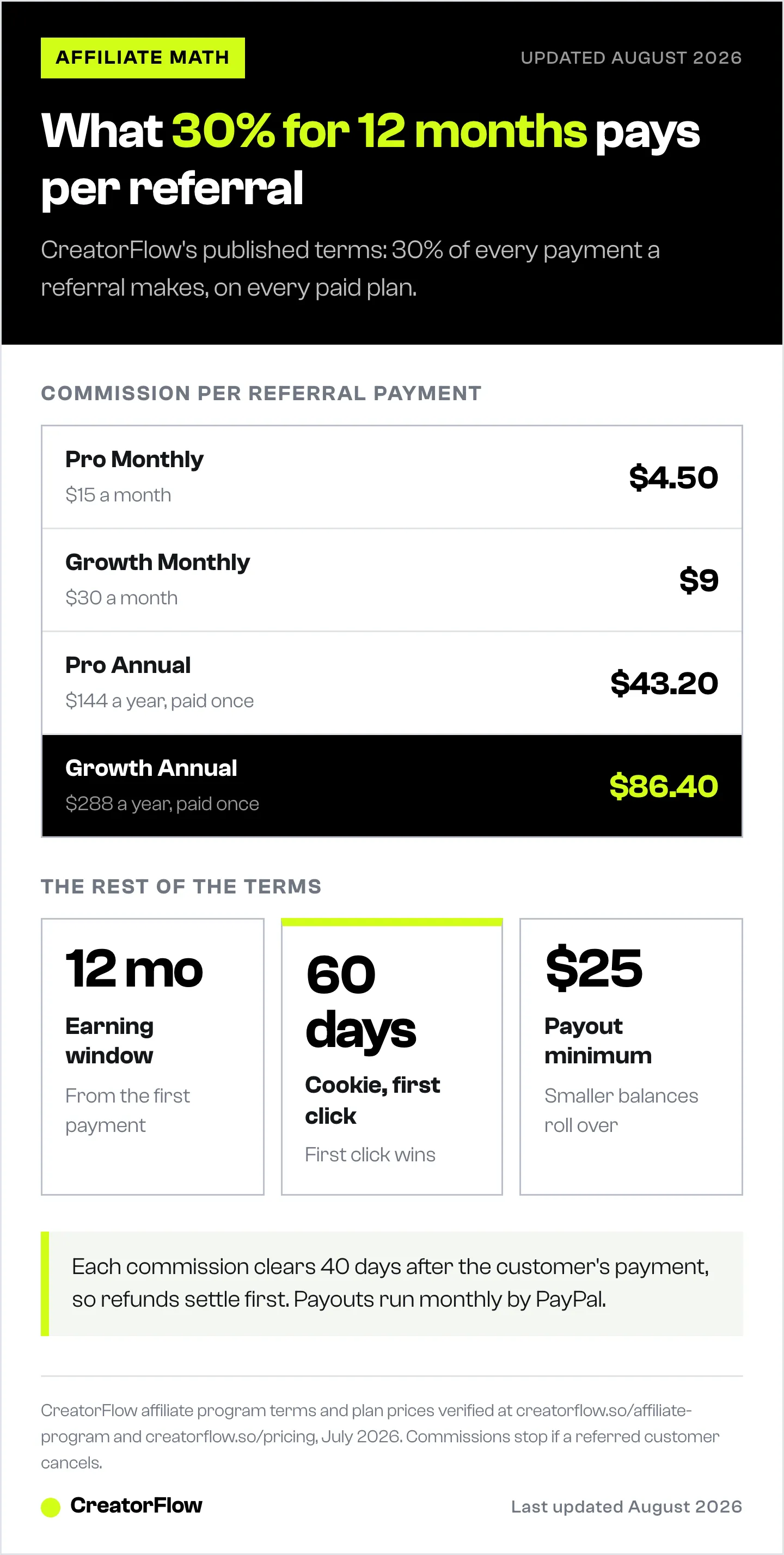
| Term | CreatorFlow’s published number |
|---|---|
| Commission | 30% of every payment, flat, all paid plans |
| Earning window | 12 months from the referral’s first payment |
| Cookie | 60 days, first click wins |
| Payout minimum | $25, smaller balances roll over |
| Payout schedule | Monthly via PayPal, after a 40-day clearing period |
| Audience-side offer | Personal promo code, 20% off the referral’s first payment |
| Approval | Manual review, audience fit over follower count |
Run the formula from the previous section: one Growth Annual referral clears the $25 payout minimum in a single $86.40 commission, and a handful of monthly referrals builds the stacking base. The audience-side code matters more than it looks, because it converts a recommendation into a deal and tracks the referral even where links cannot be clicked. Full terms and the commission table are in the launch announcement, and the product itself is explained on the how it works page.
If your audience includes creators who sell on Instagram, you are the audience-fit case this program was built for. Coaches, newsletter operators, bloggers, and educators who teach Instagram growth convert best, because the product answers a question their audience already asks. For a sense of the day-to-day problem it solves, see how affiliate creators save 10+ hours a week with DM automation.
Who Should Skip Recurring Programs
Skip this model if you need income this week: clearing periods (40 days at CreatorFlow, similar elsewhere) and payout minimums mean your first payout is a month or two behind your first referral. Skip it if your audience has no overlap with people who buy software subscriptions; recurring programs approve on audience fit, and a mismatch wastes everyone’s time. And skip it if you want a one-post windfall, because this model rewards patience, not spikes.
If you are still choosing which programs to apply to, the guide to affiliate programs micro-influencers can join sorts options by entry requirements.
For the other side of the table, the guide to designing an influencer affiliate program covers how brands set the rate, duration and payout terms you are evaluating. For where recurring programs sit against one-time product programs on Instagram specifically, see how affiliate income works on Instagram.
FAQ
What is a recurring affiliate program?
A recurring affiliate program pays a commission on every payment a referred customer makes, rather than a single payment at signup. The model is standard among subscription software companies, where commissions typically run 20% to 30% of each payment for a fixed window or the customer’s lifetime.
How long do recurring affiliate commissions last?
It varies by program: common windows are 12 months, 24 months, or the customer’s lifetime. CreatorFlow’s program pays for 12 months from each customer’s first payment. Always check the window before comparing rates, because a lower rate with a longer window can out-earn a higher one.
Do I need a media kit or a minimum follower count to apply?
Not for most SaaS programs. CreatorFlow reviews applications manually on audience fit and has no follower minimum; a focused audience of the right people beats a large general one. A short description of where you publish and who reads you does the job a media kit would.
How do recurring affiliate programs pay out?
Typically monthly, through PayPal or bank transfer, once your cleared balance passes a minimum. CreatorFlow pays via PayPal in the first 10 days of each month from a $25 balance, with each commission clearing 40 days after the customer’s payment so refunds settle first.
Do commissions stop if the customer cancels?
Yes. Recurring commissions are a share of payments actually made, so when a customer stops paying, the commission stops with them. This is also why the model stays honest: it only rewards referrals who genuinely stick with the product.
Turn a Recommendation Into a Recurring Line
If people already ask you about the tools you use, you have the only asset this model needs.
Apply to Join the CreatorFlow Affiliate Program
Recurring commission ranges from public SaaS program roundups (partners.livechat.com, supademo.com), accessed July 2026. CreatorFlow program terms verified at creatorflow.so/affiliate-program as of July 2026. Individual results vary.


