
An influencer affiliate program pays creators a commission on the sales they drive, tracked by a personal link or code, instead of a flat fee for a post. Four numbers decide whether creators promote you: the commission rate, how long it keeps paying, the attribution window, and how fast the money reaches their account. Get those wrong and the roster goes quiet.
Most guides on this topic explain the models and skip the numbers. You will read about pay-per-sale, pay-per-lead and revenue share, then reach the end without a single commission rate or cookie length. That is how brands ship a program at 5% with a 7-day cookie and a 90-day payment hold, then wonder why 200 signups produced eleven sales.
This guide gives the numbers. What commission rates are normal by category in 2026, what a cookie window is worth, what the tracking platforms cost once their percentage fee is included, and a full teardown of one live program with every term and every dollar figure published. Sources are listed at the end.
Key Takeaways
- Four numbers decide participation. Commission rate, commission duration, attribution window and time-to-first-payout. A creator can compute their expected earnings from those four before they agree to post, and they do
- Rate benchmarks vary by margin, not by generosity. SaaS programs commonly pay 20% to 30%, beauty runs roughly 15% to 25%, fashion 10% to 15%, and general ecommerce sits near a median of 8.4% of order value (rate benchmarks published by referralcandy.com and track360.io, August 2026)
- Thirty days is the default cookie. Standard ecommerce roundups place 30-day windows as the industry default, capturing the large majority of conversions (track360.io, August 2026). Shorter windows transfer risk to the creator
- Platform fees can outweigh the subscription. Refersion’s Launch plan is $39/month plus 3% of affiliate-driven sales and Growth is $199/month plus 2% (refersion.com/pricing, August 2026). Rewardful charges $49 to $149+/month with a 0% transaction fee (rewardful.com/pricing, August 2026). At $50,000 of affiliate sales those two models are thousands of dollars apart
- Recurring beats one-off for subscription products. CreatorFlow pays 30% of every payment for a referral’s first 12 months, which is $4.50 per Pro monthly payment or $86.40 on a single Growth annual plan (creatorflow.so/affiliate-program, August 2026)
- The brand is liable for disclosure too. Under the FTC Endorsement Guides, 16 CFR Part 255, a brand that directs, finances or benefits from an undisclosed endorsement shares responsibility, with civil penalties currently assessed per violation (ftc.gov and ecfr.gov, August 2026)
- Recruitment is a distribution problem. The programs that fill without a discovery budget run the application through a public post and a keyword, not an email form nobody sees

What an Influencer Affiliate Program Is
An influencer affiliate program is a standing arrangement where creators earn a percentage of the revenue they generate, tracked through a unique link or discount code assigned to each person. Payment happens after the sale, not before the post. The brand carries no upfront media cost and the creator carries the performance risk.
Two comparisons make the boundaries clear.
Against a paid sponsorship: a sponsorship buys one deliverable at a fixed price whether it sells anything or not. An affiliate arrangement buys outcomes, and the creator decides how much effort to spend chasing them. Brands often run both, paying a flat fee for the first post and commission on everything after. Current flat-fee medians by tier are in how much Instagram influencers charge.
Against an ambassador program: the ambassador is rewarded for producing content, and sales follow as a second-order effect. The affiliate is rewarded for sales and has no obligation to post at all. The two models are frequently blended, which is covered in the breakdown of how to build a social media ambassador program that produces posts rather than signups.
The distinction matters for budgeting. An ambassador roster has a cost that scales with headcount, mostly in product and shipping. An affiliate roster costs nothing until it earns, which is why brands can afford to approve a thousand affiliates and only ever pay the forty who sell.
The Four Numbers That Decide Whether Creators Promote You
A creator evaluating your program does one calculation: what do I expect to earn per thousand people I send. Four terms feed that calculation, and every one of them is a number you choose.
1. Commission rate. The percentage of order value or subscription payment the creator keeps. This is the number every brand thinks about and the only one most brands publish.
2. Commission duration. Does the creator earn once, for a fixed window, or for the customer’s lifetime? On subscription products this term is worth more than the rate. A 20% lifetime commission outperforms a 40% one-off within nine months on a typical monthly plan.
3. Attribution window and model. How long the tracking cookie survives, and whether credit goes to the first or last click. First-click protects the creator who introduced the customer. Last-click rewards whoever caught them at checkout, which in practice is often a coupon site rather than the creator who did the persuading.
4. Time to first payout. Approval delay, clearing period, payout minimum and payout schedule, added together. A program with a 60-day hold, a monthly payout run and a $100 minimum can leave a creator’s first commission sitting unpaid for four months. New affiliates quit inside that gap.
Publish all four on the program page. Creators who have run affiliate links before will look for them, and a missing term reads as a term you intend to change.
The number brands get wrong most often
Time to first payout. It costs nothing to improve and it decides whether a first-time affiliate ever posts a second time. Lowering the payout minimum from $100 to $25 does not change your total commission spend by a cent. It changes how many people reach it.
Influencer Affiliate Commission Rates by Industry
Commission rates track gross margin, not ambition. A 3% rate is generous in consumer electronics and insulting in supplements, because the underlying margins differ by an order of magnitude. The figures below are the ranges published in 2026 rate benchmarks, useful as a starting position rather than a rule.
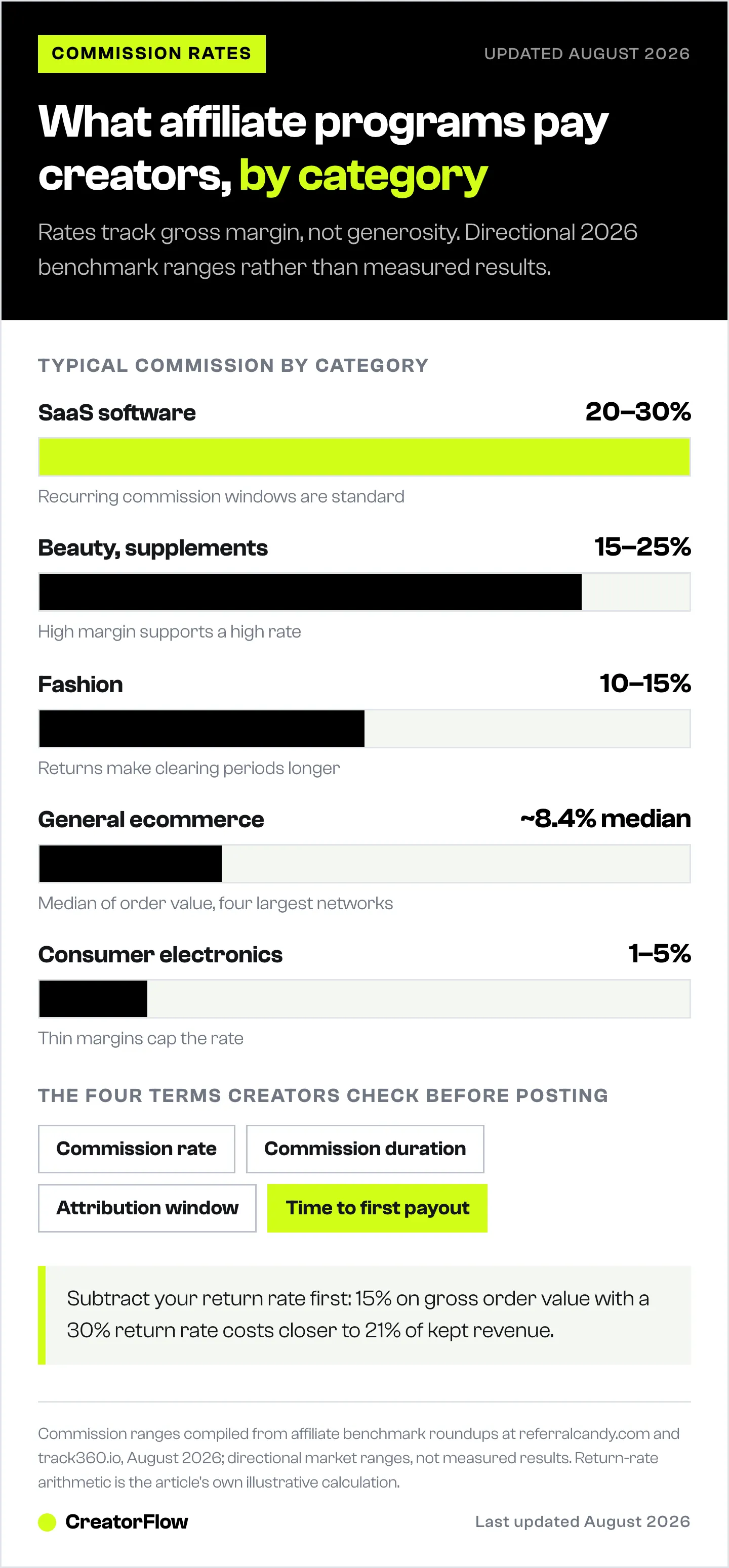
| Category | Typical commission | Notes |
|---|---|---|
| SaaS and subscription software | 20% to 30% | Some programs reach 40% for top-tier partners; recurring windows are standard |
| Beauty and skincare | 15% to 25% | Entry SKUs sometimes pay a flat $10 to $15 instead |
| Supplements and wellness | 15% to 25% | High margin supports high rates |
| Fashion and apparel | 10% to 15% | Returns rates make clearing periods longer |
| General ecommerce | ~8.4% median | Median of order value across the four largest networks |
| Consumer electronics | 1% to 5% | Thin margins cap the rate |
Rate ranges compiled from affiliate benchmark roundups published at referralcandy.com and track360.io, August 2026. Treat them as the market’s centre of gravity, then set your own number from your contribution margin after returns.
Two adjustments are worth making before you publish a rate.
Subtract your return rate first. Fashion brands paying 15% on gross order value with a 30% return rate are paying closer to 21% on kept revenue. Commission on net revenue after returns, with a clearing period long enough to cover the return window, is the standard fix.
Build in a tier, not a renegotiation. A published bump at a volume threshold, for example 10% moving to 15% above $2,000 in monthly attributed sales, gives your best creators a reason to push without you fielding individual rate requests every quarter.
Affiliate Links vs Discount Codes for Influencers
Both track sales. They fail in different places, and the right answer depends on where the creator posts.
Links carry a cookie, work with any checkout, and let you see clicks as well as conversions. They break where links are not clickable. Instagram captions, Reels captions and comments do not carry live links, so a creator posting there has to route people through their bio or a DM.
Codes need no click at all. A creator can say the code out loud in a Reel, put it in a caption, or write it on a Story, and it still tracks when the customer types it at checkout. Codes also survive the customer switching devices, which links often do not. The trade is that codes are copied to deal sites, so attribution gets noisy and your margin gets shared with people who did no promoting.
The working setup is both: a link for the placements where links work, a code for everywhere else, and a discount attached to the code so it earns its place in the caption. Public code leakage is worth accepting for one reason, which is that a code is the only tracking method that survives a spoken mention in a video.
For the creator’s view of the same problem, including where links can and cannot be placed on Instagram, see the guide to adding affiliate links on Instagram.
What Affiliate Platform Fees Cost You
Affiliate platforms bill on two different models, and the difference is invisible at launch and large at scale. One charges a subscription plus a percentage of affiliate-driven sales. The other charges a subscription tied to tracked revenue with no per-sale cut. Below roughly $10,000 in monthly affiliate sales they land close together. Above it they diverge fast.
| Platform | Published pricing | Fee on affiliate sales |
|---|---|---|
| Refersion Launch | $39/month ($29 billed annually) | +3% of affiliate-driven sales |
| Refersion Growth | $199/month ($159 billed annually) | +2% of affiliate-driven sales |
| Refersion Scale | Quoted, for brands above $1M annual GMV | Not published |
| Rewardful Starter | $49/month, up to $7,500/month in affiliate revenue | 0% |
| Rewardful Growth | $99/month, up to $15,000/month in affiliate revenue | 0% |
| Rewardful Enterprise | $149+/month, above $15,000/month | 0% |
| Modash | From $199/month (Essential), $499/month (Performance) | Not published |
| Upfluence | Quoted per use case | Not published |
| impact.com | Quoted per use case | Not published |
Refersion pricing verified at refersion.com/pricing and Rewardful at rewardful.com/pricing, August 2026. Modash and Upfluence figures as listed by those companies, August 2026. Refersion also publishes a free marketplace listing tier, and Rewardful lists a 14-day trial on all plans with two months free on annual billing.
Run your own volume through both shapes before choosing. At $50,000 in monthly affiliate-driven sales, a 2% transaction fee is $1,000 a month on top of the subscription. That is a real number that belongs in the program’s unit economics next to the commission itself, because you are paying it out of the same margin.
The percentage model is not the worse deal by default. It is the cheaper deal early, when a flat platform fee would be most of your program’s cost, and it stays attractive if your affiliate channel is a small share of revenue. It becomes the expensive one precisely when the program succeeds.
A Program Disclosed End to End
Most program pages publish a rate and stop. Here is every term of one live program, so you have a complete example to model against rather than a partial one.
CreatorFlow runs an affiliate program for its Instagram DM automation product. The published terms, verified at creatorflow.so/affiliate-program in August 2026:
| Term | Value |
|---|---|
| Commission rate | 30% of every payment |
| Duration | The referral’s first 12 months as a customer |
| Qualifying plans | All paid plans: Pro Monthly $15, Pro Annual $144, Growth Monthly $30, Growth Annual $288 |
| Attribution | 60-day cookie, first-click wins, referral permanently linked after signup |
| Clearing period | 40 days after the customer’s payment |
| Payout minimum | $25 |
| Payout method and schedule | PayPal, first 10 days of each month |
| Customer incentive | Personal promo code giving 20% off the first payment |
| Approval | Manual, on audience fit; no follower minimum |
| Restriction | No bidding on the brand name in paid search |
What those terms produce in dollars, which is the calculation a creator runs before deciding whether to bother:
- Pro Monthly referral: $4.50 per payment, up to $54 across the 12-month window
- Pro Annual referral: $43.20, paid on the single annual payment
- Growth Monthly referral: $9.00 per payment, up to $108 across the window
- Growth Annual referral: $86.40, paid on the single annual payment
Four design decisions in there are worth copying regardless of what you sell.
First-click attribution. The creator who introduced the customer keeps the commission even if the buyer later clicks someone else’s link. This is the term that makes creators willing to do top-of-funnel work, because last-click programs quietly hand their effort to whoever is closest to the checkout.
A promo code that tracks with no click. The code works when typed at checkout, so it survives a spoken mention in a Reel or a line in a caption where links do not function. That single decision opens the placements where Instagram creators really post.
A $25 payout minimum. Low enough that a first referral on an annual plan clears it immediately. The affiliate sees real money in the first payout cycle rather than waiting to accumulate.
Terms published rather than quoted. Cookie length, clearing period, payout schedule and restrictions are all on the public page. Creators comparing programs can complete their maths without emailing anyone, and the programs that make that easy get picked.
Creators, coaches, agencies and marketers with an Instagram-focused audience can apply to the CreatorFlow Affiliate Program and earn 30% for twelve months on every referral. If you want to see what the payout curve looks like over a year before applying, the honest math on recurring affiliate income works through a realistic first quarter rather than a best case.
How to Recruit Creators Without a Discovery Budget
Discovery platforms start around $199 a month and climb into the thousands. They are worth it when you need to find creators who have never heard of you. They are the expensive way to sign up people who already follow you.
Work the free pools first, in this order:
- Existing customers who post. Anyone who has tagged your account has already demonstrated the behaviour. Pull them from Instagram’s tags and mentions data, covered in UGC tracking.
- Repeat purchasers. Two or more orders means they can talk about the product without a script.
- Frequent commenters. Weekly engagement predicts participation better than follower count does.
- Small creators in your niche. Recruit these last. They cost the most to reach and are the most likely to treat the program as a paid campaign.
The seven channels those creators come from, ordered by how well each one converts, are broken down in the guide to finding influencers for an affiliate program.
The mechanic that scales without a team is an application that runs through a public post. You announce the program, ask people to comment a keyword, and the application link arrives in their DMs within seconds while they are still holding the phone. A form linked from a Story that expires in 24 hours converts a fraction of what an instant reply does.
That flow, including the qualifying questions worth asking and how to log the responses, is set out in the walkthrough of ambassador enrollment via Instagram DM.
State the bar inside the recruitment post: the niche you want, what the commission is, what the creator gets on day one, and the deadline. Fewer applications with better fit is the trade worth making, because every approved affiliate who never posts still costs you an onboarding email and a slot in your reporting.
What new affiliates need in the first 48 hours
Send four things, fast. The tracking link and code. Three ready-to-post assets sized for Reels, Stories and a static post. The three product claims they may make and the one they may not. And the disclosure wording, written out, so they can copy it rather than invent it.
Programs that send a login and nothing else get a signup. Programs that send assets get a post.
FTC Disclosure Is the Brand’s Problem Too
Every affiliate post needs a clear and conspicuous disclosure of the material connection between the creator and the brand, placed before the endorsement rather than buried below a fold or behind a “more” link. This sits under the FTC Endorsement Guides at 16 CFR Part 255. A brand that directs, finances or benefits from an endorsement shares liability when the disclosure fails, and civil penalties are assessed per violation, adjusted annually for inflation (ftc.gov and ecfr.gov, August 2026).
Three operational consequences follow.
Put the wording in the onboarding kit. “#ad” or “Paid partnership” at the start of a caption, spoken aloud in video content, and visible without tapping. Do not ask creators to work out compliant phrasing themselves.
Write it into the program terms. Approval conditional on disclosure gives you a documented policy and a stated basis for removing someone who ignores it.
Audit a sample every month. Pull ten recent affiliate posts and check the disclosure is present and visible before the endorsement. Undisclosed posts from your top earner are the ones that carry the risk, and they are the ones nobody wants to flag.
The full wording options and placement rules by post format are in the guide to Instagram affiliate disclosure and FTC rules. This article is not legal advice.
What to Measure in the First 90 Days
Roster size is the vanity metric here exactly as it is in ambassador programs. Four numbers tell you whether the program works.
Active rate. Affiliates who drove at least one click this month, divided by approved affiliates. Under 10% means your onboarding or your assets are the problem, not your rate.
EPC, or earnings per hundred clicks. What a creator earns per hundred people they send. This is the number experienced affiliates use to compare your program against everything else competing for the same caption slot, so calculate it before they do.
Revenue concentration. The share of affiliate revenue coming from your top three partners. Above 70% is a single-point-of-failure risk that looks like success on the dashboard.
Time from approval to first sale. The gap that predicts churn. Measure the median and work on shortening it, because affiliates who make nothing in month one rarely appear in month three.
New-customer share is worth adding once the program is running. If most affiliate-attributed orders come from customers who already buy from you, the program is paying commission on revenue you would have collected anyway, and the rate needs to be reconsidered rather than the roster expanded.
FAQ
What commission rate should an influencer affiliate program pay?
Set it from your contribution margin after returns, then check it against the category. SaaS programs commonly pay 20% to 30%, beauty 15% to 25%, fashion 10% to 15%, and general ecommerce sits near an 8.4% median of order value (referralcandy.com and track360.io, August 2026). On subscription products, commission duration is worth more than the headline rate.
How long should the cookie window be?
Thirty days is the industry default for ecommerce and captures the large majority of conversions (track360.io, August 2026). Longer windows favour creators doing awareness work, since the buying decision on considered purchases often takes weeks. Shorter windows transfer risk to the creator and are the term experienced affiliates check first.
Should I use affiliate links or discount codes for influencers?
Use both. Links carry a cookie and report clicks, which codes cannot do. Codes track without any click, so they survive a spoken mention in a Reel or a caption where links are not clickable, and they follow a customer across devices. Codes leak to deal sites, which is the cost of that reach.
What does an influencer affiliate program cost to run?
Two costs, not one. The platform subscription, and any percentage the platform takes of affiliate-driven sales. Refersion lists $39/month plus 3% of affiliate sales on Launch and $199/month plus 2% on Growth. Rewardful lists $49 to $149+/month with a 0% transaction fee (both verified August 2026). Model your own sales volume through both shapes.
Do influencers have to disclose affiliate links?
Yes, and the brand shares responsibility. The FTC Endorsement Guides at 16 CFR Part 255 require a clear and conspicuous disclosure of the material connection, placed before the endorsement. Brands that direct, finance or benefit from an undisclosed endorsement share liability, with penalties assessed per violation (ftc.gov and ecfr.gov, August 2026).
How many affiliates does a program need to work?
Fewer than most brands assume, because participation is concentrated. Plan on a small fraction of approved affiliates producing most of the revenue and size your reward budget on the active fraction rather than the roster. Track active rate monthly, and treat a rising roster with a flat active rate as a recruitment problem you have already solved.
Can a small brand run an affiliate program without a discovery platform?
Yes. Recruit from customers who already tag you, repeat purchasers and frequent commenters before paying for discovery. Run the application through a public post with a comment keyword so the link reaches applicants in seconds. Discovery platforms earn their fee when you need creators who have never heard of you.
Where to Start
Pick the four numbers first and publish them: rate, duration, attribution model and window, and time to first payout. Then choose the platform by running your realistic monthly affiliate sales through both fee shapes rather than comparing subscription prices. Recruit from the people who already post about you before paying anyone to find strangers. Send assets and disclosure wording inside 48 hours of approval.
The two moments that decide whether a program compounds are both speed problems: the reply when someone applies, and the first payout after someone sells. CreatorFlow is a Meta Tech Provider (since December 2025) built for the first one on Instagram. A comment, Story reply or keyword trigger sends your application link instantly, links inside the message carry click tracking with country and city data, and everyone who replies can be exported to CSV. Pro is $15 a month flat, so the bill stays put as applications climb.
If you are a creator rather than a brand, the comparison of affiliate programs for micro-influencers covers which programs accept small accounts and how fast each one pays, and the walkthrough of Instagram affiliate marketing covers earning from the creator side of the same terms.
Sources: CreatorFlow Affiliate Program terms verified at creatorflow.so/affiliate-program, August 2026. Refersion plan pricing and transaction fees verified at refersion.com/pricing, August 2026. Rewardful plan pricing verified at rewardful.com/pricing, August 2026. Modash and Upfluence pricing as listed by those companies, August 2026; impact.com and Upfluence quote per use case. Commission rate ranges compiled from affiliate benchmark roundups published at referralcandy.com and track360.io, August 2026, and are directional market ranges rather than measured results. FTC Endorsement Guides referenced at 16 CFR Part 255 via ftc.gov and ecfr.gov, August 2026; civil penalty amounts are adjusted annually for inflation. Per-payment commission figures in this article are arithmetic on CreatorFlow’s published rate and plan prices. This article is not legal advice. Individual results vary.


