
Brand ambassador enrollment via Instagram DM uses a comment-to-DM trigger to deliver an application directly inside the conversation. A creator comments AMBASSADOR on your recruitment post, gets an instant DM with 5-7 qualifying questions, and you collect responses into a tracked list. Lower friction than a landing page form, faster qualification, and built-in FTC disclosure handoff for compliance.
You posted “we are looking for ambassadors!” Two hundred comments rolled in within 24 hours. You started DMing each one manually. By comment 40 you were copy-pasting the same paragraph and missing context. By comment 100 you accidentally sent the wrong reply to the wrong creator. Of the original 200, maybe 10 actually filled out anything. The rest dropped off because they had to leave Instagram, click a link, and complete a form on a separate page.
This guide shows how to run the entire ambassador funnel inside Instagram DMs. You will see how to structure the comment trigger, what to ask in the application, how to track applicants, how to onboard accepted ambassadors, and how to stay FTC-compliant while doing it.
Key Takeaways
- Ambassador and UGC programs grew significantly between 2023 and 2026 as brands shifted from one-off paid creator deals to longer-term performance-based partnerships.
- DM enrollment converts higher than landing page forms because friction is lower and intent is already signaled by the comment.
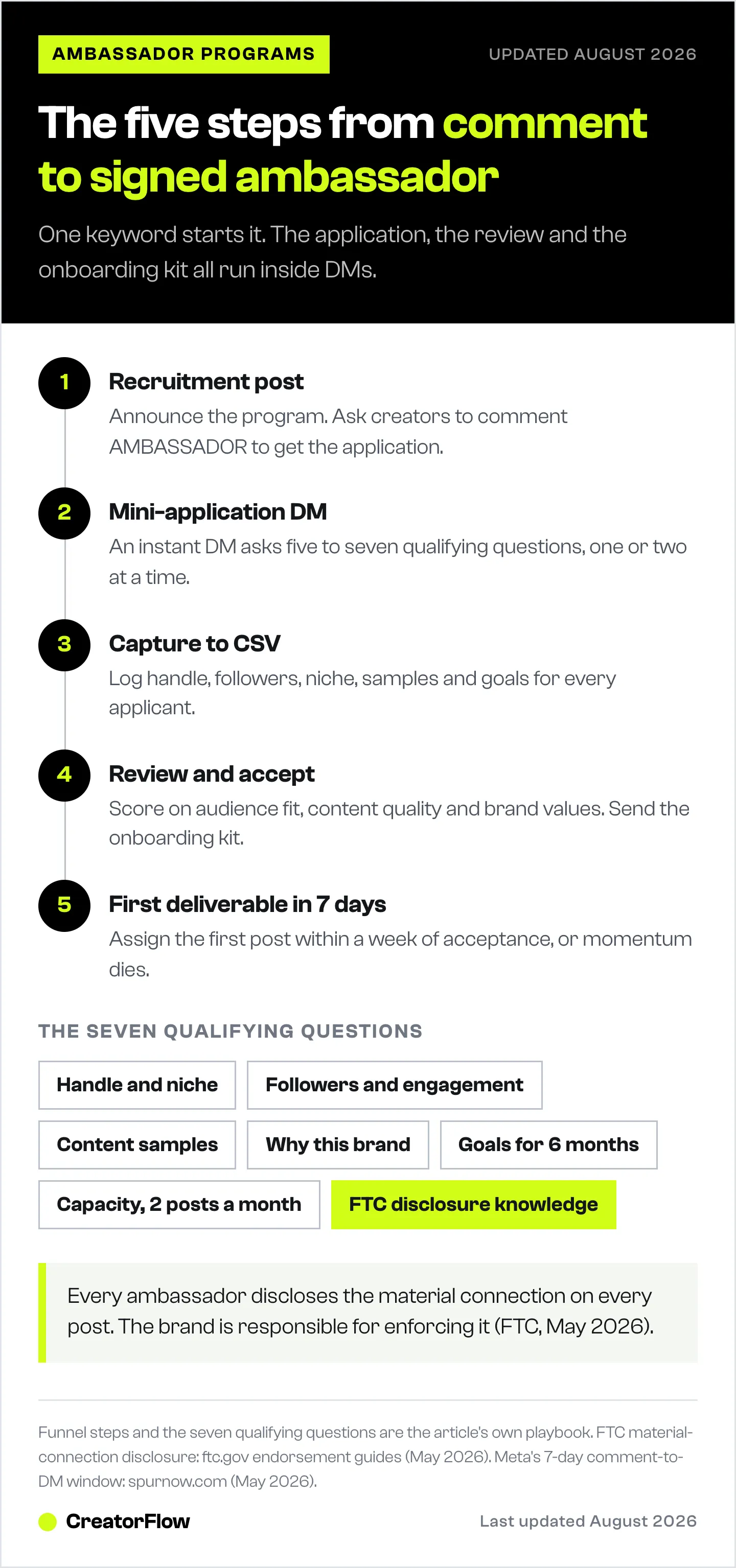
- A working funnel needs five steps: recruitment post, mini-application DM, capture, review, onboarding kit.
- Each ambassador must disclose the material connection per FTC rules (#ad or “ambassador” in bio plus per-post disclosure) (ftc.gov, May 2026).
- Meta’s Graph API enforces a 7-day comment-to-DM window, and automation tools pace sends at about 200 DMs per hour (spurnow.com, May 2026).
- CreatorFlow Pro at $15/mo flat with CSV export handles applicant tracking without needing a separate CRM (creatorflow.so, May 2026).
- Programs fail when there are no clear deliverables, no payout structure, or no enforcement of disclosure.

How a Brand Ambassador Program Runs Through Instagram DMs
You post a recruitment Reel or carousel and ask creators to comment one keyword, usually AMBASSADOR. That comment triggers a DM that opens the application and asks the first of 5 to 7 qualifying questions, dripped one or two at a time so it reads like a chat. Answers get logged and exported to CSV. You review weekly, accept the creators who fit, and send the onboarding kit and first deliverable in the same thread.
What Modern Ambassador Programs Look Like in 2026
The old model was simple: pay a macro-influencer five figures for one Reel, hope it converts, move on. That model burned a lot of cash with thin attribution. Brands have shifted toward something more durable.
Modern programs share three traits:
- Performance-based. Ambassadors earn commission, free product, or tiered rewards tied to actual sales or content output, not flat upfront fees.
- Micro and nano focused. Creators with 1K to 50K followers convert better per dollar than macro-influencers because their audience trusts them more.
- Longer-term partnerships. Three to twelve month commitments with monthly content quotas, not one-shot campaigns.
This shift means recruitment volume matters. You need a funnel that can process 50 to 500 applicants per recruitment push without burning your team out. Where those applicants come from in the first place is covered in the seven sourcing channels for finding influencers for an affiliate program.
For the commission side of the arrangement, including rate benchmarks by category and what the tracking platforms charge, see the guide to running an influencer affiliate program.
Why DM Enrollment Beats a Landing Page Form
The instinct is to send people to a Typeform or Google Form. Resist it. Three reasons.
Lower friction. Every click out of Instagram drops conversion. A creator who is already commenting on your post is in active mode. Asking them to leave the app, switch context, and complete a form on a separate page kills momentum. Roughly half drop off at the link click alone.
Higher signal of intent. A comment is a public commitment. Creators who comment AMBASSADOR are signaling intent in front of their own audience. That self-selection is a useful filter.
Instant delivery. The DM arrives in seconds. There is no “we will review and get back to you” delay. The applicant feels seen immediately, which raises completion rates.
Integrated tracking. When DMs are the application channel, you can pipe responses straight into a CSV and route them into your CRM or email tool without a third party form provider in the middle.
For a deeper walkthrough of the underlying mechanic, see the comment-to-DM automation setup guide.
Setup: 5-Step Ambassador Enrollment Funnel
Step 1: Recruitment Post With “AMBASSADOR” Keyword
Post a Reel or carousel announcing the program. The CTA in the caption: “Comment AMBASSADOR and I will DM you the application.” Pin a comment from the brand account repeating the instruction so latecomers see it.
What to include in the post itself:
- Who you are looking for (niche, follower range, content style)
- What ambassadors get (commission rate, free product, exclusive drops)
- The commitment (e.g., 2 posts per month for 6 months)
- The deadline to apply
Keep the bar visible. If you only want creators with 5K+ followers, say so. You will get fewer comments but better fit.
Step 2: DM With Mini-Application (5-7 Qualifying Questions)
The first DM thanks them for their interest, sets expectations, and asks the first qualifying question. Do not dump all seven questions in one message. Drip them across the conversation so it feels like a chat, not a form.
Sample opening DM:
Thanks for your interest in joining the [Brand] ambassador program. We review every application personally. To get started, what is your Instagram handle and what niche do you mostly post in?
Then ask the rest one or two at a time as they respond. The full question list is in the next section.
Step 3: Capture Into CSV/CRM
Every response gets logged. The minimum data to capture per applicant:
- Handle
- Follower count
- Niche
- Engagement rate (auto or self-reported)
- Sample content links
- Why they want to join
- Goals for the partnership
Export to CSV from your DM automation tool, or pipe into a sheet via Zapier or Make. CreatorFlow Pro at $15/mo flat includes CSV export for exactly this use case (creatorflow.so, May 2026).
Step 4: Review, Accept, Send Onboarding Kit
Set a weekly review cadence. Score applicants on three axes: audience fit, content quality, alignment with brand values. Accept the top tier. Send the onboarding kit (covered below) via DM with a follow-up email if you have their address.
For the rest, send a polite “not right now” message. Keep them on a “future round” list.
Step 5: Activate With First Deliverable
Within seven days of acceptance, the ambassador should have their first deliverable assigned. Otherwise momentum dies. Common first deliverables:
- One in-feed post with branded hashtag and disclosure
- One Story set with affiliate link sticker
- One Reel using a provided hook framework
Tie payment or product shipment to delivery confirmation. If you ship product first and never see a post, you have leakage.
For brands running this at scale, AI agents for Instagram DM automation can handle the qualifying conversation while a human reviews flagged applicants.
What to Ask in the DM Application
Seven questions covers what you need without exhausting the applicant. More than seven and completion drops. Use these or adapt:
- Handle and niche. What is your Instagram handle and primary content niche?
- Audience size and engagement. What is your current follower count and average engagement rate?
- Content samples. Drop two or three links to recent posts you are proud of.
- Brand alignment. Why do you want to represent [Brand] specifically? What do you actually use from us?
- Goals. What do you want out of an ambassador partnership over the next 6 months?
- Capacity. Can you commit to 2 posts per month minimum?
- Disclosure understanding. Are you familiar with FTC disclosure requirements for sponsored content?
Question 7 doubles as a screening tool. Anyone who says “what is the FTC?” needs onboarding before activation. Anyone who says “no” or evades is a compliance risk.
For UGC-focused recruitment, the Instagram automation for UGC creators playbook covers nuances specific to user-generated content workflows. Once ambassadors start posting, the next job is licensing what they make: see how to collect user-generated content on Instagram for the rights request and the permission log.
Onboarding Kit Delivered via DM
Accepted ambassadors get a single onboarding DM with everything they need. Five components:
- Welcome message. Personal, signed by a real person at the brand. Restate why they were chosen.
- Brand kit link. Logo files, color codes, approved photo library, brand voice notes. Host on Drive or Notion.
- Ambassador agreement. Plain-English contract covering term, deliverables, payment, IP usage, termination. Use HelloSign or similar for signature.
- Content briefs. First three content briefs with hooks, talking points, and disclosure language pre-written. Our guide to briefing a UGC creator covers the format specs, usage rights, and revision terms each one should carry.
- Payment terms. When they get paid, how (PayPal, Stripe, gift card), what triggers payout (post live, sale attributed, content approved).
If the ambassador does not respond within 72 hours, send one reminder. After that, archive and move on. The ones who are excited respond fast.
Compliance: FTC Material Connection Disclosure
This is non-negotiable. The FTC requires every ambassador to disclose the material connection to the brand on every piece of sponsored content (ftc.gov, May 2026). The brand is responsible for enforcing it.
Required at minimum:
- In bio: “Ambassador for [Brand]” or similar clear language
- Per post: #ad, #sponsored, or “Paid partnership with [Brand]” placement that is visible without clicking “more”
- In Stories: Verbal disclosure if speaking, plus the paid partnership tag
- In Reels: Caption disclosure plus the paid partnership tag
Sample disclosure language to include in your ambassador agreement and onboarding brief:
As an ambassador for [Brand], you agree to disclose this paid partnership on every piece of content you create about our products. Acceptable disclosures include #ad, #sponsored, “Paid partnership with [Brand]” tag, or a verbal mention. The disclosure must be visible without clicking “see more” or scrolling. Failure to disclose may result in immediate termination from the program.
Audit ambassador posts monthly. One missed disclosure = warning. Two = pause. Three = termination. Document everything. For the full rules breakdown, see Instagram affiliate disclosure FTC rules.
Tracking Ambassador Performance
What gets measured gets posted. Track three categories:
Content frequency. How many posts per month vs the contractual minimum? Use a shared sheet or a tool like Modash, GRIN, or a custom dashboard pulling from Instagram Graph API.
Engagement and reach. Per ambassador: average likes, comments, saves, shares, and reach on branded content. Spot underperformers early.
Sales attribution. Give each ambassador a unique UTM-tagged link or discount code. Track clicks and conversions in your analytics. The discount code doubles as an attribution mechanism and a perk for their audience.
A simple monthly scorecard per ambassador:
| Metric | Target | Actual | Status |
|---|---|---|---|
| Posts | 2 | 3 | Green |
| Avg engagement | 3% | 4.2% | Green |
| Sales via code | 10 | 4 | Yellow |
| Disclosure compliance | 100% | 100% | Green |
Share the scorecard with the ambassador monthly. Top performers get tier upgrades. Bottom performers get a coaching message or get cut.
When Ambassador Programs Fail
Three failure modes account for most dead programs:
No clear deliverables. “Just post about us when you feel like it” produces zero posts. Ambassadors need a quota and a deadline. Two posts per month minimum, due by the 28th.
No payout structure. Free product is not enough for established creators. If you want serious posting, pay commission (10-25% of attributed sales is standard) or a flat monthly retainer ($50-$500 depending on tier). A combination works best.
No enforcement of disclosure. Brands that ignore disclosure get burned twice: by the FTC if it escalates, and by Instagram which can shadow-rank undisclosed branded content. Audit monthly. No exceptions.
A fourth, quieter failure: no offboarding plan. Ambassadors will quit, lose interest, or stop posting. Have a graceful exit message and a “alumni” pathway. The ones who left on good terms will sometimes return when their lives stabilize.
For brands wanting to expand the broader DM strategy beyond ambassadors, the Instagram DM automation complete guide covers the full setup.
FAQ
How many ambassadors should we recruit per round?
Start with 10-25. That is enough to test the funnel, the onboarding kit, and the deliverable cadence without being unmanageable. Once the system runs cleanly, scale to 50-100 per round.
What should we pay ambassadors?
Three common structures: commission only (10-25% of attributed sales), flat retainer ($50-$500 per month based on follower tier), or hybrid. Hybrid converts best because it rewards both content production and sales performance.
How do we handle ambassadors who stop posting?
Send a check-in DM after 30 days of no posts. If no response or no commitment to restart within 14 days, move them to alumni status. Do not keep paying or shipping product to inactive ambassadors.
Can we use the same DM automation for ambassadors and regular customers?
Yes, but use a dedicated keyword for the ambassador program (AMBASSADOR or APPLY) so the trigger flow stays clean. Mixing flows leads to wrong-message-to-wrong-person errors.
Do ambassadors need to sign a contract?
Yes. Even a one-page agreement covering deliverables, payment, IP usage, disclosure obligations, and termination is enough. Without one, you have no recourse if an ambassador goes dark with shipped product.
How do we know which ambassador drove a sale?
Unique discount code per ambassador is the simplest method. UTM-tagged links work for click attribution but break in Stories and DMs. Discount codes survive screenshots and word of mouth.
Is comment-to-DM allowed under Instagram’s rules?
Yes, when used through the official Meta Graph API. Meta’s API enforces a 7-day window from when a comment was made, and automation tools pace sends at about 200 DMs per hour (spurnow.com, May 2026). Stay inside those limits and use a Meta-approved provider to avoid account risk.
Sources: ftc.gov endorsement guides (May 2026), spurnow.com Meta API limits (May 2026), creatorflow.so pricing (May 2026). Industry observations on ambassador program growth and DM-vs-form conversion are presented as observations, not measured statistics.


