
Brand collab giveaways on Instagram pool prizes from multiple brands into one entry flow, usually requiring participants to follow every co-host to qualify. DM automation handles the comment trigger, entry confirmation, and rules link delivery across all participating accounts. The lead host owns the master entry list and shares a CSV with co-hosts after the giveaway closes. Setup takes roughly 30 minutes per brand.
Five beauty brands ran a loop giveaway last month. Each brought 30k-80k followers. The post hit 5,000 entries in 48 hours. None of them could agree on who tracked the comments, who exported the entries, or how the email list got split. The lead brand ended up screenshotting comments at 2am the night before the winner draw.
This piece covers how to run a multi-brand giveaway without that scramble: the setup, the FTC requirements most brands skip, who owns the entry data, and the parts of loop giveaways nobody puts in the case study.
Key Takeaways
- Loop giveaways are 2026’s dominant multi-brand format because they split prize cost and cross-pollinate audiences in one post (gleam.io blog, May 2026).
- One brand must own the entry list. Without a designated lead host, no one tracks comments and entries get lost.
- DM automation triggers on a shared keyword (like “ENTER”) across every co-host’s repost, capturing entries to one master list.
- Each participating brand must be named in the caption per FTC sponsorship disclosure rules (ftc.gov, May 2026).
- Tools pace sends at about 200 DMs/hour on their own side, and the 7-day comment-to-DM window applies per account, so high-volume loops need rate-limit awareness (spurnow.com, May 2026).
- Expect a meaningful share of new followers to unfollow within two weeks of announcing winners. This is normal, not a failure — plan reporting around 14- and 30-day retention, not day-one follower count.
- A single shared rules page (hosted by the lead brand) keeps compliance clean and avoids contradictory entry requirements.

What Is a Brand Collab Giveaway on Instagram?
Three formats get lumped under “collab giveaway”:
Loop giveaway: 3-10 brands each post the same giveaway. Entrants must follow every brand to qualify. Each brand tags the next, forming a follow loop. One winner takes the combined prize bundle.
Single-brand co-host: One brand hosts, a creator co-hosts. The creator posts on their feed, the brand reposts. Entry usually requires following both accounts.
Multi-brand bundle (no loop): Several brands contribute prizes but only one brand posts. No follow loop, just a value-stack giveaway. Less viral, less compliance overhead.
Loop giveaways drive the most reach. They also create the most coordination headaches.
Why Loop Giveaways Are 2026’s Dominant Format
Three forces made loops the default for brand collabs this year.
Cost split. A $5k prize bundle costs each of five brands $1k. Standalone, that prize tier is out of reach for most DTC brands. Pooled, it gets affordable.
Audience cross-pollination. Each brand exposes its followers to four others. If the brands are well-matched (same audience persona, non-competing categories), the audience overlap is high-intent.
Algorithm reach boost. When five accounts post the same giveaway in a 24-hour window, Instagram’s recommendation system reads it as a coordinated event. Reach per post tends to outperform a solo giveaway by a wide margin, though Instagram down-ranks posts that demand follow plus tag plus share plus comment combinations (per Meta community guidelines, May 2026), so keep entry requirements lean.
The catch: every benefit assumes the brands actually coordinate. Most don’t.
The Coordination Problem No Brand Talks About
When five brands post the same giveaway, comments land on five separate posts. Without automation, here’s what happens:
- Brand A’s social manager screenshots their comments.
- Brand B exports nothing because their tool doesn’t support exports.
- Brand C forgets to track until day 6.
- Brand D’s intern copy-pastes 800 usernames into a Google Sheet.
- Brand E’s CMO asks “wait, who’s drawing the winner?”
Entry attribution becomes a mess. Winner verification (did this person actually follow all five?) becomes guesswork. Prize fulfillment stalls because nobody knows whose CRM the winner is in.
The fix is structural: one brand owns the entry list. Everyone else mirrors the trigger. See the complete giveaway automation playbook for the underlying setup logic.
Setup: Comment-to-DM Across Multiple Hosts
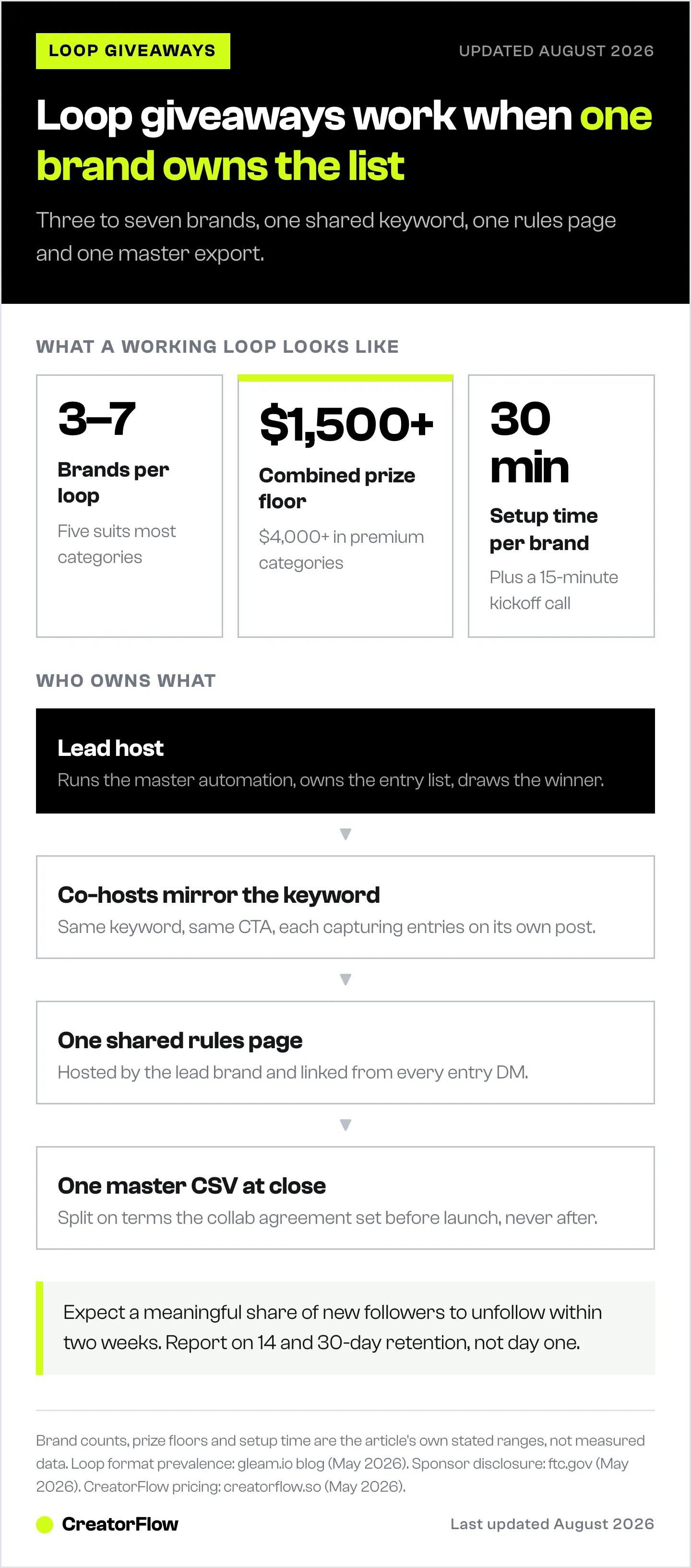
Five steps. Allocate 30 minutes per brand for setup, plus a 15-minute kickoff call.
- Pick a shared keyword. “ENTER” is the standard. Avoid generic words like “yes” or “me” that get caught by other automations. The keyword goes in every co-host’s automation.
- Choose the lead host. Usually the brand with the largest audience or the one initiating the collab. The lead host runs the master automation, owns the entry list, and handles the winner draw. Other brands run mirror automations that feed into the same logic.
- Each brand reposts with the same keyword. Identical caption (with brand-specific intro line allowed), identical CTA, identical keyword. Co-hosts tag the next brand in the loop. The lead host pins their post.
- Aggregated DM tracking via the lead host. Each brand’s automation captures entries to its own dashboard. The lead host’s automation is the source of truth for the winner draw. Tools like CreatorFlow ($15/mo Pro, 5,000 DMs included; creatorflow.so, May 2026) handle the comment trigger, DM delivery, and CSV export per account.
- One shared rules page, linked from every DM. Hosted on the lead brand’s site. Every co-host’s automation links to the same URL. Rules cover eligibility, entry method, sponsors, prize details, winner selection date, and how the winner is contacted.
For agencies running multiple of these per month, the workflow patterns in agency giveaway automation reduce repeat setup time.
Splitting the Entry List Fairly
This is where collabs break down. Define list-sharing terms before the giveaway launches, not after.
Default model: Lead host exports the master entry CSV after the giveaway closes. Each co-host receives the full list, with consent language built into the entry DM (the entrant agreed to be added to all sponsor lists when they entered).
Alternative model: Each co-host gets only entries that came through their own post. Cleaner from a privacy standpoint, but loses the cross-pollination benefit.
What to put in the collab agreement:
- Who exports the master list and when
- What format (CSV, integration to email tool, etc.)
- How the list-sharing consent appears in the entry DM
- Whether co-hosts can market to the list immediately or only after a cool-down
- Data retention rules (some brands require deletion after 90 days)
Without this in writing, expect at least one brand to feel shorted on the list quality. Always.
FTC + Compliance for Multi-Sponsor Giveaways
Each participating brand sponsor must be disclosed in the caption (ftc.gov, May 2026). This is non-negotiable, and it’s the most common compliance failure in loop giveaways.
What disclosure looks like:
- Caption names every sponsor by handle: “Sponsored by @brand1, @brand2, @brand3, @brand4, @brand5”
- A clear statement that the giveaway is a sponsored collaboration
- Material connection disclosure if any participating creator was paid (separate from prize value)
Single shared rules page covers:
- Eligibility (age, geography, void where prohibited)
- Entry mechanism (the keyword + follow requirement)
- Full sponsor list with legal entity names
- Prize details and approximate retail value
- Winner selection method and notification process
- No-purchase-necessary alternative entry method (required in many jurisdictions)
- Sponsor contact info
For a deeper compliance breakdown specific to DM-automated giveaways, see FTC compliance for Instagram giveaway automation.
Loop Giveaway Risks
Brands rarely publish these in case studies. Plan for them.
Follower drop-off after winner announcement. Expect a meaningful share of new followers to unfollow within two weeks. They came for the prize, not the brand. The followers who stay are still a net gain, but plan reporting around two-week and 30-day retention, not day-one follower count.
Low-quality entries. Loop giveaways attract giveaway-only accounts. These accounts follow thousands of brands, never engage, and unfollow on schedule. Filter your follower-quality reporting to exclude the giveaway window for at least 30 days.
Brand misalignment. If the five brands don’t share an audience persona, the cross-pollination falls flat. A skincare brand looping with a power-tools brand exposes audiences who have no reason to convert. Pre-vet co-hosts on audience overlap, not just follower count.
Winner disputes. If the winner didn’t actually follow all hosts, your verification process gets tested. Build verification into the automation: the winner DM asks for confirmation of follows, and the lead host manually checks before announcing.
Prize fulfillment delays. Five brands shipping to one winner means five different fulfillment timelines. Designate a fulfillment lead (often the lead host) who coordinates ship dates so the winner gets one delivery moment, not five awkward weeks of trickling boxes.
For the broader strategy on collab posts beyond giveaways, see Instagram collab post DM automation strategy.
A media kit makes the pitch easier to say yes to. Build one in a few minutes with the free media kit generator.
FAQ
How many brands should a loop giveaway include?
Three to seven. Below three, the prize pool isn’t compelling. Above seven, the follow requirement becomes friction-heavy and entry rates drop. Five is the sweet spot for most consumer categories.
Can multiple brands run the same automation through one account?
No. Each brand’s automation runs on their own connected Instagram account. The lead host’s automation captures entries from their post; co-host automations capture from theirs. Aggregation happens via CSV export, not shared automation accounts.
What’s the entry rate I should expect?
Highly variable, but a healthy loop giveaway in the 30k-100k follower range per brand sees 1,500-8,000 entries depending on prize value and audience match. Anything below 500 entries on a five-brand loop suggests audience-fit problems.
Do all co-hosts need DM automation tools?
Ideally yes, since manual comment tracking on a high-volume post is impractical. At minimum, the lead host needs automation. Co-hosts without tools can rely on the lead host’s master list, but they lose the ability to send branded follow-up DMs to entries from their own post. The DM automation guide covers what each brand needs.
How do you handle entries from accounts that don’t follow all hosts?
Two paths. Path one: the entry DM confirms entry and reminds them to follow all hosts to qualify. Final eligibility is checked at winner-draw time. Path two: the automation only sends the entry confirmation if the entrant follows all hosts (technically harder to implement, requires API checks). Path one is more common.
Who owns the email list collected through the entry DM?
Whatever the rules page says. Default convention: all sponsors share the list, with consent embedded in the entry flow. If you want exclusive ownership, write that into the rules and the collab agreement, not after the fact.
What’s the minimum prize value to make a loop giveaway worth running?
Combined retail value of $1,500-$2,500 is the floor for meaningful participation in most consumer categories. Below that, the follow-five-brands ask isn’t worth it for entrants. For premium categories (luxury, beauty, fitness gear) the floor is $4,000+.
Sources: spurnow.com (May 2026), gleam.io blog (May 2026), Meta community guidelines (May 2026), ftc.gov (May 2026), creatorflow.so (May 2026).


