
FTC-compliant Instagram giveaways require four things: a clear and conspicuous disclosure that identifies the post as a giveaway or sweepstakes, the sponsor’s name visible in the caption, a link to full official rules, and disclosure of any material connection between the creator and the brand. Hashtags alone do not satisfy disclosure. This guide is general information, not legal advice — consult an attorney before running prize promotions over $5,000.
A mid-sized swimwear brand recently pulled a $40K creator partnership three days before launch. The reason was not creative differences. The creator’s previous giveaway used “#sweeps” buried in a hashtag wall, no sponsor identification in the caption, and a “rules in bio” link that 404’d. The brand’s legal team flagged it during routine vendor review and walked away. The creator lost the deal, and the brand lost a launch window.
Compliance is not glamorous, but it is the difference between a giveaway that drives followers and one that gets your post hidden, your account warned, or your sponsor relationship terminated. This article covers the four FTC rules that apply to every Instagram giveaway, what an official rules page must contain, caption templates that pass legal review, state-level considerations, and how DM automation creates a defensible audit trail when a winner disputes the outcome.
Key Takeaways
- FTC requires “clear and conspicuous” disclosure — abbreviations like “#sweeps” do not satisfy the rule (ftc.gov, May 2026)
- Spell out “sweepstakes” or “giveaway” in plain language at the top of the caption (ussweeps.com, May 2026)
- Material connection between sponsor and endorser must be disclosed (thesocialmedialawfirm.com, May 2026)
- Full official rules must be accessible from the post itself, not buried in bio (rtm.com, May 2026)
- 2024-2026 enforcement trends emphasize digital transparency and entrant data handling (snipp.com, May 2026)
- State registration may apply for high-value prizes — NY, FL, and RI have stricter thresholds (kickofflabs.com, May 2026)
- DM automation creates timestamped entry logs that serve as proof of compliance during disputes

What FTC Compliance Requires for an Instagram Giveaway
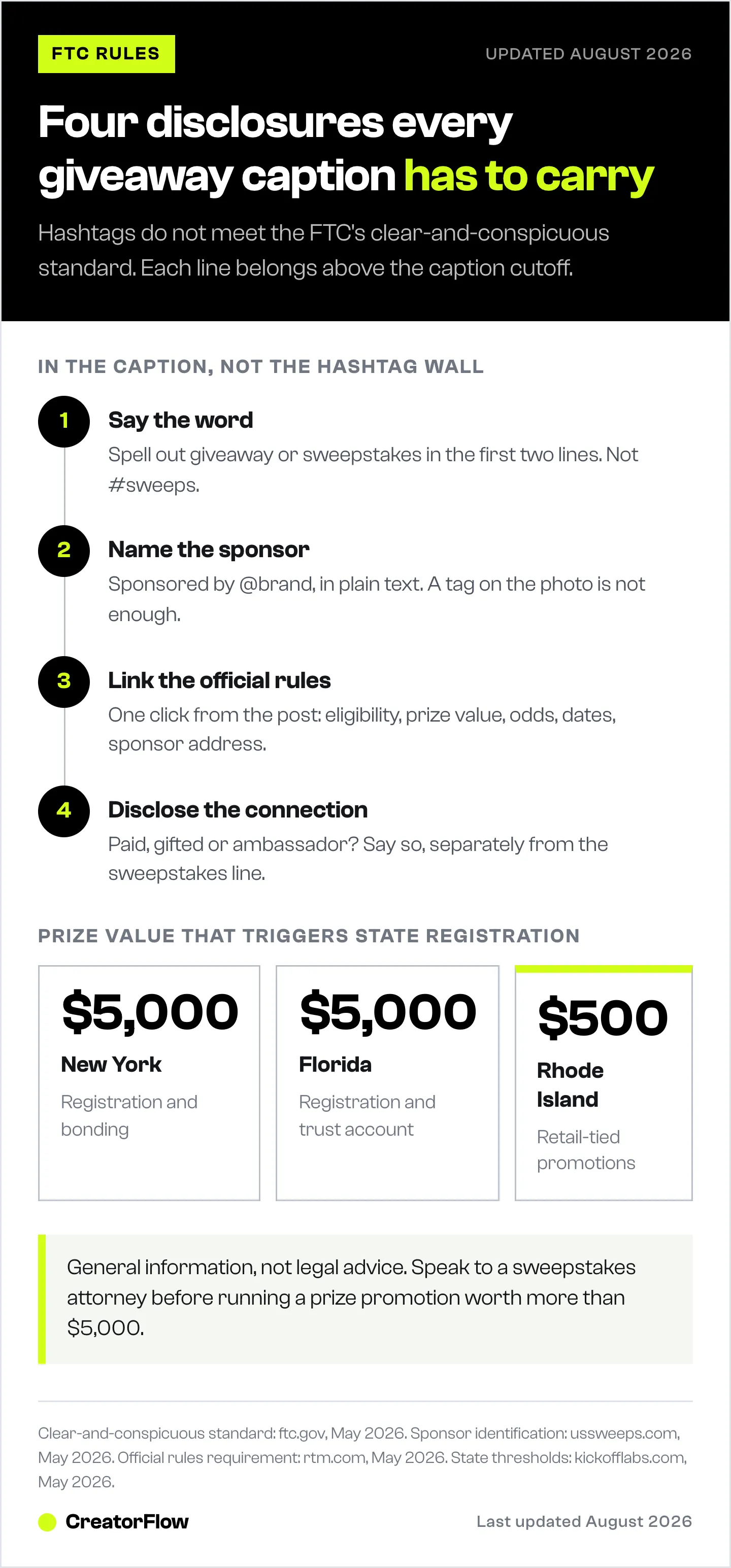
The FTC’s Endorsement Guides apply to any post where a brand provides value (free product, payment, or sponsorship) in exchange for promotion. Giveaways almost always trigger these rules because the prize itself is value provided by a sponsor. Four things have to be true. The caption spells out “giveaway” or “sweepstakes” above the “more” cutoff, the sponsor is named in plain text rather than only tagged, a working link leads to full official rules, and any paid relationship between you and the sponsor is disclosed on its own.
Clear Disclosure Language
The disclosure must be in plain English, visible without tapping “more,” and not buried in a hashtag wall. The FTC has stated that abbreviations like “#sp,” “#sweeps,” or “#collab” do not meet the clear and conspicuous standard because the average user cannot reliably interpret them (ftc.gov, May 2026). Use full words: “Giveaway,” “Sweepstakes,” “Sponsored by,” “Paid partnership.”
For Instagram, this means the disclosure should appear:
- In the first two lines of the caption (above the “more” cutoff)
- In the post itself (on-screen text in Reels)
- Using Instagram’s built-in “Paid Partnership” tag when applicable
Sponsor Identification
The sponsor’s name must be visible in the caption, not just tagged in the photo. If a brand is providing the prize, that brand is the sponsor and must be named. Tagging alone is not sufficient because tags can be hidden depending on user settings (ussweeps.com, May 2026).
Format: “Sponsored by @brandname” or “Giveaway by @brandname” within the first two lines.
Full Official Rules Link
A link to complete official rules must be accessible from the post. “Rules in bio” is acceptable only if the bio link works, leads directly to the rules page, and the rules cover all required elements. Best practice is to host the rules on a dedicated landing page with a permanent URL (rtm.com, May 2026).
The link should be flagged in the caption: “Full rules: link in bio” or “Official rules at [URL].”
Material Connection Disclosure
If the creator is being paid, given free product, or has any other arrangement with the sponsor beyond the giveaway prize itself, that material connection must be disclosed. This is separate from the sweepstakes disclosure (thesocialmedialawfirm.com, May 2026).
A creator running a giveaway with a brand they have an existing affiliate or ambassador relationship with must disclose both: “Sweepstakes sponsored by @brand. I’m a paid ambassador.”
For more on material connection rules outside the giveaway context, see Instagram affiliate disclosure FTC rules.
What an Official Rules Page Must Contain
A defensible official rules page covers every element a reasonable entrant or regulator would need. Missing elements weaken your position if a winner disputes the outcome or a state attorney general asks questions.
- Eligibility: Age minimum (typically 18+), geographic restrictions, exclusions (employees, family of sponsor)
- Entry methods: Exactly how to enter, how many entries allowed per person, entry deadline with timezone
- Prize description: Specific prize, approximate retail value (ARV), any restrictions on use
- Odds of winning: Statement that odds depend on number of eligible entries
- Winner selection: Method (random drawing, judging criteria), date of selection, how winners will be notified
- Dispute resolution: Governing law, arbitration clause if applicable
- Void-where-prohibited language: “Void where prohibited by law”
- Sponsor information: Full legal name and address of sponsor
- No purchase necessary: Statement that purchase does not improve chances of winning
Caption Templates That Pass FTC Review
These templates contain the required disclosure elements. Replace bracketed text with your specifics.
Template 1: Brand-run giveaway
GIVEAWAY: Win [prize] from [Brand]. Sponsored by @brandname.
To enter:
- Follow @brandname
- Comment your favorite [product] below
Open to US residents 18+. Ends [date] at 11:59pm ET. Full official rules: link in bio. No purchase necessary. Void where prohibited.
Annotation: Disclosure (“GIVEAWAY”), sponsor named in plain text, full rules linked, eligibility stated, deadline with timezone, no-purchase language included.
Template 2: Creator hosting brand-sponsored giveaway
SWEEPSTAKES sponsored by @brandname. I’m a paid partner.
Win [prize] (ARV $[amount]). Comment “ENTER” below to receive entry details via DM.
Open to US/CA residents 18+. Ends [date]. Official rules: [URL]. No purchase necessary.
Annotation: Both sweepstakes disclosure AND material connection disclosed, ARV stated, geographic eligibility clear, direct URL to rules.
Template 3: Multi-brand collaboration
GIVEAWAY: Win a bundle from @brand1, @brand2, and @brand3 (ARV $[amount]). Sponsored by @brand1 (lead sponsor).
To enter: Follow all three accounts and comment below. One entry per person.
Open to US residents 18+. Ends [date] at 11:59pm PT. Full rules: link in bio. No purchase necessary. Void where prohibited.
Annotation: Lead sponsor identified to clarify legal responsibility, all participating brands named, single entry rule prevents inflated counts.
For the full operational setup behind these captions — including comment-to-DM flow, follower verification, and winner selection — see the Instagram giveaway automation complete guide.
State-Level Considerations
Federal FTC rules set the floor. States can and do add requirements on top, especially for higher-value prizes (kickofflabs.com, May 2026).
- New York: Requires registration and bonding for sweepstakes with a total prize value over $5,000
- Florida: Requires registration and trust account for sweepstakes over $5,000
- Rhode Island: Requires registration for retail sweepstakes over $500
If your prize total exceeds $5,000 or you’re running a giveaway tied to retail purchase, registration may be required in these states. Most brands handle this by either:
- Excluding NY, FL, and RI residents from eligibility (stated in official rules)
- Working with a sweepstakes administration company that handles registration
For prize values under $1,000, state registration is typically not required, but FTC disclosure rules still apply. When in doubt, consult a sweepstakes attorney before posting — a one-hour consultation costs less than defending an enforcement action.
How DM Automation Helps Compliance
Comment-to-DM automation, when set up correctly, produces a compliance audit trail that manual giveaways cannot match. Three specific benefits:
Timestamped entry logs. Every triggered DM is logged with the commenter’s username, the comment text, and the exact timestamp. If a winner disputes whether they were eligible or whether their entry counted, the log answers the question without ambiguity.
Proof of entry confirmation. When a user comments and receives the automated DM with entry instructions or rules, that DM is proof they were notified of terms. This matters if rules change mid-promotion or if a winner claims they did not see the eligibility requirements.
Exportable winner selection data. Most automation platforms let you export the full list of qualifying entries to CSV. A random number generator applied to that list produces a defensible winner selection process. Document the selection method and timestamp it.
DM automation also enforces Instagram’s technical limits automatically. Automation tools pace API-based DM sending at around 200 messages per hour to stay well under Meta’s per-second rate limits, and comment-to-DM triggers must fire within a 7-day window of the original comment (spurnow.com, May 2026). Manual workflows often violate these limits and trigger rate-limiting; automation respects them by design. See Instagram API rate limits explained for the full breakdown.
For agency teams managing giveaways across multiple client accounts, the audit trail benefit compounds. See Instagram giveaway automation for agencies for multi-workspace compliance setup.
Common Compliance Mistakes That Get Posts Hidden
Instagram suppresses posts it identifies as engagement bait. Combine that with FTC violations and the risk profile gets ugly.
- Engagement-bait combinations: Posts requiring follow + tag friends + share to story + comment are throttled by the algorithm (spurnow.com, May 2026). Pick one or two entry methods, not five.
- Hashtag-only disclosures: Using “#sweepstakes” or “#sweeps” buried in a hashtag block does not meet the clear and conspicuous standard
- Missing official rules link: “Rules in comments” or “DM for rules” does not satisfy the requirement that rules be accessible from the post
- No sponsor identification in caption: Tagging the brand in the photo is not the same as naming them in plain text
- Geographic eligibility not stated: “Open to all” without specifying countries creates legal exposure in jurisdictions you didn’t intend to enter
- No “no purchase necessary” language: Required to distinguish a sweepstakes from an illegal lottery in most US states
For broader DM automation compliance and setup, see the Instagram DM automation complete guide.
FAQ
Is this article legal advice?
No. This is general guidance for content creators and brands running Instagram giveaways. Sweepstakes law is jurisdiction-specific and fact-dependent. For prizes over $5,000, recurring promotions, or any cross-border giveaway, consult a sweepstakes or marketing attorney.
Does the FTC actually enforce against small creators?
Enforcement actions against individual creators are rare but documented. The more common outcome is enforcement against the sponsoring brand, which then claws back fees from the creator and terminates the relationship. Brands now routinely audit creator compliance before signing contracts (snipp.com, May 2026).
Can I run a giveaway without official rules?
Not safely. Official rules are required to define eligibility, prize terms, and dispute resolution. Without them, you have no defensible answer when a non-winner claims the contest was rigged or when a state regulator asks for documentation. Hosting rules on a single landing page takes 30 minutes and removes the risk.
What counts as “clear and conspicuous” disclosure on Instagram?
The disclosure must be visible without tapping “more,” in plain English, and at the top of the caption. Acceptable: “GIVEAWAY,” “SWEEPSTAKES,” “Sponsored by [brand].” Not acceptable: “#sweeps,” “#sp,” “#collab,” or any disclosure buried below the fold (ftc.gov, May 2026).
Do I need to register my giveaway with a state?
Only if total prize value exceeds state thresholds. New York and Florida require registration above $5,000. Rhode Island requires registration above $500 for retail-tied promotions (kickofflabs.com, May 2026). Most creators handle this by excluding these states from eligibility, which must be stated in the official rules.
How does DM automation help with FTC compliance specifically?
Automation produces timestamped logs of every entry, every DM sent, and every confirmation received. If a winner disputes the outcome or a regulator asks for documentation, the logs answer the question. Manual workflows depend on screenshots and memory, which are not defensible.
Can I require people to follow me to enter?
Yes, but combine it with too many other requirements (tag friends, share to story, comment) and Instagram’s algorithm will suppress the post as engagement bait. Keep entry requirements simple: follow + comment is the most common compliant structure (spurnow.com, May 2026).
Sources: ftc.gov, ussweeps.com, thesocialmedialawfirm.com, rtm.com, snipp.com, kickofflabs.com, spurnow.com (all accessed May 2026). This article is general information and does not constitute legal advice.


