
Instagram influencer marketing is paying creators to feature your product in their Reels, Stories, carousels, or posts, then measuring what that content sells. In 2026 the median rate for a nano creator’s Reel is $250 and a macro creator’s is $4,000 (Aspire, July 2026). The return is decided after publishing, by whether the comments and DMs the post generates turn into tracked clicks and sales.
Here is the part most guides skip. A sponsored Reel goes live at 6pm. By 9pm it has 300 comments, 80 of them asking where to buy. The creator is at dinner. The brand’s community manager logged off at 6. By morning the comments are buried, the people who asked have scrolled on, and the only number anyone reports is reach. The post did its job. Nobody was there to take the order.
This guide covers how Instagram influencer marketing works in 2026, what creators charge by tier, which tier returns the most per dollar, how to measure ROI without leaning on a 2019 statistic, and how to set up the comment-to-DM layer that catches demand while it is still warm. It is written for brands and agencies, with a creator-side note where the job differs.
Key Takeaways
- Rates are lower than the headlines suggest. Aspire’s 2026 survey of roughly 1,200 creators puts the median Instagram Reel at $250 for nano creators and $4,000 for macro creators. Collabstr’s 2026 data shows about 80% of Instagram collaborations close under $300.
- Smaller accounts hold their audience. HypeAuditor’s 2026 analysis of 76 million Instagram accounts measured 1.78% engagement for nano creators, 0.54% for micro, and 0.33% for accounts over 1 million followers.
- The $5.78-per-$1 figure is 2019 earned media value. Influencer Marketing Hub has not published a return multiple since 2020. Measure tracked clicks and sales per creator instead.
- The return is decided after the post goes live. Comments asking for the link are demand. A comment-to-DM automation delivers the link in seconds and records who clicked, and from where.
- Disclosure travels with the link. The paid partnership label sits on the post, so the DM that carries the paid link needs its own line.
- Write automation into the agreement. Usage rights, partnership-ads permission, who runs the DM automation, and who owns the collected emails belong in the contract, not in a follow-up message.
What Is Instagram Influencer Marketing?
Instagram influencer marketing is a paid or gifted partnership in which a creator publishes content featuring a brand on their own Instagram account. The brand pays in cash, product, commission, or a mix. The creator discloses the partnership, publishes in their usual style, and the brand measures the clicks, codes, sales, and follower growth that trace back to the post.
The mechanics have settled into a repeatable sequence. What changed by 2026 is where the money is made: less on the post itself, more in the conversation it opens.
| Stage | Who acts | What happens | Where it breaks |
|---|---|---|---|
| 1. Brief | Brand | Goal, format, deliverables, disclosure, usage rights, tracking link or code | Vague goal, no tracking plan |
| 2. Selection | Brand | Shortlist by audience overlap and engagement, not follower count | Choosing on reach alone |
| 3. Agreement | Both | Rate, timeline, revisions, rights, automation clause | Rights and data ownership left out |
| 4. Content | Creator | Reel, carousel, Story, or post in the creator’s voice | Over-scripted brief |
| 5. Publish | Creator | Paid partnership label, caption disclosure, trackable link or code | Link only in bio, no keyword call to action |
| 6. Capture | Creator’s account | Comments and DMs asking for the link get answered in seconds | Nobody watching the comments |
| 7. Measure | Brand | Clicks, sales, codes, cost per result per creator | Reporting reach instead of outcomes |
Stage 6 is the one missing from most playbooks, and it is the stage this guide spends the most time on. For the creator-side view of the same deal, see how creators price and pitch Instagram brand deals.
How Much Do Instagram Influencers Charge in 2026?
Median Instagram rates in 2026 run from $95 for a nano creator’s Story to $4,000 for a macro creator’s Reel, according to Aspire’s survey of about 1,200 creators. Reels cost the most in every tier, Stories the least. Most deals are small: Collabstr’s analysis of 21,000+ collaborations puts the average paid Instagram price at $193.
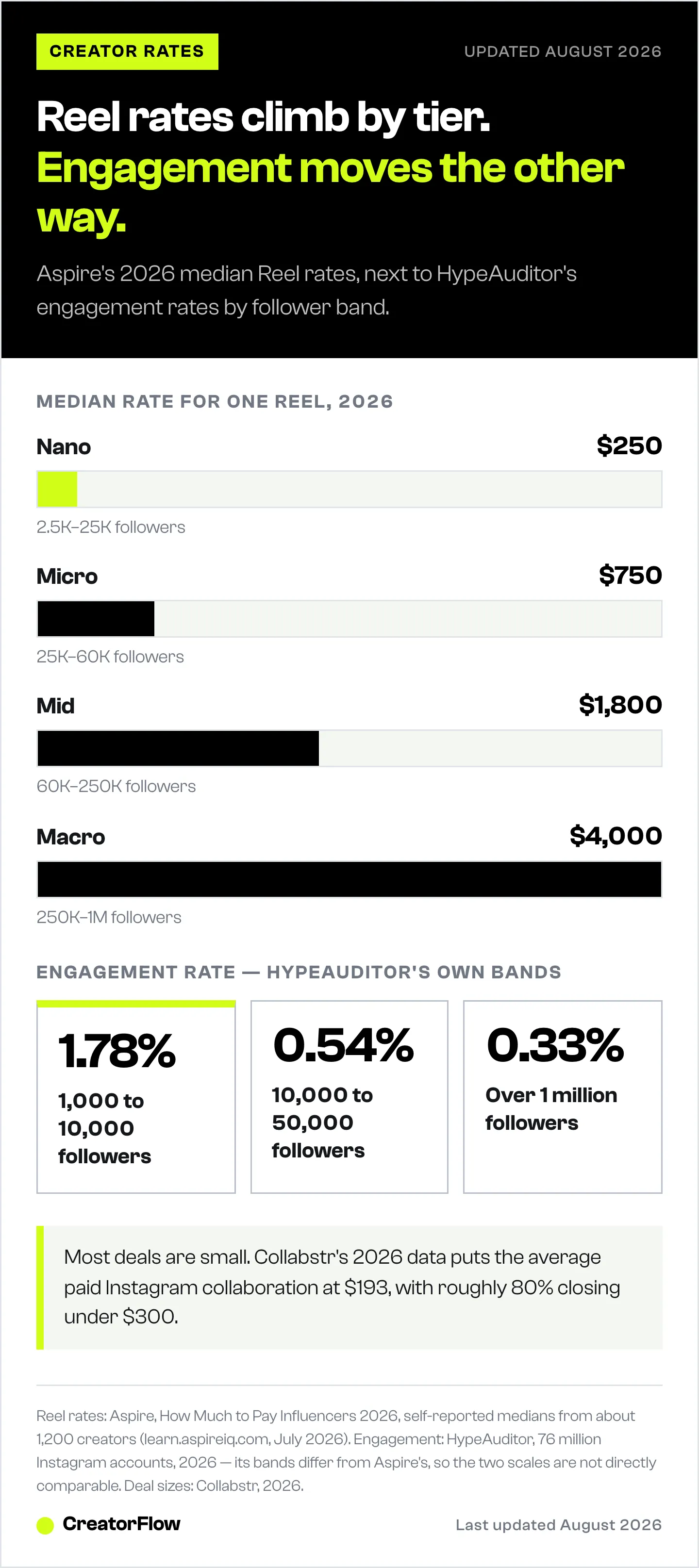
| Tier (Aspire bands) | Reel | Carousel | Static post | Story |
|---|---|---|---|---|
| Nano (2.5K to 25K followers) | $250 | $200 | $150 | $95 |
| Micro (25K to 60K) | $750 | $500 | $400 | $180 |
| Mid (60K to 250K) | $1,800 | $1,200 | $1,000 | $450 |
| Macro (250K to 1M) | $4,000 | $2,500 | $2,000 | $1,000 |
Source: Aspire, How Much to Pay Influencers 2026, self-reported medians from roughly 1,200 creators (learn.aspireiq.com, July 2026). Aspire’s tier bands differ from the usual 10K and 100K cut-offs, so do not mix these figures with other tables.
Three things to read into the numbers.
Reels carry a premium of roughly 1.7x to 2x over a static post in every tier. That premium buys reach, and reach is what generates the comment volume the capture stage depends on.
The spread inside a tier is wide. Shopify’s June 2026 round-up of published ranges runs from $25 to $150 per post for nano creators and $5,000 to $25,000 for macro creators (shopify.com, June 2026). Niche, audience location, and usage rights move the price more than follower count does.
Most of the market is cheap. Collabstr’s 2026 report found an average listed Instagram price of $214, an average paid price of $193, and roughly 80% of deals closing under $300 (collabstr.com, 2026). A first campaign of five nano or micro creators fits inside $1,500.
The spend behind those prices keeps growing. US creator economy ad spend is projected at $43.9 billion in 2026, up 18% year over year (Aspire, citing industry estimates; Marketing Dive attributes the figure to the Association of National Advertisers, March 2026). Brands put an average of 23% of their marketing budgets into creator partnerships in 2025, and 74% plan to increase that in 2026 (Aspire, State of Influencer Marketing 2026, February 2026).
Which Creator Tier Gives the Best Return?
Nano and micro creators return the most per dollar on Instagram in 2026. HypeAuditor’s analysis of 76 million Instagram accounts measured 1.78% engagement for accounts with 1,000 to 10,000 followers, 0.54% for 10,000 to 50,000, and 0.33% for accounts over 1 million. Smaller accounts cost less per post and keep a larger share of their audience paying attention.
Two cautions before you build a campaign on that.
First, the absolute numbers depend on the formula. HypeAuditor divides by views for Reels-heavy accounts, which is why its figures sit below the 3% to 6% nano rates on stats round-ups. Those higher numbers have no traceable sample. Use one methodology, say which, and compare creators inside it. Our guide to Instagram engagement rate by follower count walks through the calculation.
Second, engagement rate measures attention, not purchase intent. A 1.78% rate on 8,000 followers is 142 interactions. If 30 of those are comments asking for the link, that is the real top of the funnel for the post. Count those.
The market is moving toward small creators anyway. In Influencer Marketing Hub’s May 2026 benchmark survey of 600+ marketing professionals, 51% plan to expand nano-influencer partnerships, 53% plan to expand micro partnerships, and 87% expect their influencer budgets to rise this year (influencermarketinghub.com, May 2026).
A practical split for a first campaign: five to ten nano or micro creators at $150 to $750 per Reel to test audience fit and message, then one mid-tier creator at roughly $1,800 once you know which message converts. Buy macro reach only when you have a tracked cost per sale from the smaller tiers to compare it against.
Paying creators on commission instead of flat fees is its own model. The rates, cookie windows, and platform fees are in our guide to building an influencer affiliate program.
How Do You Measure Instagram Influencer Marketing ROI?
Measure Instagram influencer marketing ROI by dividing tracked revenue from a creator’s post by what you paid for it, including product cost and usage fees. Tracked revenue comes from a unique link, a unique code, or both. Earned media value, which estimates what the same reach would cost in ads, is a secondary number because it does not prove a sale.
Retire the $5.78 figure
The most quoted return in the industry, $5.78 earned for every $1 spent, comes from Influencer Marketing Hub’s 2020 benchmark report and describes earned media value reported by marketers for 2019 (influencermarketinghub.com, 2020). It measures estimated media equivalence, not revenue, and the report has not published a return multiple since. If a deck leans on it, the deck is six years behind.
The demand is real. Sprout Social’s 2025 State of Influencer Marketing survey of 2,000+ consumers found 86% make a purchase inspired by an influencer at least once a year (sproutsocial.com, 2025). Your tracking decides how much of that you can see.
The four numbers per creator
- Link requests. Comments and DMs asking for the link or code. This is demand the post created, before any tracking.
- Clicks on the tracked link. Unique clicks, per creator, per post.
- Conversions and revenue. From the code, the link’s UTM parameters, or the affiliate platform.
- Cost per result. Fee plus product cost, divided by clicks and again by sales.
A worked example (hypothetical numbers)
The figures below are invented to show the arithmetic. Replace them with your own.
| Creator A (micro) | Creator B (mid) | |
|---|---|---|
| Fee for one Reel | $600 | $1,800 |
| Product sent | $60 | $60 |
| Link requests in comments | 140 | 260 |
| Tracked clicks | 95 | 150 |
| Orders (unique code) | 11 | 13 |
| Revenue at $70 average order | $770 | $910 |
| Cost per click | $6.95 | $12.40 |
| Cost per order | $60.00 | $143.08 |
| Return on spend | 1.17x | 0.49x |
Creator B reached more people and produced more comments. Creator A produced a sale for less than half the cost. Without per-creator tracking, the brand would renew B because the reach number looked better.
One more column is worth adding: where the clicks came from. If a brand ships only to the UK and 40% of a creator’s clicks came from elsewhere, the engagement was real and the audience was wrong. Click-by-country data catches that on the first post instead of the third. CreatorFlow’s Insights shows click-through rate per automation and clicks by country and city on the Pro plan; how to read it is covered in the CreatorFlow Insights guide.
What Happens in the First 24 Hours After the Post Goes Live
The first 24 hours after a sponsored post goes live are when its comments, DMs, and link requests peak. Instagram lets a professional account send one private reply to a comment within seven days of that comment, and once the person replies, a 24-hour window opens for free-form follow-up. Demand that goes unanswered inside those windows mostly disappears.
This is the capture window, and it is where influencer campaigns quietly leak.
A sponsored Reel concentrates attention into a short burst. People comment “link?” or “code?” because that is the lowest-effort way to ask, and because the link in bio is three taps away and belongs to the creator, not the product. Each of those comments is a person with intent and a phone in their hand. If the answer arrives in seconds, a meaningful share of them click. If it arrives the next morning, the comment is buried under 200 others and the person has moved on.
Meta’s rules shape what is possible here, and they are often misquoted:
- Private replies to comments. A professional account can send one private message in reply to a comment on a post or Reel, at up to 750 private replies per hour per account (developers.facebook.com, rate limiting documentation, August 2026).
- The 24-hour messaging window. After a person replies in DMs, the account has 24 hours to send free-form messages. The human agent tag extends this to seven days for manually handled conversations.
- Standard message sends. Meta’s published limit on the Instagram API with Instagram Login is 100 calls per second for text and links. The “200 DMs per hour” figure in tool documentation is a pacing convention tools apply to stay well under spam thresholds, not a Meta-published limit.
The comment opens the door, the automated reply walks through it, and the person’s response opens a day-long conversation where the brand or creator can send the code, ask a qualifying question, or collect an email. The asset you paid for keeps working while everyone sleeps.
Creator-side note: the automation runs on the account that published the post. If you are the creator, that is your account and your tool. The brand receives the report, not the login. Running a brand’s tracking link through your own automation without breaking attribution is covered in our guide to sponsored-post DM tracking.
How to Set Up Comment-to-DM on a Sponsored Post
Set up comment-to-DM on a sponsored post by connecting the publishing account to a Meta-approved automation tool, choosing a trigger keyword, writing one DM that opens with the disclosure and carries the tracked link, and publishing the post with a caption that tells people which word to comment. Build it in advance, attach it the moment the post is live, and test it from a second account.
Brand side: what to write into the brief
The trigger keyword (one word: “LINK”, “CODE”, the product name). The exact tracked URL or discount code. The disclosure line that opens the DM. Whether to collect emails, and the consent wording if so. The report you expect: clicks, clicks by country, emails collected, as a CSV, by a named date. A format-by-format brief template is in how to brief a UGC creator; these lines slot into its deliverables section.
Creator side: the five-minute setup
- Connect the Instagram professional account to the tool through Meta’s official login. CreatorFlow is a Meta Tech Provider (since December 2025) and connects through the Instagram API with Instagram Login, so no password changes hands.
- Create a comment-to-DM automation and select the sponsored post as soon as it is live.
- Set the keyword. Add the variations (“link”, “Link”, “link please”) so a stray capital or extra word does not block delivery.
- Write the DM. Disclosure first, then the link or code, then one sentence on what they get. Keep it under 60 words.
- Add gates if the brief asks for them. An Email Gate asks for an email before releasing the link and exports the list to CSV. A Follow Gate asks the person to follow and confirm before the link is released.
- Test it yourself from a second account. Comment the keyword, receive the DM, click the link, confirm the click registered in the dashboard.
For a full walkthrough of comment triggers, Story replies, and keyword DMs, see the Instagram DM automation setup guide.
Put the disclosure inside the DM
The FTC’s guidance for influencers says a disclosure has to be hard to miss, should not be buried at the end of a post or behind “more”, and should not be mixed into a group of hashtags (ftc.gov, Disclosures 101, updated December 2024). It also says not to rely on a platform’s disclosure tool alone. The paid partnership label covers the post. The DM is a separate message on a separate surface, and it is the one carrying the paid link.
So the DM opens with the relationship: “Here’s the link from my paid partnership with [brand].” One line, ten words, and the message is compliant on its own. Civil penalties under the FTC Act run to $53,088 per violation (16 CFR 1.98, ecfr.gov, 2026), a large number to risk over a line of text. Templates for captions, Stories, and DMs are in our Instagram affiliate disclosure guide.
Plan and pricing
CreatorFlow’s Free plan covers 500 DMs a month on one account, enough to test one campaign. Pro is $15 a month for 5,000 DMs per workspace, two workspaces, the Email Gate, the Follow Gate, CSV export, and clicks by country and city. Growth is $30 a month for five workspaces and 10,000 DMs each. Full details are on the pricing page.
What to Put in the Influencer Agreement
An Instagram influencer agreement should cover the fee and payment date, deliverables and timeline, revision limits, the disclosure wording, usage rights with a duration, whether the brand may run the post as a partnership ad, who runs the comment-to-DM automation and for how long, and who owns any emails it collects. Each of these becomes a dispute if it is left to a DM thread.
The clauses most templates leave out:
Usage rights with a clock. Repurposing the creator’s Reel into your own ads, emails, or product pages is where a $750 post earns its keep. State the channels, the duration (90 days, 12 months, perpetual), and whether edits are allowed. Perpetual rights cost more, and should.
Partnership ads. Instagram lets creators give a brand permission to boost a post as an ad from the brand’s own account, through a toggle on the post or an ad code, and these ads appear in the Meta Ad Library (help.instagram.com, Partnership ads, August 2026). It is a separate permission from usage rights, so name it separately.
The automation clause. Who sets up the comment-to-DM automation, on which keyword, delivering which link, and for how long after publishing. Meta’s seven-day private-reply window on comments means the automation stays useful for at least a week, so a clause that ends on the day of publishing leaves money on the table.
Data ownership. If the DM collects emails through an Email Gate, the emails land in the creator’s tool. Decide in writing whether the creator hands over a CSV, whether the consent text names the brand, and what the brand may send. For EU audiences the lawful basis for that transfer needs to be in the consent wording. Ask your counsel to read it once.
What happens at the end. Whether the post stays up, whether the automation is switched off, whether the tracked link keeps resolving. A link that dies while the Reel keeps getting views is a bad experience for everyone.
Creator-side note: the same clauses protect you. A brand that asks for perpetual rights, partnership-ad permission, and the email list for a flat $400 is asking for three things that each have a price.
How to Find Instagram Influencers for a Campaign
Find Instagram influencers for a campaign through Meta’s Creator Marketplace, which is being folded into the Meta Creator Marketing Hub later in 2026, through your own customer and follower base, through affiliate networks, and through manual search on niche hashtags. Shortlist on audience overlap, comment quality, and past sponsored content, then verify with a small paid test before committing budget.
Meta’s own surface is the first stop. Creator Marketplace lets brands discover creators, see performance data, and message them, and is accessed through Meta Business Suite or Ads Manager (help.instagram.com, Creator Marketplace, August 2026). At Cannes Lions in June 2026, Meta announced that Creator Marketplace and the Partnership Ads Hub will merge into a single Meta Creator Marketing Hub launching later this year, with 5 million+ Instagram creators discoverable (facebook.com/business, June 2026).
Vet a shortlist on four things: audience overlap (ask for audience insights screenshots), comment quality (real questions, or emoji strings and bot replies), past sponsored posts (how the audience responded, how often the creator posts paid content), and a small paid test. One Reel at the tier’s median rate, with the full capture setup, tells you more than any media kit.
The sourcing channels beyond the marketplace, the qualification filter, and the 30-day activation window are covered in how to find influencers for your affiliate program.
If a synthetic persona is on the shortlist alongside human creators, our decision guide on whether brands should use AI influencers sets out which asset each one actually sells. If your program runs on gifted product and user-generated content rather than paid posts, UGC tracking explains what Instagram lets you measure from tags and mentions and what it does not.
FAQ
How much does Instagram influencer marketing cost?
Median 2026 rates from Aspire’s creator survey run from $95 for a nano creator’s Story to $4,000 for a macro creator’s Reel. Most deals are smaller: Collabstr’s 2026 data puts the average paid Instagram collaboration at $193, with about 80% closing under $300. A first test campaign of five nano or micro creators fits inside $1,500 plus product.
Is Instagram influencer marketing still worth it in 2026?
Yes, and budgets say so. Brands put an average of 23% of marketing budgets into creator partnerships in 2025, 74% plan to increase that in 2026 (Aspire), and 87% of marketers in Influencer Marketing Hub’s May 2026 survey expect their influencer budgets to rise. The campaigns that lose money pay for reach and never capture the demand the post creates.
What is a good ROI for Instagram influencer marketing?
There is no current industry multiple to benchmark against. The often-quoted $5.78 per $1 is 2019 earned media value from a report that stopped publishing the figure after 2020. Set your own target from tracked revenue: cost per click and cost per order per creator, compared against what the same sale costs you through paid ads.
How do I track sales from an Instagram influencer post?
Give each creator a unique link and a unique code, and deliver them through a comment-to-DM automation so every request is answered and every click is recorded. Read clicks per creator, clicks by country, and orders per code. Instagram Insights shows reach and engagement on the post. The automation shows who asked, who clicked, and from where.
Do influencers have to disclose sponsored posts on Instagram?
Yes. The FTC requires a clear disclosure of any material connection, placed where it is hard to miss, and says a platform’s disclosure tool alone is not enough. Instagram requires the paid partnership label on all branded content. Because the label sits on the post, a DM that carries the paid link should open with its own one-line disclosure.
Can a brand run DM automation on a creator’s sponsored post?
The automation runs on the account that published the post, so the creator connects their account and runs it, using the brand’s link, code, and disclosure line. The brand receives the click report and, if agreed in writing, the CSV of collected emails. Put the keyword, the link, the duration, and the data handover in the agreement before the post goes live.
Rates, engagement benchmarks, and platform rules verified from Aspire (How Much to Pay Influencers 2026; State of Influencer Marketing 2026), Collabstr (2026 Influencer Marketing Report), HypeAuditor via eMarketer (State of Influencer Marketing 2026), Influencer Marketing Hub (Benchmark Report, May 2026; Benchmark Report 2020), Sprout Social (State of Influencer Marketing 2025), the FTC (Disclosures 101; 16 CFR 1.98), Meta’s Instagram Help Center and developer documentation, and CreatorFlow’s pricing page as of August 2026. The attribution example uses hypothetical figures. Individual results vary.


