
Brands should use AI influencers when what they need is production control and usage rights, and skip them when what they need is audience trust. A synthetic persona gives you a face you own, unlimited usage, no scheduling, and consistent output. It cannot supply a first-hand claim about your product, and since August 2026 it arrives on Instagram with a label the audience reads before the post.
The debate has been running on the wrong axis. Most coverage argues whether AI influencers are good or bad for marketing, which is unanswerable, because the answer depends entirely on which asset the campaign was buying. Reach and rights are different purchases. A brief that needed a real person’s endorsement and got a rendered one has not saved money, it has bought a different product.
This guide covers what you are actually purchasing, where a synthetic persona wins and where it does not, what the audience research says and why the headline numbers contradict each other, who carries the disclosure liability, and a 30-day test that answers the question for your specific offer.
Key Takeaways
- Rights and repeatability are the real product. An owned persona removes negotiation, exclusivity windows, availability, and per-asset usage fees. Those are the wins, and they are operational rather than persuasive.
- A synthetic persona cannot make a first-hand claim. Anything that depends on a real body having used the product is outside what it can credibly say, whatever the render quality.
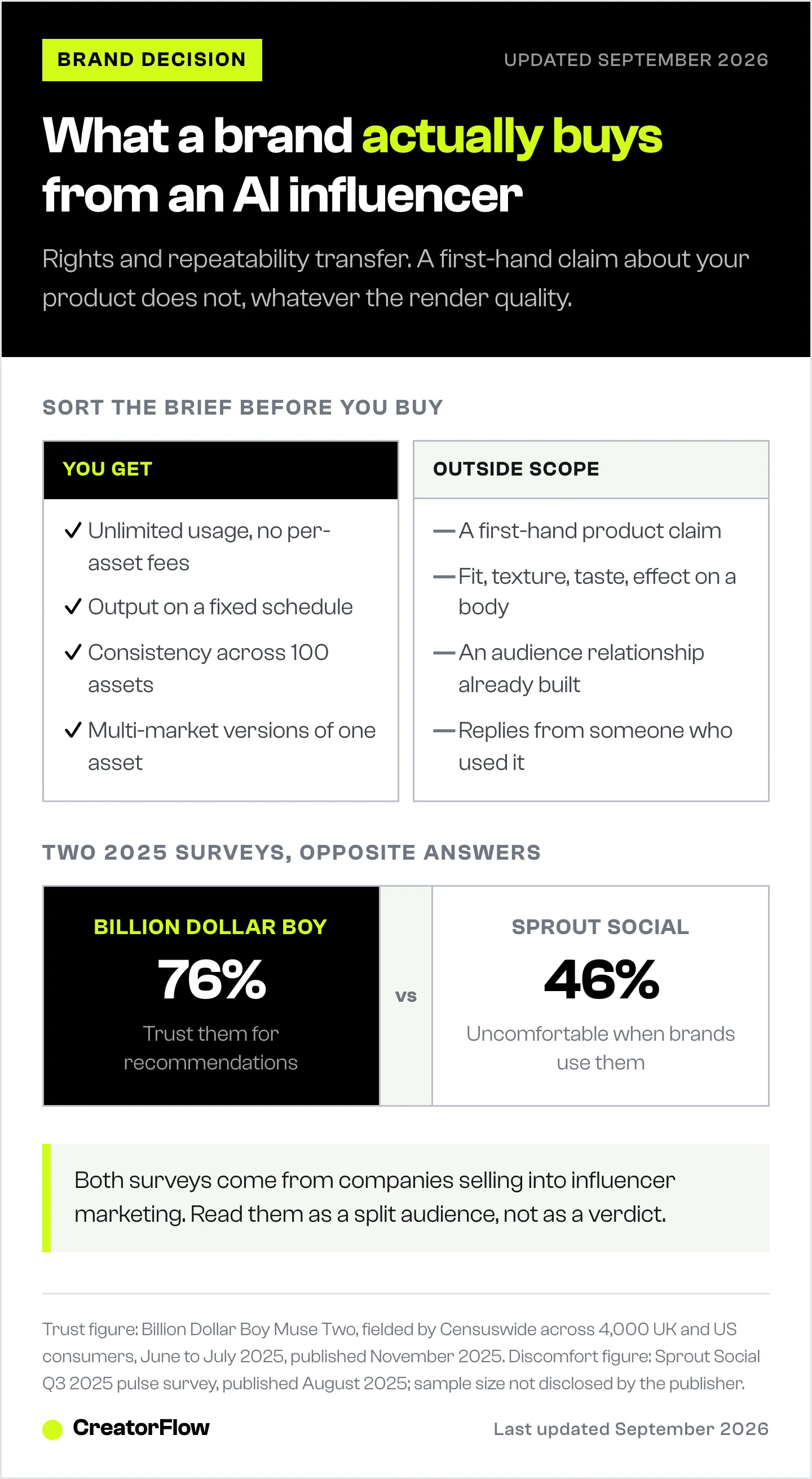
- The audience research contradicts itself, and both sides are commercially interested. One 2025 survey found 76% of consumers trust virtual influencers for product recommendations; another found 46% uncomfortable with brands using them against 23% comfortable.
- Disclosure liability sits with the advertiser. The FTC applies its Endorsement Guides to virtual endorsers, with maximum civil penalties of $53,088 per violation, and EU AI Act Article 50 has applied since 2 August 2026.
- The strongest use is usually not “hire a virtual influencer”. AI-produced product video that you own, and a brand-owned recurring character, both capture the production win without buying borrowed trust.
- Test it against a human creator on the same offer. Separate trigger keywords, same landing page, 30 days. Revenue per thousand views settles it faster than any survey.
What You Are Actually Buying
Every influencer purchase is really a bundle of four things: attention, endorsement, creative assets, and usage rights. A human creator sells you all four, weighted heavily toward the first two. A synthetic persona sells you the last two cleanly and the first two conditionally.
That reframing does most of the work. If the line item in your plan says “reach a fitness audience through someone they already trust”, a rendered persona is not a cheaper version of that, it is a different line item. If it says “produce 40 on-brand product videos this quarter with unlimited paid usage and no reshoots”, a rendered persona is the same line item at a fraction of the cost.
The market is being priced as though it were the first. Grand View Research put the global virtual influencer market at $8.30 billion in 2025 with a forecast of $45.88 billion by 2030, a 40.8% compound annual rate, in a report published in November 2024 (grandviewresearch.com, November 2024). That is a projection from a 2024 base year rather than a measurement, and it is worth reading as an estimate of enthusiasm as much as of spend. For scale, eMarketer put total US creator marketing spend across all creators at $21.10 billion for 2026 (emarketer.com, February 2026).
Published rates for established synthetic personas sit in ordinary influencer territory rather than below it. Forbes India reported the virtual influencer Kyra, built by FUTR Studios, charging ₹5 to 10 lakh per video, roughly $6,000 to $12,000 at the time (forbesindia.com, October 2024). The Clueless told reporters in November 2023 that its persona Aitana earned just over €1,000 per advert, with monthly income around €3,000 and peaks near €10,000 (euronews.com, published November 2023, updated December 2024). Neither figure has been independently audited, and both are the agency’s own account of its own asset. Our review of what AI influencers actually earn separates the verified numbers from the estimates.
Where an AI Persona Wins, and Where It Does Not
The split is clean once you sort briefs by whether the claim needs a body behind it.
| What the campaign needs | Synthetic persona | Human creator |
|---|---|---|
| Unlimited paid usage, no per-asset fees | Strong | Negotiated, often expensive |
| Output on a fixed schedule | Strong | Depends on availability |
| Visual consistency across 100 assets | Strong | Varies by shoot |
| Multi-market versions of one asset | Strong | Needs reshoots or dubbing |
| A first-hand claim about using the product | Outside scope | The core of what you buy |
| Demonstrating fit, texture, taste, or effect on a real body | Outside scope | Strong |
| An existing audience relationship | Built from zero | Already exists |
| Comments answered by someone who used the product | Outside scope | Strong |
| Crisis exposure from a person’s behaviour | Low | A real risk to manage |
The right-hand column is not a knock on synthetic personas. It is the definition of the product. A brand that wants a face it owns, working every day, in six languages, with no exclusivity clause, is buying something a human creator structurally cannot sell.
The wrong purchase looks like this: a skincare brand commissions a synthetic persona to post a six-week results sequence. The renders are excellent. The claim is that a person’s skin changed, and no person’s skin changed. The disclosure that makes the post lawful also makes the claim inert, which means the brand paid production money for an endorsement that cannot function.
What the Audience Data Says, and Why It Conflicts
The two most-quoted consumer numbers in this space point in opposite directions, and both come from companies with a commercial position.
Billion Dollar Boy, an influencer marketing agency, published research in November 2025 finding that 76% of consumers trust virtual influencers for product recommendations and 68% trust them to inform purchase decisions. The same study found 57% believe digital twins erode trust in creator content, that the share preferring generative-AI creator content fell from 60% in 2023 to 26% in 2025, and that only 45% feel confident they can identify AI-generated creator content. It was fielded by Censuswide across 4,000 UK and US consumers between 20 June and 1 July 2025 (billiondollarboy.com, November 2025).
Sprout Social, a social media management platform, reported from its Q3 2025 pulse survey that 46% of consumers are uncomfortable with brands using AI influencers against 23% who are comfortable, and that a brand using an AI influencer makes 37% more interested and 37% more distrustful (sproutsocial.com, August 2025). Sample size is not published.
Those two findings cannot both be the headline. Read them together and the usable conclusion is narrower and more reliable than either: the audience is split, the split is roughly even, and a meaningful share will actively distrust the brand rather than the persona. eMarketer’s analysis of the same period found 32% now see generative AI as a negative disruptor of the creator economy, up from 18% in late 2023, and 52% concerned about undisclosed AI-generated brand content (emarketer.com, December 2025).
Engagement evidence is no cleaner. HypeAuditor’s 2021 analysis of 129 virtual influencers found engagement “almost three times higher” than human accounts, while a 2024 study in the Journal of Interactive Advertising covering 99,680 Instagram posts across 424 influencers found human influencers drew significantly greater engagement. The specific percentage pairs repeated across marketing blogs do not appear in any retrievable primary source. Plan a campaign on your own measured numbers, not on either of these.
Who Carries the Disclosure Liability
The advertiser does. Three regimes apply at once and none of them is discharged by the others.
FTC Endorsement Guides, United States. The FTC’s guides cover virtual endorsers on the same terms as human ones, and a material connection between advertiser and endorser has to be disclosed clearly and conspicuously in the post. Maximum civil penalties run to $53,088 per violation (ftc.gov, 2025 inflation adjustment, unchanged for 2026). The mechanics for Instagram specifically are in our guide to FTC disclosure rules for Instagram.
EU AI Act Article 50. Transparency obligations for deployers of AI-generated content have applied since 2 August 2026. Content that is artificially generated or manipulated has to be disclosed clearly and at first exposure, perceivable without special tools. The European Commission’s guidance explicitly treats a synthetic influencer video demonstrating a sponsored product as falling outside the lighter regime, and the obligation follows whoever publishes to EU users, including when a third-party tool produced the asset (digital-strategy.ec.europa.eu, 2026).
Instagram’s AI-generated profile label. Since 31 August 2026 a profile featuring an AI-generated person needs the label, and unlabeled profiles Instagram detects lose recommendation eligibility (creators.instagram.com, August 2026). If you commission a campaign from an existing persona account, its label status is now a media-buying variable, because an unlabeled account is one enforcement action away from losing the reach you paid for. The full ruling is in our guide to Instagram’s AI-generated profile label.
The practical consequence for a brand is that “the studio handles disclosure” is not a defence. Write it into the agreement, name the responsible party, and keep the evidence.
Two Uses That Beat Hiring a Virtual Influencer
Most brands arrive at this question because they want the production economics, not because they want to rent someone else’s synthetic audience. Two structures deliver that directly.
AI-produced product video that you own. Generated presenters, demonstrations, and variant testing, published from your own account and your own paid media, with no third party in the chain. You keep the rights, the data, and the disclosure control, and you skip the borrowed-trust problem entirely because nobody is being asked to trust a stranger. The economics, the formats that convert, and the disclosure rules are in our guide to AI UGC for ecommerce.
A brand-owned recurring character. A mascot or host that appears in every post, labeled as AI, doing the same job a presenter does. This is closer to advertising than to influencer marketing, which is the point: the audience knows what it is watching, so the character earns attention on format rather than on personhood.
Both capture the operational wins in the left column of the table above without buying the thing a synthetic persona cannot sell. If the campaign genuinely needs a person’s endorsement, hire a person, and put the automation on the sponsored post instead. Our guide to Instagram influencer marketing covers verified creator rates by tier and how to measure the return.
What to Put in the Agreement
Six clauses do the work when you are commissioning from a studio or an existing persona account.
- Ownership and usage. Who owns the generated likeness, for how long, in which channels, and whether paid amplification is included. Get this in writing even when the persona is “yours”, because the studio built the model.
- Disclosure responsibility. Name who applies the in-post FTC disclosure, who applies the Instagram profile label, and who is responsible for EU Article 50 compliance on assets shown to EU users.
- Claim limits. A list of things the character will not say, specifically any first-hand experience claim about the product. This protects both parties from an unsubstantiated endorsement.
- Data ownership. Who owns the comments, the DM conversations, and any emails collected during the campaign. On a persona account run by a studio, the default is that they do.
- Attribution mechanics. A dedicated trigger keyword and a dedicated destination link for the campaign, so performance is measurable independently of the studio’s reporting.
- Termination and takedown. How fast an asset comes down, and what happens to derivative assets already in paid rotation.
How to Run a Test That Answers It in 30 Days
Surveys will not settle this for your product. A paired test will, and it costs one month.
- Write one brief, produce it twice. Same offer, same hook, same call to action. One version from a human creator in your category, one synthetic. Keep everything except the presenter constant.
- Give each a separate trigger keyword. Different words, both pointing at the same landing page. This is the only reliable way to attribute a comment-driven funnel to a creative variant.
- Automate the reply on both. When someone comments the keyword, the DM goes out immediately with the link. Instagram’s 24-hour messaging window starts from their action, so a manual reply the next morning loses the sale and corrupts the test. Instagram DM automation handles this on both variants identically.
- Measure revenue per thousand views, not engagement rate. Engagement rate is where the contradictory published research lives. Clicks and orders are not ambiguous.
- Read the comments as data. Count how many ask whether the account is real. On the synthetic variant, that count is the tax you are paying, because those people are asking about the format rather than the product.
Run it once per category rather than once per brand. The answer tends to hold for a product type: the closer the purchase sits to a claim about a body, the worse the synthetic variant performs, and the more it sits on information or aesthetics, the closer the two come. Tracking the sponsored side of this properly is covered in our guide to tracking sponsored post performance through DMs.
Attribute every campaign variant separately. CreatorFlow gives each keyword its own DM flow and its own click data, so a paired creative test reads cleanly. Start free.
FAQ
Are AI influencers cheaper than human creators?
The production is cheaper; the media and the audience-building are not. Established synthetic personas charge conventional influencer rates, with Forbes India reporting roughly $6,000 to $12,000 per video for one Indian virtual influencer in 2024. Savings appear when a brand produces its own assets and skips the audience purchase entirely, which is a different structure from hiring a virtual influencer.
Do consumers trust AI influencers?
The published research splits almost evenly and comes from commercially interested sources. Billion Dollar Boy found 76% trust virtual influencers for product recommendations in research fielded across 4,000 UK and US consumers in 2025. Sprout Social found 46% uncomfortable with brands using AI influencers against 23% comfortable. Assume a meaningful share of your audience reacts negatively and measure your own.
Is it legal for a brand to use an AI influencer?
Yes, with disclosure. The FTC applies its Endorsement Guides to virtual endorsers, so paid posts need clear disclosure of the material connection, with maximum civil penalties of $53,088 per violation. EU AI Act Article 50 has required clear disclosure of artificially generated content at first exposure since 2 August 2026. Instagram separately requires the AI-generated profile label on profiles featuring an AI-generated person.
Can an AI influencer make claims about a product?
It can describe features, price, availability and use cases. It cannot credibly claim first-hand experience, because there is no first-hand experience to substantiate. In the US, an endorsement has to reflect the honest opinions or experience of the endorser, which is exactly the ground a synthetic persona cannot occupy. Write the claim limits into the agreement.
Which industries do AI influencers work best for?
Categories where the value sits in information, design or aesthetics rather than in bodily proof. Software, digital products, gaming, media, home and interiors, and fashion styling all work. Skincare, supplements, fitness results, and food perform worst, because the purchase depends on believing a real person experienced the outcome.
Should a brand build its own AI persona or hire an existing one?
Build if the goal is production economics and owned rights, which is where the durable advantage is. Hire if the goal is borrowing an audience that already exists, and price it as a media buy with the same scrutiny you would apply to any creator. Check the account’s Instagram label status before signing, since an unlabeled AI profile now risks losing recommendation reach.
How do I measure whether an AI influencer campaign worked?
Give the campaign its own trigger keyword and its own destination link, automate the DM so every commenter gets the link inside Instagram’s messaging window, and measure clicks and orders per thousand views against a human-creator control running the same offer. Engagement rate is the least reliable measure available for this comparison.
Market sizing from Grand View Research’s virtual influencer market report, published November 2024. US creator marketing spend from eMarketer, February 2026. Virtual influencer rates from Forbes India, October 2024, and Euronews reporting of The Clueless, published November 2023 and updated December 2024; both are agency-reported and not independently audited. Consumer sentiment from Billion Dollar Boy’s Muse Two research, fielded by Censuswide across 4,000 UK and US consumers in June and July 2025, from Sprout Social’s Q3 2025 pulse survey, and from eMarketer’s December 2025 analysis. Engagement comparisons from HypeAuditor’s 2021 virtual influencer analysis and Looi et al., Journal of Interactive Advertising 24(2), 2024. FTC penalty figure from the FTC’s 2025 inflation adjustment, unchanged for 2026. EU AI Act Article 50 obligations from European Commission guidance, 2026. Instagram label rules from Instagram’s creators blog, August 31 2026. Verify current figures before acting on them.