
AI influencers make money four ways: subscription platforms that pay a revenue share, digital products the operator owns, affiliate commissions on real products, and brand deals. Subscription platforms and owned products carry the most verified revenue. Brand deals produce the biggest headline numbers, but the largest published figures are follower-count estimates rather than reported revenue.
The gap between those two things is the whole story. Search this topic and you get monthly incomes from $20,000 to $200,000, tiered earnings tables, and per-post rates in the tens of thousands. Trace the citations and most of them lead to a tool vendor’s blog, a marketplace’s press release, or one calculation that multiplied a human influencer’s rate card by a virtual account’s follower count.
This guide separates what is documented from what is modelled. It covers the verified earnings on record, how each revenue stream actually pays, what the subscription platforms keep, what Meta’s rules say about synthetic accounts, and the disclosure regime that arrived in 2026 and now decides how much of the money you keep.
Key Takeaways
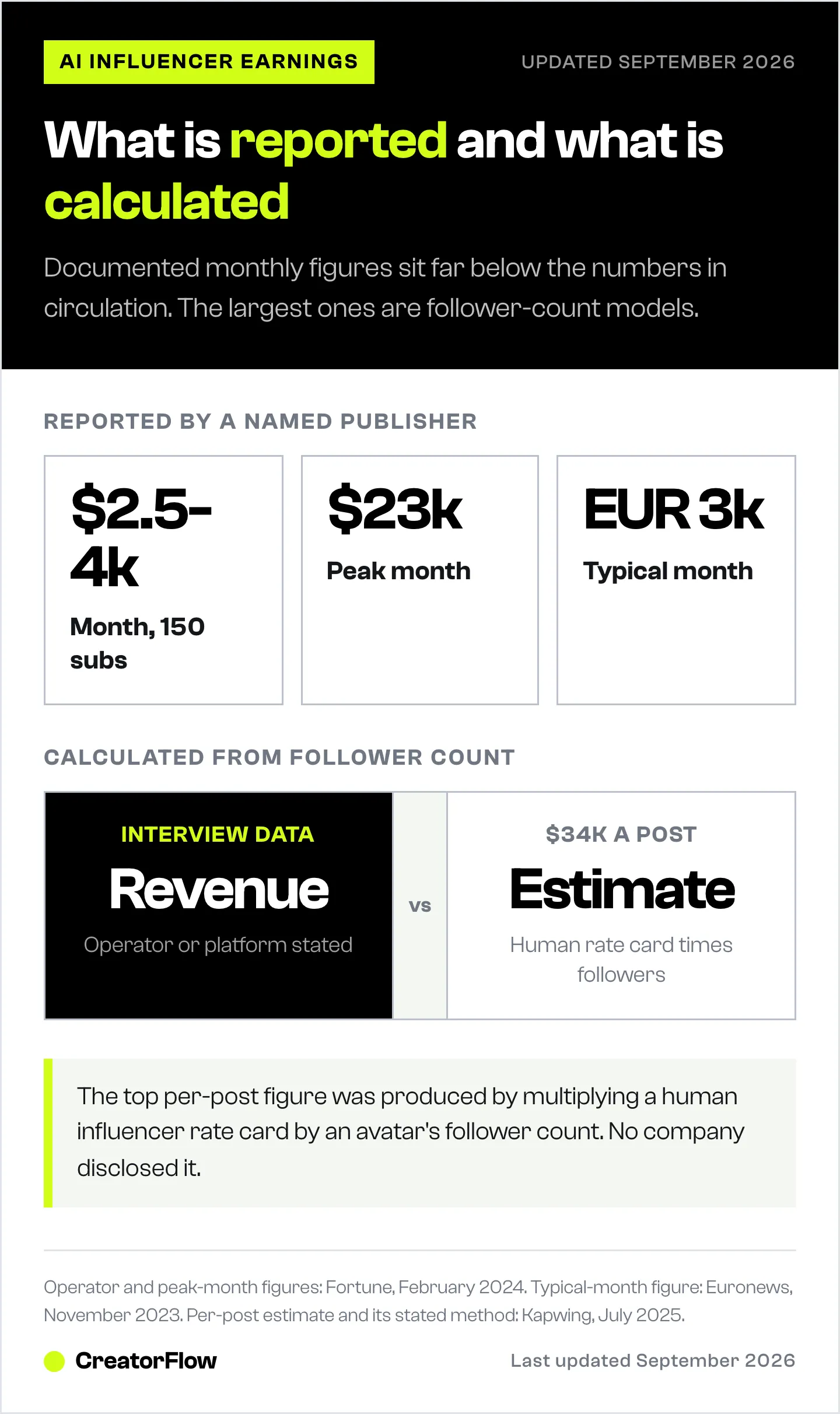
- Verified earnings are modest: the documented figures run from about $2,500 per month for a small operator to roughly $23,000 in a strong month for a top persona, not the six-figure monthly incomes that circulate online (fortune.com, February 2024)
- The famous numbers are estimates: the “highest-paid virtual influencer” figure of roughly $34,000 per post is a calculation that multiplied a human rate card by follower count, published as an estimate by the analysts who made it (kapwing.com, July 2025)
- Subscription platforms are the clearest path: Fanvue publishes an 80/20 split and explicitly permits AI-generated media within stated limits (legal.fanvue.com and help.fanvue.com, August 2026)
- Meta’s rules do not single out AI: the originality policy targets reposting other creators’ work and never mentions AI-generated content, and Meta says AI labels do not automatically reduce distribution (about.fb.com, March 2026)
- Disclosure became enforceable in 2026: New York’s synthetic performer law took effect June 9, 2026, and EU AI Act transparency duties apply from August 2, 2026 (cooley.com, January 2026; digital-strategy.ec.europa.eu, July 2026)
- Disclosure has a measured cost: when consumers notice AI in brand marketing, 31% trust the brand less against 7% who trust it more (emarketer.com, April 2026)
- Bottom line: the streams that survive disclosure are the ones selling something real, so build revenue around an owned product and a reliable way to deliver it
How Much Do AI Influencers Actually Make?
Documented AI influencer earnings range from roughly $2,500 per month for an independent operator with a small subscriber base to about $23,000 in a peak month for one of the best-known personas. Those are the figures with a named publisher behind them. Larger numbers exist in circulation, but they are either estimates built from follower counts or claims made by the agency selling the service.
The category itself is growing fast, which is part of why the earnings claims have outrun the evidence. The virtual influencer market was valued at $6.06 billion in 2024 and is projected to reach $45.88 billion by 2030, a compound annual growth rate of 40.8% (grandviewresearch.com, November 2024). Rapid growth in a market attracts both operators and people selling tools to operators, and the second group produces most of the income figures in circulation.
Here is what is on the record, and who reported it.
| Persona or operator | Reported figure | Who reported it | What kind of number |
|---|---|---|---|
| Aitana Lopez | Up to EUR 10,000 in a month, averaging about EUR 3,000 | euronews.com, November 2023 | Stated by the agency that runs her |
| Aitana Lopez | About EUR 1,000 per advert | euronews.com, November 2023 | Stated by the agency |
| Emily Pellegrini | $23,000 in January, up from $6,000 in October | fortune.com, February 2024 | Platform-reported by Fanvue |
| Anonymous operator, 150 subscribers | $2,500 to $4,000 per month | fortune.com, February 2024 | Operator interview |
| Lu do Magalu | About $34,000 per post, roughly $2.5m across 74 posts | kapwing.com, July 2025 | Estimate from follower count |
| Lil Miquela | $73,920 across a year | kapwing.com, July 2025 | Estimate from follower count |
Two details in that table get lost when these numbers are repeated. The Aitana figure most often quoted is the peak month, not the typical one; the same reporting puts the average nearer EUR 3,000. And the Lil Miquela figure of $73,920 is an annual total, not a per-post rate, though it is frequently reproduced as the latter.
The honest read is that a synthetic persona is a small business with real but ordinary revenue, and that the ceiling most people have in mind comes from a single corporate-owned account.
Why the Biggest AI Influencer Earnings Numbers Are Estimates
The headline figure for the highest-earning virtual influencer is not revenue. It is a model, and the analysts who published it said so plainly.
The widely cited $34,000-per-post number for Lu do Magalu, the avatar owned by Brazilian retailer Magazine Luiza, comes from an analysis that described its own method: the authors took the average cost per follower that human influencers charge for sponsored posts, using a published rich list, then multiplied that rate by each virtual influencer’s follower count (kapwing.com, July 2025). No earnings were disclosed by the company that owns the account.
That method assumes a virtual account converts like a human one at the same follower count. The available engagement evidence points the other way. One analysis of sponsored posts found human influencers averaging 187,039 likes per post against 86,786 for AI accounts, and put Lil Miquela’s engagement rate below 0.01% at 2.4 million followers, against 6.04% for a human creator with 4.5 million (hypeauditor.com, updated August 2026).
Treat any per-post rate you see for a virtual influencer as an asking price or an estimate until someone names the payer. This matters practically: if you are deciding whether to build a persona, modelling your revenue on a number that was itself modelled compounds the error.
A related warning applies to the tiered earnings tables that show what an AI influencer “should” make at three months, six months, and a year. Those tables have no fieldwork behind them, and they appear almost exclusively on sites selling AI persona tools or courses.
The same caution applies to engagement claims pointing the other way. The frequently repeated line that virtual influencers get roughly three times the engagement of human ones traces to a study of 88 accounts published in 2020, which gave no percentages. The same analyst firm published figures in 2025 showing the opposite. When a statistic in this space is quoted without a date, assume it is older than the market it describes.
The Revenue Streams That Pay a Synthetic Persona
Revenue streams for an AI persona sort by a single question: does the buyer need to believe a human is behind the account? Streams that sell an artifact survive disclosure intact. Streams that sell a personal endorsement get harder once the account is labelled.
Subscription and paid messaging. The buyer pays for access to content. This is where the clearest independent revenue sits, because the product is the content itself. Fanvue reported that AI models accounted for 15% of its total revenue in a single month as early as November 2023 (fortune.com, February 2024).
Owned digital products. Guides, presets, templates, and courses. The buyer receives a file, and the file is either useful or it is not. Nothing about the seller’s nature changes what the buyer gets, which is why this stream is the most durable of the four. Our guide to selling digital products on Instagram covers the setup.
Affiliate commissions. The persona points at a product someone else makes and ships. The endorsement is synthetic, but the product is real, so disclosure is manageable as long as it is done properly.
Brand deals. The largest single payments, and the hardest to reach. The published examples are concentrated in corporate-owned avatars, where the brand owns the character outright rather than hiring one. An independent operator is competing for a much smaller pool. If you are weighing which category to build in, which AI influencer niches convert works through that choice in detail.
The pattern across all four is that the money follows whatever the buyer actually receives. A persona with nothing to sell has no revenue stream at all, only reach.
Which Platforms Pay AI Creators, and What They Keep
Platform choice decides both whether an AI persona is permitted and how much of each sale survives fees. These are the published terms as of August 2026.
| Platform | Position on AI personas | What the creator keeps |
|---|---|---|
| Fanvue | Supports AI-generated media within stated limits | 80% of gross revenue |
| Passes | Terms do not address AI either way | 80% of net consideration |
| Gumroad | No AI clause in published terms | 90% on direct sales, 70% via its marketplace |
| Whop | No AI clause in published terms | Card processing from 2.7% plus $0.30 |
| Amazon Associates | No AI clause in the operating agreement | Commission varies by category |
Fanvue is the most explicit. Its help documentation states the company is open to and supportive of creators using AI-generated media, with conditions: the content must not depict real people other than the account owner, must not resemble minors, and must not be misleading, with moderation applied by a stated reasonableness test (help.fanvue.com, August 2026). Its earnings policy sets the standard creator rate at 80% of gross revenue from paid services (legal.fanvue.com, August 2026). The platform reported a $200m annualised run rate and more than 250,000 creators in July 2026 (Business Wire, July 2026).
Passes retains 20% of card sales and pays creators 80% of net consideration (passes.com, terms effective February 2025). Its terms contain no reference to AI, generated content, or synthetic personas in either direction.
For product checkout, Gumroad charges 10% plus $0.50 on direct sales and 30% on sales that come through its own marketplace (gumroad.com, August 2026). Whop’s published card processing starts at 2.7% plus $0.30 domestically, with additional layers available for tax handling and payouts (whop.com, August 2026). A wider fee comparison sits in our roundup of the best platform to sell digital products.
One 2026 change matters for anyone using Amazon. From July 22, 2026, photorealistic AI-generated people in product images, videos, and A+ content must carry synthetic performer metadata in the image file itself (geekseller.com, August 2026, citing Amazon Seller Central). Amazon also added a definition in April 2026 requiring original content to contain commentary, analysis, or transformation (affiliate-program.amazon.com, April 2026).
What Meta and Instagram Pay an AI Account
Meta’s creator payouts are real and sizeable, and its published rules are quieter on synthetic personas than most coverage suggests.
Meta’s originality policy, the one that decides whether an account stays recommendable and monetized, is about reposting other people’s work. It names duplicative content, minor edits to another creator’s post, adding borders or captions to someone else’s video, and narrating what is already on screen. AI-generated content is not mentioned anywhere in it (about.fb.com, March 2026). The bar is whether the work came from another creator, not whether a machine helped make it.
On labelling, Meta says it applies an AI info label when it detects standard AI indicators or when a creator discloses AI use, and that labelled content stays on the platform with context added rather than being removed or demoted (about.fb.com, updated October 2025).
Meta also runs direct payment programs. Creator Fast Track guarantees $1,000 per month for creators with at least 100,000 followers on Instagram, TikTok, or YouTube, and $3,000 per month for creators above one million on at least one platform, for three months, with access to Facebook Content Monetization (about.fb.com, March 2026).
The exception, and it is a significant one, is the profile-level label Instagram announced on August 31, 2026. Profiles featuring an AI-generated person that skip the label may lose reach and become ineligible for recommendations, while Instagram says creators who apply it are not penalized for featuring an AI-generated person (creators.instagram.com, August 2026). The full rules are in our guide to Instagram’s AI-generated profile label.
The Disclosure Rules That Decide What You Keep
Three disclosure regimes now apply to a monetized AI persona, and all three arrived or took effect recently enough that most published advice on this topic predates them.
| Rule | In force since | Penalty |
|---|---|---|
| FTC Endorsement Guides and reviews rule | Rule effective October 2024 | Up to $53,088 per violation |
| New York synthetic performer disclosure | June 9, 2026 | $1,000 first violation, $5,000 after |
| EU AI Act transparency duties | August 2, 2026 | Up to EUR 15m or 3% of worldwide turnover |
The FTC. Its rules define an endorser as a party whose opinions the message appears to reflect, and state that an endorser “could be or appear to be an individual, group, or institution” (16 CFR 255.0). That wording is what brings a virtual persona inside the Endorsement Guides. Maximum civil penalties stand at $53,088 per violation in 2026, with no inflation adjustment applied for the calendar year, so the prior figure carried forward unchanged (16 CFR 1.98). Our breakdown of FTC disclosure rules for affiliate posts covers the placement requirements.
New York. The synthetic performer disclosure law took effect June 9, 2026. Advertisers must conspicuously disclose that a synthetic performer appears in an advertisement where they have actual knowledge of its use. The definition covers any digitally created asset meant to give the impression of a human performer who is not a recognisable real person, and it reaches beyond generative AI to any software-created performer. Penalties are $1,000 for a first violation and $5,000 for each subsequent one (cooley.com, January 2026).
The EU. AI Act Article 50 transparency rules apply from August 2, 2026. Providers must apply a machine-readable mark to synthetic content, and deployers must disclose deepfakes with clear and perceivable labels, with fines reaching EUR 15m or 3% of worldwide annual turnover. A grace period runs to December 2026 for systems placed on the market before August 2026, and content generated and published before that date does not need retroactive labelling (digital-strategy.ec.europa.eu, July 2026).
Note that these apply to the advertising, not only to the profile. Switching on Instagram’s label satisfies Instagram. It does not satisfy the FTC, New York, or the EU, each of which asks for disclosure at the point where a commercial message reaches a consumer.
What Disclosure Costs You at the Point of Sale
Disclosure is not free, and the article that tells you otherwise is selling something.
The best-sourced measurement available: when consumers notice AI-generated content in brand marketing, 31% say they trust the brand less, against 7% who trust it more, a ratio of more than four to one. The finding comes from a survey of 8,000 consumers aged 18 and over across eight markets including the US, UK, Germany, France, and Australia, fielded in December 2025 (emarketer.com, April 2026, reporting Klaviyo and Datalily research).
A second survey points the same direction. 63% of respondents said they would be less likely to buy from a brand using AI-generated ads, and 73% said they would be less likely to trust an ad they suspected was AI-made (marketingbrew.com, June 2026, reporting Harris Poll research with the 4As and Infillion).
This is the number that should shape the business model rather than discourage it. If a share of the audience discounts the endorsement once they know the face is synthetic, then revenue built on the strength of that endorsement is exposed, and revenue built on a product the buyer can evaluate independently is not. A preset pack either improves photos or it does not. A guide either answers the question or it does not. That is why the digital product stream holds up under labelling while the pure endorsement stream gets thinner.
Where the Money Is Actually Collected
Every stream above shares one mechanical step: someone shows interest in public, and something has to reach them privately. The persona posts, people ask where to get the thing, and the sale happens wherever that answer lands.
For an Instagram-based persona this is the comment-to-DM path. A viewer comments a keyword, and the link, the file, or the checkout page arrives in their direct messages. Tools like CreatorFlow, at $15 per month, send that message automatically through Meta’s official Instagram API, so the reply arrives in seconds rather than whenever the operator next opens the app. The same flow can collect an email before it delivers the link, which turns a one-time viewer into an audience you can reach again without depending on reach.
That last part matters more for a synthetic persona than for a human one, because a labelled profile’s distribution depends on rules that can change. An email list does not. Our guide on turning AI influencer comments into sales covers the flow in full, and if you have not built the persona yet, start with how to create an AI influencer on Instagram.
FAQ
How do AI influencers make money if they are not real people?
They sell things that do not depend on the seller being human. The four working streams are subscription access on platforms that permit AI creators, digital products the operator owns, affiliate commissions on real products, and brand deals. Payment goes to the operator or studio behind the account, who owns the character as intellectual property.
How much do AI influencers make per month?
Documented figures range from about $2,500 to $4,000 per month for an independent operator with roughly 150 paying subscribers, up to about $23,000 in a peak month for a top persona on a subscription platform (fortune.com, February 2024). One well-known persona was reported at an average nearer EUR 3,000 per month with peaks around EUR 10,000 (euronews.com, November 2023). Monthly income tables showing $20,000 and above have no primary sourcing behind them.
Which AI influencer earns the most?
By published estimate, Lu do Magalu, the avatar owned by Brazilian retailer Magazine Luiza. The roughly $34,000 per post figure attached to her is an estimate produced by multiplying a human influencer rate card by follower count, not disclosed revenue (kapwing.com, July 2025). She is also a corporate marketing asset rather than an independent creator business, so the number is not a benchmark for an operator building their own persona.
Do brands actually pay AI influencers?
Yes, though the documented deals concentrate in avatars that brands own outright rather than personas they hire. For independent operators, brand deals are the least reliable of the four streams. Advertising disclosure obligations also fall on the advertiser, which is one reason brands approach synthetic endorsers cautiously.
Can an AI influencer earn money on Instagram directly?
Meta runs creator payment programs with published thresholds, including Creator Fast Track at $1,000 per month for accounts above 100,000 followers on Instagram, TikTok, or YouTube (about.fb.com, March 2026). Meta’s originality policy, which governs monetization eligibility, addresses reposting other creators’ work and does not mention AI-generated content (about.fb.com, March 2026). Instagram’s separate profile label, announced August 31, 2026, affects reach for unlabelled AI persona profiles.
Is it legal to make money with an AI influencer?
Yes, with disclosure. Three regimes apply as of 2026: FTC rules treating anything that appears to be an individual as an endorser, with penalties to $53,088 per violation; New York’s synthetic performer disclosure law effective June 9, 2026, at $1,000 then $5,000 per violation; and EU AI Act transparency duties from August 2, 2026, with fines to EUR 15m or 3% of worldwide turnover. Instagram’s profile label satisfies Instagram, not these.
Do you need a large following before an AI persona earns anything?
Not for the product and subscription streams. The documented small-operator example earned $2,500 to $4,000 per month from about 150 paying subscribers (fortune.com, February 2024). Follower count matters most for brand deals, which is the stream with the least verified revenue for independent operators, so audience size is a weaker predictor of income here than what the account has to sell.
Earnings figures verified from Fortune, Euronews, and Kapwing as of September 2026, with each figure attributed to its reporting method. Platform terms verified from Fanvue, Passes, Gumroad, Whop, and Amazon published pages, August 2026. Regulatory positions verified from 16 CFR 255.0, 16 CFR 1.98, the European Commission AI Act transparency guidance, and published analysis of New York S.8420-A. Individual results vary.