
The best platform to sell digital products depends on one number: your monthly sales. Percentage-fee platforms like Gumroad (10% + $0.50 per sale) and Payhip’s free plan (5%) cost least while you are under roughly $400 to $600 a month. Above that, flat-monthly platforms like Stan Store ($29) and Sellfy ($29) win, because their cut stops growing while your revenue keeps going.
That single crossover decides more of your take-home than any feature on a comparison chart. A creator doing $10,000 a month can pay $419 or $1,167 for the same sales, on platforms that both look reasonable on their pricing page. The difference is roughly $9,000 a year, and it comes down to whether you picked a percentage or a monthly fee.
This guide compares what six platforms charge, works out the exact revenue level where each one becomes the cheapest, and covers the question almost no comparison answers: who is legally responsible for the VAT on a digital sale to a customer in Germany.
Key Takeaways
- Fee shape beats fee size. A 10% cut and a $29 monthly fee are the same cost at about $370 a month in sales. Below that the percentage wins, above it the flat fee wins, and the gap widens fast in both directions.
- Cheapest under $600 a month: Payhip’s free plan (5% plus processing) or Lemon Squeezy (5% + $0.50, processing included). Neither charges a monthly fee, so a slow month costs you nothing.
- Cheapest above $2,000 a month: Stan Store Creator at $29/month or Shopify Basic at $39/month, both with 0% platform cut. You pay only the card processor on top.
- Payment processing is a separate bill on most platforms. Payhip, Stan Store, Sellfy and Shopify all sit on top of Stripe or PayPal, which take about 2.9% + $0.30 per US card sale (stripe.com, August 2026).
- Merchant of record is the real differentiator. Gumroad, Lemon Squeezy and Payhip collect and remit tax for you. Where a platform does not, EU digital-goods VAT is charged at the buyer’s local rate and the paperwork is yours (europa.eu, August 2026).
- Sellfy prices by annual sales volume, not features, so the tier you need changes as you grow (sellfy.com, August 2026).
- The platform is not the hard part. Checkout takes an afternoon to set up. Getting a buyer from a Reel to that checkout link is the work that decides whether any of this matters.
What Is the Best Platform to Sell Digital Products?
For most creators the answer is Payhip’s free plan under $600 a month in sales, and Stan Store or Shopify Basic above roughly $1,000 a month. Payhip charges 5% per sale with no monthly fee, so it costs nothing during slow months. Stan Store charges $29 a month and takes 0% of sales, so its cost stays flat while revenue grows. Gumroad is the fastest to set up and the most expensive at volume.
There is no single winner, because the platforms are not competing on the same axis. Three of them charge a percentage of what you make. Three charge a fixed monthly fee and take nothing per sale. Those two shapes cross at a specific revenue number, and everything else is a rounding error next to it.
Digital Product Platform Fees Compared
Every figure below is the published rate as of August 2026, taken from each platform’s own pricing page.
| Platform | Monthly fee | Platform cut per sale | Handles your VAT and sales tax |
|---|---|---|---|
| Gumroad | $0 | 10% + $0.50 | Yes, worldwide since January 1, 2025 |
| Payhip Free | $0 | 5% | EU and UK VAT collected and remitted |
| Payhip Plus | $29 | 2% | EU and UK VAT collected and remitted |
| Payhip Pro | $99 | 0% | EU and UK VAT collected and remitted |
| Stan Store Creator | $29 | 0% | Not stated in published pricing material |
| Stan Store Creator Pro | $99 | 0% | Not stated in published pricing material |
| Sellfy Starter | $29 ($22 billed annually) | 0% | Not stated in published pricing material |
| Sellfy Business | $79 ($59 billed annually) | 0% | Not stated in published pricing material |
| Lemon Squeezy | $0 | 5% + $0.50, processing included | Yes, global |
| Shopify Basic | $39 ($29 billed annually) | 0% | Not stated in published pricing material |
Sources: gumroad.com/pricing, payhip.com/pricing, stan.store, sellfy.com/pricing, lemonsqueezy.com, shopify.com/pricing, all accessed August 2026.
Two entries deserve a note before the math.
Sellfy’s tiers are volume caps, not feature gates. Starter covers up to $10,000 in sales a year, Business up to $50,000, and Premium up to $200,000 (sellfy.com, August 2026). All three charge 0% per sale. The tier you need is decided by how much you sell, so a good year moves you up a plan whether or not you wanted new features.
Sellfy and Shopify both advertise a lower headline price for annual billing. Sellfy Starter is $29 month to month and $22 when you pay for a year up front. Shopify Basic is $39 month to month and $29 annually (sellfy.com and shopify.com, August 2026). Compare like for like, or the annual column will make a platform look 25% cheaper than the plan you end up on.
Percentage Fee or Monthly Fee: Where the Lines Cross
A percentage fee and a monthly fee are the same cost at exactly one revenue level. Below it, the percentage is cheaper. Above it, the flat fee is cheaper, and the gap grows every month you keep selling.
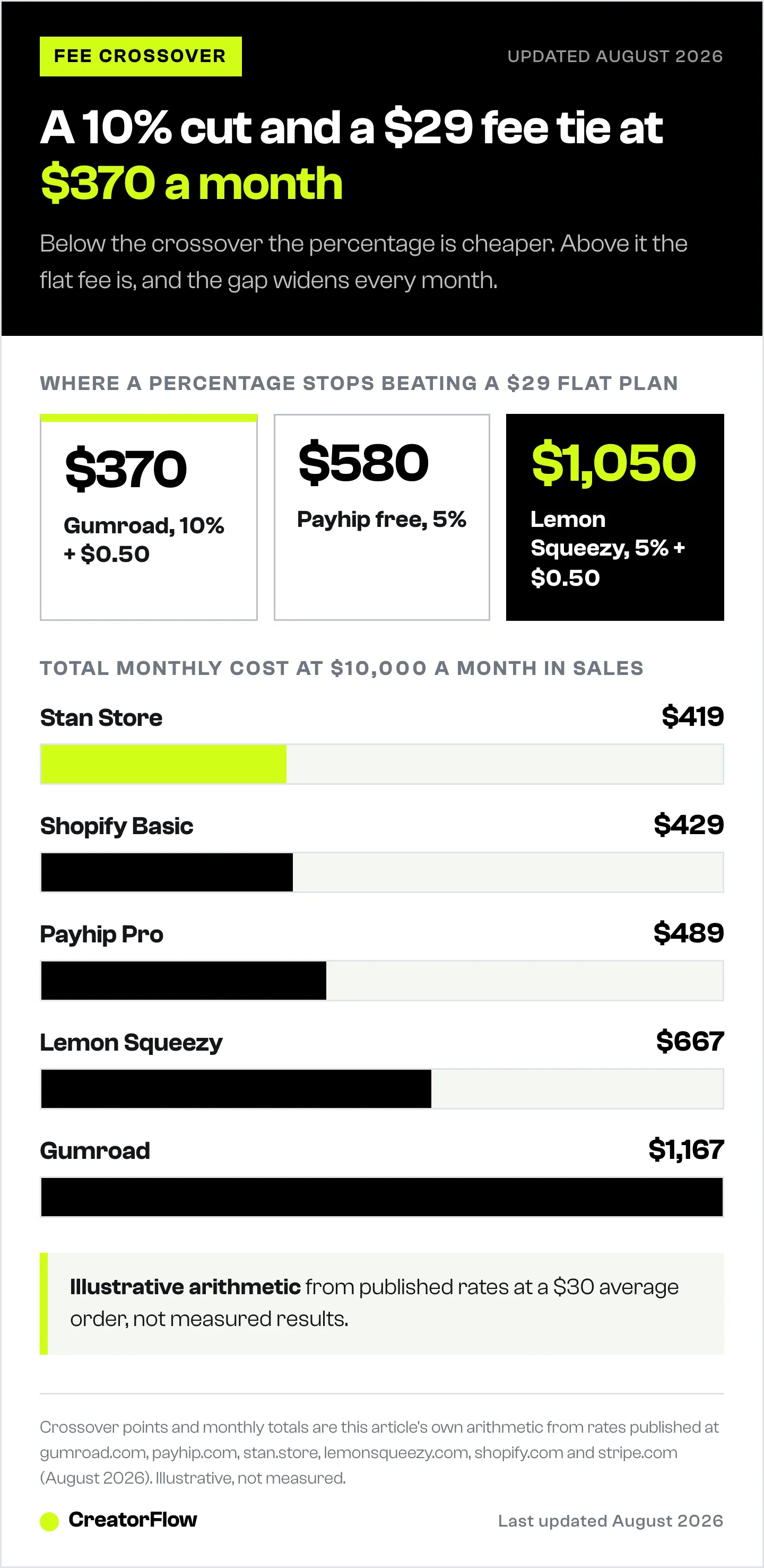
Here is the arithmetic for a $30 average order, a US seller, and Stripe’s standard 2.9% + $0.30 card rate where the platform does not bundle processing (stripe.com, August 2026).
- Gumroad (10% + $0.50) equals a $29/month flat plan at about $370 a month in sales. Under $370, Gumroad’s simplicity is free. Over it, you are paying a growth tax.
- Payhip’s free plan (5% plus processing) equals a $29/month flat plan at about $580 a month. That is the point where paying Payhip $29 for the Plus plan, or moving to Stan Store, starts returning more than it costs.
- Lemon Squeezy (5% + $0.50, processing included) equals a $29/month flat plan at about $1,050 a month. It holds out longest of the percentage platforms because there is no second bill from Stripe underneath it.
- Payhip Plus ($29 + 2%) equals Payhip Pro ($99 + 0%) at about $3,500 a month. Below that, the $99 tier costs more than the fee it saves.
These are illustrative calculations from published rates at a stated average order value, not measured results. Change the order value and the crossovers move: higher-priced products push every crossover down, because the fixed $0.30 and $0.50 per-sale fees stop mattering and the percentages dominate.
What Each Platform Costs at $500, $2,000 and $10,000 a Month
Same assumptions: $30 average order, US seller, monthly billing, Stripe’s 2.9% + $0.30 added where the platform does not include processing.
| Platform | $500/month | $2,000/month | $10,000/month |
|---|---|---|---|
| Lemon Squeezy | $33 | $133 | $667 |
| Payhip Free | $45 | $178 | $890 |
| Stan Store Creator | $49 | $107 | $419 |
| Sellfy (tier set by volume) | $49 | $157 | $549 |
| Gumroad | $58 | $233 | $1,167 |
| Payhip Plus | $59 | $147 | $619 |
| Shopify Basic | $59 | $117 | $429 |
| Payhip Pro | $119 | $177 | $489 |
Read the columns, not the rows. At $500 a month the whole field sits inside $86 and the choice barely matters. At $10,000 a month the spread is $748, and picking wrong costs about $9,000 a year for identical sales.
The Sellfy row moves tier as revenue grows: Starter at $500 a month, Business at $2,000, Premium at $10,000, because those revenue levels cross its annual volume caps.
One honest caveat on the Gumroad row. Gumroad’s pricing page publishes 10% + $0.50 per transaction with no monthly fee, and its fee help article sits behind a login, so the figures above apply Gumroad’s published rate with nothing added for card processing. Treat that row as the floor rather than the ceiling, and confirm the processing question with Gumroad before you commit at volume.
Who Pays the VAT on Your Sales
This is the part that costs people money quietly, and it almost never appears in a platform comparison.
Digital products sold to consumers in the EU are taxed at the rate of the customer’s country, not yours. The EU calls it destination-based VAT. A seller established in the EU can charge their own country’s rate while cross-border sales stay under EUR 10,000 a year, and above that threshold the buyer’s local rate applies (europa.eu, August 2026). A seller established outside the EU gets no threshold at all and registers through the Non-Union One Stop Shop scheme.
Three of the platforms take that job off your desk.
Gumroad became the merchant of record on January 1, 2025 and states it handles all sales tax collection and remittance worldwide, with tax settings removed from the seller dashboard entirely (gumroad.com, August 2026). That is a large part of what the 10% buys.
Lemon Squeezy is the merchant of record and bundles payment processing, global tax compliance and fraud handling into its 5% + $0.50 (lemonsqueezy.com, August 2026). Stripe acquired Lemon Squeezy, and the same team now also builds Stripe Managed Payments, Stripe’s own merchant-of-record product, so check which of the two you are signing up for before you migrate.
Payhip states it collects and remits EU and UK VAT on your behalf automatically on every plan, including the free one (payhip.com, August 2026).
Where a platform does not publish merchant-of-record status, assume the registration, the returns and the liability are yours. For a creator selling a $27 template to buyers in nine countries, that difference is worth more than a few percentage points of fee.
The Costs That Are Not on the Pricing Page
Four line items change the real number and none of them appear in a headline fee.
Payment processing is usually a second bill. Payhip, Stan Store, Sellfy and Shopify all connect your own Stripe or PayPal account, and those processors charge separately. Stripe’s standard US online rate is 2.9% + $0.30 per successful charge, plus 1.5% on international cards and 1% for currency conversion (stripe.com, August 2026). A platform advertising “0% transaction fees” means zero of its own.
International cards cost more than domestic ones. If a meaningful share of your buyers sit outside your own country, add the international and conversion surcharges to every calculation above. On a $30 sale that is another $0.75.
Payout fees exist. Lemon Squeezy charges $0.50 per payout to US accounts and 3% capped at $30 outside the US (lemonsqueezy.com, August 2026).
Volume caps force upgrades. Sellfy’s plans are bounded by annual sales, so growth changes your bill without you changing anything.
How to Pick in Five Minutes
There is no single best platform to sell digital products for everyone, so work down this list and stop at the first line that describes you.
- You have not sold anything yet. Start on Payhip’s free plan or Gumroad. Neither charges a monthly fee, so a month with no sales costs nothing, and you can move later without losing anything but an afternoon.
- You sell to buyers in the EU or UK and do not want tax registrations. Gumroad, Lemon Squeezy or Payhip. All three publish that they collect and remit the tax for you.
- You are doing $1,000 a month or more. Move to a flat-fee platform. Stan Store Creator at $29 or Shopify Basic at $39, both 0% platform cut, are the cheapest at volume in the table above.
- Instagram is your main channel. Stan Store is built around a mobile storefront for exactly that traffic, and Gumroad and Payhip links work identically well when the link is delivered in a DM.
- You sell physical products too. Sellfy and Shopify handle both. The others are digital-first.
- You also sell courses or 1:1 coaching. None of the six above is built for that. Compare the platforms that sell courses and coaching from the same account instead.
- Your order values are above $100. Percentage fees hurt more than fixed ones at high prices, so cross over to a flat monthly plan earlier than the $600 figure above.
Whichever you pick, the switching cost is low. These are checkout links and file hosts, not databases. Choose the cheap option for where you are now, and re-run the math when your monthly revenue doubles.
Getting Buyers to the Checkout Link
Every platform above ends at the same place: a URL. The platform’s job finishes there, and the part that decides your revenue starts.
The gap most creators never close is the one between a Reel that performs and a checkout page that nobody reaches. Someone watches, comments “link”, and waits. Four hours later they get a reply, and by then they have scrolled past two hundred posts. The checkout was never the problem.
Instagram DM automation closes it by sending the link the moment the comment lands. A follower comments your trigger word, the DM arrives in a few seconds with your Gumroad, Payhip or Stan Store URL inside it, and the buying impulse is still live. CreatorFlow does this at $15 a month flat, with click tracking on every link, geographic analytics on who is clicking, and a follow gate that requires the follow before the link goes out. It runs on Meta’s official Instagram API, and CreatorFlow has been a Meta Tech Provider since December 2025.
Practical starting points once your checkout link exists:
- Sell digital products on Instagram covers the content formats that generate link requests in the first place.
- Send Gumroad checkout links from Instagram DMs walks through the trigger-word setup end to end.
- If the product itself does not exist yet, launch a first digital product in seven days is the shortest path from idea to a live link.
- For a release rather than an always-on offer, the three-phase launch sequence handles waitlist, launch day and follow-up.
- Selling a service instead of a file? You can take deposits directly in DMs without a checkout platform at all.
FAQ
What is the cheapest platform to sell digital products?
The cheapest platform to sell digital products changes with your revenue. Under about $600 a month, Payhip’s free plan (5% per sale, no monthly fee) and Lemon Squeezy (5% + $0.50, processing included) are cheapest. Above about $1,000 a month, Stan Store at $29 a month and Shopify Basic at $39 a month cost less, because both take 0% of each sale (platform pricing pages, August 2026).
Can I sell digital products without a website?
Yes. Gumroad, Payhip, Stan Store and Lemon Squeezy all host the product, the checkout and the file delivery. You get a link, and that link is the entire storefront. Put it in your bio, or send it in a DM when someone asks for it.
Do I have to charge VAT on digital products sold to EU customers?
VAT on digital services sold to EU consumers is charged at the customer’s country rate. An EU-established seller can apply their own country’s rate while cross-border sales stay under EUR 10,000 a year; above that, the buyer’s rate applies and you file through the One Stop Shop. Sellers established outside the EU use the Non-Union scheme with no threshold (europa.eu, August 2026). Gumroad, Lemon Squeezy and Payhip publish that they handle this for you. Confirm your own position with a tax adviser.
Is Gumroad or Payhip better for a first product?
Both are free to start and neither charges monthly. Gumroad takes 10% + $0.50 per sale and acts as merchant of record worldwide. Payhip’s free plan takes 5% and connects your own Stripe or PayPal, which bills about 2.9% + $0.30 on top. Payhip is cheaper per sale at typical creator price points; Gumroad removes more tax admin.
What does Stan Store cost, and is there a free plan?
Stan Store Creator is $29 a month and Creator Pro is $99 a month, with 0% platform fee on sales and a 14-day free trial rather than a free plan (stan.store, August 2026). You still pay your own payment processor, around 2.9% + $0.30 per US card sale through Stripe.
Do these platforms charge payment processing fees on top of their own?
Payhip, Stan Store, Sellfy and Shopify connect your own Stripe or PayPal account, and those processors bill you separately. Lemon Squeezy includes processing inside its 5% + $0.50. A “0% transaction fee” claim refers to the platform’s own cut, never the card network’s.
How do I get people to the checkout link once I have one?
Trigger-word DM automation is the shortest route on Instagram. A follower comments a keyword on your post or Reel, and the checkout link arrives in their inbox in seconds instead of hours. That timing is what converts an impulse into a sale, and it works identically whichever checkout platform sits behind the URL.
Platform pricing, fee structures and merchant-of-record status verified from gumroad.com, payhip.com, sellfy.com, stan.store, lemonsqueezy.com, shopify.com and stripe.com in August 2026, and EU VAT rules from europa.eu in August 2026. Cost comparisons are illustrative arithmetic from published rates at a stated average order value, not measured results. Pricing changes without notice; confirm current rates before choosing a platform. Individual results vary.