

Take a deposit by sending a payment link the moment somebody agrees to the price, with a deadline attached. A deposit converts a verbal yes into a booking, and the gap between agreement and payment is where most Instagram bookings die. Send the link inside the DM, name what the deposit secures, and hold the slot only until the stated deadline.
They said yes. You said great, I will pop you in for the 14th. Then you spent three days holding a slot for somebody who never paid, turned down another enquiry for the same date, and eventually sent an awkward message asking whether they still wanted it. That is not a booking, it is an option you gave away for free.
This guide covers why the deposit is the actual close, how much to take, how to send a link without making it feel like a demand, what the message should say, and the sequence when somebody agrees and then goes quiet.
Key Takeaways
- A yes is not a booking. The deposit is the moment the sale exists.
- Send the link inside the conversation, not in a follow-up email hours later.
- Attach a deadline. “Held until Friday” converts far better than an open invitation.
- Twenty-five to fifty percent is the usual range, higher where you have real costs before the day.
- Say what the deposit does. It secures a date and covers preparation. That framing removes most resistance.
- State the refund position once, plainly, before payment rather than after a cancellation.
Why You Take a Deposit in the Instagram DM
For anything booked in advance, the deposit does three jobs that a verbal agreement cannot.
It commits the person. Money changes how a date is treated. Somebody who has paid turns up, replies to messages, and sends what you asked for.
It protects the slot. Once you hold a date, you are turning away other work for it. A deposit means you are turning that work away against something real.
It covers what you spend before the day. Materials, travel booked in advance, a room hired, preparation time. Without a deposit you carry all of that on a promise.
The gap between “yes” and “paid” is where bookings evaporate, and it is almost always caused by delay rather than reluctance. The person meant to pay, got busy, and by the time your reminder arrived their enthusiasm had cooled. Closing that gap to minutes is the whole technique.
How Much to Take
| Situation | Typical deposit | Why |
|---|---|---|
| Service booked for a specific date | 25% to 50% | Covers the slot you stop selling |
| Work with materials bought up front | Enough to cover the materials, often more | You are out of pocket before you start |
| Custom or made-to-order | 50% | The item has no resale value if they walk |
| Coaching or a programme with a start date | First month or 50% | Commitment matters more than cost recovery |
| Small, quick jobs | Full payment | A deposit process costs more than the job is worth |
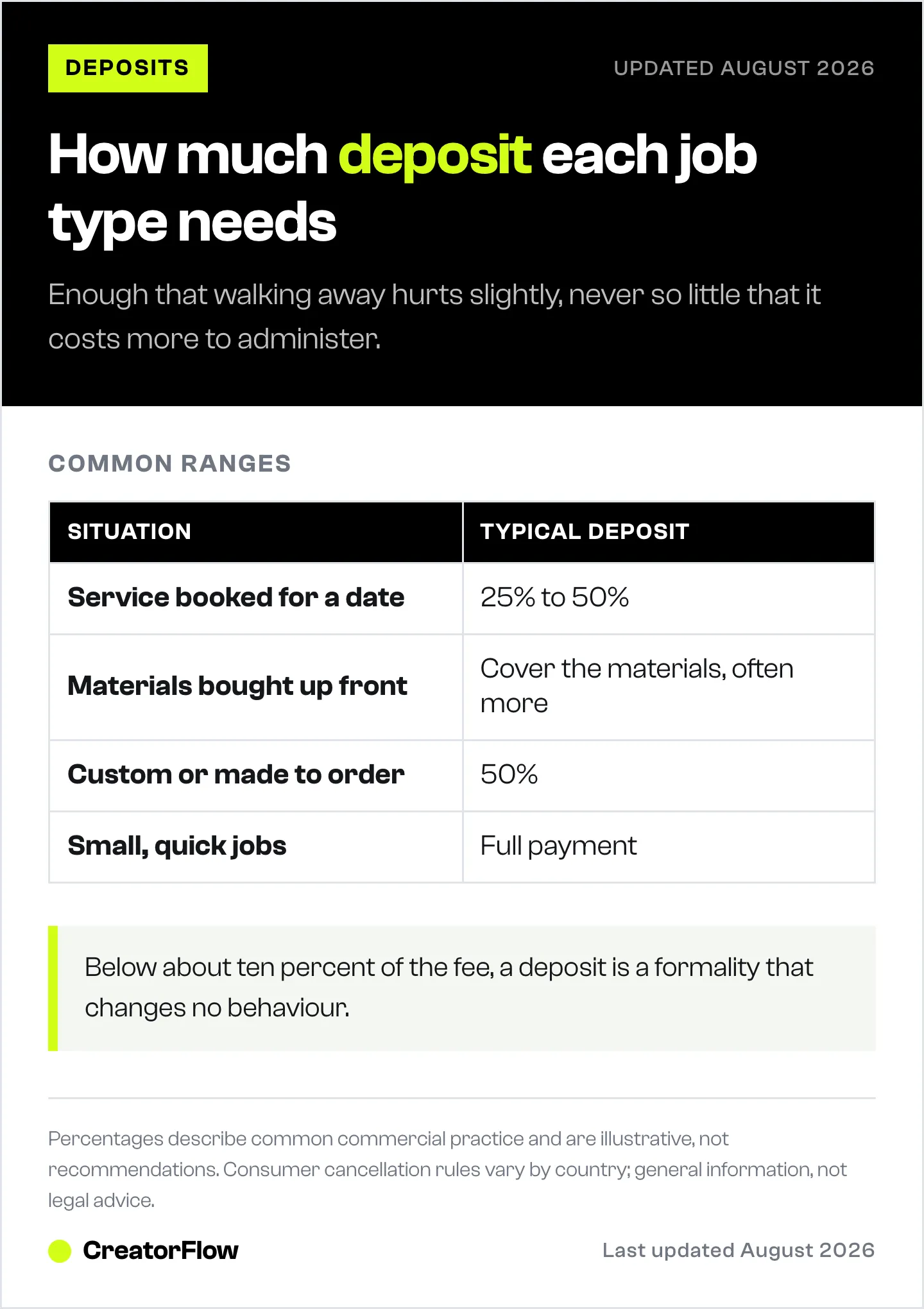
Two rules that hold across all of them. Take enough that walking away hurts slightly, and never take so little that the deposit costs more to administer than it protects. Below about ten percent of the fee, a deposit is a formality that does not change behaviour.
Where you have real up-front costs, say so. “The deposit covers the materials, which I order as soon as you confirm” is a reason rather than a policy, and reasons get paid faster.
How to Send the Link
Send it in the DM, in the same conversation, within a minute or two of the agreement. Most payment processors provide a shareable payment link you can create once per service and reuse, which means this takes seconds rather than being a job for later.
The message has four parts:
Confirm the thing. Restate the date, the service and the total, so there is no ambiguity later.
Name the deposit and what it does. Amount, and what it secures.
The link.
The deadline.
Lovely, that is the 14th at 10am, £480 total. To hold the date I take £150 now and the rest on the day. Here is the link: [link]. I will keep the 14th open until Friday evening, then it goes back in the diary.
That is 45 words and it removes every reason to delay. The deadline is doing most of the work, and it works because it is a fact about your diary rather than a sales tactic.
Three things to avoid in this message. Do not apologise for asking. Do not explain your payment policy at length. Do not ask whether a deposit is okay, because asking invites a negotiation about something that is standard in every service business.
What to Say About Refunds
State the position once, before payment, in one sentence. It prevents almost every difficult conversation later.
Deposits are non-refundable inside 14 days of the date, but I will always try to move you rather than lose it.
That sentence is short, it is clear, and the second half makes it feel reasonable rather than harsh. Most people never test it. The ones who do have been told already, which changes the conversation entirely.
Whatever your policy is, apply it consistently, and make sure it complies with the consumer rules in your country. Cancellation and refund rights for consumers vary by jurisdiction and by how the service is sold, so it is worth checking your position with a qualified adviser rather than copying another business’s wording. This article is general commercial information, not legal advice.
When They Agree and Then Go Quiet
A clear, calm sequence, and then let it go.
At the deadline, one reminder. Not a chase, a fact.
Hi, just to say the 14th is still held until tonight. Link is here if you would like it: [link]. If the timing has changed, no problem at all, tell me and I will release it.
The last sentence is the important one. It gives the person a socially easy exit, and an easy exit produces an answer where pressure produces silence.
After the deadline, release it and say so.
No problem, I have put the 14th back in the diary. Message me any time if you want to look at another date.
That message is worth sending rather than going quiet yourself. It ends the ambiguity, it costs you nothing, and a surprising number of people reply within an hour because losing the slot made the decision for them.
Then stop. If they were going to pay, the deadline was the moment. The wider follow-up discipline for enquiries that stall is in following up on a quiet price enquiry.
Getting to the Deposit Faster
Most of the delay happens before the deposit conversation, in the hours between somebody asking about you and getting an answer. Removing that is where automation belongs.
A working setup for a service business:
- A post or Reel about the service, with a keyword in the caption.
- A comment or keyword trigger that sends the price, what is included, and your availability window within seconds.
- A booking or enquiry link in that message so people who are ready can move immediately.
- You picking up the conversation, agreeing the date, and sending the deposit link.
The automated first message does the part where speed matters and the human does the part where judgement matters. CreatorFlow sends that first reply through Meta’s official Instagram API and tracks the clicks, so you can see which posts produce actual booking conversations rather than compliments. The structure for that first message is in answering “how much?” in Instagram DMs, and where the person pushes back on the number, handling price objections covers the replies.
One platform constraint shapes the timing. Meta’s standard messaging window gives 24 hours to respond to a person’s message, extendable to seven days with the human agent tag (developers.facebook.com, August 2026). A deposit conversation that drifts past a week needs a different channel, which is another argument for collecting an email when somebody is serious.
FAQ
How much deposit should you take for a booking?
Twenty-five to fifty percent is the common range for services booked on a date, and fifty percent is usual for custom or made-to-order work where the item has no value to anyone else. Where you buy materials before starting, take at least enough to cover them.
Can you take payment directly inside Instagram DMs?
You send a payment link and the person pays through your processor, so the transaction happens outside the app while the conversation stays in it. Creating one reusable link per service means sending it takes seconds, which is what keeps the booking from cooling.
What do you say when asking for a deposit?
Confirm the date and total, state the deposit amount and what it secures, send the link, and give a deadline for when you release the slot. Do not ask whether a deposit is acceptable. It is standard practice, and asking invites a negotiation you do not need to have.
Should deposits be refundable?
That is your decision and it needs to fit the consumer rules where you operate. Whatever you choose, state it in one sentence before payment rather than after a cancellation, and apply it consistently. Offering to move a booking rather than refund it resolves most cases.
What if someone agrees to the price but never pays the deposit?
Send one reminder at your deadline that includes an easy way out, then release the slot and tell them you have. Going quiet yourself leaves the date blocked and the conversation unresolved, which is the worst of both outcomes.
Does asking for a deposit put people off?
It filters rather than repels. Customers who intend to turn up expect a deposit, because every service business they use takes one. The people it puts off are disproportionately the ones who were going to cancel.
How quickly should you send the payment link?
Within a minute or two of the agreement, in the same conversation. Every hour between the yes and the link is an hour for the person’s enthusiasm to fade and for something else to take their attention.
Instagram messaging window verified from developers.facebook.com as of August 2026. Deposit percentages and message examples are illustrative of common practice, not recommendations for your business. Consumer cancellation and refund rules vary by country; this is general commercial information and not legal advice.


