

Follow up on a quiet price enquiry by hand, twice, with something useful attached each time. Meta’s standard messaging window gives your app 24 hours to respond to a person’s message, extendable to seven days with the human agent tag, so automated follow-ups weeks later are not something the platform offers (developers.facebook.com, August 2026). The follow-up is manual work, and it is worth doing because most sales happen after the first reply.
You sent the price. Then nothing. The message shows as seen, the conversation sat there for four days, and now sending anything feels like begging. So you send nothing, and a lead who was interested enough to ask what things cost quietly becomes someone who bought from somebody else.
This guide covers what the platform actually permits, why “just checking in” fails, the two follow-ups worth sending, how to space them, and how to build a system so the follow-up takes five minutes a week instead of living in your head.
Key Takeaways
- Silence is pending, not no. People check budgets, ask partners, and get busy. Read a quiet thread as unfinished.
- Two follow-ups, then stop. Each one carries something useful. A third costs more relationship than it recovers.
- “Just checking in” gets ignored because it asks for something and gives nothing.
- Closed questions beat open ones after silence. Two easy options get answered when “any thoughts?” does not.
- Meta’s window is real. 24 hours standard, seven days with the human agent tag (developers.facebook.com, August 2026). Plan the follow-up around it.
- Automate the first reply, do the follow-up yourself. The volume is small and the value per person is high.
What the Platform Actually Allows
Worth being precise about, because a lot of advice assumes an email-style drip sequence is available here. It is not, and the reason is Meta’s messaging rules rather than any particular tool.
Under Meta’s standard messaging window, an app has 24 hours to respond to a message an Instagram user sent, and only after the user has messaged the professional account first. The human agent tag extends the response time to seven days, and its stated purpose is human support where a person’s issue cannot be resolved inside the standard window, for example when a business is closed for the weekend (developers.facebook.com, August 2026).
What that means in practice:
| Timing | What is available |
|---|---|
| Seconds after they message or comment | Automated reply with your price and offer |
| Within 24 hours | Standard messaging, replies flow normally |
| Up to 7 days | Human agent tag, for a person picking the thread back up |
| Beyond 7 days | You need them to message you again, or another channel |
The design conclusion is simple. Put the automation at the front, where it is allowed and where speed matters most, and treat the follow-up as human work. That is not a workaround. It is how the platform is built, and it is also why the follow-up that does happen carries weight: the person can tell a human wrote it.
The other conclusion is to collect an email address when someone shows real buying intent. Email has no seven-day ceiling. A DM that ends with “want me to send the full breakdown by email?” converts a closing window into an open one.
Why “Just Checking In” Fails
“Just checking in” is the default follow-up and it is the weakest message you can send. It asks the person for a decision, gives them nothing, and reminds them they owe you something. Most people answer that by not answering.
Three things go wrong at once:
- It has no content. There is nothing to react to, so replying takes more effort than ignoring.
- It signals you are waiting. That transfers pressure to them and lowers your position at the same time.
- It repeats the last message. They already have the price. Sending the same conversation again does not change the decision.
The replacement rule: every follow-up must carry something the person would want even if they never buy. A relevant example, a photo, an answer to a question they did not ask, a change in availability. Give the message a reason to exist that is not “have you decided yet”.
Follow-Up One: The Useful Thing
Send it roughly 48 hours after the price, not the same evening. Same-day follow-ups read as anxiety and they cost you the anchor you just set.
The shape is a piece of proof plus a closed question.
Thought of you when this came in. Same setup as what we talked about, finished last week, and she was in exactly your spot before it. Is the price the blocker, or is it more about timing?
Two jobs, one message. The proof answers the doubt they did not voice. The closed question gives two doors that are both easy to walk through, and each one tells you what to do next. “The price” sends you into handling price objections. “Timing” means set a date and stop selling.
Other things that work as the useful half, in rough order of strength:
- A result from someone similar, with the detail that makes it recognisable.
- A photo of the actual thing, especially for physical products.
- An answer to the obvious next question: how long it takes, what happens in week one, what they need to have ready.
- A genuine change: one slot left this month, a price rising, a new option that fits them better.
Do not stack all four. One item, one question, under 50 words.
Follow-Up Two: The Clean Close
Send this a week to ten days after the first. It is the last message you send, and its job is to make it easy to say no.
No pressure at all, I will stop here. If it is a no for now that is completely fine, just say and I will leave you to it. If it is a not-yet, tell me roughly when and I will check back then.
That message performs better than almost anything else because it removes the thing making the person avoid you. They are not ignoring you because they hate you. They are avoiding an awkward conversation. Giving them a socially easy exit means they take one of the doors instead of neither.
A meaningful share of these come back with “sorry, been mad here, can we do January?” which is a sale with a date attached. Some come back with a straight no, which is worth more than a maybe you carry around for six months.
Then genuinely stop. The credibility of “I will stop here” is what makes it work, and a third message after it teaches the person that nothing you say is load-bearing.
Spacing, and How Many
The pattern that holds up across offer types:
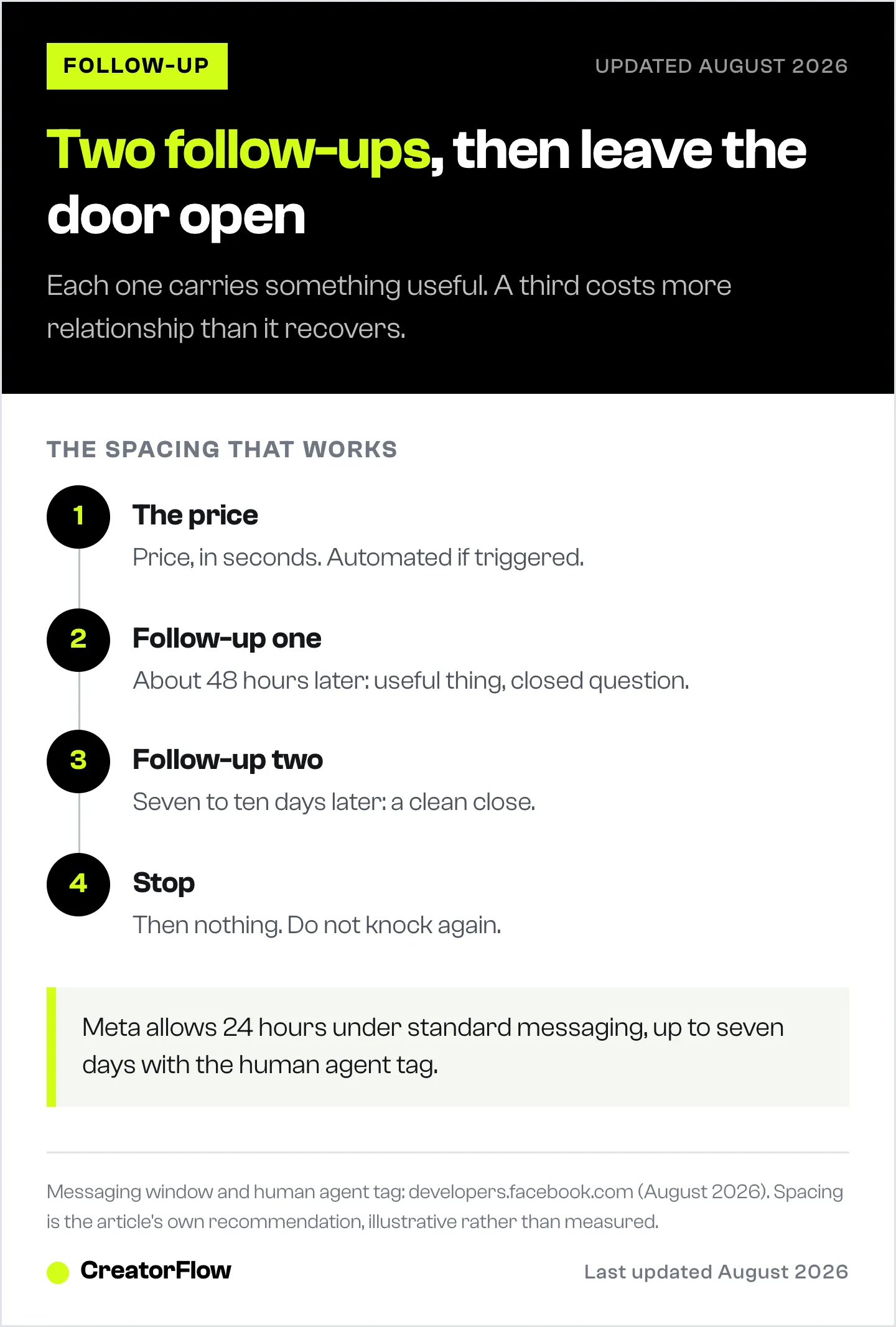
| Message | Timing | Job |
|---|---|---|
| Price | Immediately, automated if triggered by a comment or keyword | Answer the question, ask one back |
| Follow-up one | About 48 hours later | Useful thing plus a closed question |
| Follow-up two | 7 to 10 days after that | Clean close, easy exit |
| Nothing | After that | Leave the door open, do not knock |
Two exceptions. If the person replied to follow-up one with a date, that date is your next contact and the sequence resets. If the offer has a real deadline, one extra message naming the deadline is fair, provided the deadline is real. Invented urgency is noticed more often than people think, and it is remembered.
Make It Take Five Minutes a Week
The reason follow-ups do not get sent is not discipline, it is that they live in your head alongside everything else. A list fixes that.
The lightest version that works is four stages in a spreadsheet or your notes app: Asked, Quoted, Followed up, Closed. One row per person, with the date of the last message and one line about what they wanted. Once a week you open it, look at anything sitting in Quoted for more than two days, and send the next message.
Instagram’s own tools cover part of this. Flag the conversation, or move it to a folder, so quiet price threads are findable instead of buried under 200 comment notifications. The wider version of this pipeline, including qualifying and closing, is laid out in closing sales in Instagram DMs.
What automation contributes is the top of the funnel and the record. CreatorFlow sends the first reply the moment somebody comments your keyword, delivers your price and your link through Meta’s official Instagram API, and tracks the clicks so you can see which posts produced price conversations. Getting that first message right removes a chunk of the follow-ups entirely, because a person who received a clear number, an outcome and a question is far more likely to answer the first time. The structure for it is in answering “how much?” in Instagram DMs.
FAQ
How long should you wait before following up on a price enquiry?
About 48 hours. Same-day follow-ups read as nervous and undercut the price you just gave. Waiting more than three or four days lets the conversation go cold and pushes you towards Meta’s seven-day human agent limit, after which you need the person to message you first (developers.facebook.com, August 2026).
How many times should you follow up in Instagram DMs?
Twice. The first carries something useful and a closed question. The second is a clean close that makes saying no easy. A third message rarely converts and reliably damages how the person remembers you.
Can you automate follow-up messages on Instagram?
Automation belongs at the start of the conversation, where a reply is triggered by a comment, keyword or story reply and sent within seconds. Meta’s messaging rules give a 24-hour standard window and up to seven days with the human agent tag, so a follow-up sequence running for weeks is not something the platform provides. Collect an email if you want a longer runway.
What do you say instead of “just checking in”?
Say something with content. A result from a similar client, a photo, an answer to the question they were probably about to ask, or a genuine change in availability. Then ask a closed question that splits the two likely blockers, price or timing.
Should you follow up if they read the message and said nothing?
Yes. A read receipt with no reply usually means the person saw it at a bad moment and meant to come back. That is the single most common reason for silence, and it is not a rejection.
What if they say “let me think about it” and go quiet again?
Ask for a date instead of a decision. “Shall I check back the first week of next month?” turns an open loop into a diary entry, and it gives you a legitimate reason to return that is not a sales message.
Is it worth following up on old price enquiries from months ago?
Only if you have a real reason, and only through a channel that allows it. Meta’s window will have closed, so a cold DM is not available. An email, if you captured one, or a post that brings them back to comment, are the routes that work.
Instagram messaging window, human agent tag and standard messaging rules verified from developers.facebook.com as of August 2026. Message examples are illustrative, not measured results. Individual results vary.


