

The right DM length tracks the price. A low-priced product sells in one message with a link, because the decision is small and any extra text adds friction. A mid-priced offer needs one qualifying question before the price. A high-priced offer needs a conversation across several messages, and sending its price in the first reply usually ends it. Using one script for all three is the most common reason DM offers fail.
You wrote a good message. It sells your £27 template beautifully. Then you use the same structure for your £2,400 programme, send the price in message one, and get nothing back. The script was not wrong, it was aimed at a decision ten times smaller than the one you were asking for.
This guide covers three complete scripts, one per price band, what changes between them and why, and how to decide which one a given conversation needs.
Key Takeaways
- Length tracks price. Small decision, one message. Large decision, several.
- Under about $100: lead with the link. Persuasion adds friction, it does not add sales.
- $100 to $1,000: one qualifying question, then the price and the outcome.
- Over $1,000: no price in the first message. Qualify, then quote in context.
- Automate the first message at every tier. What changes is what that message tries to do.
- Meta’s window is 24 hours for standard messaging, extendable to seven days with the human agent tag (developers.facebook.com, August 2026). High-ticket conversations need an email backup.
Why an Instagram DM Sales Script Changes With the Price
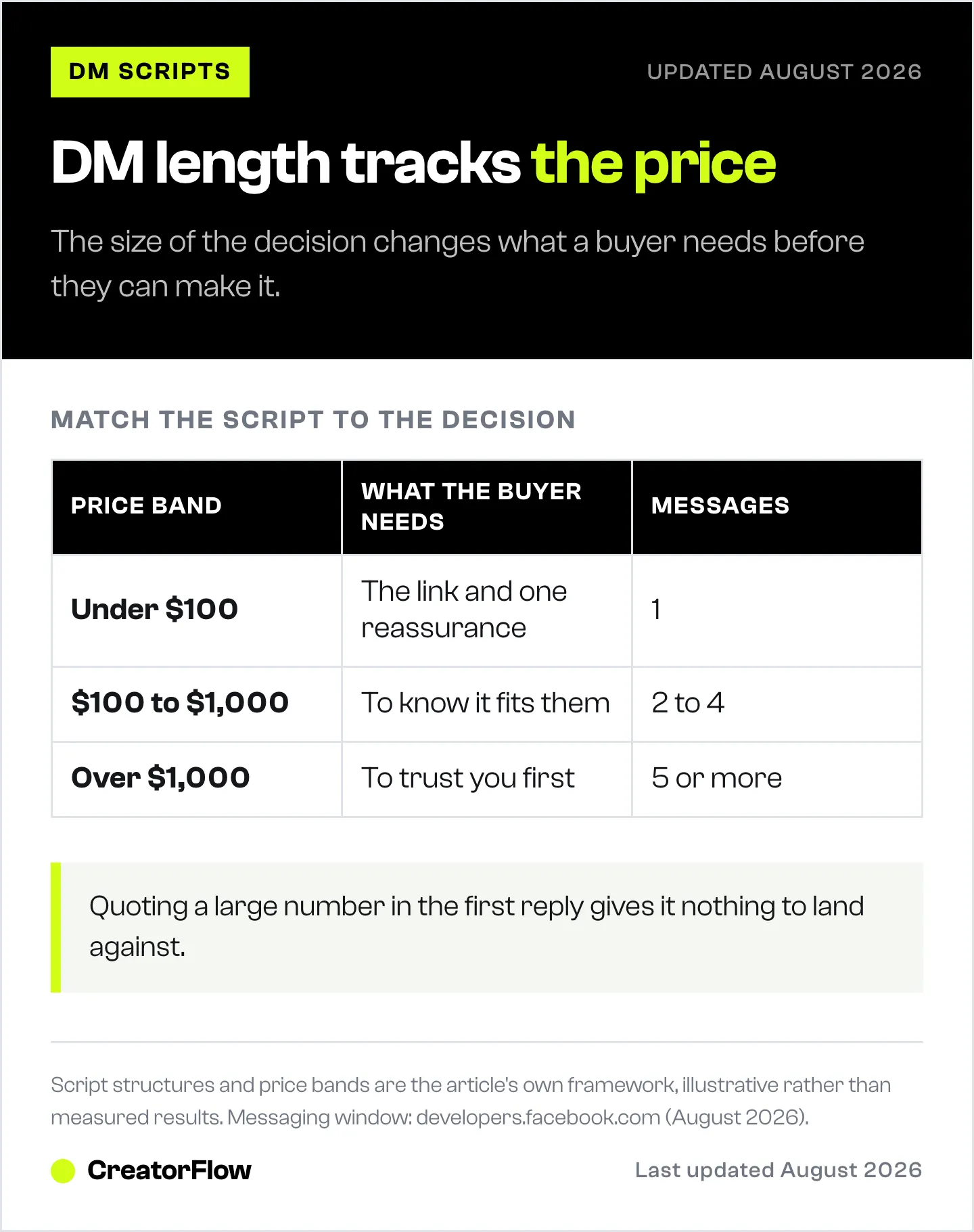
The size of the decision changes what the buyer needs before they can make it.
| Price band | What the buyer needs | Messages to close |
|---|---|---|
| Under $100 | The link, the price, one line of reassurance | 1 |
| $100 to $1,000 | To know it fits their situation | 2 to 4 |
| Over $1,000 | To trust you, and to see themselves in the result | 5 or more, often plus a call |
Two failure modes follow from ignoring this.
Overselling a small purchase. Three paragraphs of persuasion on a £27 product introduces doubt where there was none. Somebody deciding whether to spend the price of a lunch does not want a case study, they want the link.
Underselling a large one. Quoting £2,400 in the first reply to somebody who has not told you their situation gives them a number with nothing attached to it. They compare it to their bank balance and stop replying. The reasoning behind quoting cleanly, and when to hold the number back, is in answering “how much?” in Instagram DMs.
Script One: Under $100, Sell in One Message
The whole job is to remove steps. This message should be fully automated, triggered by a comment or keyword, and it should end at a checkout.
Here it is: [link]
It is the exact template I use, $27, and it takes about ten minutes to set up. If it does not do what you need, message me and I will refund it.
Structure: link, price, time to value, risk removed. Four elements, under 40 words.
What to leave out at this price: your story, testimonials, a list of features, a question. Each one adds a beat to a decision that should take fifteen seconds, and every extra beat loses people.
The refund line is doing real work. At a low price, the objection is rarely “can I afford it”, it is “will this be rubbish”. Removing the downside is faster and cheaper than arguing the upside. Only include it if you will honour it.
Script Two: $100 to $1,000, Ask One Thing First
At this price the buyer needs to know it applies to them. One question does that, and the price follows immediately in the same thread.
Message one, automated:
Sent you the outline here: [link]
Quick question so I can tell you whether it is the right fit: are you starting from scratch, or do you have something running already that is not converting?
Message two, after they answer:
That is the exact situation it is built for. It is $600, runs six weeks, and by the end you will have [specific outcome] set up and tested. Two review points with me along the way so you do not go three weeks in the wrong direction.
Are you looking to start this month or later?
Structure: resource, one question, then outcome, price, mechanism, and a timing question. The order matters. The outcome comes before the number so the number lands against something.
Note that the question is closed and gives two options. Open questions in DMs produce short non-answers or silence, because composing a paragraph about your business is work.
Script Three: Over $1,000, No Price in Message One
At high ticket the first message sells the conversation, not the offer. Quoting immediately reliably kills these threads.
Message one, automated:
Here is the breakdown I mentioned: [link]
Worth asking before I say anything about how I would approach it: what does your current setup look like, and what is the bit that is not working?
Message two, after they describe the situation:
That is a familiar pattern. The reason it stalls is usually [specific diagnosis], not effort. Two things I would change first: [one] and [two]. Have you tried either?
Message three:
Want me to walk you through what fixing it properly looks like? Takes about twenty minutes and you will get the plan whether or not we work together.
Then, in the conversation or on the call:
Working together on this is $2,400, over three months. That covers [scope]. Most people in your position are losing more than that in [specific cost] over the same period.
Structure: resource, diagnostic question, free insight, invitation, and only then the price, anchored against a cost the person has already described to you.
The free insight in message two is the part people skip and it is the part that works. Giving away a real diagnosis before asking for anything establishes that you know what you are doing, which is the actual purchase decision at this price.
One practical constraint: these conversations run over days. Meta’s standard messaging window gives 24 hours to respond, extendable to seven days with the human agent tag (developers.facebook.com, August 2026), so get an email address once the conversation is real. “Want me to send the plan over email so it is not lost in DMs?” does that naturally.
What Changes and What Does Not
Across all three scripts, five things stay constant:
- Plain language. No jargon, short sentences.
- One ask per message. Two requests in one message gets neither answered.
- The last line is a question, except at the lowest tier where the last line is the link.
- Specific outcomes, not feature lists.
- No invented urgency. Real deadlines work, fake ones are noticed.
What changes:
| Under $100 | $100 to $1,000 | Over $1,000 | |
|---|---|---|---|
| Price in first message | Yes | No, second | No, much later |
| Question first | No | Yes, one | Yes, diagnostic |
| Length | Under 40 words | Two short messages | Several, plus a call |
| Automated portion | The whole sale | The opening and the resource | The opening only |
| Proof needed | A refund promise | One relevant example | A diagnosis they recognise |
The tiering logic behind having three price points at all is in turning one offer into three price tiers.
Setting These Up
Each script starts with an automated first message triggered by a comment, keyword or story reply, so the response arrives in seconds rather than hours. What differs is the job that message does: a checkout at the bottom, a qualifier in the middle, a diagnostic at the top.
CreatorFlow handles the trigger and the first message through Meta’s official Instagram API, supports multiple keyword variations, and can collect an email before the link goes out, which matters most on the higher-priced offers where the conversation outlives the messaging window. Click tracking per automation shows which posts produce which kind of buyer, which over a few weeks tells you whether your high-ticket content is reaching high-ticket people. The setup walkthrough is in the Instagram DM automation guide, and the objections that follow these scripts are covered in handling price objections in Instagram DMs.
FAQ
How long should a sales DM be?
As long as the decision is large. Under $100, one short message with the link. Between $100 and $1,000, two short messages with one question between them. Over $1,000, a conversation across several messages before any price is named.
Should you send the price in the first DM?
At low and mid prices, yes, because withholding it wastes the buyer’s time and yours. Above roughly $1,000, no. A large number with no context attached gets measured against the person’s bank balance rather than against the result.
What is the best first line for a sales DM?
Whatever they asked for, delivered. If somebody commented a keyword to get a resource, the first line is the resource. Opening with a pitch instead of the thing they requested is the fastest way to lose the conversation.
How many questions should you ask in a DM?
One per message. Two requests in a single message reliably gets one of them answered and usually the easier one. Closed questions with two options get answered far more often than open ones.
Can you automate a high-ticket DM script?
Automate the opening: the resource delivery and the first diagnostic question. The diagnosis, the reframe and the close need judgement about a specific person’s situation, and an automated attempt at those reads as a script at exactly the moment trust is being decided.
What do you do when someone stops replying mid-script?
Give it 48 hours, then send one message carrying something useful and a closed question splitting price from timing. One more after a week to close it cleanly. The full sequence is in following up on a quiet price enquiry.
Should the same script work for Stories replies and comments?
The structure transfers, the opening does not. A story reply is a response to something specific you just showed, so reference it. A comment reply should deliver whatever the keyword promised. Generic openings underperform in both.
Instagram messaging window and human agent tag verified from developers.facebook.com as of August 2026. Scripts, prices and outcomes shown are illustrative examples, not measured results. Individual results vary.


