

Split one offer into three tiers by changing how much of the work you do, not by removing value. The bottom tier gives the buyer the method to apply themselves, the middle adds your input at defined points, and the top adds your direct involvement. The same underlying material carries all three, which is why this adds revenue without adding three times the delivery load.
You sell one thing at one price. Everybody who cannot afford it leaves and everybody who would have paid double pays what you asked. Two groups of buyers walk past every month and you see neither of them, because a single price is a single door and most people are not standing in front of it.
This guide covers where the three tiers come from, what actually changes between them, how to price the gaps, why the middle tier is the one that does the work, and how to sell them in a DM without turning the conversation into a menu.
Key Takeaways
- Change the delivery, not the outcome. All three tiers should reach the same result by different routes.
- The bottom tier is your method without you. Templates, a recording, a documented process.
- The middle tier is where most revenue comes from, and it is the one to design first.
- Price gaps of roughly 3x to 10x keep the tiers meaningfully different.
- Three is the number. Two forces a binary, four introduces paralysis.
- Never present all three at once in a DM. Ask one question, then name one tier.
Where the Three Tiers Come From
Take the offer you already sell and ask what the buyer is actually paying for. Almost always it is three separable things: the method, feedback on their application of it, and your direct involvement in doing it.
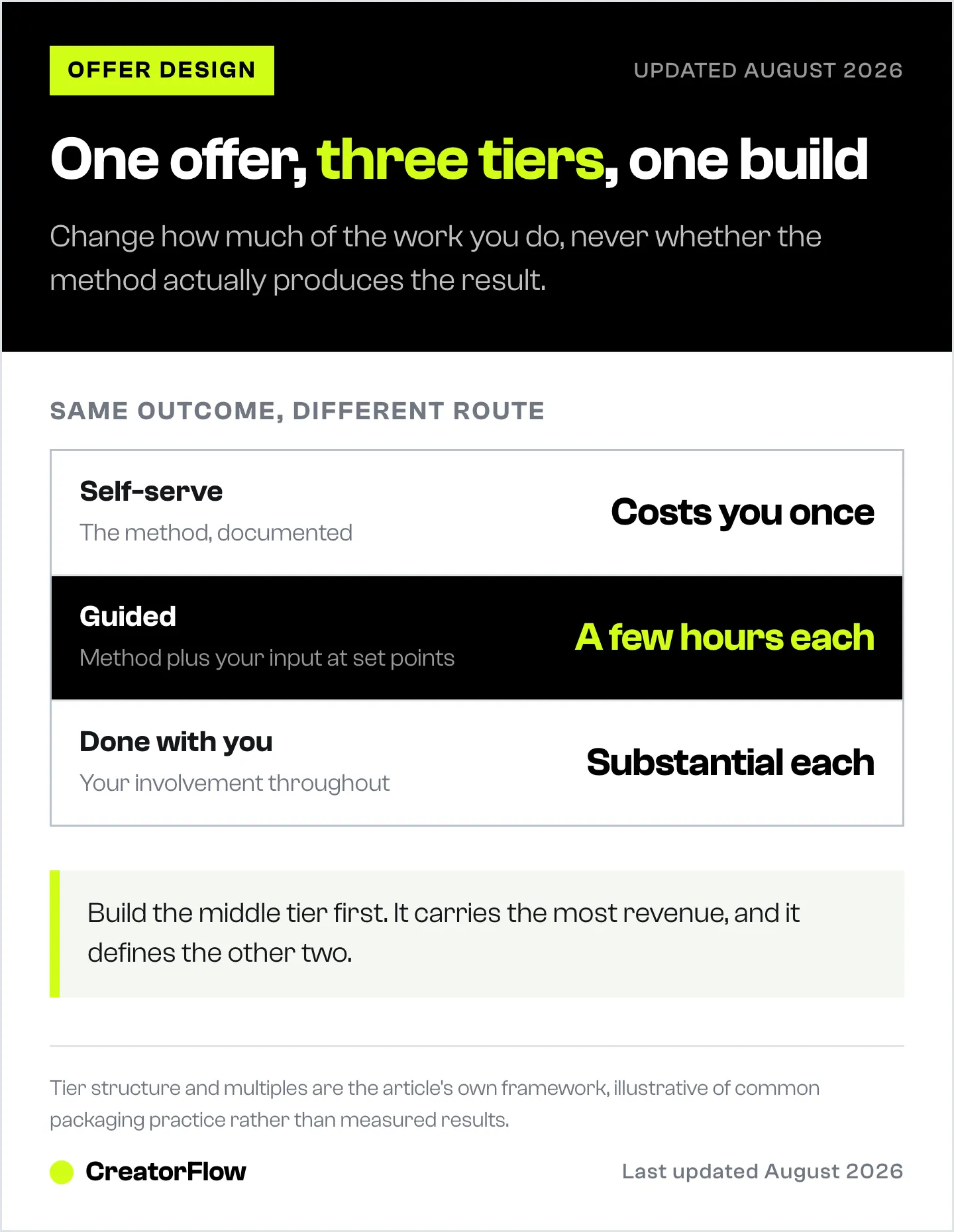
That gives the ladder.
| Tier | What the buyer gets | What you spend |
|---|---|---|
| Self-serve | The method, documented. Templates, a recording, a checklist | Once, up front |
| Guided | The method plus your input at defined points. Reviews, a call, a group | A few hours per buyer |
| Done with or for you | Your direct involvement throughout | Substantial per buyer |
The important property is that the outcome is the same in all three. A buyer at the bottom is not buying a worse result, they are buying a slower and more effortful route to it. That framing keeps the low tier honest, and it is what makes upgrading feel natural rather than like admitting defeat.
The failure mode is building three tiers by removing features until the cheap one is useless. A bottom tier that cannot produce a result damages your reputation with the largest number of people, and those people are your future middle tier.
Build the Middle Tier First
Counterintuitive, and it is the thing that makes this work.
The middle tier is where most buyers land. It carries the highest volume of revenue in most creator businesses, because it is affordable to a wide group while still being priced properly. Design it first, and let the other two define themselves against it.
To build it: take your existing offer, and identify the two or three moments where your input changes the outcome most. Usually those are the start, where the plan is set, and a review point partway through where mistakes get caught. Everything between those moments is the buyer doing the work, and it does not need you present.
That produces a tier that costs you a few hours per buyer instead of many, at a price much closer to your top tier than to your bottom one. Then:
- The bottom tier is that same material with the input moments removed. It costs you nothing per additional buyer.
- The top tier is the middle tier with your involvement extended across the whole thing, plus access.
One build, three products.
Price the Gaps
Tiers that sit too close together give the buyer no reason to choose, and they make the top tier look like a rounding error rather than a different proposition.
A workable shape:
- Bottom: a self-serve price. Low enough to be an easy decision, high enough to be taken seriously.
- Middle: roughly three to five times the bottom.
- Top: roughly three to ten times the middle.
The exact multiples matter less than the principle: each step should feel like a different decision. When the middle is only slightly more than the bottom, buyers take the middle without thinking, which sounds good and means you underpriced the middle.
Two structural rules:
Name the tiers by who they are for, not by metal. “Templates”, “Coached” and “Done with you” tell somebody which one they are. Bronze, Silver and Gold tell them nothing and make everyone want Gold or feel insulted by Bronze.
Make the top tier genuinely limited. Four places a quarter, because that is what you can deliver. Scarcity that is a fact about your capacity is credible in a way that invented scarcity is not.
How to arrive at the underlying numbers in the first place is covered in pricing an offer for an Instagram audience.
What Changes Between Tiers, and What Never Should
Change these:
- How much of the work you do.
- Speed. Faster turnaround, priority replies.
- Access. Group, then scheduled, then direct.
- Personalisation. Generic, then reviewed, then built for them.
- Depth. One area, then several, then everything.
Never change these:
- Whether the method actually works. Do not hold back the part that produces the result.
- Quality of materials. Same templates, same recordings.
- Basic support. Somebody who paid you anything should be able to ask a question.
- Honesty about what is included. Every tier’s description should be accurate enough that nobody feels tricked at the point of delivery.
That first one is the line that separates a tiered offer from a bait offer. If the bottom tier omits the crucial step to force an upgrade, buyers notice, and the reviews follow them around.
Selling Tiers in a DM Without Making a Menu
The mistake is pasting all three options into the conversation. A DM is a small space and three options with prices reads as a price list, which invites comparison shopping rather than a decision.
Ask one question, then name one tier.
Quick one so I point you at the right thing: have you tried doing this yourself already, or are you starting from scratch?
Their answer routes them, and the reply you send next depends on which tier you named, because price objections at the top of a ladder are rarely the same objection as at the bottom:
- Starting from scratch, low budget signals leads to the bottom tier.
- Tried it, got stuck leads to the middle tier. This is most people.
- No time, wants it handled leads to the top tier.
Then name that one with its price and what it does. Mention a second only if they ask, or if the first is clearly wrong for them:
Based on that, the coached option is the one, £600, and it gets you through in six weeks with two reviews from me along the way. There is a self-serve version at £150 if you would rather work through it alone. Which sounds closer?
One recommendation, one alternative, one question. That converts better than a menu because you have done the choosing, which is what the person actually wanted.
Where the Tiers Meet Your DMs
Tiers change what automation is for. With one price, the automated first message states it. With three, the first message should sort rather than list.
The pattern that works: the automated reply delivers the method overview and the one sorting question, then you take over and name the tier. The bottom tier can often be sold entirely from the automated message with a direct link, because a self-serve product at a low price does not need a conversation.
That gives a useful split. Software sells the bottom rung and qualifies for the other two. You spend your conversation time on the middle and top tiers, where it is worth having.
CreatorFlow triggers on comments, keywords and story replies through Meta’s official Instagram API, delivers the link, and can collect an email before it goes out, which matters most for the bottom tier where the buyer may not be ready today. Click tracking per automation shows which posts produce which kind of buyer. The scripts for each tier are in Instagram DM offer templates by price point.
FAQ
How many price tiers should you have?
Three. Two forces a yes-or-no decision and loses everyone in the middle. Four or more introduces enough comparison that people delay, and delay usually means no purchase at all.
What should the cheapest tier include?
Your method, documented well enough that somebody can get the result on their own. Templates, a recording, a checklist, a process. It should work without you, and it should genuinely work, because those buyers become your middle tier later.
How big should the gap between tiers be?
Roughly three to five times from bottom to middle, and three to ten times from middle to top. Each step should feel like a different decision. Tiers that sit close together get chosen without thought, which usually means the higher one was underpriced.
Which tier makes the most money?
The middle one, in most creator businesses. It is affordable to a wide group and priced properly, so it carries volume and margin at once. Design it first and let the other two define themselves against it.
Should you show all three tiers in a DM?
No. Ask one question about where the person is, then recommend one tier and mention at most one alternative. A list of three options with prices turns a conversation into comparison shopping and slows the decision down.
Can you add tiers to an offer you already sell?
Yes, and it is easier than building from scratch. Your existing offer is usually the middle or top tier already. Strip your involvement out to create the self-serve version, and extend it to create the top one.
How do you avoid the cheap tier cannibalising the expensive one?
Make the difference about effort and speed rather than about whether it works. Buyers who choose self-serve were rarely going to buy the top tier, and a good bottom tier produces the results and testimonials that sell the higher ones.
Price multiples and figures in this article are illustrative of common packaging practice, not measured results or recommendations for your business. Individual results vary.


