

Handle a price objection by finding out what it actually means before you answer it. “Too expensive” is usually one of three things: no money, no urgency, or no belief that the offer works. Each needs a different reply, and only one of them is about money. Discounting on reflex answers the wrong question and lowers your price permanently.
You quoted £900. They wrote back “that’s a bit more than I was expecting” and now you are staring at the message trying to decide between dropping to £700 and saying nothing at all. Both are bad. One costs you £200 and teaches the person your prices are soft, the other ends a conversation with someone who was interested enough to reply.
This guide covers the five price objections that show up in Instagram DMs, what each one is really saying, a reply for each, and the point where the honest move is to let the person go.
Key Takeaways
- “Too expensive” is a category, not a reason. Diagnose before you respond: no budget, no urgency, or no belief.
- Never discount in the first reply. A price that drops under mild pressure was never a price. Reframe, resize, or hold.
- Offer a smaller version, not a cheaper one. Less scope at a lower price protects your rate. The same scope at a lower price destroys it.
- “I’ll think about it” needs a closed question, because open questions after hesitation get silence.
- A clean no is worth more than a bad yes. Discounted clients are consistently the ones who need the most attention.
- Reply inside the window. Meta gives you 24 hours to respond under standard messaging, and up to seven days with the human agent tag (developers.facebook.com, August 2026).
How to Diagnose Price Objections in an Instagram DM
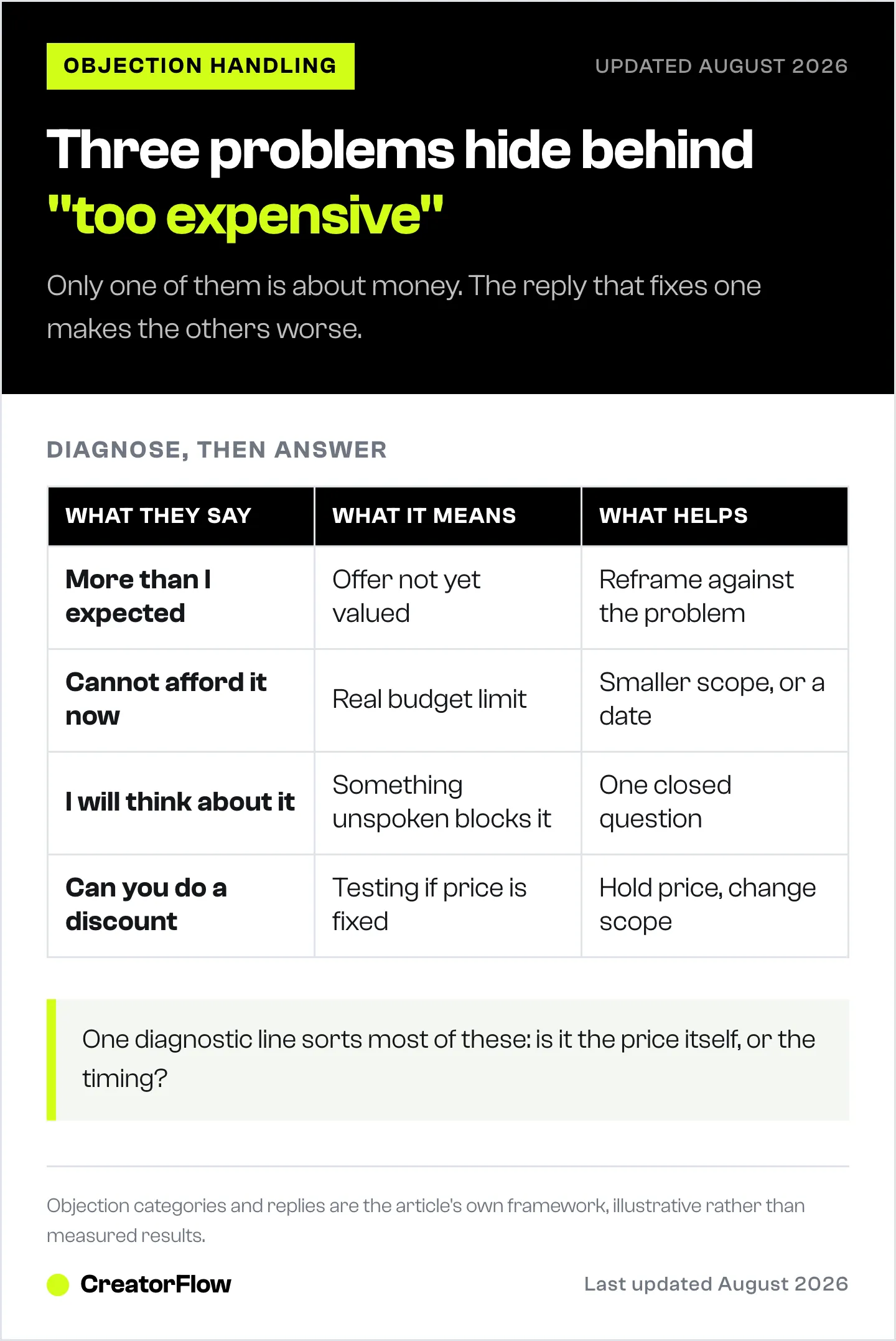
Every price objection is one of three things, and the reply that fixes one makes the others worse.
| What they say | What it usually means | What actually helps |
|---|---|---|
| ”That’s more than I expected” | The offer has not been valued yet | Reframe against the cost of the problem |
| ”I can’t afford it right now” | Real budget limit, real interest | A smaller version, or a date to revisit |
| ”I’ll think about it” | Something unspoken is blocking it | One closed question to surface it |
| ”Can you do a discount?” | Testing whether the price is fixed | Hold the price, add or remove scope |
| ”I found someone cheaper” | Comparing on price because nothing else was compared | Name the difference, then stop |
The diagnostic question that sorts most of these takes one line: “Is it the price itself, or the timing?” It gives two easy doors, it is answerable in four words, and the answer tells you which of the five replies below to use. Ask it before you argue with anything.
Objection 1: “That’s More Than I Expected”
This is a valuation problem, not a money problem. The person has a number in their head from somewhere else, and your number does not match it. Nothing has yet told them why.
The reply names the gap without apologising for it, then anchors against something real.
Fair, it is a jump from a template. The difference is you are not doing the thinking. Most people come to me after two months of trying it themselves, which is the part that actually costs. What were you working to?
Three things happen there. You acknowledge the gap, so you do not sound defensive. You name what the money buys in one line. You ask what their number was, which is the single most useful piece of information in the conversation and almost nobody asks for it.
When they tell you their number, you find out whether this is a £200 gap or a £2,000 gap. A £200 gap is usually closeable with scope. A £2,000 gap is a different customer, and knowing that in one message instead of five is worth a lot.
Objection 2: “I Can’t Afford It Right Now”
Take this one at face value. It is the most honest objection you will get and the one most likely to become a sale later.
Two moves work. Offer less, or offer later.
Completely understand. Two options. There is a smaller version at £300 that covers the setup without the ongoing calls, or we pick this up in the new year and I hold the current rate for you. Which is more useful?
Offering less means cutting scope, not cutting price. Half the sessions, one deliverable instead of three, the self-serve version instead of the done-for-you version. The rate per unit of work stays where it was. That is the difference between a price ladder and a discount. Building that ladder deliberately is covered in turning one offer into three price tiers, and a digital product is the usual way to create the lowest rung.
Offering later means setting an actual date. “Let me know when you’re ready” is where leads go to die. “Shall I message you the first week of March?” gets a yes and gives you a reason to return that is not a pitch.
Objection 3: “I’ll Think About It”
Something is blocking this and it is not the sentence they sent you. Your job is to surface it in one message without pressure.
Open questions fail here. “What’s holding you back?” reads as a sales technique and gets a polite nothing. Closed questions work, because picking between two options is easier than composing a reason.
Of course. Quick one so I know how to help: is it the price, or is it whether it will work for your situation?
Both answers are useful. “The price” sends you to objection one or two. “Whether it will work” is a proof problem, and proof is easy to send: a before and after, a specific example from someone in their situation, a walkthrough of what week one looks like.
If they answer neither and go quiet, that is your answer. Two useful follow-ups, then leave it. This is the same discipline that governs the wider DM close: persistence with something valuable attached works, repeated pressure does not.
Objection 4: “Can You Do a Discount?”
Most discount requests are a test rather than a demand. The person wants to know whether the number is real. If it moves, everything you said before it becomes negotiable too.
Hold the price and change something else.
I keep the price the same for everyone, so no. What I can do is split it across two payments, or drop the strategy call and take it to £750 if the budget is firm at that.
That reply does three things at once: it explains the no with a principle rather than a refusal, it offers a payment structure that costs you nothing, and it offers a genuine smaller scope. Nobody feels rejected, and the rate survives.
Payment splitting is underused. A large number of “too expensive” objections are cash flow objections wearing a costume. Two payments of £450 solves a real problem for a lot of people and costs you a fortnight.
The one time a discount is fine: you are asking for something back. A testimonial with numbers in it, a case study you can publish, a first-cohort rate that is explicitly first-cohort. A discount with a reason attached does not damage the price. A discount because somebody pushed does.
Objection 5: “I Found Someone Cheaper”
Somebody comparing on price alone has not been given anything else to compare. That is a positioning gap, and it is fixable in one message or not at all.
They probably are cheaper, and for a straightforward job they might be the right call. Where I am different is that I handle the launch as well as the build, so nothing breaks the week you go live. If the build is all you need, take the cheaper one, genuinely.
Naming one concrete difference is the move. One. A list of five reads as insecurity, and the person is already leaning away. Then release them, which is disarming, honest, and occasionally the thing that turns the decision.
Never disparage the other option. You do not know what they were quoted or what for, and a creator who talks down competitors in a DM is memorable for the wrong reason.
When to Let Them Go
Some conversations should end and knowing which ones saves you hours. Let it go when:
- They have asked for a discount twice. The second ask tells you what working together will feel like.
- The gap is more than about half your price. You cannot bridge that with scope, only with a different offer.
- They will not answer the diagnostic question. Someone who will not say whether it is price or timing is not in a decision.
- The objection changes every time you solve it. Moving objections mean the real one has not been said, and it usually is not yours to fix.
- You feel the urge to convince. That feeling is the reliable signal that the sale is gone.
Ending it cleanly is worth doing well, because the person remembers it:
No problem at all. If it changes, message me and I will let you know where I am. Good luck with it either way.
That leaves the door open without a follow-up sequence, and a surprising number of these come back three months later at full price.
Where Automation Fits
Objection handling is human work. What automation should do is get you into the conversation fast enough that there is one to have, and remove the objections that come from confusion rather than money.
The setup that helps: a comment or keyword trigger that sends the price and what it includes in seconds, so the person has the real number before they build an imaginary one. Half of “that’s more than I expected” comes from people guessing. Answering early kills that half. The script structure for that first message is in answering “how much?” in Instagram DMs.
CreatorFlow handles the trigger and the first message through Meta’s official Instagram API, with link tracking so you can see which posts produce price conversations at all. The objection, the reframe, and the close stay with you, which is where they belong. For the full path from a comment to a paid order, the Instagram DM sales playbook covers the surrounding steps.
FAQ
What do you say when someone says your price is too expensive?
Do not defend the price and do not drop it. Acknowledge the gap, name in one line what the money buys, and ask what number they were working to. That last question turns a vague objection into a specific one, and a specific gap can be solved with scope or a payment split.
Should you ever discount in an Instagram DM?
Only in exchange for something. A testimonial you can use, a case study, or an explicit first-cohort rate are all fair trades. Discounting because somebody pushed teaches them the price is fiction and makes the next client harder to charge properly.
How do you respond to “I’ll think about it”?
Ask one closed question that splits the two likely blockers: the price, or whether it will work for them. Closed questions get answered when open ones do not. If neither lands and they go quiet, send two useful follow-ups over the following weeks and then stop.
How many times should you follow up after a price objection?
Two, each carrying something the person actually wants: an example, an answer, a relevant result. Then stop. Beyond that the return drops sharply and the cost to the relationship rises. People who go quiet often return on their own months later.
Is it better to offer a payment plan or a discount?
A payment plan, almost always. Many objections that sound like price are cash flow, and splitting into two or three payments solves that without touching your rate. A discount solves the same problem once and lowers your price permanently.
What if someone says a competitor is cheaper?
Agree that they might be, name one concrete difference in what you deliver, and release the person without pressure. One difference, not five. Never criticise the other option, because you do not know what they were quoted or what it covered.
Can Instagram DM automation handle objections for you?
It should not try. Automation is for the first reply: delivering the price, the inclusions, and a question within seconds of somebody asking. Objections need judgement about which of three problems you are looking at, and an automated guess at that reads as a script and loses the sale.
Instagram messaging window and human agent tag verified from developers.facebook.com as of August 2026. Prices and scripts are illustrative examples, not measured results. Individual results vary.


