

You close sales in Instagram DMs by qualifying before you pitch. Lead with a question, not an offer. Ask what the person wants, where they are now, and how the problem affects them. Pitch only once they ask for help, and match a simple offer to the exact pain they describe. Then follow up consistently until they buy or opt out.
Your DMs are probably full of half-finished conversations. Someone replies to a Story, you answer, and the thread dies. Someone asks “how much?” and ghosts the second you send a price. It feels like the inbox is busy but the bank account is not. The problem is rarely the offer. It is that the conversation jumps straight to selling before the other person feels understood.
This guide breaks down a repeatable DM sales process built for solo creators, coaches, and affiliates who sell directly through Instagram. No funnels, no ads, no scripts you read like a robot. Just a conversation structure that earns trust, qualifies the lead, handles doubt, and closes without pressure.
Key Takeaways
- Qualify before you pitch: Ask what the person wants and how the problem affects them before you mention price or product. Diagnosis comes before prescription.
- Trust beats expertise: People buy from creators they feel they know. A recognizable personality opens more conversations than another credential.
- Every follower is a conversation: Inbound (“DM me for the template”) and outbound (a short question to new followers) both turn quiet followers into warm leads.
- Reframe doubt, do not argue: Most people are either too unsure or too overconfident to buy. Comparison, math, and analogy move them into a realistic buying mindset.
- Follow-up is where the money is: A large share of sales happen after the first reply. Persistence with value, not pressure, wins.
- A four-tag pipeline is enough: Lead, Qualified, Booked, Paid keeps your inbox organized without a separate CRM.
- Automation opens the door, you close it: Tools handle the instant first reply and lead capture so you can spend your time on real conversations.

How to Close Sales in Instagram DMs, Step by Step
Run the same sequence in every thread. Open with a question instead of an offer. Ask what they want, where things are now, and how the problem is affecting them. Ask permission before you pitch, so the offer is something they invited. Match one simple offer to the pain they described, in their words. Then follow up until they buy or opt out, tagging each thread Lead, Qualified, Booked, or Paid.
What Makes Instagram DM Sales Different From a Pitch
A pitch talks at someone. An Instagram DM sales conversation works with someone. The DM is a private, one-to-one channel, so the same hard-sell language that gets ignored in a caption feels intrusive in an inbox.
The difference matters because of how people use Instagram. They are not browsing a store. They followed you for content, then raised a hand by commenting or replying to a Story. That action is interest, not a buying decision. Treat it as the start of a chat, not a checkout.
The core belief behind everything below: simple scales, complexity fails. You do not need a 12-step funnel. You need a conversation you can run the same way every time, so the warm leads stop slipping through the cracks.
Build Trust Before You Sell Anything
People buy from creators they feel they know, not just experts they respect. Expertise gets you followed. Familiarity gets you bought from. The content you post before anyone reaches your DMs decides how warm that first message is.
Four things make a creator memorable enough to message:
- What you are known for. One clear theme. If a follower cannot finish the sentence “she is the person who teaches ___,” your positioning is too vague to act on.
- Your flaws and setbacks. The struggle is the content. Sharing what went wrong makes you relatable and gives people a version of you they can see themselves in.
- Your quirks. Odd habits, strong opinions, a running joke. These are what people remember and repeat.
- Your passions outside the work. Interests beyond your niche add depth and give followers more reasons to connect.
Three beliefs stop creators from posting this kind of content. “My life is not interesting” ignores that your transformation is exactly what people a few steps behind you want. “I am not qualified” forgets that you only need to be ahead of the person you are helping, not the best in the world. “What will people think” shrinks more opportunities than any skill gap ever will.
Authenticity creates connection faster than polished perfection. The creator who posts honestly three times a week will out-sell the one waiting for the perfect launch.
Turn Every Follower Into a Conversation
Every follower is a lead you have not spoken to yet. Two simple habits start conversations without feeling like cold outreach.
Inbound: trade a resource for a reply. Post something genuinely useful, such as a template, a script, a checklist, or a short blueprint. Then tell people exactly how to get it: “Comment the word TEMPLATE and I will send it over.” Anyone who does is a warm lead who asked first. This is also the cleanest, most ban-safe way to automate, because you are only messaging people who opted in. See our 25 Instagram DM scripts that convert for opener wording you can adapt.
Outbound: greet new followers with one question. When someone follows you, send a short, human message. Thank them, then ask a “this or that” question that sorts them: “Glad you are here. Are you following for the content, or are you also working on growing your own thing?” End with the option you actually want them to pick, since that is the answer that opens a sales conversation.
Neither move is a pitch. Both just open a door. Speed matters here: a Harvard Business Review study of online sales leads found that companies replying within an hour were roughly seven times more likely to reach a real conversation with a decision-maker than those who waited just one hour longer (Harvard Business Review, 2011). A reply that lands while interest is hot is worth far more than a perfect reply that lands a day late. If slow replies are costing you, read why slow DM responses kill sales.
Qualify Before You Pitch: The Four-Question Method
The biggest mistake in DM selling is pitching too early. You do not know what to recommend until you know what the person actually needs. Diagnosis before prescription.
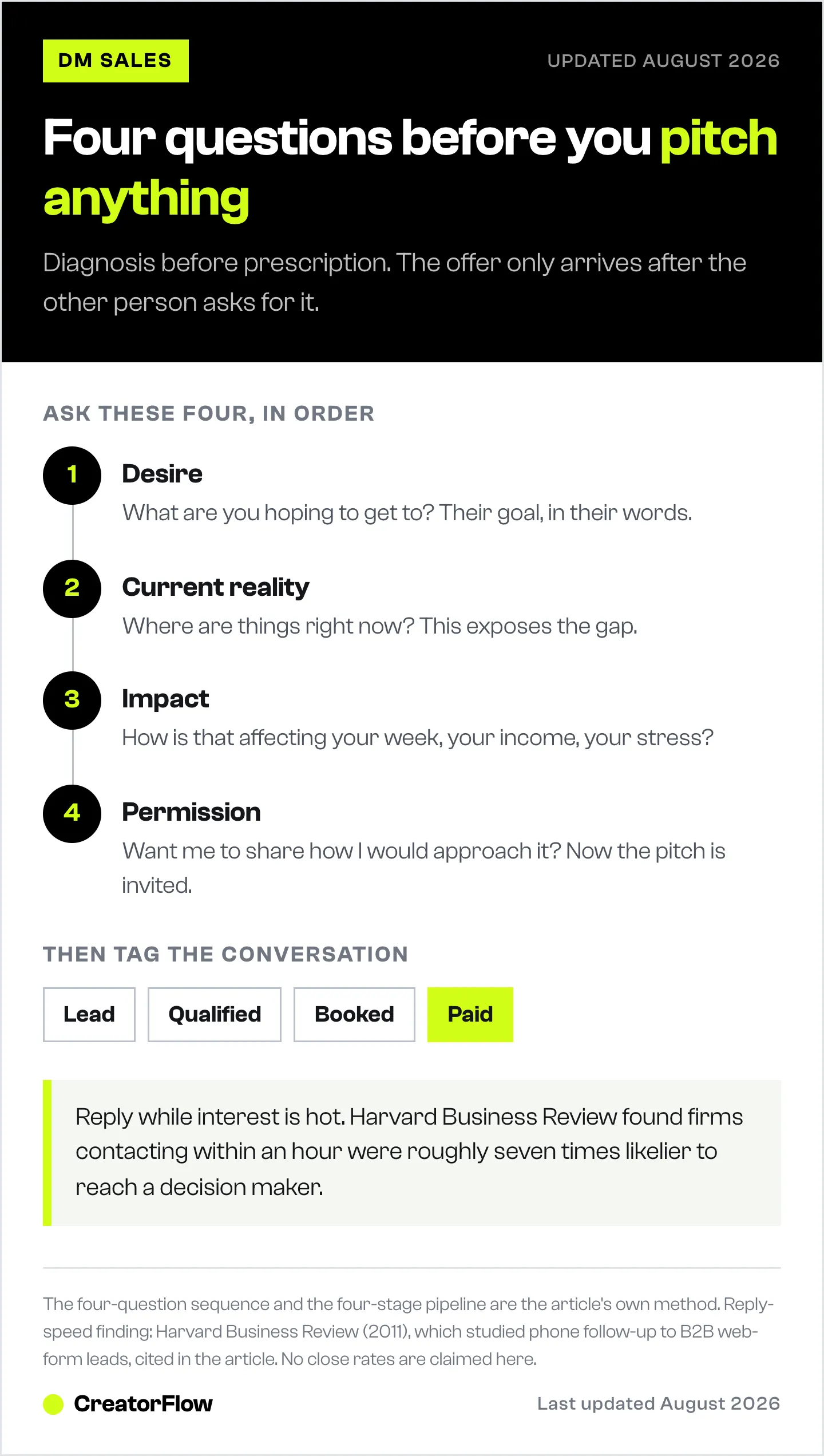
Run every serious conversation through four questions, in order. Keep them casual and spread them across a few messages so it feels like a chat, not an intake form.
| Step | What you ask | Why it works |
|---|---|---|
| 1. Desire | ”What are you hoping to get to?” | Surfaces the real goal in their words, not yours |
| 2. Current reality | ”Where are things right now?” | Shows the gap between where they are and where they want to be |
| 3. Impact | ”How is that affecting your week, your income, your stress?” | Makes the cost of staying stuck concrete and personal |
| 4. Permission | ”Want me to share how I would approach it?” | Turns the pitch into something they invited |
The permission step is what removes the pressure. You never push an offer onto someone. You ask if they want help, and they say yes. Now the pitch is a welcome answer instead of an interruption. For a deeper version of this aimed at premium offers, see how high-ticket coaches qualify leads via Instagram DMs, and for service providers, how to qualify Instagram leads before discovery calls.
Move People Into a Buying Mindset
Once someone wants help, they still may not buy. Most people sit on one of two edges: too doubtful to believe it will work, or too overconfident to think they need help. Your job is to move them to the middle, where buying makes sense. You do this by reframing, not arguing.
Three reframes do most of the work:
- The comparison reframe. Normalize the result. “The creators I work with started right where you are, posting to a few hundred followers.” This tells a doubtful person the goal is reachable for someone like them.
- The calculation reframe. Break a big goal into honest math. “You do not need to go viral. Twenty replies a week at a five percent close rate is one client a week.” This makes a vague dream feel like a plan.
- The correlation reframe. Use an analogy that reframes the decision. “Elite athletes still have coaches. Hiring help when you are already good is normal, not a sign you are behind.”
People buy when three things line up: they believe the goal is possible, they believe the solution fits them, and they trust you. Reframes handle the first two. The trust you built with your content handles the third.
Sell a Simple Offer, Then Improve the Delivery
You do not need a perfect product before you sell. You need to validate that people will pay for the result. Most creators stall here, building funnels, recording video sales letters, and polishing systems for an offer nobody has bought yet.
Flip the order. Sell first, build second.
- Understand the pain. Your qualifying questions already told you exactly what the person is stuck on.
- Map the offer to that pain. Describe the outcome in their words. The offer is a bridge from their current reality to their desire, nothing more.
- Sell it. Make the offer in the DM, with a clear price and a clear next step.
- Improve delivery later. Once people are paying, refine the product, add the templates, record the lessons. Paying customers tell you what to build.
A simple offer that solves one painful problem will out-sell a complex program nobody asked for. Validate demand with conversations before you spend a month building.
Follow Up Until They Buy or Tell You to Stop
A large share of sales never happen on the first reply. Life interrupts, people get busy, the message gets buried. The creators who win are the ones who keep showing up after the first “let me think about it.”
Follow-up is not nagging. Each touch should carry something useful:
- Check in with a genuine question, not “just bumping this.”
- Share a relevant win or result that matches their situation.
- Send a piece of content that answers a doubt they raised.
- Stay visible in their feed and Stories so you never go cold.
Persistence beats intensity. One thoughtful follow-up a week for a month does more than five pushy messages in two days. One timing note: Meta’s Instagram API gives automated tools a 24-hour window to reply to anyone who messaged you, with a human agent able to respond manually for up to seven days (developers.facebook.com, May 2026). Longer follow-up is a manual or email job, which is why capturing an email during the conversation is worth the extra step.
There is a real reason most creators fail at this. They go too transactional and skip the empathy, so they never mirror back what the person said. They lose the authority frame and slide into being “just friends” who chat but never lead. Or they are inconsistent and simply stop replying. A repeatable process fixes all three, because you are running the same steps every time instead of improvising.
Organize Your DM Pipeline With Four Tags
You cannot follow up well if you cannot see who is where. You do not need software. Instagram’s own flag and folder tools, or a tab in a spreadsheet, are enough. Tag every active conversation with one of four stages:
- Lead: they replied or opted in, but you have not qualified them yet.
- Qualified: they answered your four questions and want help.
- Booked: they agreed to a call, a checkout link, or a next step.
- Paid: the sale closed. Now they become a testimonial and a referral source.
Then work the pipeline in priority order, warmest first:
- People who already offered to buy or asked for the next step.
- Qualified leads waiting on your follow-up.
- New leads and fresh openers.
This order matters. Most creators do the opposite, chasing new followers while warm, qualified leads grow cold. Move the closest opportunities first, every day.
Four tags are enough while the volume is low. Once more than about 30 conversations are open at a time, the same board works better as a six-stage version with an age limit on each stage, because a tag alone does not tell you how close a lead is to going quiet.
Where Automation Fits in a DM Sales System
Automation does not close sales. People close sales. What automation does is remove the two failure points that break a DM system: the slow first reply and the lead that never gets captured.
When someone comments your keyword or replies to a Story, an automated first message lands in seconds instead of hours, while their interest is still hot. It can deliver the promised template, ask for an email so the lead is not trapped inside Instagram’s 24-hour window, and tag the conversation so it enters your pipeline. From there, the human work begins: you qualify, reframe, and close.
CreatorFlow handles that opening layer. It connects through Meta’s official Instagram API, sends the instant first reply, captures emails inside the DM, and tracks which posts drive the most conversations, starting on a free plan with paid plans from $15 a month. The job is to start more conversations so you spend your time on the ones worth closing. For the full setup, see the Instagram DM automation guide, and to sharpen your replies, read how to turn customer questions into sales on Instagram.
FAQ
How do you start a sales conversation in Instagram DMs?
Start with a resource or a question, never an offer. Inbound, post something useful and tell people to comment a keyword to get it, then send it by DM. Outbound, message new followers with a short “this or that” question that sorts buyers from browsers. Both open a conversation without pitching, which keeps the other person comfortable enough to reply.
How do you sell in Instagram DMs without being pushy?
Qualify before you pitch. Ask what the person wants, where they are now, and how the problem affects them. Then ask permission: “Want me to share how I would approach it?” When they say yes, the pitch is something they invited rather than something you forced. Pressure disappears because you are answering a request, not interrupting.
What questions should you ask to qualify a lead in DMs?
Use four, in order. Desire: what result are they after. Current reality: where things stand today. Impact: how the problem affects their income, time, or stress. Permission: do they want your help. Keep them casual and spread them across messages so it reads as a conversation, not a form. The answers tell you exactly what to offer.
How many follow-ups should you send in Instagram DMs?
There is no fixed number, but most sales happen after the first reply, so do not stop at one. Send useful follow-ups, roughly one a week, each carrying a question, a win, or a helpful piece of content. Stop the moment someone asks you to, or after several touches with no response. Persistence with value works; repeated pressure does not.
Should you automate Instagram DM sales conversations?
Automate the opening, not the closing. Tools should send the instant first reply, deliver a promised resource, capture an email, and tag the lead. The qualifying, reframing, and closing should stay human, because that is where trust is built. Full automation of a sales conversation reads as robotic and breaks the connection that makes people buy.
How do you handle “I can’t afford it” in a DM?
Do not argue or discount on reflex. Reframe instead. Use honest math to show the result is closer than it feels, normalize it by sharing that others started in the same spot, or use an analogy that makes the decision feel reasonable. If the budget genuinely is not there, mark them as a lead, stay in touch, and revisit when their situation changes.
How do you track sales leads inside Instagram DMs?
Use a simple four-stage pipeline: Lead, Qualified, Booked, Paid. Tag each active conversation with Instagram’s flags and folders or a basic spreadsheet. Then work it warmest first, starting with people ready to buy, then qualified leads, then new openers. A simple pipeline you actually update beats a full CRM you ignore.
Instagram API messaging rules verified from developers.facebook.com and sales response-time data from Harvard Business Review as of June 2026. Individual results vary.


