

Reaching $1,000 from Instagram DMs takes one offer, a post that names the problem it solves, and roughly fifteen to twenty real conversations. At a $300 price that is four sales. At a $50 price it is twenty, which is a different and harder job. Choosing the higher price is the single decision that most changes how long this takes, because conversations are the constraint, not followers.
Most advice for a small account is about growth. Get to 10,000, then monetise. That order is wrong and it is why people spend a year making content and earn nothing. Accounts with 1,200 followers close sales in DMs every week, because a sale needs one person with a problem and the money to fix it, not a crowd.
This plan covers what to sell, the arithmetic of how many conversations you need, four weeks of specific actions, and the three places a first thousand usually stalls.
Key Takeaways
- Conversations are the constraint, not follower count. Fifteen to twenty real ones is the target.
- Price higher. Four sales at $300 is far less work than twenty at $50.
- Sell something that already exists. Your time, your process, or a thing you have already made.
- One offer, one post, one keyword. Complexity is what stops people finishing week one.
- Automate the first reply. It removes the delay that kills most of these conversations.
- Ask directly. Most first-thousand failures are people who never named a price to anyone.
The Arithmetic of Your First 1000 Dollars on Instagram
Work backwards from the number and the plan becomes obvious.
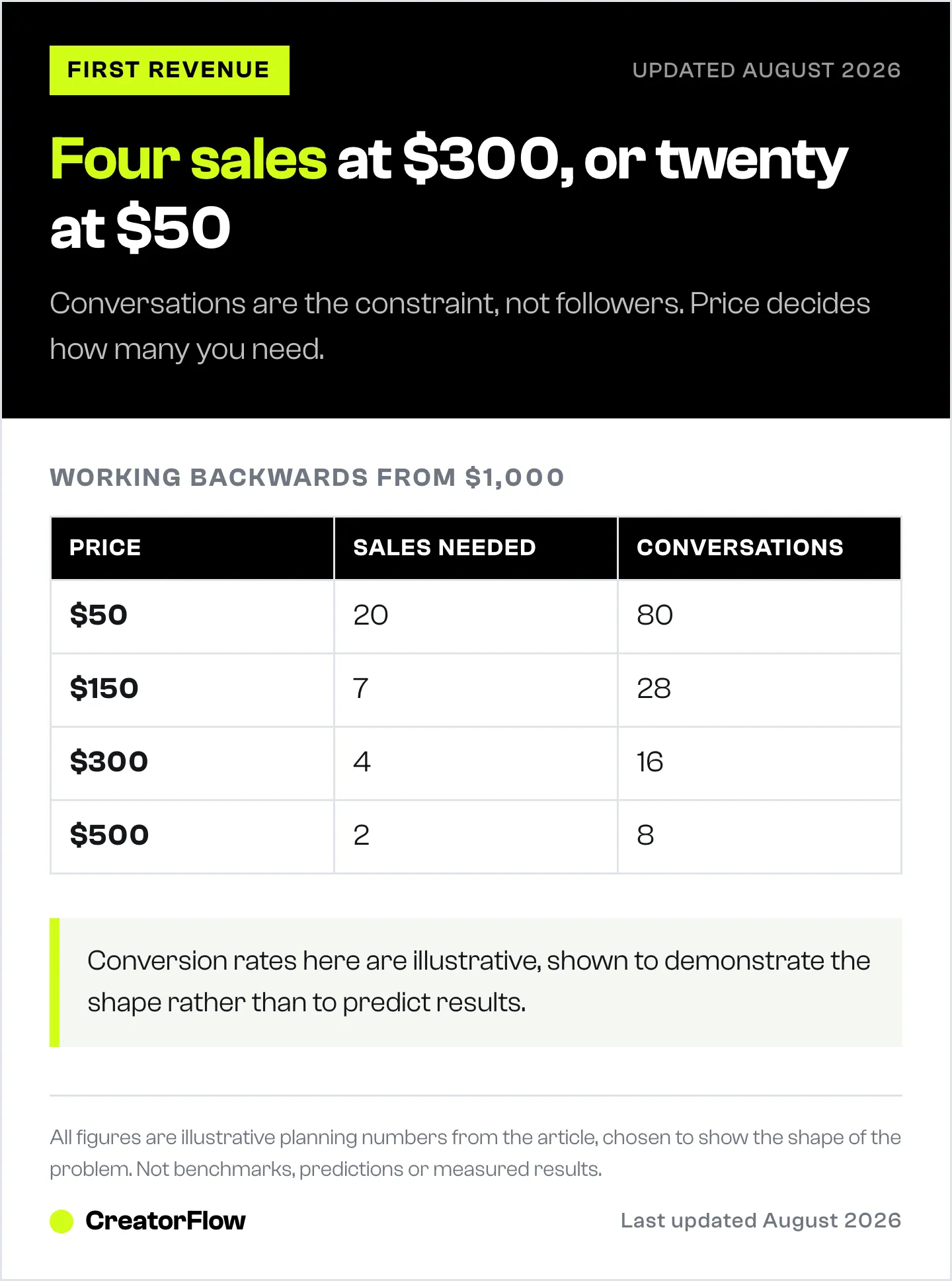
| Price | Sales needed | Conversations needed at 25% | Comments needed at 40% reply |
|---|---|---|---|
| $50 | 20 | 80 | 200 |
| $150 | 7 | 28 | 70 |
| $300 | 4 | 16 | 40 |
| $500 | 2 | 8 | 20 |
| $1,000 | 1 | 4 | 10 |
The conversion figures here are illustrative, used to show the shape of the problem rather than to predict your results. What the table demonstrates holds regardless of the exact rates: the low-price row is a volume business and the high-price row is a conversation business, and only one of those is achievable in a month by one person with a small account.
Forty comments on a post is reachable for an account with a thousand followers if the post is about something people actually want. Two hundred is not. That is the whole argument for pricing at $300 rather than $50, and the fuller reasoning is in pricing an offer for an Instagram audience.
What to Sell
Three things you can sell in the next 30 days without building anything new.
Your time, applied to one problem. A 90-minute session with a specific outcome. Not “consulting”, but “your first automation set up and live by the end of the call”. This is the fastest to sell because it needs no production.
Your process, written down. The thing you already do, documented as a template, checklist or short course. It takes a weekend and then sells forever.
A small done-for-you service. One deliverable, fixed scope, fixed price. Fastest to deliver and easiest to price.
What not to sell in month one: a membership, a cohort programme, anything requiring twenty people to start, or anything you have to build for six weeks first. Those are good businesses and they are bad first sales, because the feedback loop is too long to teach you anything.
Pick one. Name the outcome in the offer, not the format. “Three months of content planned in one afternoon” sells; “content strategy session” does not.
Week One: Make the Offer Exist
Five things, none of which take a day.
- Write the outcome in one sentence. If you cannot, the offer is not ready. “By the end you will have X” is the test.
- Set the price. Somewhere between $150 and $500 for a first offer. Higher than feels comfortable.
- Decide what is included, in three bullets. Not eleven.
- Set up the way people pay. A payment link from whatever processor you use, created once and reused.
- Write the DM you will send when somebody asks. Price, outcome, one question. The structure is in answering “how much?” in Instagram DMs.
That is the whole product. Resisting the urge to build a landing page, a logo and a five-module curriculum is the actual skill in week one.
Week Two: Post the Problem, Not the Product
The post that produces DMs describes the situation the buyer is in, not the thing you are selling.
The shape that works:
- Open with the problem in their words. The sentence they would say to a friend.
- Show that you understand why it happens. One specific reason, not a list.
- Give one thing they can do about it today. Real value, given away.
- Then the ask. “I made a thing that does the rest. Comment WORD and I will send it.”
Post two or three of these across the week, in different formats. A Reel, a carousel, a Story sequence. Same problem, different angles.
Set up the automation before you post, not after. A keyword trigger sends your first message within seconds of somebody commenting, which is when their interest is highest. CreatorFlow does this through Meta’s official Instagram API and tracks the clicks, so at the end of the week you know which post produced conversations rather than which produced likes. The setup takes minutes and is covered in the Instagram DM automation guide.
Week Three: Have the Conversations
This is the week that decides the outcome, and it is the week most people skip.
For every person who replies:
- Deliver what you promised, immediately, with no pitch attached.
- Ask one question about their situation. Closed, two options.
- When they answer, name the offer and the price. In that order: outcome, then number, then a question about timing.
- Handle the objection if there is one. Do not discount on the first push. The replies are in handling price objections in Instagram DMs.
- Send the payment link the moment they say yes. Not later, not by email.
Target fifteen to twenty of these. Keep a list with four columns: name, what they wanted, what you quoted, what happened. That list is worth more than the money, because after twenty rows you can see exactly where people stop.
The one rule for this week: name a price to every single person who shows interest. Most first thousands fail here, not at the offer and not at the traffic. People have twelve friendly conversations, never mention money in any of them, and conclude that their audience will not buy.
Week Four: Follow Up and Close
About half the sales in this period come from people who did not say yes the first time.
The sequence for each quiet thread: one message about 48 hours after the price, carrying something useful and a closed question splitting price from timing. One more a week later that makes saying no easy. Then stop. The full pattern is in following up on a quiet price enquiry.
Also this week:
- Repost the best performer from week two. The post that produced the most conversations will produce more, and most of your audience never saw it.
- Ask your first buyers for one sentence about what changed. That sentence is the proof that makes week five easier than week three was.
- Count the numbers. Comments, conversations, quotes given, sales. Those four figures tell you what to change next month.
Where This Stalls
Three failure points, in order of frequency.
Never naming a price. By far the most common. The conversations are pleasant, nobody buys, and it feels like an audience problem. Fix: quote in every conversation, without exception.
Pricing too low. Twenty sales in a month from a small account is not realistic, so a $50 offer sets a target that cannot be hit. Fix: raise the price and lower the number of sales required.
Selling the format instead of the outcome. “A 90-minute call” is a description of a calendar entry. “Your next quarter of content planned by Friday” is a result somebody wants. Fix: rewrite the one-sentence outcome until it names a change.
A fourth, less common: building for four weeks and selling for none. If nothing has been offered to a real person by day ten, stop building and start asking.
FAQ
How many followers do you need to make $1,000 on Instagram?
Far fewer than most people assume, because sales come from conversations rather than reach. An account with around a thousand engaged followers can produce the fifteen to twenty conversations a first thousand needs, provided the offer is priced high enough that four sales are enough.
What is the easiest thing to sell first?
Your time applied to one specific problem, with the outcome named. It requires no production, you can price it properly, and delivering it teaches you what your eventual product should be. A documented version of your own process is the natural second step.
How much should a first offer cost?
Between roughly $150 and $500 for most creators. Lower than that turns a first thousand into a volume problem that a small account cannot solve in a month. Higher is possible but usually needs proof you do not yet have.
How many DM conversations does it take to make a sale?
It varies by offer, audience and price, so treat any single figure with caution. Planning on something in the region of four conversations per sale is a reasonable starting assumption, and after twenty conversations you will have your own rate, which is the only one that matters.
Should you automate DMs when you are just starting?
Yes, for the first reply. The delay between somebody commenting and hearing back is the single biggest leak at any account size, and it is worse when you are also making the content. Keep the conversation itself human, because that is where the sale happens.
What do you do if nobody replies to your offer post?
Change the post before you change the offer. Most no-reply posts describe a product rather than a problem. Rewrite the opening as the sentence your buyer would say to a friend, and give away something genuinely useful before the ask.
How long does it realistically take?
Thirty days is achievable with an offer that exists, a post that names a real problem, and the discipline to quote a price in every conversation. It takes longer when the first two weeks go into building things nobody has asked for yet.
Conversion rates, prices and timelines in this article are illustrative planning figures used to show the shape of the problem, not measured results or predictions. Individual results vary.


