

Answer “how much?” with a real number, then a question. Give the price plainly, attach the outcome it buys, and end with something the other person can reply to. Withholding the number to force a call is what kills most of these conversations. The exception is when the price genuinely depends on scope, and then you ask one qualifying question before quoting.
“How much?” is the most common money question on Instagram and the one most creators answer worst. The two standard replies both lose. “DM me for prices” was already a DM. “It depends, let’s hop on a call” asks a stranger for 30 minutes before they know if you are in their budget. Both read as evasion, and the reply rate after them collapses.
This guide covers why price-dodging costs you the sale, the rule for deciding between a number and a question, a three-line reply structure that works for almost every offer, six scripts by business type, and what to do when someone goes quiet after seeing the price.
Key Takeaways
- Give the number. People asking “how much?” are further along than people asking anything else. Hiding the price converts a warm lead into a cold one.
- Never reply with only a price. A bare number invites a bare “ok”. Price plus outcome plus a question keeps the thread open.
- One qualifying question, not five. If your price genuinely varies, ask the single question that changes the number, then quote.
- Anchor before you quote when your offer is premium. State what the result is worth first, then the price reads as small against it.
- Silence after a price is normal, not rejection. Most people need to check a bank balance or a partner before they answer.
- Meta gives you 24 hours to reply to a DM under standard messaging, so speed is a rule, not a preference (developers.facebook.com, August 2026).
Why “DM Me for Prices” Loses the Sale
“DM me for prices” fails because the person already did that. They are in your inbox, asking, and the reply sends them back to the start. Every extra step between a question and its answer is a place where somebody leaves.
The reasoning behind price-hiding is that a number without context sounds expensive, so you want to sell the value first. That instinct is right. The execution is wrong. You can deliver value and the number in the same message. What you cannot do is make somebody chase you for basic information and still feel warm towards you.
There is also a filtering argument for hiding prices: only serious buyers will push through. That is true and it is the problem. You filter out everybody who would have bought at your price but does not enjoy being handled. Buyers who tolerate friction are a small subset of buyers who can afford you.
The practical test: if a competitor answers “£450, here is what is included” and you answer “let’s jump on a call”, the person with a decision to make today has already chosen. Speed of answer is a competitive position, and slow DM responses cost sales in measurable ways.
When to Give a Number and When to Ask First
Give the number immediately when your price is fixed or has a floor. Ask one question first only when the number genuinely moves by more than about 30% depending on the answer.
| Your situation | What to send |
|---|---|
| Fixed price product or package | The price, straight away |
| Tiered offer with a clear entry point | The entry price, framed as “starts at” |
| Price varies by scope (services, custom work) | One qualifying question, then a range |
| Price varies by volume (wholesale, retainers) | A starting range plus the one thing that moves it |
| You genuinely do not sell to this person | A polite no and a redirect |
The “starts at” framing does most of the work. It is honest, it sets the floor, and it stops the conversation ending because somebody assumed you were four times more expensive than you are.
When you do ask a qualifying question, ask exactly one. Every additional question before a number reads as a form, and people stop filling in forms. The right question is whichever one actually changes the price: how many rooms, how many people, which month, how many units.
The Three-Line Reply That Keeps It Alive
Nearly every good answer to “how much?” has the same three parts, in this order.
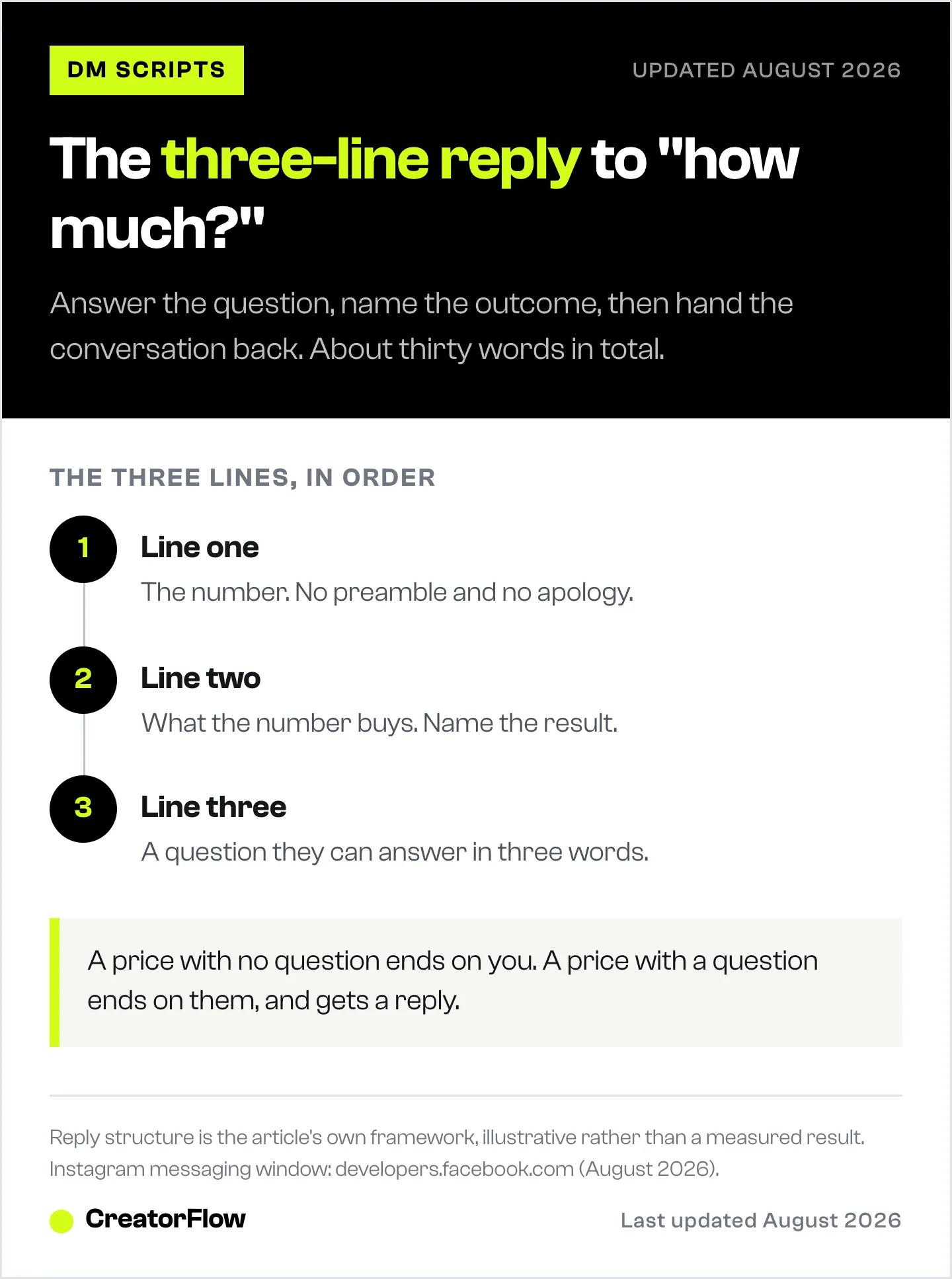
Line one: the number. No preamble, no apology, no “so glad you asked”. Say it.
Line two: what the number buys. One sentence naming the result, not the deliverables. “Six weeks to your first ten clients” beats “12 sessions plus worksheets”.
Line three: a question. Something specific and easy to answer. “Are you looking to start this month or later in the year?” A question that can be answered in three words gets answered.
Put together:
£450. That covers the full brand kit and gets your shop live in about two weeks. Are you working to a launch date, or is timing open?
That is 30 words and it does four jobs: answers the question, sets the outcome, checks urgency, and hands the conversation back. Compare it to “DM me for prices”, which does none.
The third line matters more than people expect. A price with no question ends on you. A price with a question ends on them, and a message that ends on them gets a reply. This is the same mechanic behind DM scripts that convert: the last line decides whether there is a next message.
6 Scripts for Answering “How Much?” in an Instagram DM
Use these as structure, not as copy to paste. Change the numbers and the nouns to yours.
1. Coach or consultant, fixed package
$1,200 for the 8-week programme. Most people come in wanting a repeatable way to get clients and leave with one that runs without them. What is the situation you are trying to fix right now?
2. Service business, scope-dependent
Depends on one thing: how many pages. A five-page site is usually $2,000 to $2,800, bigger builds go up from there. Roughly how big is yours?
3. Product seller, single price
£68, and shipping is free over £50. It is the last of the navy in a medium. Want me to hold one while you decide?
4. Digital product with a ladder
The template on its own is $47. The full course with the templates included is $297. If you have never done this before, the course is the one that saves you the pain. Which sounds closer to where you are?
5. High-ticket, anchor first
Clients usually come to me spending around $3,000 a month on ads and not tracking what it returns. The audit is $1,500 and it typically finds more than that in the first month. Are you running paid traffic already?
6. Genuinely not a fit
Honestly, I am probably not the right fit. I start at $2,500 and for what you have described you would get the same result from a template. Happy to point you at a good one if that helps.
Script six is the one people skip and it is worth keeping. A clean no protects your time and it makes the yes credible. People remember being told the truth.
How to Anchor So the Price Lands Small
Anchoring is telling the person what the result is worth before you tell them what it costs. The order is the whole trick. A number arriving with no context gets measured against their bank balance. A number arriving after a cost or a value gets measured against that instead.
Three anchors that work in a DM, in rough order of strength:
- The cost of the problem. “Most people in this spot are losing two or three sales a week to slow replies.” Then the price.
- The cost of the alternative. “A part-time VA is about £900 a month.” Then the price.
- The time saved. “This takes about six hours a week off your plate.” Then the price.
Keep it to one sentence. An anchor that runs three paragraphs stops being an anchor and starts being a pitch, and the person asked a one-line question.
Do not invent the anchor. If you cannot say honestly what the problem costs, skip it and give the plain number. A made-up figure is worse than no figure, and people who buy things can tell.
When They Go Quiet After the Number
Silence after a price is the normal case, not the failure case. The person is checking money, checking with somebody else, or is at work. Read it as pending, not as no.
What actually helps:
- Give it a day. Replying to your own message 20 minutes later reads as anxiety and it prices you down.
- Follow up with something, not with “just checking in”. A relevant example, a photo of the thing, an answer to the question they did not ask.
- Ask a closed question. “Is the price the blocker, or the timing?” gives two easy doors. Open questions after silence get more silence.
- Stop after two. Two useful follow-ups and then leave it. Third and fourth messages cost you the relationship for a sale you were not going to get.
One platform constraint shapes all of this. Under Meta’s standard messaging window, your app has 24 hours to respond to a message from an Instagram user, and the human agent tag extends that to seven days when a person needs longer to resolve something (developers.facebook.com, August 2026). Automated follow-ups days later are not a thing the platform allows, so the follow-up here is you, by hand, and that is fine. The volume is small because the people who ask your price are few and valuable.
Automate the First Reply, Not the Conversation
The part worth automating is the opening. Somebody comments a keyword on a post about your offer and gets your price and your outcome line in seconds instead of hours. From there it is a human conversation, because the qualifying and the closing are where trust gets built.
A practical setup: a Reel that names the offer, a comment keyword like “price”, and an automated DM carrying the number, the outcome, and the question. That message does the three-line job every time and it does it at 2am. You pick the thread up when you are awake.
CreatorFlow does this part through Meta’s official Instagram API, with comment triggers, keyword triggers, and story reply triggers, plus link tracking so you can see which post actually produced the price questions. The conversation after that first message stays yours. If you want the fuller picture of how a DM turns into a sale, the close in Instagram DMs walks the whole sequence, and high-intent comment signals covers spotting the buyers before they even ask.
FAQ
Should you put prices in your Instagram bio or posts?
Put a starting price somewhere public. A “from £450” in a highlight, a pinned post, or the caption removes the cheapest, most repetitive DM you get and filters people before they reach your inbox. It does not stop price questions, and it should not. It changes them from “how much?” to “does the £450 one include X?”, which is a much better conversation.
Is it bad to say “it depends” when someone asks your price?
It is bad on its own. It is fine when it is followed immediately by the one thing it depends on and a range. “Depends on how many rooms, but most jobs land between £800 and £1,400” answers the question and qualifies in a single message. “It depends, let’s chat” answers nothing.
How fast should you reply to a price question in a DM?
As fast as you can, and automatically if the question came from a comment or a keyword. Interest in a price is at its highest in the minutes after somebody asks. Meta’s standard messaging window gives you 24 hours to respond at all, so a reply two days later is not only cold, it may not be deliverable (developers.facebook.com, August 2026).
Should you discount when someone says your price is too high?
Not on the first push. Discounting immediately teaches the person that your price was never real, and it prices every future client too. Reframe, offer a smaller version of the offer, or accept the no. Handling this properly has its own playbook in price objections in Instagram DMs.
What do you say when your price is much higher than they expected?
Say the number, then name the gap without apology. “I know that is a jump from a template. The difference is you get the strategy, not just the file.” Then ask what budget they were working to. You often find they can reach a smaller version of your offer, and that is a sale you would otherwise have lost.
Can you automate the answer to “how much?”
You can automate the first message, and you should. A keyword trigger or a comment trigger can deliver your price, your outcome line, and your question within seconds. What should stay human is everything after that: the qualifying, the objection, and the close.
Does giving your price publicly attract time-wasters?
It does the opposite. Public prices remove the people who were never going to pay before they take up your time, and they raise the quality of the questions from the ones who stay. The volume of DMs usually drops. The proportion of them worth answering goes up.
Instagram messaging window and human agent tag verified from developers.facebook.com as of August 2026. Scripts and price figures are illustrative examples, not measured results. Individual results vary.


