

Answer a wholesale enquiry with a line sheet, your minimum order quantity and your terms, in one message, within a day. A retailer asking whether you wholesale is comparing you against other suppliers that week, and the one who answers with complete information usually gets the order. Asking them to email you instead adds a step that loses a meaningful share of enquiries.
“Do you do wholesale?” arrives in your DMs between a follower asking about sizing and a bot selling followers. It is worth more than both of your best retail days combined, and most small brands answer it with “yes! email hello@ and we will send info”, which is where a third of them stop.
This guide covers what to send, how to qualify a shop without interrogating them, how to set a minimum order that protects your margin, the terms to state up front, and how to automate the first reply so nothing sits unanswered overnight.
Key Takeaways
- One wholesale order can exceed a month of retail. Treat the enquiry accordingly.
- Send the line sheet in the first reply, not after a form. Every extra step loses people.
- State the minimum order quantity early. It qualifies harder and faster than any question you could ask.
- Qualify with two questions, not ten. Shop name and location tells you almost everything.
- Payment terms up front. New stockists pay before dispatch. That is normal and nobody is offended.
- Automate the acknowledgement, not the relationship. Speed matters, then a human takes over.
Why Most Brands Answer This Badly
Three failure modes, and each one costs orders.
Redirecting to email. “Email us for the wholesale pack” asks a buyer who was already in a buying mood to switch channel, compose a message and wait. Buyers are usually researching several suppliers at once, and the ones who reply immediately with everything needed get shortlisted.
Answering with a question. “Sure! What kind of shop are you?” makes the retailer do the work first. It is a reasonable question and it belongs after the information, not instead of it.
Sending too little. “Yes we do, our wholesale price is 50% off retail” leaves out everything that decides whether they can order: minimums, lead time, payment, delivery. They then have to ask four more questions, and each round trip takes a day.
The fix is one complete message. It costs you nothing after you have written it once, and it moves a supplier decision that normally takes two weeks into a single afternoon.
What to Send in the First Reply
Five things, in this order, and then one question.
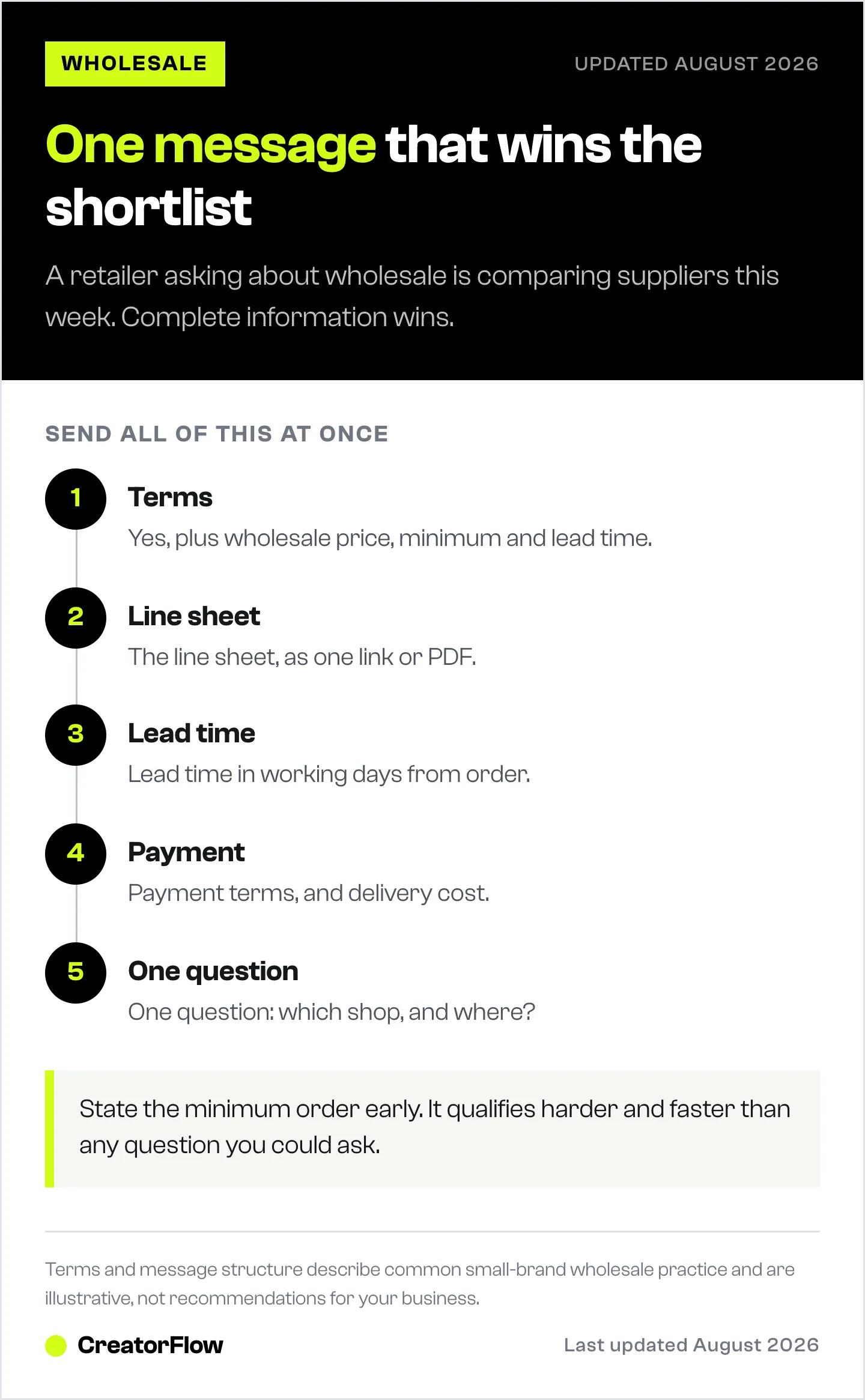
1. Yes, plus the headline terms. Wholesale price or margin, minimum order value or quantity, and lead time. Three numbers.
2. The line sheet. A single PDF or a link. It should carry product names, product codes, wholesale price, recommended retail price, case pack sizes, and a photo of each item. Nothing else.
3. Lead time. How many working days from order to dispatch. Retailers plan around this and a vague answer reads as a small operation that might miss a season.
4. Payment terms. What you accept and when. First order paid before dispatch is standard for a new account.
5. Delivery and shipping cost. Free over a threshold, or a flat rate, or quoted per order.
Then one question. “Which shop is it and where are you based?”
A worked version:
Yes, we do. Wholesale is 50% of RRP, minimum first order £300, and we dispatch within 5 working days. Full line sheet here: [link]. First orders are paid before dispatch, repeat accounts move to 30 days. Shipping is free over £500. Which shop is it and where are you based?
That message answers everything a buyer needs to decide whether to proceed, and the one question at the end tells you what you need to know about them.
Set a Minimum Order That Does the Qualifying
A minimum order quantity or minimum order value is the most efficient filter you have. It answers “is this a real shop or somebody after a discount” without you having to ask.
Setting it:
- Cover your handling cost. Picking, packing, invoicing and answering questions costs roughly the same for a £90 order and a £900 one.
- Make it a real order, not a sample. Enough that the shop has to display the range properly, which is what makes it sell through.
- Different minimums for first and repeat orders. A higher first order and a lower reorder is common and it rewards accounts that stick.
- Case packs, not singles. Selling in packs of six or twelve keeps your picking sane and pushes order values up naturally.
State it in the first message. Brands hide their minimum in case it puts people off, and the effect is that they spend two weeks on conversations with buyers who were never going to reach it.
If a shop cannot meet the minimum, offer the alternative rather than a no: a smaller starter pack at a lower margin, or a place on the list for when you introduce one. Some of those become full accounts within a year.
Qualify Without Interrogating
Two questions do almost all the work: which shop, and where. The answer lets you check them in a minute.
What to look at:
- Do they have a shop, online or physical, that actually exists?
- Do they stock things in your category and roughly your price bracket? A brand at four times your price point or a quarter of it is usually a poor fit for both sides.
- Are you already stocked nearby? This is the one that causes problems later. Two shops on the same high street selling the same range at the same price ends badly.
- Does the shop look like it is trading? Recent posts, current stock, an active site.
Two things worth raising before the first order rather than after:
Territory. If you intend to protect stockists geographically, say so now. “We keep it to one stockist per town” is a selling point to the shop you are talking to.
Pricing. Ask them to hold the recommended retail price. You can set an expectation even where you cannot enforce a fixed price, and it protects both your other stockists and your own direct sales.
Automate the First Reply, Not the Relationship
Wholesale enquiries arrive at every hour and they compete with other suppliers on response speed. An automation that acknowledges the enquiry and delivers the line sheet within seconds does the heavy lifting, and you handle the actual conversation when you are at your desk.
The setup:
- A post or Reel aimed at retailers, saying you wholesale and naming the keyword.
- A keyword trigger on the words buyers use: wholesale, stockist, trade, retail, bulk, reseller.
- A message carrying the line sheet link, the minimum and the lead time.
- An email gate on the line sheet, so you capture the buyer’s address at the moment of highest interest.
That last step is the one that pays for the whole system. A retailer who downloaded your line sheet is the highest-quality name you will ever add to a list, and a new-season email to fifty of them produces orders in a way a general newsletter never will. CreatorFlow’s email gate collects the address inside the DM before the link goes out, and CSV export moves those contacts into whatever you send email with.
What should stay human: the qualifying, the territory conversation, terms for a specific account, and anything about credit. Those are judgement calls about a business relationship that may run for years.
The rest of the trigger setup is the same mechanism used for availability and stock questions, and the broader selling sequence for product brands is in the Instagram DM ecommerce playbook.
Terms That Protect a Small Brand
Four positions worth holding, particularly with a new account.
Payment before dispatch on the first order. Universal in small-brand wholesale. Move an account to invoice terms once they have ordered two or three times without incident.
Thirty days maximum when you do offer terms. Longer periods move the financing cost of the shop’s inventory onto you. Where a shop pays late, statutory interest exists in the UK for commercial debts, set at 8% over the Bank of England base rate (gov.uk, August 2026), and the EU provides interest plus a fixed recovery sum per invoice (ec.europa.eu, August 2026).
No sale or return, at least at first. Sale or return means you carry the stock risk and can receive shop-worn goods back months later. Established brands with capacity offer it. A small brand generally should not.
Everything in writing. A short order confirmation naming products, quantities, prices, delivery date and payment terms. Not a contract, an email. It prevents most disputes.
The chasing process when a wholesale invoice goes past due is the same one that works for brand collaborations, laid out in how to invoice a brand for an Instagram collaboration.
FAQ
What should a wholesale line sheet include?
Product name and code, wholesale price, recommended retail price, case pack size, and a clear photo of each item. Add your minimum order, lead time, payment terms and shipping on the front page. Keep it to one document a buyer can forward internally without explanation.
What is a normal wholesale price for a small brand?
Fifty percent of recommended retail is the common starting point in many product categories, meaning the shop doubles its money. What matters more is whether that leaves you a workable margin after production, packing and shipping. If it does not, the retail price is too low rather than the wholesale discount being too high.
How do you set a minimum order quantity?
Set it high enough to cover the fixed cost of handling an order and to make the shop display the range properly. A higher first order with a lower reorder minimum is a common structure, and case packs rather than single units keep both picking and order values sensible.
Should you give a new stockist payment terms?
Not on the first order. Payment before dispatch is standard practice for new wholesale accounts and buyers expect it. Move them to thirty-day terms once they have ordered a few times and paid on time.
How do you know if a wholesale enquiry is genuine?
Ask which shop and where, then spend a minute looking. A real stockist has a trading shop or site, sells in your category and price bracket, and posts recently. Enquiries that will not name the shop are almost always after a personal discount.
Can you automate wholesale enquiry replies on Instagram?
Automate the acknowledgement and the line sheet delivery, which is where speed wins the shortlist. Keep the qualifying, territory and terms conversation human, because those decisions shape a relationship that may last years.
Should you tell retailers your minimum order in the first message?
Yes. It filters out enquiries that cannot proceed before either side spends time, and it signals that you run an organised operation. Hiding the minimum produces longer conversations and the same outcome.
UK statutory interest verified from gov.uk and EU late payment rules from ec.europa.eu as of August 2026. Prices and terms shown are illustrative examples of common practice, not recommendations for your business. This is general commercial information, not legal or financial advice.


