

Invoice a brand the day the content goes live, addressed to the accounts payable team rather than your contact, with a purchase order number if one was issued. Include your legal name or company, an invoice number, the deal reference, the deliverables, the agreed amount, tax if you charge it, payment terms, and bank details. Most late creator payments are caused by a missing PO number or an invoice sent to the wrong inbox.
You posted the Reel three weeks ago. The brand loved it. You sent an invoice to the marketing manager who briefed you, and since then there has been silence, two “chasing this internally” replies, and no money. The work is done and there is nothing left to negotiate, which is exactly why nobody is in a hurry.
This guide covers what a creator invoice needs on it, who it actually goes to, when to send it, how to chase without damaging the relationship, and the escalation ladder when a payment goes properly late. This is general information about commercial practice, not tax or legal advice.
Key Takeaways
- Send it the day the content goes live, not at the end of the month. Payment terms start counting from the invoice date.
- The marketing contact is not who pays you. Ask for the accounts payable email at the point you agree the deal.
- A missing PO number is the single most common cause of delay at any brand large enough to use them.
- Number your invoices sequentially. Finance systems reject duplicates and gaps look like errors.
- State the payment terms on the invoice itself, even if the contract says them, because the person paying may never see the contract.
- Chase on a schedule, not on a feeling. Day one after due, day seven, day fourteen, then escalate.
What Goes on the Invoice
A creator invoice is a business document and finance teams process them mechanically. Anything missing means it sits in a queue until somebody has time to ask you for it, which can take weeks.
| Field | Why it matters |
|---|---|
| Your legal name or registered company name | Must match the bank account, or the payment fails checks |
| Your address | Required for most accounts payable systems |
| Company number and VAT or tax number | Where applicable to how you are registered |
| Invoice number | Sequential and unique. Duplicates get rejected automatically |
| Invoice date | Payment terms are counted from here |
| Purchase order number | If the brand issued one, this is the field that unblocks payment |
| Bill to | The brand’s legal entity, not the agency, unless the agency contracted you |
| Description of deliverables | One line each: what, where, when it ran |
| Amount per deliverable | Itemised, so a partial query does not hold the whole invoice |
| Tax | Only if you are registered to charge it |
| Total due | The number, unambiguous |
| Payment terms | ”Payment due within 30 days of invoice date” |
| Due date | Spelled out as a date, not a calculation |
| Bank details | Account name, number, sort code or IBAN, and reference |
Two lines people leave off that cause most of the friction: the purchase order number and an explicit due date. A PO number is how a finance system matches your invoice to money that was already approved. Without it, your invoice is an unexpected request for funds and gets treated accordingly.
On deliverable descriptions, be specific enough that somebody who was not involved can tell what was bought. “One in-feed Reel, published 12 August, plus three Stories with link sticker, published 12 August” is processable. “Content creation” is not, and it is the version that gets queried.
Who You Actually Send It To
The person who briefed you almost never pays you. At most brands they forward your invoice into a system, and if they are on holiday or have left, it stops.
Ask this at the point you agree the deal, before you make anything:
Two quick admin things so payment goes smoothly: is there a PO number for this, and which email should the invoice go to for accounts payable?
That one message removes the most common source of delay. Send the invoice to accounts payable, copy your contact so they know it has gone, and reference the PO in the subject line.
Where an agency sits between you and the brand, your contract is with the agency and your invoice goes to the agency. Do not invoice the end brand because you saw their logo on the brief. It will be rejected and you will have lost a fortnight.
When to Send It
Send it the day the content is live and the deliverables in the contract are complete. Not before the work is done, and not weeks after.
The reason is arithmetic. Payment terms count from the invoice date, so a two-week delay in sending is a two-week delay in getting paid, and it is entirely self-inflicted. Creators who batch invoicing to the end of the month are choosing to wait an extra fortnight on average.
Two exceptions worth negotiating into the deal itself:
- A deposit up front for larger projects, typically a third to half, invoiced when the contract is signed and payable before production starts.
- Staged payments on multi-month deals, invoiced per milestone rather than at the end.
Both shift risk away from you and both are normal in commercial work. Asking for one is not cheeky, and the response tells you something useful about how the brand operates. The terms side of this, including what to agree before you sign, is covered in creator payment terms and getting paid faster.
Chasing Without Damaging the Relationship
Chase on a schedule. Deciding each time whether it feels too soon is how invoices go 90 days late.
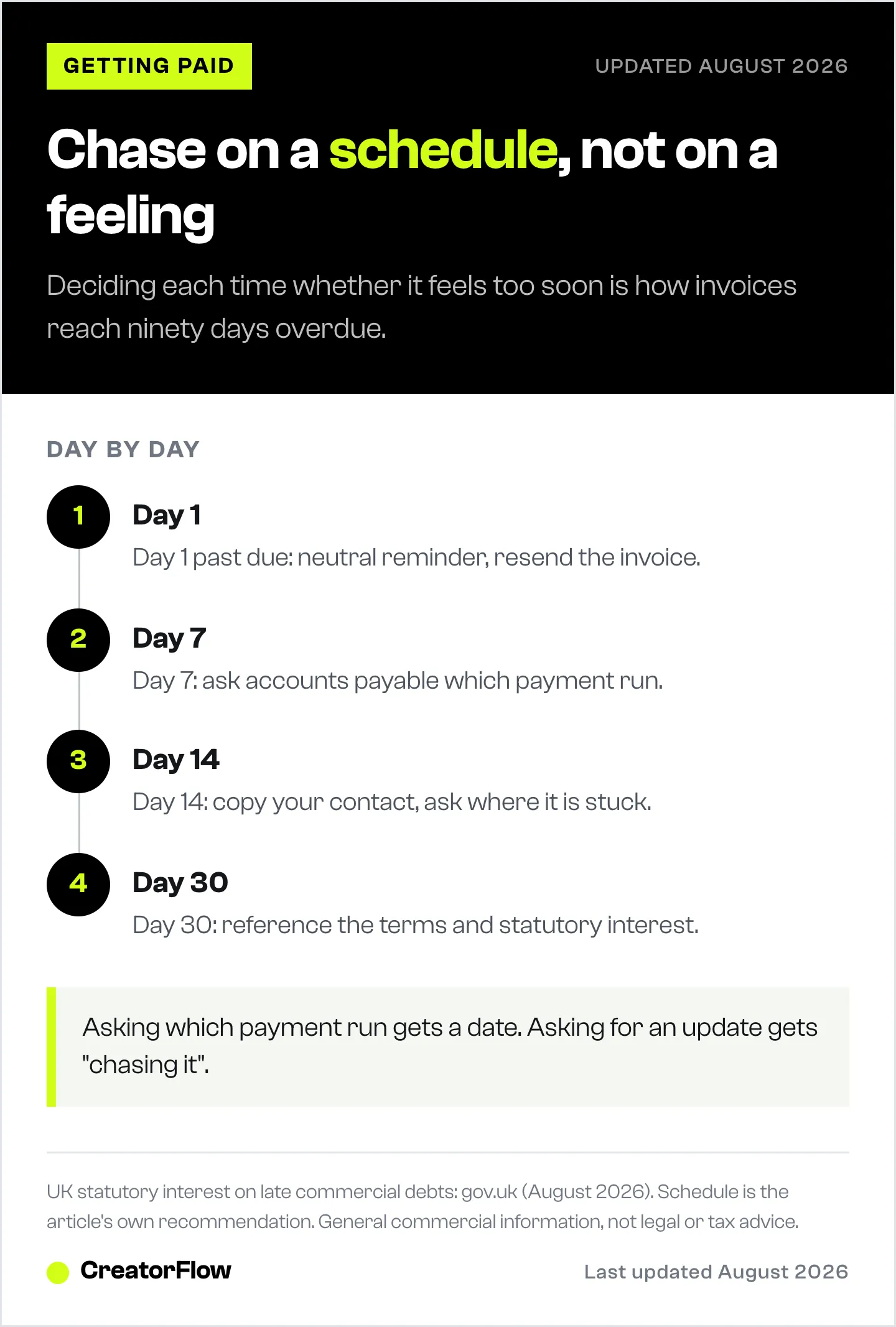
Day 1 after due date. Short, neutral, assume an administrative reason.
Hi, invoice 0142 was due yesterday and I have not seen it come through. Attaching it again in case it needs re-uploading. Is there anything you need from me?
Day 7. Move to accounts payable directly and ask for a date rather than a status.
Following up on invoice 0142, now a week past due. Could you confirm which payment run it is scheduled for?
Asking which payment run is the useful question. Large companies pay in batches on fixed days, so “which run” gets a date while “any update” gets “chasing it”.
Day 14. Copy your original contact back in and state the position plainly, without threat.
Invoice 0142 is now two weeks overdue. Could you help find out where it is stuck? Happy to resend anything that has gone missing.
Day 30. This is where the tone changes and where the contract and the law start mattering. Reference the payment terms in the agreement, state that you will apply statutory interest if it is available to you, and give a date.
Keep every message short, factual, and free of apology. You are not asking for a favour. You delivered work that was ordered, and the brand’s own process is what has failed.
When It Goes Properly Late
An escalation ladder, in order, stopping as soon as it works:
- Accounts payable, by phone if you can get a number. A five-minute call frequently resolves what four emails did not.
- Your original contact’s manager. Not as a complaint, as a request for help unblocking a process.
- A formal letter before action, if you have exhausted the polite route. This is the point where taking advice is sensible.
- Statutory interest and recovery costs, where your jurisdiction provides them. In the UK, the Late Payment of Commercial Debts (Interest) Act 1998 gives businesses a statutory right to claim interest on late commercial payments at 8% above the Bank of England base rate (gov.uk, August 2026). In the EU, Directive 2011/7/EU sets a default payment period and entitles creditors to interest plus a fixed recovery-cost sum per invoice (ec.europa.eu, August 2026).
- Small claims, for amounts and situations where it is proportionate.
Most creator invoices never get past step one or two. Knowing the ladder exists changes how you write step one, which is most of the value.
Do not post about it publicly. It feels satisfying, it occasionally works, and it ends your relationship with that brand and quite often with their agency’s other clients too.
Keep the Paperwork That Proves the Work
Disputes usually come down to whether a deliverable ran as agreed. Keep the evidence at the time, because Stories vanish and posts get archived.
Worth saving for every deal:
- Screenshots of each deliverable live, with the timestamp visible.
- The insights screen for each post, captured a week or two after publishing.
- The signed contract or the email where scope was agreed.
- The brief, including any changes requested mid-project.
This also makes the next negotiation easier, because performance data from past deals is what justifies a higher rate. What the published rate figures do and do not tell you is covered in Instagram brand deal rates by country, and if you are still building the pipeline of deals in the first place, how to get brand deals on Instagram covers the outreach side.
FAQ
Do you need a company to invoice a brand?
In most countries a sole trader or individual can invoice using their own legal name and address, and many creators start that way. Registration requirements, tax handling and what you must show on the document vary by country, so take advice from an accountant in your jurisdiction rather than copying another creator’s setup.
What are normal payment terms for creator work?
Thirty days from invoice is the common default in Europe, and sixty appears in agency contracts. Both are negotiable before you sign and neither is negotiable afterwards, which is the reason to read the terms clause first rather than the fee.
Should you invoice before or after the content goes live?
After, unless you agreed a deposit or staged payments in the contract. Invoicing the day of publication is the right default, because payment terms start counting from the invoice date and every day you wait is a day added to the wait.
What is a PO number and do you need one?
A purchase order number is a reference a brand’s finance system issues to authorise spend in advance. If the brand uses them, an invoice without one usually cannot be paid, no matter how correct everything else is. Ask whether there is a PO when you agree the deal.
What do you do if a brand ignores your invoice?
Work the ladder: a neutral reminder the day after it is due, a request for a payment run date at one week, an escalation to your contact’s manager at two weeks, then a formal letter and statutory interest where available. Keep every message factual and short.
Can you charge interest on a late creator invoice?
In the UK, the Late Payment of Commercial Debts (Interest) Act 1998 gives businesses a statutory right to claim interest on qualifying late commercial debts at 8% over the Bank of England base rate (gov.uk, August 2026). In the EU, Directive 2011/7/EU provides for interest and a fixed recovery sum. Whether it applies to your situation depends on your contract and your jurisdiction, so take advice before relying on it.
Should you send the invoice to your brand contact or to finance?
Both, with accounts payable as the addressee and your contact copied. The contact confirms the work was delivered; finance is who actually pays. Sending only to your contact is the most common reason an invoice sits untouched for a month.
UK statutory interest verified from gov.uk and the EU Late Payment Directive from ec.europa.eu as of August 2026. This article is general information about commercial practice and is not tax or legal advice. Requirements vary by country. Take advice from a qualified accountant or adviser.


