

Creator payment terms set when your money arrives, counted from a specific trigger. Net 30 from invoice date is the common European default, net 60 appears in agency contracts, and both are negotiable before you sign. The two changes that move cash forward most are taking a deposit up front and tying the invoice to publication rather than to approval. Statutory interest exists in the UK and EU when a business pays late.
Nobody negotiates terms because the fee feels like the deal. Then the work goes live in August, the contract says sixty days from approval, approval takes three weeks because the brand manager is on leave, and the money lands in November. The fee was fine. The cash flow was terrible, and it was decided in a clause nobody read.
This guide covers what the common terms mean, which trigger to insist on, how to ask for a deposit, what the law provides when a brand pays late, and the specific sentences that move a brand off its default.
Key Takeaways
- Net 30 from invoice date is the term to aim for. Net 60 is common in agency paperwork and is negotiable.
- The trigger matters more than the number. “30 days from approval” can be worse than “60 days from publication”.
- Deposits are normal on anything with real production cost. A third to a half, payable before you start.
- UK statutory interest on late commercial debts is 8% over the Bank of England base rate (gov.uk, August 2026).
- EU rules set a default payment period and entitle creditors to interest plus a fixed recovery sum per invoice (ec.europa.eu, August 2026).
- Ask about terms while you are still discussing the fee. Afterwards you are asking for a favour.
What Creator Payment Terms Actually Mean
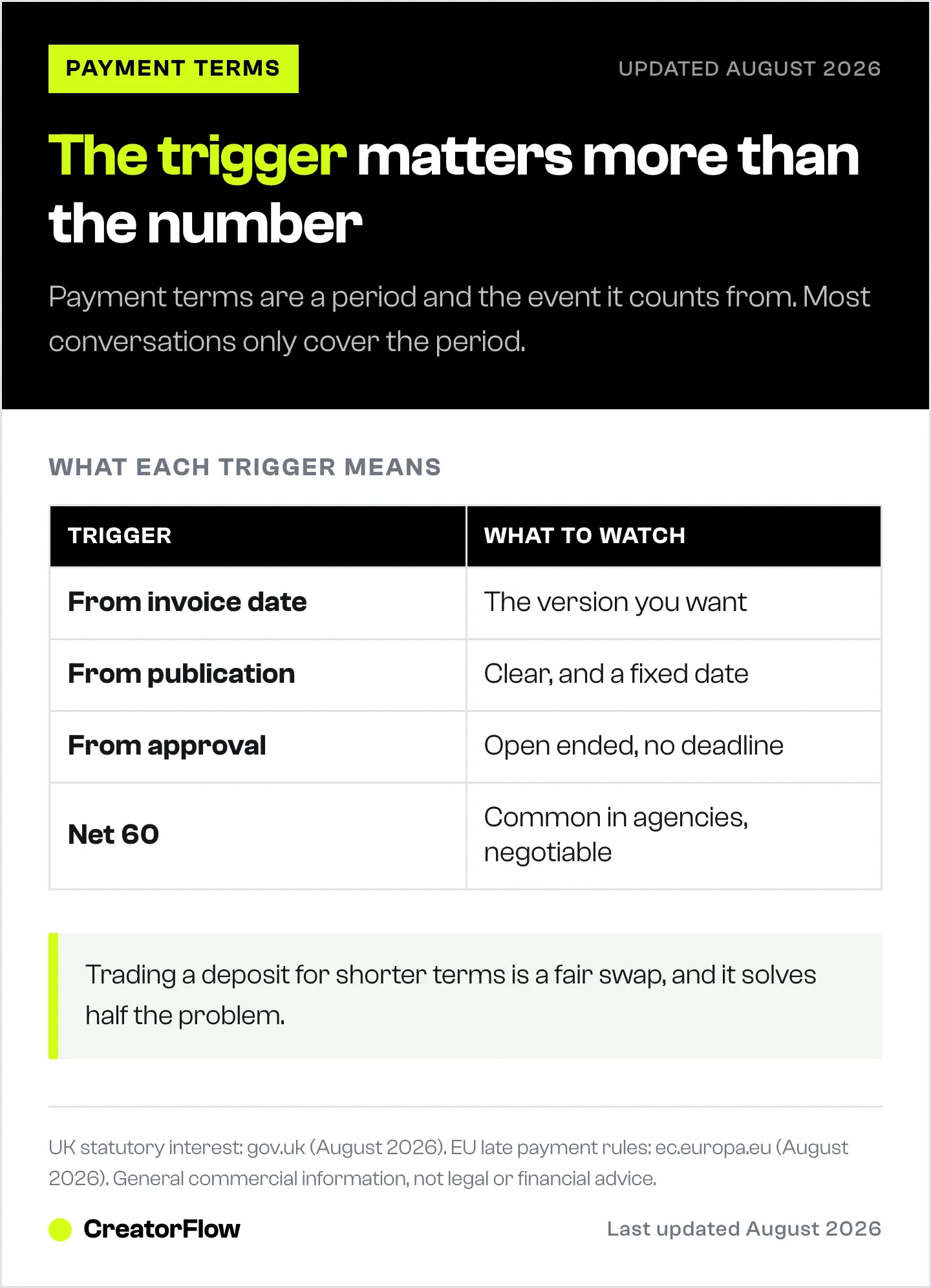
Payment terms are two things: a period, and the event the period counts from. Most conversations only cover the first.
| Term | What it means | What to watch |
|---|---|---|
| Net 30 | Payment due 30 days after the trigger | Fine, if the trigger is the invoice date |
| Net 60 | Payment due 60 days after the trigger | Common in agency contracts, negotiable |
| From invoice date | The clock starts when you invoice | The version you want |
| From approval | The clock starts when the brand signs off | Open ended, because approval has no deadline |
| From publication | The clock starts when the content goes live | Acceptable, and clear |
| On receipt | Due immediately | Rare, and usually means their next payment run |
“From approval” is the clause that causes the most damage, because it hands the brand control of when your clock starts. A month of internal review is not unusual, and it is added on top of whatever the payment period is.
Ask for the invoice date, and if the brand wants a delivery-linked trigger, publication is the fair version because it is a fact with a date attached rather than a decision somebody has to remember to make.
Get the Deposit
A deposit is the single biggest improvement you can make to creator cash flow, and it is standard practice in every adjacent industry.
Where it is reasonable to ask:
- Production costs. Anything involving travel, props, a studio, a second shooter or paid software.
- Larger fees. Once a single deal is a meaningful share of a month’s income.
- New brands. No history, no evidence of how they pay.
- Long projects. Multi-month retainers should invoice monthly, not at the end.
How to ask, at the point you agree the work:
Happy to lock this in. My standard for projects at this size is 50% on signature and 50% on publication, which covers the production spend up front. Shall I send the first invoice with the contract?
Two things make that work. It is framed as standard rather than as a concern about them, and it names what the money is for. Brands refuse this far less often than creators expect, because their own suppliers work the same way.
Where a brand genuinely cannot pay in advance, ask for a shorter payment period instead. Trading a deposit for net 14 is a fair swap and it still solves half the problem.
What the Law Gives You
Two regimes matter for most creators working with European brands, and both apply to business-to-business payments rather than consumer ones.
United Kingdom. The Late Payment of Commercial Debts (Interest) Act 1998 gives businesses a statutory right to claim interest on qualifying late commercial debts. The rate is 8% above the Bank of England base rate, and the applicable base rate is the one in force on 30 June or 31 December preceding the period in which the interest starts to run (gov.uk and legislation.gov.uk, August 2026).
European Union. Directive 2011/7/EU on combating late payment in commercial transactions sets a default payment period for business-to-business transactions of 60 days maximum unless expressly agreed otherwise and provided the terms are not grossly unfair to the creditor. Late payment triggers statutory interest at the European Central Bank reference rate plus eight percentage points, plus a fixed recovery-cost compensation of EUR 40 per invoice, with reasonable additional collection costs recoverable on top (ec.europa.eu, August 2026).
Two practical notes. Whether either applies to you depends on how you are set up and what your contract says, so this is background rather than advice you should act on unaided. And the value of knowing it is rarely in claiming the interest. It is in being able to write a calm sentence at day 30 that says you are aware of the position, which moves invoices without any escalation at all.
The Sentences That Move a Brand
Terms are set in the conversation before the contract. Four moments and what to say.
When the fee is agreed.
Great. Two admin things before the contract: what are your standard payment terms, and is there a PO number for this?
Asking about terms in the same breath as the PO makes it a process question rather than a challenge.
When they say net 60.
Net 60 is longer than I can carry on a project this size. I can do net 30 from invoice, or net 60 with 50% up front. Either works for me.
Two options, both acceptable to you, and the brand picks. That is a much better position than a single request they can decline.
When the trigger is approval.
Could we tie the payment period to publication rather than approval? Approval timing sits with your team and publication is a fixed date, so it is easier for both of us to track.
Framing it as clarity rather than distrust is what gets it agreed.
When it goes past due.
Invoice 0142 was due on the 14th. Could you confirm which payment run it is scheduled for? Terms in the agreement are 30 days and statutory interest applies after that, though I would much rather not have to.
Naming the position and immediately declining to use it is a considerably more effective message than a threat.
Retainers Beat One-Off Deals
The most reliable improvement to creator cash flow is fewer, longer arrangements. A monthly retainer invoiced on the first of the month, with a fixed scope, removes the entire negotiation cycle and makes income forecastable.
What makes a retainer work:
- Fixed deliverables per month, itemised, so scope does not drift.
- Monthly invoicing in advance or at the start of the period, not in arrears at the end of a quarter.
- A notice period on both sides, typically 30 days, so an ending is not a cliff.
- A review point at three or six months where the rate can move.
Retainers also change the pricing conversation, because a brand buying twelve months of work is buying reliability rather than a single post. What the published rate benchmarks can and cannot tell you about setting that number is covered in Instagram brand deal rates by country.
Track What Is Owed
A creator with six live deals and no list of what is owed will lose money, not through fraud but through forgetting.
The minimum that works is a spreadsheet with seven columns: brand, deal, amount, invoice number, invoice date, due date, and paid. Sort by due date. Look at it once a week. Anything past due gets a message that day.
Add two more columns when you have the habit: the PO number, and the accounts payable email. Those are the two pieces of information that unblock late payments, and looking them up again each time is what makes chasing feel like work.
The chasing sequence itself, from the day-one reminder to the escalation ladder, is in how to invoice a brand for an Instagram collaboration. The clauses that set these terms in the first place are in brand deal contracts and what to check before signing.
FAQ
What does net 30 mean for a creator invoice?
Payment is due 30 days after the trigger event named in the contract. The trigger is the part that matters: 30 days from invoice date is predictable, while 30 days from approval can stretch indefinitely because approval has no deadline attached to it.
Is net 60 normal for brand deals?
It appears often in agency contracts and in larger companies’ standard terms. It is a default rather than a rule, and it is negotiable before signing. Offering a choice between net 30 and net 60 with a deposit gets movement more reliably than refusing outright.
Can a creator ask for a deposit up front?
Yes, and it is standard in comparable industries. A third to a half on signature is a common structure, particularly where you are carrying production costs. Ask at the point the work is agreed, framed as your standard practice.
What interest can you charge on a late invoice in the UK?
The Late Payment of Commercial Debts (Interest) Act 1998 provides a statutory right for businesses to claim interest on qualifying late commercial debts at 8% above the Bank of England base rate (gov.uk, August 2026). Whether it applies to your arrangement depends on your contract and your circumstances, so take advice before relying on it.
What does the EU Late Payment Directive give creators?
Directive 2011/7/EU sets default payment periods for commercial transactions and entitles creditors to statutory interest at the ECB reference rate plus eight percentage points, plus a fixed EUR 40 recovery-cost compensation per invoice and reasonable further collection costs (ec.europa.eu, August 2026).
Should you charge a late fee instead of statutory interest?
A contractual late fee is possible where both sides agree it in advance, and it has to be reasonable. Statutory interest is available without needing the clause, where the legislation applies. In practice the mention is more useful than the charge, because it moves invoices.
How do you get paid faster without annoying the brand?
Change the trigger and take a deposit, both agreed before signing. Then invoice the day the content goes live, address it to accounts payable with the PO number, and chase on a fixed schedule rather than when it starts to bother you.
UK statutory interest verified from gov.uk and legislation.gov.uk, and EU late payment rules from ec.europa.eu, as of August 2026. This article is general information about common commercial terms and is not legal, tax or financial advice. Rules vary by country and by contract. Take advice from a qualified adviser.


