

Read the usage rights, exclusivity and payment clauses before the fee. Those three decide what a brand deal is actually worth, and all three are routinely written far wider than the money justifies. Perpetual usage across all media, category exclusivity with no end date, and sixty-day payment terms can turn a good fee into a bad deal. Every one of them is negotiable before you sign and none of them afterwards.
The contract arrives as a PDF the day before filming, the fee is what you agreed, and the temptation is to sign it and get on with the work. Then six months later the same photo is on a billboard, you have turned down two competitors because of a clause you skimmed, and the money arrived in November for work you did in August.
This guide covers the nine clauses that decide the value of a deal, what a fair version of each looks like, and the question to ask when one is written too wide. This is general information about common commercial terms, not legal advice, and a contract of any size is worth showing to a qualified adviser.
Key Takeaways
- Usage rights are a separate product from the post. Wider or longer usage should cost more, and often costs nothing because nobody asked.
- “In perpetuity” means forever. Ask for a term, normally 6 or 12 months, renewable for a fee.
- Exclusivity without an end date or a defined category removes income you cannot forecast.
- A kill fee protects you when a brand cancels after you have done the work.
- Payment terms belong in the negotiation, not the paperwork you read afterwards.
- Whitelisting and paid amplification are different from organic posting and should be priced separately.
- Approvals need a limit. Unlimited revisions turn a fixed fee into unpaid open-ended work.
The Nine Clauses That Decide the Deal
Read these first, in this order, before you look at the fee.
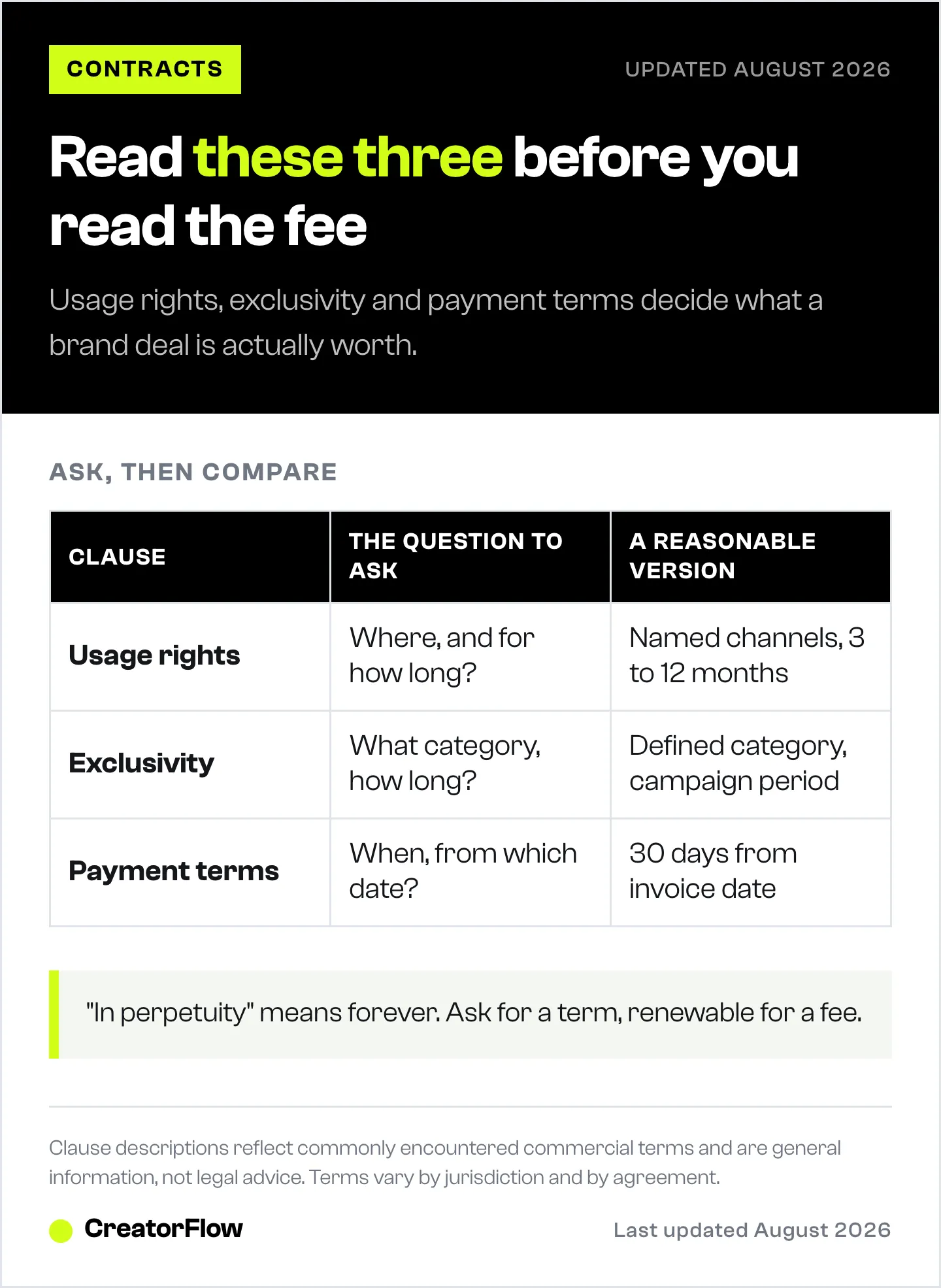
| Clause | The question to ask | A reasonable version |
|---|---|---|
| Usage rights | Where can they use this, and for how long? | Named channels, 3 to 12 months, organic only unless paid for |
| Exclusivity | What am I prevented from doing, in what category, for how long? | Defined category, matching the campaign period, priced in |
| Payment terms | When exactly do I get paid, from which date? | 30 days from invoice, deposit on larger jobs |
| Kill fee | What if they cancel after I have started? | 50% if cancelled after contracting, 100% after delivery |
| Approvals | How many rounds of changes are included? | Two rounds, then additional rounds billed |
| Whitelisting | Can they run this as an ad from my handle? | Separate line item with its own fee and term |
| Deliverables | Exactly what am I making, and where does it run? | Itemised, with dates and formats |
| Indemnity | What am I responsible for if something goes wrong? | Limited to your own content and claims you made |
| Termination | How does either side exit? | Symmetrical notice, payment for work completed |
The pattern across all nine: the first draft is written by the brand’s lawyer to protect the brand. That is their job and it is not hostile. It does mean the opening position is the widest reasonable version of everything, and it is expected that you will push back on some of it.
Usage Rights: The Clause That Costs Most
Usage rights determine where the brand can put your content, in which media, and for how long. This is where value quietly leaves the deal.
Three dimensions to check:
- Media. Organic social only? Paid social? Their website? Email? Out of home, print, in-store, TV? Each is a different product with a different market value.
- Term. Three months, twelve months, or the phrase you are looking for, “in perpetuity”, which means forever.
- Territory. One country, a region, or worldwide.
A fee quoted for one organic Reel should not carry perpetual worldwide rights across all media. When it does, it is usually because a template was reused rather than because anyone decided that was the trade.
The question to ask:
Happy to look at extended usage. The fee we discussed covers organic on my channels for six months. Could you tell me which channels and what period you need, and I will price it?
That reply does two things. It does not refuse, and it makes the rights a priced item rather than a free extra. Brands with a media budget frequently agree, because they know rights cost money elsewhere.
Exclusivity: What You Are Giving Up
Exclusivity stops you working with competing brands. It is legitimate and it is worth money, so the two things to nail down are scope and duration.
Scope. “Competing brands” is too vague to be safe. A skincare brand may consider a supplement brand competing. Ask for the category to be named, and named narrowly: “other retinol serums” rather than “beauty”.
Duration. Exclusivity should broadly match the campaign period. A one-post deal carrying twelve months of category exclusivity is asking you to turn down a year of work for one fee.
Rough arithmetic before you agree: how many deals in that category did you do in the last year, and what did they pay? If the answer is three deals at £800, then twelve months of exclusivity has a floor of £2,400 and the offer in front of you needs to clear it.
If exclusivity is not priced separately and cannot be narrowed, that is worth knowing before you sign rather than in March when a better offer arrives.
Kill Fees, Approvals and the Work You Do Twice
Kill fee. Campaigns get cancelled. Products slip, budgets get pulled, a brand changes direction. Without a kill fee clause, you can shoot, edit and deliver and be paid nothing. A common structure is a percentage if cancelled after signing but before delivery, and the full fee once delivered. If the contract is silent, ask for it to be added.
Approvals and revisions. “Content subject to brand approval” with no limit is an open door. Two rounds of changes is normal. Beyond that, additional rounds are billable, and saying so in the contract makes the fifth revision request stop arriving.
Reshoots. Separate from revisions and worth naming. A change of copy is a revision. Shooting the whole thing again because the brand changed the product colour is a new job.
Deliverable creep. The contract should itemise formats and quantities. “Social content” becomes three Reels, nine Stories and a carousel somewhere around week two if it is not written down.
Whitelisting and Paid Amplification
Whitelisting lets a brand run ads from your handle, or use your content in their own ads, with their targeting and their budget. It is common and it is not the same as an organic post.
Two things to check:
- Is it in the contract at all? It is often buried inside usage rights as “paid media” and it should have its own line.
- What is the term and the spend? Running your face in a paid campaign for six months is a different proposition from a two-week burst.
Price it separately. An organic post reaches your audience once. A whitelisted asset can run to millions of people you have never met, associated with your name, for as long as the term allows.
Payment Terms Belong in the Negotiation
The fee is the number everyone discusses and the terms are the number that determines when it arrives. Sixty-day terms on a £1,500 deal means the money lands roughly three months after you agreed the work, once you count production and invoicing.
Four things to settle before signing:
- The payment period, counted from the invoice date rather than from some undefined approval.
- What triggers the invoice: publication, delivery, or approval. “On approval” is the risky one, because approval can be delayed indefinitely.
- A deposit on anything large enough to require real production spend.
- Whether late payment carries interest. In the UK, statutory interest for late commercial debts is set at 8% over the Bank of England base rate under the Late Payment of Commercial Debts (Interest) Act 1998 (gov.uk, August 2026).
The mechanics of getting the money once the work is live are in how to invoice a brand for an Instagram collaboration, and the terms themselves are covered in more depth in creator payment terms and how to get paid faster.
Two Things That Are Not Negotiable
Some clauses are not about money and should not be traded away.
Disclosure. No contract can require you to hide that a post is advertising. In the UK, Section 2 of the CAP Code requires marketing communications to be obviously identifiable as such, and the ASA names both the influencer and the brand when an advertorial breaches the Code (asa.org.uk, August 2026). If a brand asks you to drop the label or bury it, that request puts you on the ruling, not them alone. The detail is in UK influencer disclosure rules.
Claims you cannot support. A script that has you stating a result or a health benefit you have not experienced is a problem regardless of who wrote it. Ask for the substantiation or ask for the line to change.
Both of these are cheaper to raise before signing than after publication.
How to Push Back Without Losing the Deal
Most creators do not negotiate because they expect the offer to be withdrawn. In practice, marked-up contracts are routine and brand teams expect them.
Three rules that keep it constructive:
- Ask questions rather than making demands. “Could you tell me what period you need the rights for?” opens a conversation. “I do not accept perpetuity” closes one.
- Pick two or three things, not nine. Usage, exclusivity and payment terms are usually where the real value sits.
- Offer the alternative alongside the objection. “Six months included, twelve for an extra £X” gives them something to say yes to.
If a brand refuses all movement on everything, that itself is information about what working with them will be like.
FAQ
What does “in perpetuity” mean in a brand deal contract?
Forever, with no end date. The brand can keep using the content indefinitely, in whatever media the contract allows. Ask for a defined term instead, commonly six or twelve months, with an option to renew for an agreed fee.
Should you accept exclusivity in a creator contract?
Only when it is narrowly defined and priced. Ask for the category to be named specifically rather than left as “competitors”, and for the period to match the campaign. Then check the fee covers the work you would have to turn down.
What is a kill fee and how much should it be?
A kill fee is what you are paid if the brand cancels after you have committed. A common structure pays a percentage if cancelled after signing but before delivery, and the full amount once you have delivered. If there is no kill fee clause, ask for one to be added.
How many rounds of revisions are normal?
Two is a common included limit, with further rounds billed. Unlimited approval rights turn a fixed fee into open-ended work, and the fifth revision request is much less likely to arrive when the contract says it costs money.
Is whitelisting the same as a sponsored post?
No. A sponsored post reaches your audience organically. Whitelisting lets the brand run paid ads from your handle or using your content, with their targeting and budget. It should be a separate line in the contract with its own fee and term.
Can a brand contract stop you from labelling a post as an ad?
It should not, and you should not agree to it. UK rules require marketing communications to be obviously identifiable as advertising, and ASA rulings name the influencer alongside the brand (asa.org.uk, August 2026). A clause asking you to hide the relationship creates a problem you personally carry.
Do you need a lawyer to review a brand deal contract?
For a small gifted collaboration, most creators do not. Once the fee is meaningful, exclusivity is involved, or perpetual rights are on the table, a review is inexpensive relative to what the clauses are worth. This article is general information and is not a substitute for advice on your specific contract.
UK disclosure requirements verified from asa.org.uk and statutory interest from gov.uk as of August 2026. This article describes commonly encountered commercial terms and is general information only, not legal advice. Contract terms vary by jurisdiction and by agreement. Take advice from a qualified adviser before signing.


