

UK influencer posts must carry a clear “Ad” label at the beginning, prominent enough that people recognise the post as advertising before they engage with it. Section 2 of the CAP Code requires marketing communications to be obviously identifiable as such. The ASA has ruled that “sponsored”, “gifted”, “aff”, brand tags, discount codes and ambassador hashtags are all insufficient on their own (asa.org.uk, August 2026).
Most creators learn the rules from American content, so they label posts the way the FTC wants and assume that transfers. It does not. The UK has a separate regulator, a stricter list of acceptable labels, and since April 2025 a second body that can issue fines directly without going to court. A post that would pass in the US can breach the CAP Code.
This guide covers when a UK post counts as an ad, which labels the ASA accepts, the specific labels it has ruled against and in which cases, where the label has to sit on each format, and what actually happens when you get it wrong. This is general information about published regulator guidance, not legal advice.
Key Takeaways
- Two bodies, different teeth. The ASA enforces the CAP Code through rulings and publicity. The CMA enforces consumer protection law and can now fine directly.
- “Ad” is the label. The ASA and CMA prefer labels that explicitly say advertising. The hash symbol is optional (asa.org.uk, August 2026).
- Gifts count as payment. Any payment or incentive, requested or unsolicited, makes the content advertising.
- Affiliate links make you the advertiser. Content referring to a product you hold an affiliate link or code for counts as advertising (asa.org.uk, August 2026).
- The label goes at the beginning, visible before anyone clicks, expands or watches.
- Your bio does not cover your posts. The ASA has ruled repeatedly that an ambassador line in a bio is not enough, because posts get seen in isolation.
- Both sides are named. When an advertorial breaches the Code, the ASA names the influencer and the brand.
Who Sets the UK Influencer Disclosure Rules, and Who Can Fine You
Two organisations, and creators routinely confuse them.
| Body | What it enforces | What it can do |
|---|---|---|
| ASA / CAP | The CAP Code (advertising rules) | Publish rulings naming you and the brand, monitoring spot checks, run paid ads highlighting non-compliance, refer you onward |
| CMA and Trading Standards | Consumer protection law | Since April 2025, impose penalties directly, up to the higher of 10% of global turnover or £300,000 for businesses, and up to £300,000 for individuals |
The ASA is the one that writes the guidance most creators read, and its sanctions are reputational rather than financial. Its non-compliant influencers page lists creators who repeatedly failed to disclose and either refused to commit to compliance or broke a previous commitment, and the ASA states it may run paid search ads highlighting that non-compliance (asa.org.uk, August 2026).
The financial risk sits with the CMA. The Digital Markets, Competition and Consumers Act 2024 gave the CMA direct enforcement powers over consumer law from April 2025, letting it impose penalties through administrative proceedings rather than court action, and it opened its first investigations under that regime in November 2025 (ashurstperkinscoie.com, August 2026). Liability under those consumer rules reaches parties who promote products, not only the business selling them.
The practical reading for a creator: the ASA is who tells you the rule, the CMA is who makes it expensive.
When a UK Post Counts as an Ad
Wider than most people assume. Per the ASA’s guidance, content needs to be obviously identifiable as advertising whenever a brand gives an influencer a payment or any other incentive, requested or unsolicited, or where the influencer is otherwise personally or commercially connected to the brand as an owner, employee, shareholder or director (asa.org.uk, August 2026).
That captures four situations creators often treat as outside the rules:
- Gifts you did not ask for. An unsolicited parcel you then post about is an incentive. Posting about it is advertising.
- Affiliate links and codes. The ASA treats an influencer with an affiliate link as acting as an advertiser, because they earn commission on the interest they generate. Any content referring to a product you hold a link or code for counts as advertising (asa.org.uk, August 2026). The mechanics of those links are covered in what affiliate links are and how they work.
- Your own brand. Promoting products you own or helped create falls inside the Code.
- Content the brand had editorial control over. Where a third-party brand had control, the ASA can act under the CAP Code, and both the influencer and the brand are named in the ruling.
The ASA also notes that when it assesses affiliate content, it typically considers the brand at least jointly responsible, regardless of whether the brand knew about or controlled the specific post. That is worth knowing when a brand tells you disclosure is your problem alone.
The Labels the ASA Accepts
Section 2 of the CAP Code requires marketing communications to be obviously identifiable as such. For influencer content the ASA expects a prominent label upfront, and it is explicit about which words do that job.
Accepted, per the ASA’s own guidance (asa.org.uk, August 2026):
- Ad
- Advert
- Advertising
- Ad Feature
- Advertisement Feature, the term the CAP Code specifically names for advertorial content
The hash symbol is not required. The ASA states it is not necessary to use a hash as part of the label provided the label is prominent and clearly separate from other content. It also suggests highlighting the label so it gets noticed, for example putting it in brackets or placing an asterisk either side.
You are free to add detail about the type of ad, as long as the word “Ad” is clear upfront and any extra wording would be understood by an average person. “Ad, gifted by X” is fine. “Gifted by X” alone is not.
The Labels the ASA Has Ruled Insufficient
This list is the part that catches people, because several of these are standard practice on Instagram. Each has a ruling behind it.
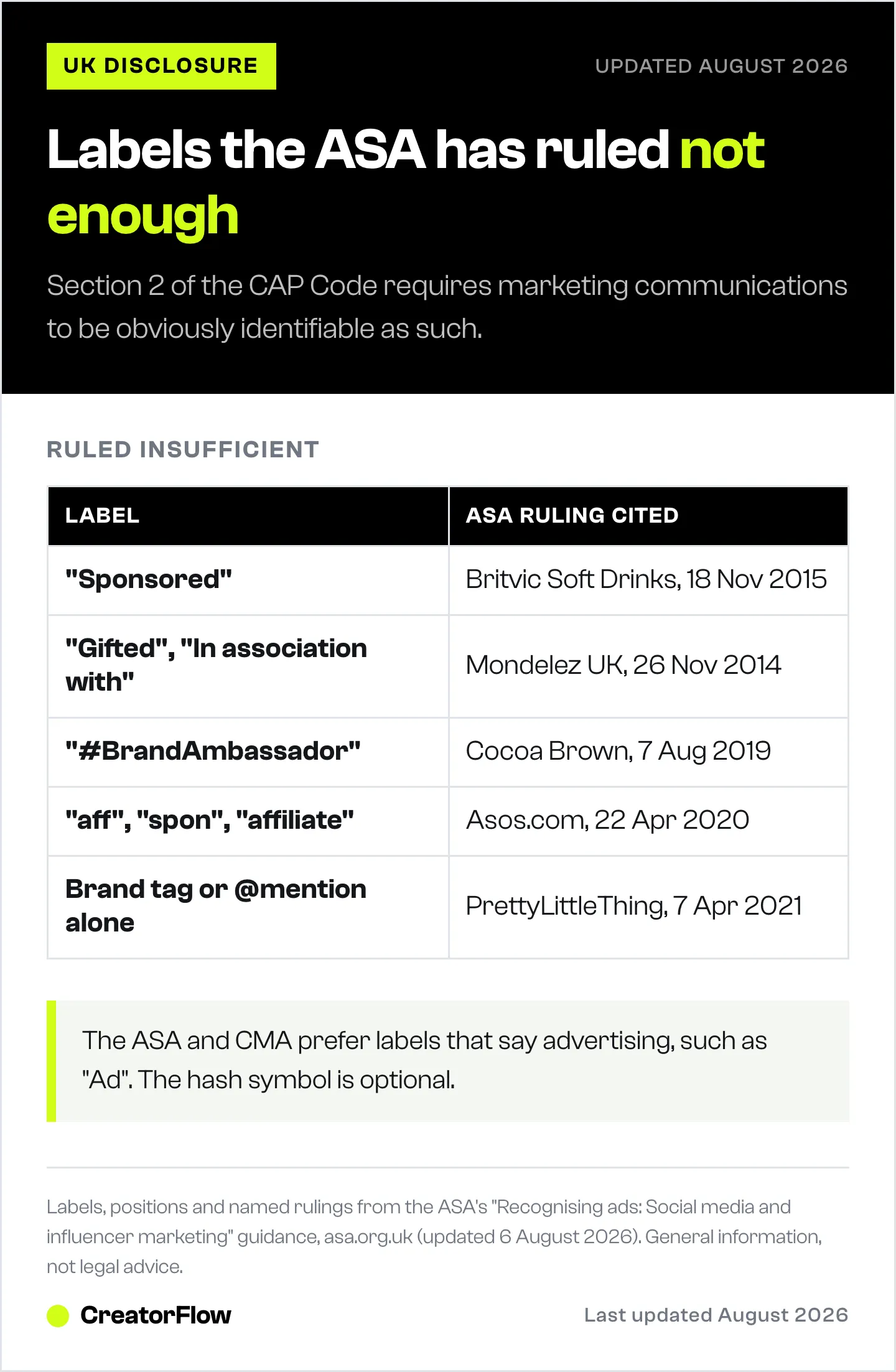
| Label | ASA position | Ruling cited |
|---|---|---|
| ”Sponsored” | Open to varied interpretation, advised against | Britvic Soft Drinks Ltd, 18 November 2015 |
| ”Supported by”, “Funded by”, “Gifted”, “In association with”, “Thanks to X” | Unlikely to be sufficiently clear | Mondelez UK Ltd, 26 November 2014 |
| ”#BrandAmbassador”, ”#[Brand]Ambassador” | Does not adequately convey the nature of the content | Emma Louise Connolly in assoc. w/ Calzedonia, 18 August 2021; Cocoa Brown, 7 August 2019 |
| ”My collection”, “we created together”, “#iworkwith[brand]“ | Unlikely to be sufficient in most contexts | Never Fully Dressed Ltd, 30 November 2022; Primark Stores Ltd, 27 October 2021 |
| ”aff”, “sp”, “spon”, “affiliate” | Consumers unlikely to be familiar with these; understanding was particularly low in ASA research | Asos.com Ltd, 22 April 2020 |
| Brand tag or @mention alone | Not sufficient to identify the post as an ad | Sony Interactive Entertainment Europe t/a PlayStation, 21 December 2022; Prettylittlething.com Ltd, 7 April 2021 |
| A discount code | Most research participants did not recognise these as ads | ASA research, cited in current guidance |
The Asos ruling is the instructive one. An Instagram Story carrying the standalone label “*affiliate” was found insufficient for two separate reasons: it was partially obscured by the swipe-up button, and the word “affiliate” itself was not widely understood by consumers (asa.org.uk, August 2026). Placement and vocabulary both have to be right, and getting one of them right does not save you.
Where the Label Has to Sit
The ASA’s placement test is that a label must be prominent enough that people easily notice it, and early enough that they notice it before they click, engage with, or watch the content. It must also stay visible across devices.
Three placements it has explicitly ruled against:
- Buried in a block of hashtags at the end of a caption.
- In a colour that contrasts poorly with the background (Emma Louise Connolly in assoc. w/ Calzedonia, 18 August 2021).
- Below the fold, where a reader has to tap “See more” to reveal it (Zoe de Pass t/a Dress Like A Mum, 20 November 2019).
By format, following the ASA’s platform guidance (asa.org.uk, August 2026):
| Format | Where the label goes |
|---|---|
| Instagram or Facebook caption | At the beginning. Very short posts may be acceptable with it at the end |
| Reels and other video | Commercial intent clear before someone taps through if possible, otherwise immediately at the outset |
| Stories | At the beginning, and not where a platform control can cover it |
| YouTube | In the video title or thumbnail, so it is clear before the click |
| X | At the start, given the character limit |
On Instagram’s own tool, the ASA’s 2026 research found the Paid Partnership label can help people recognise ads but may not be enough on its own, and advises adding a separate “Ad” label where the platform label could be obscured or unclear (asa.org.uk, August 2026). Treat the platform tag as a supplement, not the disclosure.
Your Bio and Your Old Posts Do Not Count
The ASA has ruled on this more than once, and the reasoning matters because it applies to every public account.
A post by Olivia Buckland featuring a W7 eye shadow palette was ruled non-compliant even though her bio read “Ambassador for W7 Cosmetics” and regular followers would likely have known about the relationship. Her profile was public, the posts could surface in search, and each post could be seen in isolation from the profile. Because the post itself did not make clear it was advertising, it was not obviously identifiable as a marketing communication (Warpaint Cosmetics (2014) Ltd t/a W7, 3 October 2018).
The same logic applied to a tweet from trainer Nicky Henderson promoting a Unibet blog, where the bio identified him as a Unibet ambassador (Platinum Gaming Ltd t/a Unibet, 7 November 2018), and to a Brooks Brothers post where previous posts had established the relationship (Brooks Brothers UK Ltd, 18 September 2019).
Every post is judged on its own. Prior posts, pinned posts and bios do not carry disclosure forward.
How This Differs From the US Rules
If you have been following FTC guidance, most of your instincts transfer and a few will get you in trouble.
| UK (ASA and CMA) | US (FTC) | |
|---|---|---|
| Preferred label | ”Ad” specifically | ”#ad” or “#sponsored” both accepted |
| ”Sponsored” | Advised against | Accepted |
| Who fines you | CMA, up to 10% of global turnover or £300,000 | FTC, civil penalties per undisclosed post |
| Brand liability | Brand named alongside the influencer in rulings | Brand can also be liable |
| Platform tag alone | May not be enough on its own | Also treated as insufficient alone |
The single most common mistake is “#sponsored”, which is standard in US content and which the ASA has advised against since 2015. If you post to both audiences, “Ad” satisfies both regulators, so use it everywhere and stop maintaining two habits. The American rules and their templates are covered separately in Instagram affiliate disclosure under FTC rules.
What This Means for Your DM Automation
Disclosure follows the commercial relationship, not the format. When an automated DM sends an affiliate link, a discount code, or a partner offer, that message is advertising in the same way the post was.
Two practical habits:
- Put the label in the message template, not only in the caption. The person reading a DM may never have read the caption.
- Keep the trigger post compliant too. The comment that started the automation sits under a post, and that post carries its own disclosure obligation.
CreatorFlow sends through Meta’s official Instagram API and you write the message templates yourself, so the label lives in text you control and applies to every send. If you are pairing disclosure with prize promotions, the US-side requirements are in the FTC giveaway compliance guide, and the commercial side of these partnerships is covered in how to get brand deals on Instagram.
FAQ
Is “#ad” required in the UK, or can you write “Ad” without the hash?
Either works. The ASA states it is not necessary to use a hash as part of the label, provided the label is prominent and clearly separated from other content. What matters is that the word appears at the beginning and is easy to notice (asa.org.uk, August 2026).
Does “#gifted” satisfy UK disclosure rules?
No. The ASA has ruled that “Gifted”, along with “Supported by”, “Funded by” and “In association with”, is unlikely to be sufficiently clear (Mondelez UK Ltd, 26 November 2014). You can say the item was gifted, but the word “Ad” has to be there as well.
Do you have to disclose a gift you never asked for?
Yes. The ASA’s guidance covers any payment or other incentive, requested or unsolicited. An unsolicited parcel you choose to post about is an incentive, and the post needs to be identifiable as advertising.
Is Instagram’s Paid Partnership label enough on its own?
Not reliably. The ASA’s 2026 research found the label can help people recognise ads but may not be enough by itself, and it advises adding an “Ad” label where the platform tag could be obscured by the image or does not make the advertising clear (asa.org.uk, August 2026).
Do affiliate links need an “Ad” label in the UK?
Yes. The ASA treats an influencer including an affiliate link or code as acting as an advertiser, which means any content referring to a product covered by that link counts as advertising and needs the same upfront label as a paid post.
What happens if the ASA rules against you?
The ruling is published and names both the influencer and the brand. Repeat offenders who will not commit to compliance can be added to the ASA’s non-compliant influencers page, subjected to monitoring spot checks, and targeted with ASA paid ads highlighting the non-compliance. The ASA can also refer cases to its enforcement partners.
Can an individual creator be fined in the UK?
Under the CMA’s direct enforcement regime introduced by the DMCC Act, penalties on individuals can reach £300,000, and on businesses the higher of 10% of global turnover or £300,000 (ashurstperkinscoie.com, August 2026). The ASA itself does not issue fines.
Do the rules apply to Stories that disappear after 24 hours?
Yes. The CAP Code is largely media-neutral, so the same principles apply to Stories and to new formats as they appear. The label needs to be visible at the start of the Story and positioned where platform controls will not obscure it.
UK disclosure rules verified directly from the ASA’s “Recognising ads: Social media and influencer marketing” guidance (asa.org.uk, updated 6 August 2026) and CMA enforcement powers from published legal analysis of the Digital Markets, Competition and Consumers Act 2024 as of August 2026. Named rulings and dates are the ASA’s own citations. This article is general information about published regulator guidance and is not legal advice. Take advice from a qualified adviser before relying on it.


