

A UK Instagram giveaway is legal when entry is genuinely free, or when it involves real skill, or when a free entry route sits alongside any paid one. A prize draw that charges for entry and picks winners by chance can fall inside the Gambling Act 2005 as a lottery, which generally requires a licence. The CAP Code also requires significant conditions to appear in the promotion itself, not only in linked terms.
Most giveaway guidance online is written for the FTC and stops at “disclose the sponsor”. Run that version in the UK and you can breach the CAP Code on prominence, on significant conditions, and on ad recognition all at once, without anything in the post looking unusual to an American eye.
This guide covers the three categories a UK promotion can fall into, the free entry route rule that catches most brands, what has to appear in the post itself, how the EU picture differs, and what to do with the data you collect. This is general information about published regulator guidance, not legal advice.
Key Takeaways
- Three categories in the UK: free prize draw, skill competition, or lottery. Only the first two avoid licensing.
- Paid entry needs a free route that is equally available and equally prominent, or the promotion risks being an unlicensed lottery.
- The free route must be explained clearly and prominently, per CAP rule 8.17.2 (asa.org.uk, August 2026).
- Significant conditions belong in the post, not buried in linked terms.
- A giveaway is advertising. Section 2 of the CAP Code requires it to be obviously identifiable as such.
- The EU has a common floor and national differences. Promotion rules vary by member state.
- Entry data is personal data. Decide your lawful basis before you collect it.
The Three Categories in the UK
Under the Gambling Act 2005, which applies in Great Britain, a promotion generally falls into one of three buckets. Which one you are in decides whether you need a licence.
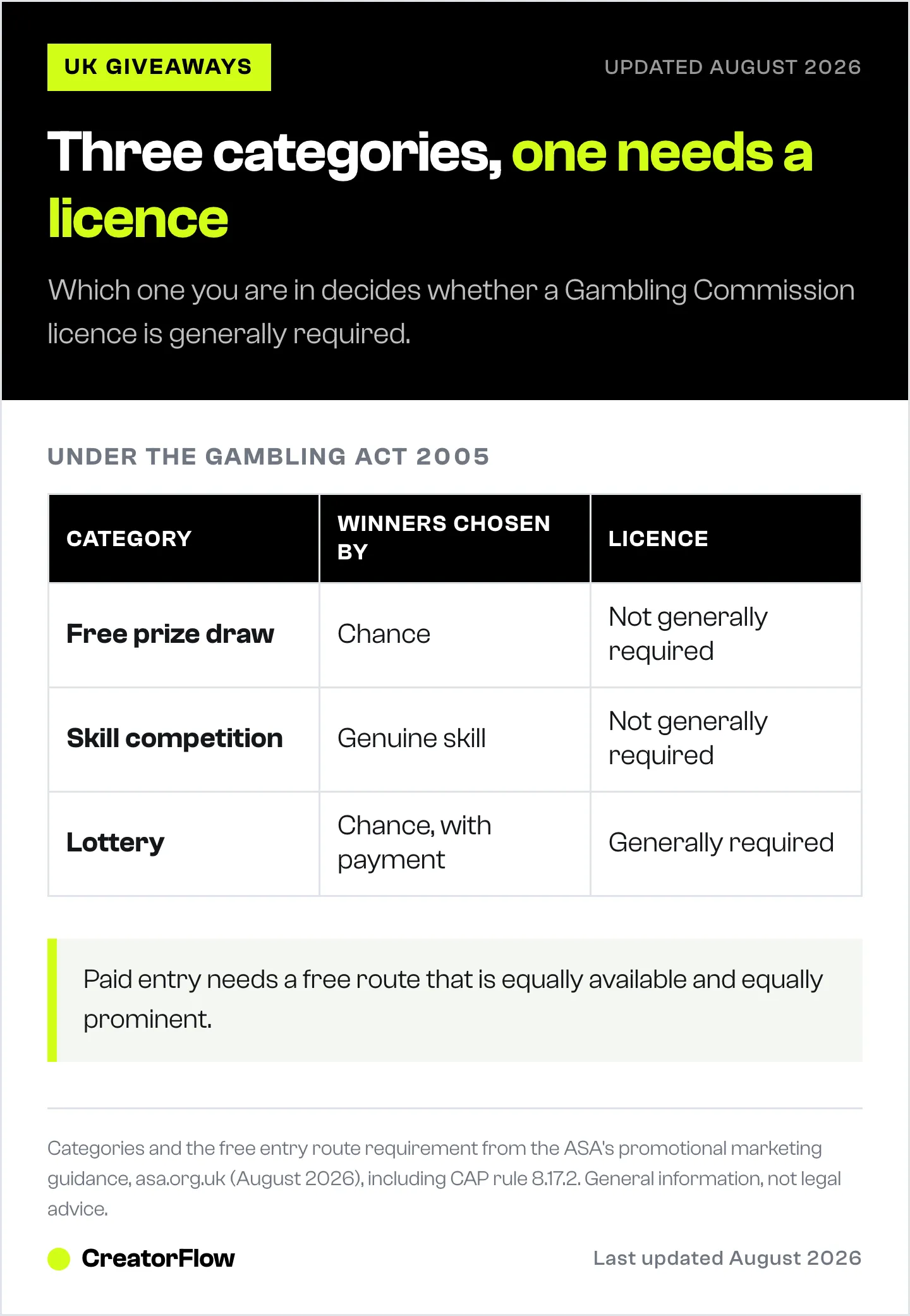
| Category | How winners are chosen | Payment to enter | Licence |
|---|---|---|---|
| Free prize draw | Chance | None, or a free route alongside | Not generally required |
| Skill competition | Genuine skill, knowledge or judgement | Permitted | Not generally required |
| Lottery | Chance | Required | Generally requires a Gambling Commission licence |
The distinction that matters for creators: if people pay to enter and winners are drawn by chance, you are likely in lottery territory unless a genuine free entry route exists (asa.org.uk and published legal guidance, August 2026).
“Payment” is broader than it sounds. It covers premium-rate routes and other charges beyond the normal cost of communication. Ordinary post, a standard-rate phone call, a basic email or a free website entry are not payment.
For most Instagram giveaways this is straightforward, because “like, follow and tag a friend” costs nothing. The risk appears the moment a purchase, a paid entry or a premium route enters the mechanic.
Skill competitions are the other clean route. The skill has to be real. A question anyone can answer by searching for ten seconds is unlikely to qualify as sufficient skill to eliminate a significant proportion of entrants, which is the test that matters.
The Free Entry Route Is Where Promotions Fail
Where a paid route exists, the free one must be genuinely equivalent and genuinely visible. This is the rule the ASA rules on most often.
CAP rule 8.17.2 requires that any free-entry route should be explained clearly and prominently (asa.org.uk, August 2026). In practice that means:
- Equal prominence. The free route cannot be small print next to a large “buy tickets” button.
- In the initial advertising. The ASA treats free entry information as a significant condition that belongs in the promotional material itself, not only in full terms and conditions.
- No differentiation in the draw. The prize allocation system must not treat free entrants differently from paying ones.
- No cost to claim. A promotion should not require the winner to pay to receive what they won.
Three ASA rulings show where the line sits:
| Ruling | Date | The problem |
|---|---|---|
| HMV Competitions | 11 April 2018 | Free postal entry details sat too far from the prominent “buy tickets” messaging |
| Omaze Inc | 7 October 2020 | The free postal option lacked visual prominence comparable to the paid online route |
| KS Competitions Ltd | 2 December 2020 | Free entry was referenced only in terms and conditions |
The pattern across all three: the free route existed and nobody could see it. Existence is not the test. Prominence is.
What Has to Be in the Post
The CAP Code requires that certain information be given before or at the time of entry. Putting it all in a linked terms page is a common and avoidable failure, because the ASA treats significant conditions as belonging in the initial advertising.
What to include in the caption or on the creative itself:
- How to enter, including the free route if one applies.
- The closing date.
- Who can enter, including any age or geographic restriction.
- What the prize actually is, described accurately, including significant restrictions.
- How and when winners are chosen and notified.
- Who is running it (the promoter’s name).
- Where the full terms live.
That is a lot for an Instagram caption, which is why a good giveaway post is mostly rules. The workable pattern is a short, complete summary in the caption’s first lines with a link to full terms for the detail, rather than a link that carries everything.
Two extras worth building in: state that the promotion is not sponsored, endorsed or administered by Instagram, and describe how you will contact the winner so people can tell a real notification from the fake accounts that follow every giveaway.
A Giveaway Is Advertising
The disclosure rules apply here in the same way they apply to any brand post, and creators routinely miss it because a giveaway feels like a gift rather than an ad.
Section 2 of the CAP Code requires marketing communications to be obviously identifiable as such (asa.org.uk, August 2026). Where a brand has paid you, gifted the prize, or has any commercial connection with you, the post needs a clear “Ad” label at the beginning, prominent enough to be recognised before somebody engages with it.
The labels the ASA has ruled insufficient apply here too, including “sponsored”, “gifted”, brand tags alone, and abbreviations. The full list, with the rulings behind it, is in UK influencer disclosure rules.
Where you are running a giveaway of your own product on your own account, the promotion still falls inside the Code as marketing content connected with the supply of goods.
How the EU Differs
There is a common floor and meaningful national variation, so treat “the EU” as a starting point rather than a single rulebook.
The common floor. Directive 2005/29/EC on unfair commercial practices governs business-to-consumer practices across the EU. Its Annex I lists practices considered unfair in all circumstances, including claiming to offer a competition or prize promotion without awarding the prizes described. Articles 6 and 7 cover misleading actions and misleading omissions, which is the provision that catches promotions where key conditions were not disclosed (eur-lex.europa.eu, August 2026).
Where it varies. Individual member states apply their own rules on prize promotions, lotteries and gambling, and several are stricter than the EU floor. Germany, one of the larger creator markets in Europe, has its own unfair competition regime and its own case law on promotional mechanics. A promotion designed for the UK does not automatically comply in Germany, France or Italy.
The practical approach for a creator or small brand running across Europe:
- Restrict entry by territory and say so in the post. Running in one or two named countries is far simpler than running everywhere.
- Keep the mechanic simple. Free entry, chance draw, no purchase. This mechanic is the least likely to hit national gambling rules anywhere.
- Get local advice for anything with real prize value or any paid element, in each market you include.
Restricting territory is the single most effective risk reduction available, and it costs you almost nothing in engagement.
The Data You Collect
A giveaway generates personal data: usernames, and often email addresses if you gate entry.
Three things to settle before you run it:
- Your lawful basis for processing, and what you will do with the data afterwards.
- Whether entering also subscribes people to marketing. If it does, say so plainly at the point of entry rather than treating an entry as consent to email.
- Retention. Decide how long you keep non-winner data and delete it when that period ends.
The version that creates a problem is a giveaway that quietly builds a mailing list. The version that works is one that offers the list as a separate, clearly stated choice at entry, which people accept far more often than expected because they wanted the prize enough to enter.
Requirements here depend on your jurisdiction and how you operate, so take advice rather than copying another brand’s entry form.
Running One Through DM Automation
Automation helps with the parts of a compliant giveaway that are otherwise unmanageable: confirming entries, delivering the terms, and keeping a record.
A workable setup:
- The post carries the summary rules and the “Ad” label where a commercial relationship exists.
- A comment keyword triggers a DM confirming the entry and linking the full terms.
- The confirmation message repeats the closing date and how winners will be contacted.
- An email gate collects the address where entry involves one, with the marketing choice stated separately.
That confirmation DM is worth more than it looks. It gives every entrant the significant conditions a second time, in a place they will actually read, and it creates a record of who entered and when. When somebody disputes the outcome, that record is the answer.
CreatorFlow sends those confirmations through Meta’s official Instagram API, supports several keyword variations per trigger, and exports contacts to CSV so the list you collected goes wherever you send email from. The US-side requirements for prize promotions are covered separately in FTC giveaway compliance and DM automation, and the general setup is in the Instagram DM automation guide.
FAQ
Are Instagram giveaways legal in the UK?
Yes, when structured correctly. A free prize draw where entry costs nothing, or a genuine skill competition, generally sits outside gambling licensing. A chance draw that requires payment to enter can be treated as a lottery under the Gambling Act 2005 and generally requires a licence.
Does “like, follow and tag” count as payment for entry?
No. Payment means a cost beyond the normal cost of communication, such as a purchase requirement or a premium-rate route. Liking, following and tagging cost the entrant nothing, which is why this mechanic is the most common for compliant Instagram giveaways.
What is a free entry route and when do you need one?
It is a way to enter without paying, required alongside any paid route in a chance-based promotion. CAP rule 8.17.2 requires it to be explained clearly and prominently, and ASA rulings have found against promotions where the free route existed only in the terms and conditions (asa.org.uk, August 2026).
Do the giveaway rules have to be in the Instagram caption?
The significant conditions do. The ASA treats information such as how to enter, the closing date, eligibility and the free entry route as belonging in the initial advertising rather than only in linked terms. Full detail can live on a linked page.
Do you need to label a giveaway as an ad in the UK?
Where a brand paid you, supplied the prize, or has any commercial connection with you, yes. Section 2 of the CAP Code requires marketing communications to be obviously identifiable, which means a clear “Ad” label at the beginning of the caption.
Can you run the same giveaway across the UK and the EU?
You can, and it is usually easier not to. National promotion and gambling rules vary between member states, so restricting entry to named territories and saying so in the post substantially reduces the complexity for very little lost engagement.
Can you add giveaway entrants to your mailing list?
Only if you have told them clearly at the point of entry and have a lawful basis for it. Present the mailing list as a separate, explicit choice rather than treating an entry as consent, and decide in advance how long you keep the data of people who did not win.
UK rules verified from the ASA’s promotional marketing guidance on free entry routes (asa.org.uk, August 2026), including the named rulings and their dates, and EU framework from eur-lex.europa.eu as of August 2026. National promotion rules vary by country and this article does not cover them individually. This is general information about published regulator guidance, not legal advice. Take advice from a qualified adviser before running a prize promotion.


