
To find influencers for your affiliate program, work seven sources in order of warmth: your own customers, creators already posting about competitors, your existing affiliate list, referrals from current affiliates, niche hashtags and communities, influencer marketplaces, and the people already asking about your product in your DMs. Qualify on posting cadence rather than follower count, then activate every recruit inside 30 days.
Recruiting is the part of an affiliate program that feels productive. You add 200 creators in a quarter, the roster looks healthy, and the revenue report shows eleven of them produced everything. The median program converts about 18% of new affiliates into a first sale within 30 days. The bottom quartile converts 6% (trackrev.io synthesis of Impact, PartnerStack and Awin data, August 2026). What separates those two numbers happens in the four weeks after someone signs up, long after sourcing is done.
This guide covers the seven places affiliate influencers come from, how to qualify one before you send an invitation, and how to run the first 30 days so the people you find turn into people who post.
Key Takeaways
- Warm sources beat cold discovery. Customers, competitor-tagged creators, and your own commenters convert better than marketplace recruits because the enthusiasm already exists
- Activation is the real bottleneck. Median 30-day activation sits near 18% and top-quartile programs reach 31%, a gap attributed to onboarding rather than recruiting volume (trackrev.io, August 2026)
- The 60-day cliff is real. An affiliate who has not driven a conversion within 60 days has roughly a 3.7% lifetime chance of ever doing so (trackrev.io, August 2026)
- Qualify on cadence, not size. A creator posting three times a week to 8,000 engaged followers outproduces one posting monthly to 80,000
- Engagement peaks in the micro tier. Nano creators from 1K to 10K average 3.5% to 6% engagement against a platform average of 0.48% by followers in Q1 2026
- Check authenticity first. Typical accounts carry 12% to 18% fake or inactive followers, and above 20% the commission math stops working
- Instant application beats a form. Replying while the creator still has the phone in hand converts better than a link that expires in a Story
What Is an Affiliate Influencer?
An affiliate influencer is a creator who promotes your product for a commission on the sales or signups they drive, tracked through a personal link or discount code, instead of a flat fee paid upfront. They combine the trust of creator content with the accountability of performance marketing: you pay after the result, and the creator keeps earning from a post long after it goes live.
The distinction changes who you approach. A creator taking a flat sponsorship fee carries no risk. A creator joining your affiliate program is betting production time against whether your product converts their audience. That is a harder yes.
For the commission rates, cookie windows and platform fees that make that bet worth taking, see the companion guide on how to build an influencer affiliate program. This article covers the recruiting half. If you pay flat fees for sponsored posts instead, start with Instagram influencer marketing rates and ROI.
Why Most Affiliate Influencer Recruiting Fails
Most programs treat recruitment as a volume exercise. Sign more people, get more sales. The benchmark data does not support that model.
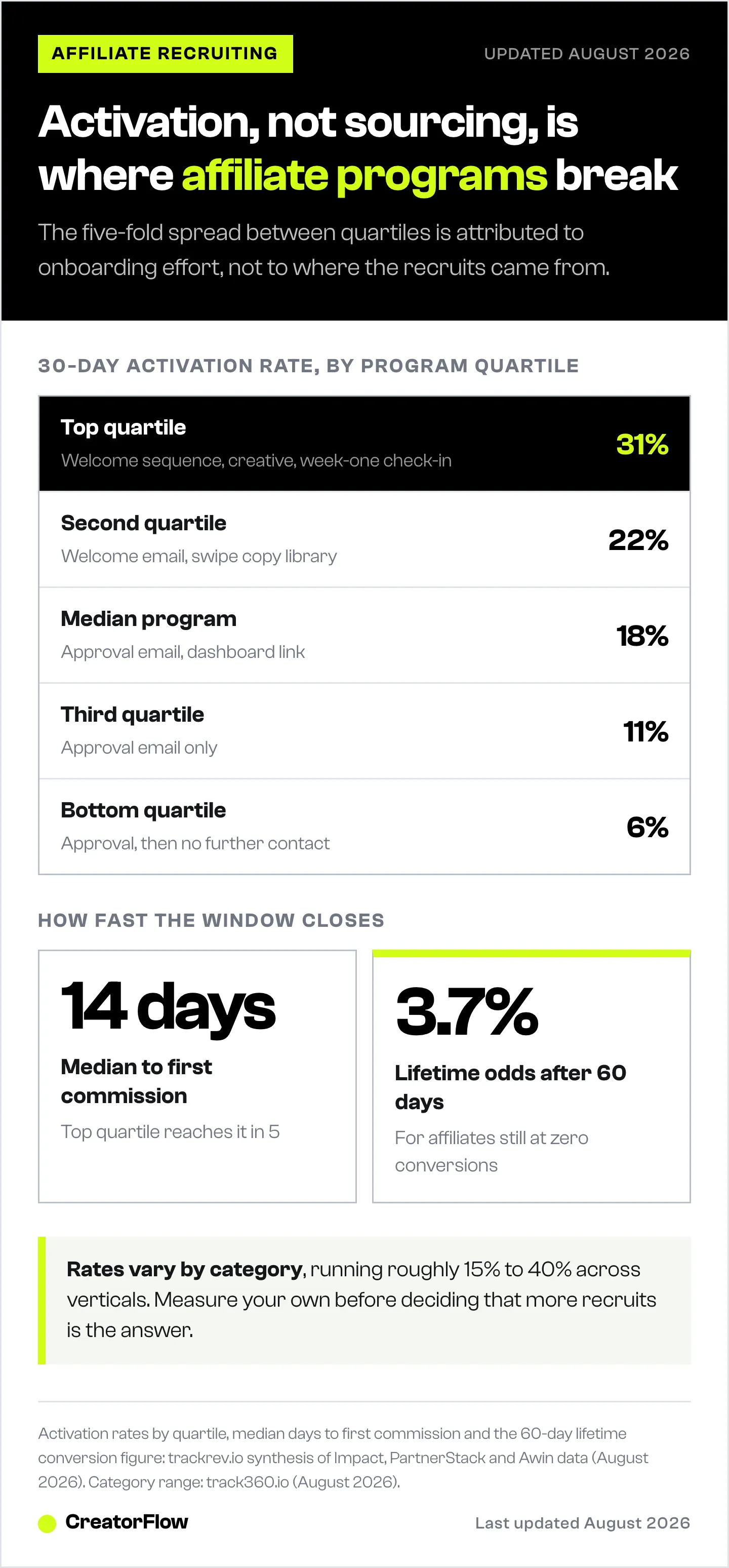
Across program quartiles, the 30-day activation rate splits like this (trackrev.io, August 2026):
| Program quartile | 30-day activation rate | What arrives after approval |
|---|---|---|
| Top quartile | 31% | Welcome sequence, ready-made creative, first-week check-in |
| Second quartile | 22% | Welcome email, swipe copy library |
| Median program | 18% | Approval email, dashboard link |
| Third quartile | 11% | Approval email only |
| Bottom quartile | 6% | Approval, then no further contact |
The five-fold spread is attributed to onboarding effort, not to where the affiliates came from. Two programs can recruit the same creator from the same hashtag and get opposite outcomes based on what lands in the inbox afterward.
Timing compounds it. The median affiliate takes 14 days to reach a first commission while top-quartile performers take 5, and affiliates who have not converted within 60 days carry a 3.7% lifetime probability of ever converting (trackrev.io, August 2026). A recruit who goes quiet for two months is finished, and your roster count is still carrying them. Rates do vary by category, running roughly 15% to 40% (track360.io, August 2026), so measure your own before deciding that more people is the answer.
How to Find Influencers for Your Affiliate Program: 7 Sources
These are ordered by warmth, which predicts activation more reliably than reach does. Most brands invert this order, start with paid discovery, and pay the most for the coldest leads.
1. Your own customers
The strongest candidate on your list has already paid you. They can describe the product without a brief, and audiences detect the difference between genuine use and a read-through of talking points.
Pull three segments from order data: customers who supplied a social handle at checkout, repeat purchasers with two or more orders, and anyone who has tagged your account. Match the handles against Instagram and TikTok, then filter for accounts that post publicly and consistently.
Approach these people personally. A templated bulk email to a loyal customer reads as a downgrade in the relationship. Name the product they bought, and offer something that acknowledges the head start: a higher rate for the first 90 days, early access to launches, or product to give away to their audience.
2. Creators already posting about competitors
A creator producing repeated content in your category has proven three things at once: they can make content in your format, their audience tolerates product recommendations, and they convert in your niche.
Search competitor branded hashtags, product tags, and the tagged-photos tab on competitor profiles. Check Reels audio pages too, because sound-driven trends surface creators that hashtag search misses. The signal is repetition. One sponsored post means someone bought a slot. Four category posts over two months means the creator is embedded in the niche.
Give them a reason to add you rather than a request to drop anyone: better commission, longer cookie, faster payout, or a product gap the competitor does not fill. Do not ask for exclusivity in a first message.
3. Your existing affiliate list
Programs that have run for a while usually have publishers who quietly built a social audience nobody noticed. A blogger from three years ago may now post daily Reels.
Export your affiliate list and match names and emails against social platforms. Where you find an active account, invite that affiliate to expand into content under a defined arrangement: a tiered commission bump for posts meeting basic quality criteria, plus a brief to work from. The relationship, the tracking link, and the payment details already exist, which removes most of the friction that kills new recruits.
4. Referrals from your current affiliates
Creators know other creators. A two-tier bonus, where an existing affiliate earns a small percentage of what their referral produces for a fixed window, turns active partners into a recruiting channel that costs nothing until it works.
Restrict this to affiliates who have already made a sale. Offered to a whole roster, referral bonuses invite signup farming from people who never produced anything themselves, which inflates the roster and drags activation down.
5. Niche hashtags and communities
For verticals such as supplements, sustainable fashion, home organization, or pet products, manual search surfaces micro-creators that marketplace filters rank too low to show.
Search category hashtags on Instagram and TikTok, and read the comments rather than the follower counts. Real community shows up as questions from followers, replies from the creator, and comments longer than an emoji. Reddit threads, Facebook groups, and Discord servers built around a product category also hold audiences with unusually high purchase intent, because those people are already in a conversation about what to buy.
6. Influencer marketplaces and search platforms
Marketplaces solve one problem well: reaching creators who have never heard of you, with filters for niche, location, engagement rate and audience size. Collabstr, Refersion, HypeAuditor and Traackr all operate in this space, and a campaign brief can reach thousands of relevant creators at once (vendor sites, August 2026).
Budget accordingly. Discovery platforms generally start near $199 per month, which is the expensive route to signing people who already follow you. Work sources one through five first, then use paid discovery for the gaps they cannot reach.
7. The people already asking you
Your comments and DMs contain creators who like the product enough to ask about it in public. Most brands never systematize this, because the requests arrive one at a time and get handled as customer service instead of logged as recruiting leads.
Turn it into a channel by announcing the program in a post or Reel and asking people to comment a keyword. The application link then arrives in their DMs within seconds, while attention is still on your content. A Story link that disappears in 24 hours converts a fraction of what an instant reply does, and a link in bio asks the creator to leave the app to find it.
How to Qualify an Affiliate Influencer Before You Invite Them
Follower count is the weakest available predictor. Instagram engagement averaged 0.48% by followers in Q1 2026, down about 24% year on year, while nano creators between 1,000 and 10,000 followers averaged 3.5% to 6% and micro creators between 10,000 and 100,000 averaged 1.5% to 3.5% (2026 platform benchmark reports). Engagement peaks in the micro tier and compresses at both ends.
Score every candidate on five signals before an invitation goes out:
| Signal | What to check | Pass mark |
|---|---|---|
| Posting cadence | Posts in the last 30 days | 8 or more, published consistently |
| Category fit | Share of recent posts in your category | Over half |
| Comment quality | Comments that ask questions or name products | Present on recent posts |
| Audience authenticity | Fake or inactive follower share | Under 15% |
| Commercial history | Has posted an affiliate link or code before | Yes, and it still reads naturally |
Roughly 12% to 18% of followers on a typical creator profile are fake, bot-generated or inactive, climbing to 20% to 25% above one million followers (2026 fraud analyses). Under 10% is normal. Above 20% the math stops working unless the rate is discounted heavily.
Cadence deserves the most weight. A creator posting three times a week to 8,000 engaged followers gives you roughly twelve promotional slots a month. A creator posting monthly to 80,000 gives you one. Affiliate revenue is a function of at-bats.
How to Write the Recruitment Message
Creators receive a high volume of partnership pitches. The ones that get answered state the offer in the first two lines and prove the sender looked at the account.
- A specific reference. Name the post, product or series they run. One sentence, verifiable from their profile.
- The commission number. Write the actual rate and cookie window. “Competitive commission” reads as a rate the sender is embarrassed by.
- What arrives on day one. Product, tracking link, creative assets, disclosure wording.
- One action. A single link to apply, not a calendar and a form and a media kit request stacked together.
Adjust the opening by source. A customer gets their order referenced. A referred creator gets the referring affiliate named in the first line, which is the strongest opener available because it borrows trust that already exists.
State the bar inside the recruitment post too: the niche you want, the commission, what the creator receives on day one, and the deadline. Fewer applications with better fit is the right trade, because every approved affiliate who never posts still consumes an onboarding sequence and a row in your reporting.
How to Run the First 30 Days
The sources above determine who joins. This determines whether they produce, and it is where the return on the whole exercise sits.
Within 48 hours of approval, send four things. The tracking link and personal discount code. Three ready-to-post assets sized for Reels, Stories and a static post. The product claims they may make and the ones they may not. The disclosure wording written out for copying. Programs that send a dashboard login and nothing else get a signup. Programs that send assets get a post.
Set a first-post date during onboarding. An open-ended start date is the most common reason a recruit drifts past 30 days.
Check in during week one. It costs one message and catches the two failures that kill new affiliates quietly: a tracking link that was never installed, and a creator who does not know what to post.
Treat day 30 as a decision point and day 60 as a cutoff. At 30 days with no click, ask what is blocking them and offer a different asset. At 60 days with no conversion, move them to a dormant list and stop counting them as active roster.
Every affiliate post also needs a clear disclosure of the material connection, placed in the same post as the link where it cannot be missed. The FTC’s Endorsement Guides treat commission as a material connection, and a bio disclaimer or separate disclosure post does not meet the standard (ftc.gov, August 2026). Supply the wording in the onboarding kit rather than asking creators to compose it. Placement rules by post format are in the guide to Instagram affiliate disclosure and FTC rules. This is not legal advice.
How to Recruit Affiliate Influencers on Instagram at Scale
Source seven scales differently from the others because it runs on a trigger instead of a list.
The mechanic is a comment-to-DM automation. You publish a Reel announcing the program and ask interested creators to comment a keyword. Everyone who comments receives a DM within seconds containing the application link. CreatorFlow runs this through Meta’s official Instagram API as a Meta Tech Provider (since December 2025), with keyword triggers, story-reply triggers and click tracking on every link sent, at $15 per month on the Pro plan.
Two features matter for recruiting specifically. The Email Gate collects an email address inside the DM before the application link is sent, giving you a contact record for every applicant whether or not they finish the form. CSV export moves those contacts into your email platform, so a creator who applied in March is reachable when you open a second round in June. Geographic analytics show which countries applicants come from, which matters when your program only pays into certain regions.
The full walkthrough, including the qualifying questions worth asking and how to log responses, is in the guide to ambassador enrollment via Instagram DM. If your program rewards content rather than sales, the structure differs, and that model is covered in the social media ambassador program guide. It also helps to know what the other side is comparing you against: the rates, payout speeds and follower minimums creators weigh are broken down in the best affiliate programs for micro-influencers.
FAQ
How do I find influencers for my affiliate program for free?
Work your own data first. Customers who supplied a social handle, people who tagged your account, your existing affiliate list matched against social platforms, and creators already commenting on your posts cost nothing to reach. Competitor hashtags and product tags are also free to search. Paid discovery platforms start around $199 per month and are best saved for reaching creators outside your existing orbit.
How much commission should I offer affiliate influencers?
Rates vary by category. Physical goods commonly run 5% to 15%, DTC brands often start affiliates at 10% to 15% on first orders, digital products and courses run 20% to 50%, and SaaS runs 20% to 30% recurring (2026 industry benchmark compilations). Come in at or above your category midpoint if you want creators who have other options, and consider a small flat fee plus commission to reduce the creator’s risk.
How many influencers should I recruit for an affiliate program?
Fewer than most brands assume, activated properly. At a median 18% activation rate, 200 recruits produce roughly 36 affiliates who make a first sale, and a smaller share who sell repeatedly. Recruiting 40 well-qualified creators with a structured 30-day onboarding produces more revenue than 200 signups left with a dashboard login.
What is a good affiliate activation rate?
The median program converts about 18% of new affiliates into a first sale within 30 days, top-quartile programs reach roughly 31%, and the bottom quartile sits near 6% (trackrev.io, August 2026). By vertical the range runs about 15% to 40% (track360.io, August 2026). Anything under 10% points at onboarding rather than recruiting.
Do affiliate influencers have to disclose commissions?
Yes. The FTC treats affiliate commission as a material connection requiring disclosure, and it must appear in the same post as the link in language that cannot be missed. A disclaimer in the bio or a separate post does not meet the standard (ftc.gov, August 2026). Brands that direct or benefit from an endorsement share responsibility, so supply the wording rather than leaving creators to write it.
Can micro-influencers work as affiliates?
They are often the strongest fit. Nano creators between 1,000 and 10,000 followers average 3.5% to 6% engagement and micro creators between 10,000 and 100,000 average 1.5% to 3.5%, against a platform average of 0.48% by followers in Q1 2026. Engagement peaks in the micro tier, and those audiences act on recommendations more readily than larger, more passive followings.
How do I recruit affiliates without a discovery budget?
Announce the program in a post or Reel and ask creators to comment a keyword, then let a comment-to-DM automation deliver the application link within seconds. This converts your existing audience, which holds the warmest candidates you have, at no cost per applicant. Pair it with customer-list mining and competitor hashtag search for a recruiting motion that runs on time rather than spend.
Start Recruiting Without the Manual DMs
Finding affiliate influencers is a sourcing problem for about a week. After that it becomes an activation problem, and the programs that win turn an interested comment into an application before the creator’s attention moves on.
CreatorFlow turns any post announcing your program into an application funnel: creators comment a keyword, the link and your qualifying questions arrive in their DMs in seconds, and every applicant lands in an exportable contact list with click tracking attached. The Free plan covers 500 DMs a month, and Pro is $15 flat.
Start recruiting affiliates on Instagram
Activation and commission benchmarks verified from trackrev.io, track360.io and 2026 industry compilations; engagement and authenticity figures from 2026 platform benchmark reports; disclosure requirements from ftc.gov, as of August 2026. Individual results vary.


