
A social media ambassador program is a standing group of customers and small creators who post about your brand in return for product, commission, status, or early access. It runs continuously and pays on output, which is what separates it from a one-off influencer campaign. Four parts decide whether it works: who you recruit, what the reward pays for, how fast a new member gets activated, and which number you track.
Most programs are built and measured backwards. The launch deck reports signups, the quarterly review reports roster size, and nobody reports the only figure that moves revenue: how many members posted this month. A roster is cheap to grow and tells you almost nothing.
This guide covers the numbers published by brands running these programs at scale, who to recruit, the reward structures that produce content, the four messages that activate a new member, and what it costs to run. Sources are listed at the end.
Key Takeaways
- Roster size is the vanity metric. Klaviyo reports that Kulani Kinis grew its ambassador program past 130,000 members and collected more than 4,800 tagged posts in a year (klaviyo.com and businesswire.com, July 2026). That is one tagged post for every 27 members over twelve months
- Plan on revenue per member, not per ambassador. Klaviyo’s case study on the same brand reports 22,000 members and $425,000 in revenue over six months, with 64% of revenue attributed to Klaviyo (klaviyo.com, August 2026). About $19 per member across half a year
- Your customer list beats a creator marketplace. People who already bought convert into posting members at a higher rate than creators recruited cold, and they cost nothing to find
- Rewards must pay per post, not per signup. A welcome gift buys a signup. A reward that fires on each piece of content buys content
- Instagram shows you two of three content channels. Tagged posts and @mentions arrive with the posting account attached. Hashtag results do not, and Story mentions land in your DM inbox instead of the Mentions API (developers.facebook.com, August 2026)
- Disclosure is the brand’s responsibility. Every ambassador post needs a clear material-connection disclosure under the FTC Endorsement Guides, 16 CFR Part 255 (ecfr.gov, August 2026)
- Tooling ranges from free to quoted. Klaviyo bills on active profiles and is free up to 250, BrandChamp lists five tiers with no public prices, and CreatorFlow Pro is $15/month flat

What a Social Media Ambassador Program Is
An ambassador program is a long-running arrangement with many small advocates. You give them a reason to post, they post, and you can identify each piece of content and the person behind it.
Three things distinguish it from the alternatives:
- Against an influencer campaign: the campaign ends, the ambassador relationship continues. You pay for a stream of content over months rather than a single deliverable.
- Against an affiliate program: the affiliate is paid on sales and does not have to post. The ambassador is paid on content, and sales are the second-order effect. The commission rates, cookie windows and platform fees behind that model are set out in the guide to building an influencer affiliate program.
- Against a loyalty program: loyalty rewards purchases. Ambassador rewards posts.
Most working programs blend the affiliate and ambassador models, paying a base reward for content and a commission on attributed sales. That combination is covered in the breakdown of affiliate programs for micro-influencers.
The Number That Predicts Revenue
Klaviyo’s launch announcement for its Social Marketing product reports that the Australian swimwear brand Kulani Kinis grew its global ambassador program to more than 130,000 members, five times its previous size, and collected more than 4,800 user-generated posts tagging the brand in the past year (klaviyo.com and businesswire.com, July 2026).
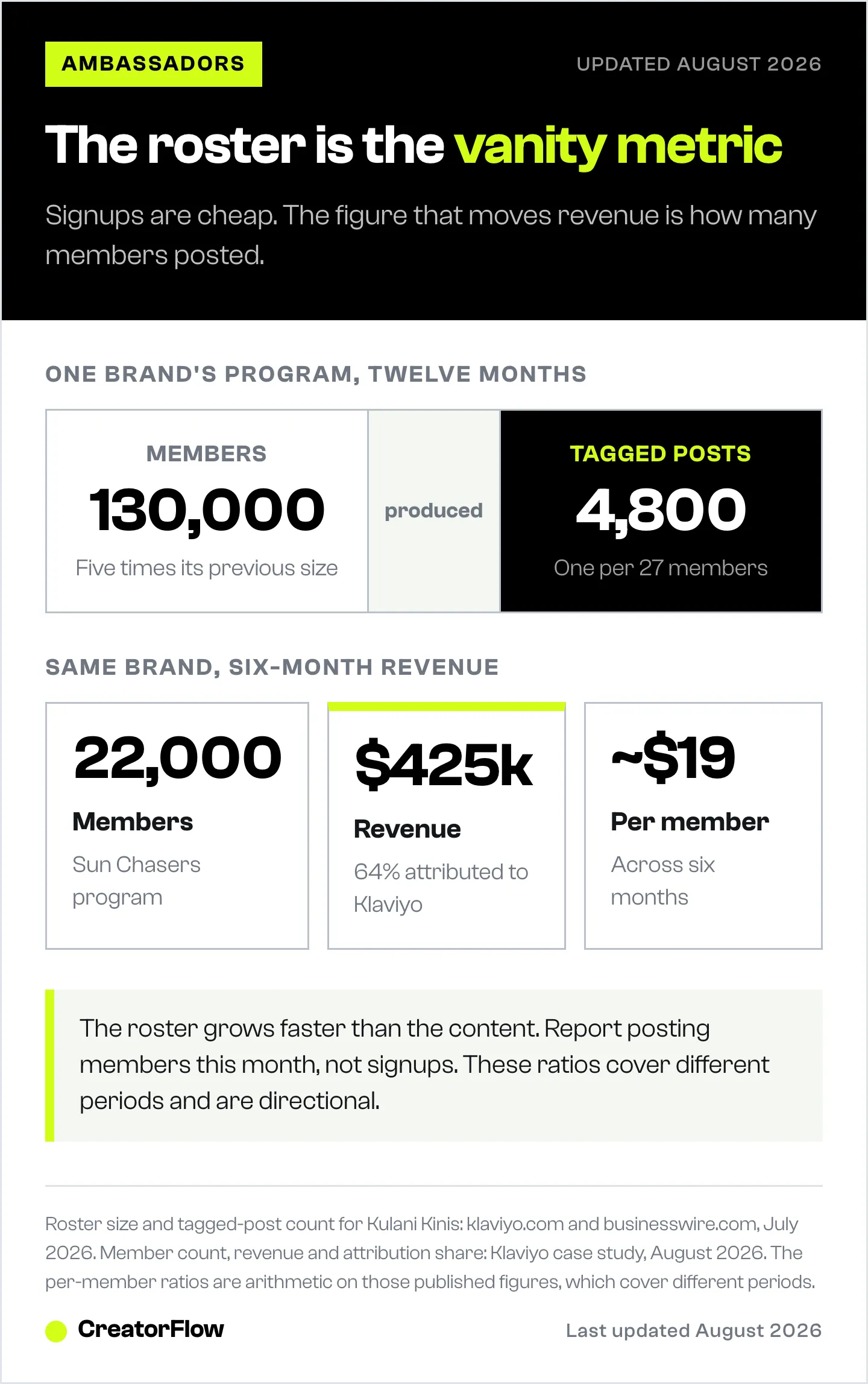
Set those two figures side by side. Roughly one tagged post per 27 members over twelve months.
The comparison is rough and worth stating plainly. Members joined at different points, the roster grew across the period, and tagged posts only count the content Instagram’s API can attribute back to an account. Story mentions and untagged posts sit outside that figure. Even with those caveats, the direction is the useful part: the roster grows much faster than the content does.
The brand’s own case study fills in the other half. It reports 22,000 members in the Kulani Sun Chasers program and $425,000 in revenue over six months, with 64% of total revenue attributed to Klaviyo (klaviyo.com, August 2026). That works out to about $19 per member across half a year.
Nineteen dollars per member is a good result from a program built on product and status rather than cash fees. It is also the right number to plan against. Budgeting from what your best ambassador produces, then multiplying by roster size, is how programs end up with a shipping bill that no content ever pays back.
Two operating consequences follow:
- Stop reporting signups as the headline. Report posting members this month, and posts per posting member.
- Size the reward budget on the active fraction. If 4% of the roster posts in a given month, a 500-person roster is a 20-person content team. Spend accordingly, and stop shipping product to the other 480 by default.
Recruit From Your Customer List First
The instinct is to go looking for creators. The higher-yield pool is already in your database.
Buyers who tagged you. Anyone who tagged your account in a post has demonstrated the exact behaviour the program depends on. They are the shortest path from recruit to active. Pull them from Instagram’s tags and mentions data, covered in detail in UGC tracking.
Repeat purchasers. Two or more orders means the product survived first contact. They can talk about it without a script.
Frequent commenters. People who comment on your posts every week are already spending attention on you. Follower count is not the filter here. Consistency is.
Small creators in your niche. Recruit these last, not first. They cost the most to find and are the most likely to treat the program as a paid campaign rather than a relationship. If your program pays commission rather than product, the sourcing order changes, and the full breakdown is in the guide to finding influencers for an affiliate program.
The recruiting mechanic that scales without a team is a post with a keyword. You announce the program, ask people to comment a word, and the application arrives in their DMs within seconds. That flow, including what to ask and how to log responses, is set out in the guide to brand ambassador enrollment via Instagram DM. The underlying trigger is the standard one described in the comment-to-DM setup guide.
State the bar in the recruitment post. Niche, minimum posting commitment, what members get, and the deadline. Fewer applications and better fit is the trade you want.
Reward Structures That Produce Posts
A reward that fires on signup buys you a signup. A reward that fires on each post buys you posts. Most programs get this backwards, spend the budget at the front, and then wonder why the roster went quiet.
Four structures, and what each one actually buys:
| Structure | What it pays for | What it buys | Watch for |
|---|---|---|---|
| Welcome gift or voucher | Joining | Roster growth | Members who take the gift and never post |
| Product for content | A delivered post | Content volume | Shipping cost with no post confirmation step |
| Commission or code | An attributed sale | Sales effort | Members with no audience earn nothing and leave |
| Status and access | Ongoing participation | Retention | Costs nothing, works only if the status is visible |
Kulani Kinis scales the welcome voucher by the member’s Instagram follower count (klaviyo.com, August 2026). That is a sensible refinement of a signup reward, though it is still paying for the signup.
The structure that holds up is a stack. A small welcome reward to confirm the relationship, a per-post reward that repeats, a commission on top for the members whose audiences buy, and a visible tier that people can climb. The tier is the cheapest lever in the whole program and the most underused. Being named a top ambassador in a monthly Story costs nothing and reliably produces the next month’s posts.
Tie every shipment to a delivered post. Ship first with no confirmation step and you will fund a lot of silence.
The Activation Loop: Four Messages
Whether a member ever posts is mostly decided in the first two weeks. Four messages cover it.
Message 1, within minutes: accepted, and here is the first thing to do. Not a welcome packet. One brief, one deadline, one deliverable. Momentum at the point of highest intent is worth more than a well-designed onboarding kit that arrives three days later.
Message 2, on delivery: reward fires immediately. The member posts, tags you, and the reward arrives while they are still looking at their phone. Delay breaks the link between the action and the payoff. This is the single mechanic that separates programs producing content from programs holding a roster.
Message 3, day 14: the second brief. One deliverable and a deadline again. If a member has not posted by day 14, one nudge, then stop. Silent members are not a problem to solve. They are the expected majority.
Message 4, monthly: the recap. What they posted, what it earned, where they sit in the tier, what next month’s brief is. Send it to everyone who posted. Do not send it to everyone.
Everything in that loop except judging content quality can run from triggers you already have. Story replies and keyword DMs handle the check-ins, and comment triggers handle recruitment. The complete DM automation guide covers the setup.
What Instagram Lets You See
Before designing measurement, know what the platform returns. Meta exposes ambassador content through three surfaces and they are not equivalent.
| Surface | Carries the posting account | Use it for |
|---|---|---|
| Tagged posts and Reels | Yes | Identifying and rewarding individual members |
| Caption and comment @mentions | Yes | Same, plus a webhook you can trigger on |
| Hashtag search | No | Volume only |
Meta’s reference states you cannot request the username field on media returned by the hashtag edge, and that hashtag results only cover public photos and videos published within 24 hours of the query (developers.facebook.com, August 2026). A branded hashtag is fine as a campaign device. It is not an attribution mechanism.
Story mentions are the other gap worth planning around. Meta’s documentation states mentions on Stories are not supported by the Mentions API. They reach you as a message in your DM inbox instead (developers.facebook.com, August 2026). Since Stories are how most customers reference a brand, treat the DM inbox as a primary ambassador channel rather than an overflow.
One more step belongs here. A tag is not permission to reuse the content. The rights request and the permission log are covered in how to collect user-generated content on Instagram.
What to Measure
Four numbers, reported monthly. Everything else is decoration.
| Metric | Definition | Why it matters |
|---|---|---|
| Posting members | Members who posted at least once this month | The real size of your program |
| Posts per posting member | Total tagged posts divided by posting members | Whether the loop is working |
| Cost per post | Reward and shipping spend divided by posts | The unit economics |
| Revenue per member | Attributed revenue divided by total roster | The number to budget against |
Attribution needs a per-member code or tracked link. Discount codes survive screenshots and word of mouth, which tracked links do not. Give each member both, and expect the code to carry most of the credit.
The trap is reporting potential reach. It sums the follower counts of everyone who tagged you and counts nobody who saw the post. It rises every time the roster grows, which is exactly why it gets reported.
Three Ways to Run the Program
Tooling splits into three shapes. Pricing verified at the dates shown.
| Category | Example | Pricing | Best for |
|---|---|---|---|
| Ambassador platform | BrandChamp: points, reward catalogue, referrals, leaderboards, branded portal | Five tiers listed (Launch, Essential, Pro, Premium, Enterprise) with no public prices (brandchamp.io/plans, August 2026) | Rosters large enough to need a portal and a points economy |
| CRM with social capture | Klaviyo Social Marketing: comment and DM capture into customer profiles, social events that trigger email and SMS flows | Billed on active profiles, free up to 250 profiles and 500 emails a month (klaviyo.com, August 2026) | Ecommerce brands already running Klaviyo email |
| Multi-channel DM automation | ManyChat: Instagram, Facebook, WhatsApp, SMS, TikTok, Telegram, email | $17 to $199/month by contact tier, or $14 to $139/month billed annually (manychat.com, July 2026) | Programs running across several messaging channels |
| Instagram DM automation | CreatorFlow: comment, Story reply and keyword triggers, link click tracking, geographic analytics, CSV export of contacts | $15/month flat on Pro, free plan available (creatorflow.so, August 2026) | Instagram-only programs run by one person or a small team |
Pick by bottleneck. If members cannot find the brief or the reward catalogue, you are paying for a portal. If the ambassador data needs to sit next to purchase history and drive email flows, you are paying for the CRM, and the schema behind that is described in the guide to what a social media CRM stores. If the bottleneck is that nobody replies fast enough at recruitment and at delivery, a DM tool is the whole answer. We wrote a longer read on what Klaviyo’s social product ships if that is the direction you are weighing.
Most programs under 200 members do not need a platform. They need the four messages to fire on time.
Disclosure Is the Brand’s Job
Every ambassador post that carries a material connection needs a disclosure the reader can see without tapping “more”. The FTC Endorsement Guides, 16 CFR Part 255, place responsibility on the brand for the endorsements it sponsors (ecfr.gov, August 2026).
Free product counts as a material connection. So does a discount code, early access, and a chance to be featured. The threshold is lower than most brands assume.
Three practical steps: put the disclosure requirement in the agreement, pre-write the disclosure line in every brief so nobody has to invent it, and audit posts monthly. The full rules and the wording that satisfies them are in the breakdown of Instagram affiliate disclosure and FTC rules.
This article is not legal advice. Requirements differ outside the United States.
FAQ
How many ambassadors should a program start with?
Twenty-five to fifty. That is enough for the active fraction to produce measurable content while the loop is still small enough to fix by hand. Scale the roster only after posts per posting member holds steady for two months.
What percentage of ambassadors actually post?
Plan for a small single-digit percentage in any given month. Published figures point that way: Klaviyo reports 130,000 members and 4,800 tagged posts across a year for one brand (klaviyo.com, July 2026). Your own number depends on how fast the reward fires and whether briefs go out at all.
Ambassador program or affiliate program?
Ambassadors are paid for content and produce it whether or not it sells. Affiliates are paid for sales and may never post. If you need content assets and social proof, run ambassadors. If you need revenue and have no use for the content, run affiliates. Most brands end up running both under one roster.
Do ambassadors need a contract?
Yes. A one-page agreement covering term, deliverables, reward terms, content rights, disclosure obligations, and how either side exits is enough. Without content rights in writing, you cannot legally reuse the posts you paid for.
How do we know which ambassador drove a sale?
A unique discount code per member is the most durable method, because it survives being screenshotted and repeated out loud. Tracked links measure clicks accurately but break the moment someone retypes the URL or shares it in a Story.
Can this run on Instagram alone?
Yes, and for most brands it should start there. Instagram exposes tags, mentions and DM triggers through the official API, which covers recruitment, activation and identification. Add a second platform once the loop produces content reliably on the first.
What kills ambassador programs?
Three things, in order of frequency. No brief, so nobody knows what to post. A reward that arrives weeks after the post, so the link between action and payoff breaks. And measuring roster size, which hides the fact that nothing is being produced.
Where to Start
Do not buy software this month. Take twenty customers who already tagged you, send each one a message offering a specific reward for a specific post by a specific date, and see how many deliver. That test tells you your real activation rate, which reward wording works, and whether the brief was clear. It costs a few hours and no subscription.
Once the loop is proven, the parts worth automating are the two where speed decides the outcome: the reply at recruitment and the reward at delivery. CreatorFlow is a Meta Tech Provider (since December 2025) built for that job on Instagram. Comment, Story reply and keyword triggers send the message instantly, links inside the message carry click tracking with country and city data, and every member who replies can be exported to CSV. Pro is $15 a month flat, so the bill stays put as the roster grows.
For the recruitment half in detail, see the walkthrough of ambassador enrollment via Instagram DM. For turning the content into something you own rather than rent, the guide to Instagram first-party data covers what the platform hands over and what it keeps.
Sources: Klaviyo Social Marketing launch announcement and Kulani Kinis figures verified at klaviyo.com and businesswire.com, July 2026. Kulani Kinis case study figures verified at klaviyo.com, August 2026. Instagram Platform API behaviour for tags, mentions and hashtag media verified at developers.facebook.com, August 2026. BrandChamp plan tiers verified at brandchamp.io/plans, August 2026. ManyChat pricing verified at manychat.com, July 2026. CreatorFlow pricing verified at creatorflow.so, August 2026. FTC Endorsement Guides quoted from 16 CFR Part 255 at ecfr.gov, August 2026. Per-member and per-post ratios in this article are arithmetic on the published figures cited, which cover different periods and are presented as directional, not as measured program benchmarks. This article is not legal advice. Individual results vary.


