
To brief a UGC creator, write down one campaign goal, the product context, the exact format specs for where the video will run, three to five talking points, and a short list of things to avoid. Then settle the three commercial terms separately: what usage rights you are buying, how many revision rounds are included, and who is responsible for the disclosure. The creative half shapes the content. The commercial half decides whether you can use it.
Most briefs cover the creative half well and the commercial half not at all. The footage arrives, it is charming, the creator nailed the tone, and then somebody in paid media points out the caption sits inside the bottom 35% of the frame where the ad UI goes, the license was never written down, and nobody knows if the brand is allowed to re-cut it.
This guide covers what belongs in the brief, the three delivery failures that make footage unusable no matter how good it is, and what the major UGC marketplaces enforce on rights and revisions. Every platform spec below is checked against the official documentation.
Key Takeaways
- A UGC brief is a spec, not a wishlist: the creative direction shapes the content, the format specs and rights terms decide whether you can run it
- Settle rights before the brief goes out, not after delivery: on Collabstr’s marketplace data, content sold with usage rights averaged $307 against $221 without, a 39% difference (collabstr.com 2025 Influencer Marketing Report, August 2026)
- Revision caps are real and platform-enforced: Billo allows two edit or reshoot requests per piece of content and warns each one adds two to five business days, Insense includes up to three before moderation steps in (help.billo.app and insense.pro, August 2026)
- Meta publishes exact safe zones and almost no brief includes them: keep 14% of the top, 35% of the bottom, and 6% of each side clear of text and logos on Reels ads, or 40% of the bottom if the ad carries a disclaimer (facebook.com/business, August 2026)
- If you plan to boost it, brief the length: Instagram limits boosting to reels of 90 seconds or less, in full-screen 9:16, without licensed music (help.instagram.com, August 2026)
- The disclosure duty is shared, and the platform label is not a safe harbour: the FTC states responsibility rests with the influencer and the brand, that brands should tell creators how to disclose and then monitor the resulting posts, and that adding your own disclosure is safer than relying on a platform tool (ftc.gov, August 2026)
- Bottom line: write the creative direction in one page, and put specs, rights, revisions, and disclosure in writing beside it. Roughly 80% of paid creator engagements on Collabstr came in under $300 (collabstr.com 2026 Influencer Marketing Report, August 2026)
What Is a UGC Creator Brief?
A UGC creator brief is the document a brand sends a paid creator before production, setting out what to make, how it will be used, and what the creator is agreeing to deliver. It differs from an influencer brief in who the content is for. An influencer brief produces a post that lives on the creator’s account and reaches their followers. A UGC brief produces raw material the brand runs on its own channels, product pages, and paid ads.
That difference drives everything else. Content going into a paid placement has to meet that placement’s technical spec, carry a license broad enough to cover paid media, and survive being re-cut into six variants. Content going onto a creator’s own feed has none of those constraints, which is why an influencer brief can stay loose and this one cannot. That side of the market, rates and tracking included, is covered in the Instagram influencer marketing guide.
The volume behind this has shifted quickly. Collabstr reported that UGC campaigns rose from 15% to 35% of all collaborations on its platform year over year, based on an analysis of 21,000+ collaborations (collabstr.com 2026 Influencer Marketing Report, August 2026). More brands are commissioning this content than have a process for specifying it.
The Seven Blocks a UGC Brief Needs
Keep the brief to one or two pages. A creator who cannot read it in five minutes will skim it, and skimming is where briefs fail.
| Block | What goes in it | Common mistake |
|---|---|---|
| Campaign goal | One outcome, stated concretely: “show the first 30 seconds of unboxing so a cold viewer understands what arrives” | Listing three goals, or writing “brand awareness” |
| Product context | What it does, who buys it, one or two benefits to hit, plus anything non-obvious like setup time | Attaching the full brand book and tone-of-voice deck |
| Format and specs | Orientation, aspect ratio, resolution, duration, and whether raw files are required alongside the edit | Saying “vertical video” and nothing else |
| Visual references | Two or three examples with a sentence on why each one works | Pasting links with “something like this” |
| Talking points | Three to five short messages, plus a separate list of exact-wording items like the product name or code | Writing a full script |
| Do-not list | Three to five items: claims to avoid, competitors not to name, settings that do not fit | Skipping it, then rejecting content for reasons never stated |
| Commercial terms | Deliverable count, deadline, revision rounds, usage rights, disclosure requirement | Leaving all of it to be negotiated after delivery |
The last row is the one that gets left out. It is also the only row that determines whether you can legally and technically use what arrives.
The Three Things That Make Delivered Footage Unusable
Content gets rejected for creative reasons and everyone learns something. Content gets rejected for these three reasons and the money is already spent.
Composition that ignores the ad safe zone. Meta publishes exact figures: on Reels ads, leave at least 14% of the top, 35% of the bottom, and 6% of each side free of text, logos, and key creative. If the ad includes a disclaimer, leave the bottom 40% clear. Meta also notes that 9:16 video ads in Instagram Feed follow the same guidance, and that on screens taller than 9:16 the creative may be zoomed, cropping anything outside the safe zone, or letterboxed with black (facebook.com/business, August 2026). A creator who centres the on-screen text vertically has done nothing wrong. Nobody told them the bottom third belongs to the interface.
A rights grant that was never written down. Collabstr’s terms state that content rights are whatever the brand and creator agreed in the accepted order (collabstr.com/terms, August 2026). There is no default to fall back on. If the order said nothing about paid media, the brand did not buy paid media.
A missing or badly placed disclosure. The FTC’s guidance is specific about placement: the disclosure belongs with the endorsement message itself, disclosures are likely to be missed if they appear only in a profile, at the end of a video, or behind a “more” click, and for video the disclosure should be in the video rather than only in the description (ftc.gov, August 2026). A creator who put “ad” in the caption of a file you are about to upload as a fresh ad has given you nothing, because your upload has a different caption.
None of the three is a creative problem. All three are brief problems.
Format Specs to Write Into the Brief
Copy the row that matches where the content will run. These come from the platforms’ own documentation, and several changed during 2026.
| Placement | Spec to brief |
|---|---|
| Instagram Reels, organic | 9:16, minimum 720 pixels, minimum 30 FPS. Reels over 3 minutes are not recommended to new audiences (help.instagram.com, August 2026) |
| Instagram Reels, boosted | 90 seconds or less, full-screen 9:16, no licensed music, no third-party camera effects, not already shared to Facebook (help.instagram.com, August 2026) |
| Meta Reels ads | Up to 15 minutes. Safe zone: 14% top, 35% bottom, 6% each side clear, or 40% bottom with a disclaimer (facebook.com/business, August 2026) |
| Instagram Feed video ads | 1.91:1 through 9:16, upload at 1080 x 1920 or better, under 4GB (facebook.com/business, August 2026) |
| TikTok auction in-feed | 9:16 at 540 x 960 or better, up to 10 minutes, under 500 MB, bitrate 516 kbps or higher, sound required, no watermarks including TikTok’s own (ads.tiktok.com, June 2026) |
| TikTok Spark Ads | No format restrictions, since the video published organically first. Sparkable videos cap at 10 minutes (ads.tiktok.com, August 2026) |
Two specifics worth adding to any brief where paid media is the destination. TikTok does not publish safe-zone percentages the way Meta does; it ships downloadable template files instead, and states in prose that text and logos must stay clear of the areas where buttons, usernames, and captions appear (ads.tiktok.com, August 2026). The 10% and 20% figures circulating for TikTok come from third-party blogs, not TikTok.
And if you intend to run Spark Ads, tell the creator early that a video cannot be deleted from their organic account until the Spark authorisation is removed (ads.tiktok.com, August 2026). Creators who clear old brand content off their profile quarterly need to know that before they agree.
Usage Rights: Decide What You Are Buying Before You Brief
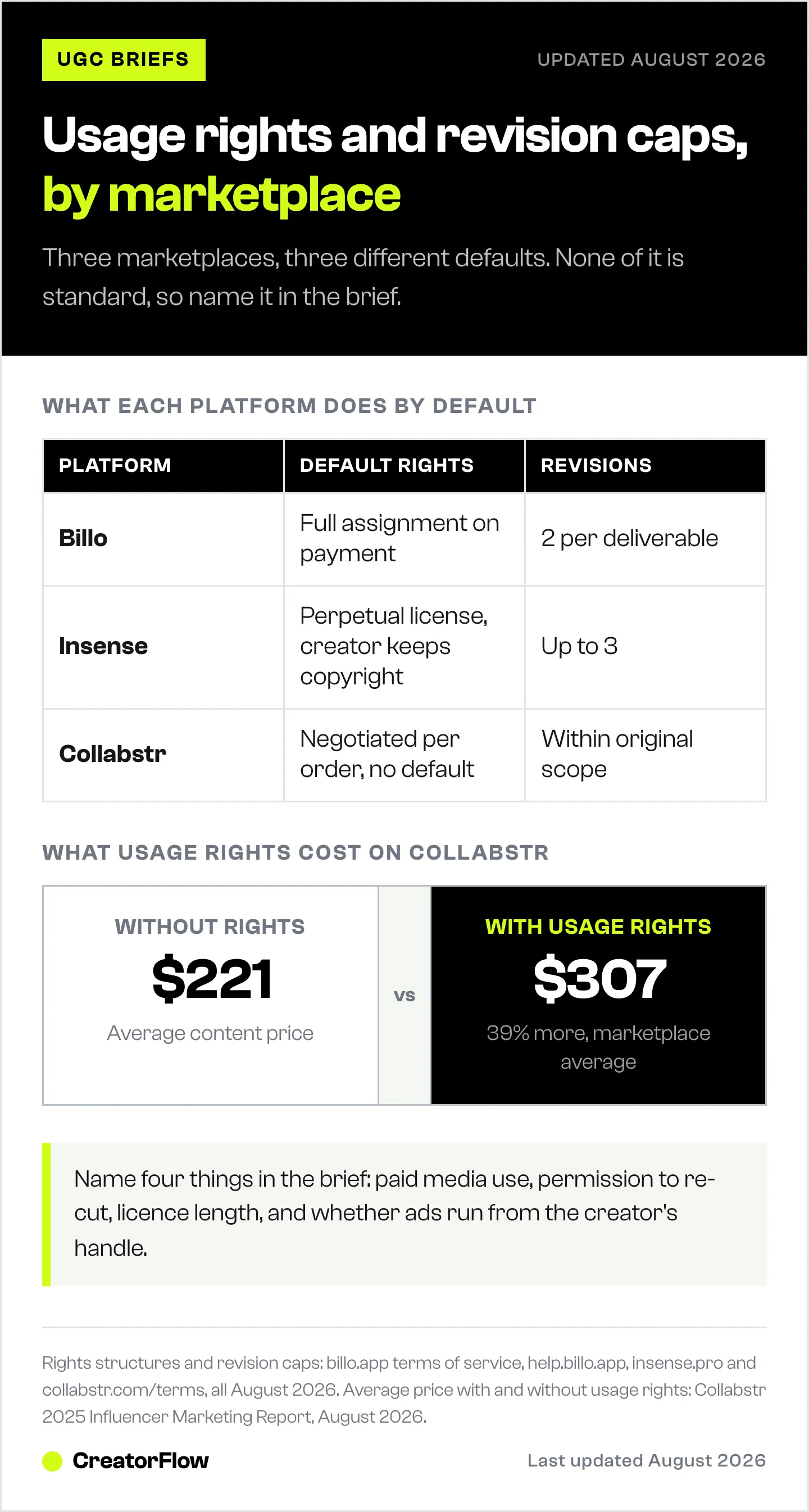
Usage rights determine the rate, so leaving them vague until delivery means renegotiating with someone who already has your money committed and your footage in hand. The three largest UGC marketplaces resolve this three different ways, which is worth knowing before you assume any of them is standard.
| Platform | Default rights structure |
|---|---|
| Billo | Full assignment. Terms state the creator irrevocably assigns all rights, title, and interest in the deliverables worldwide, conditional on full payment and brand acceptance. AI training use is excluded unless separately granted (billo.app terms of service, August 2026) |
| Insense | Perpetual license. Copyright stays with the creator; the brand gets perpetual digital rights to copy, display, distribute, modify, and create derivative works across digital marketing channels once content is approved and paid (insense.pro, August 2026) |
| Collabstr | Negotiated per order. Rights are whatever the brand and creator agreed in the accepted order, with no platform default (collabstr.com/terms, August 2026) |
Whichever route you take, the brief should name four things: whether the content can run in paid media, whether the brand may edit or re-cut the raw footage, how long the license lasts, and whether ads can run from the creator’s own handle.
That last one is a separate permission on both major platforms and is skipped constantly. Meta’s Partnership Ads work through either a content-level permission for one specific post or an account-level permission that lets an advertiser build ads from the partner’s handle without pre-existing content. Turning the permission off blocks new ads but does not stop ads already running (help.instagram.com, August 2026). TikTok’s Spark Ads use an authorisation code whose duration the creator sets, which is the closest thing either platform offers to a native license window (ads.tiktok.com, August 2026).
On what the uplift costs: Collabstr’s marketplace data put the average price with usage rights at $307 against $221 without, a 39% difference (collabstr.com 2025 Influencer Marketing Report, August 2026). Vendor blogs publish more granular ladders for whitelisting and perpetual rights, but the figures conflict with each other, including on the same domain, so treat the 39% as the sourced number and negotiate the rest.
For content your customers made rather than content you commissioned, the rights conversation runs differently and starts after the post is already live. Our guide to collecting user-generated content on Instagram covers the permission request itself.
Revision Rounds: What the Marketplaces Enforce
Include the revision count in the brief, because the platform you hire through has already decided what it will enforce.
Billo caps brands at two edit or reshoot requests per piece of content, counts the main video, hooks, and photos separately, requires each request to match the original brief, and states that a reshoot adds two to five business days while an edit must come back within 48 hours (help.billo.app, August 2026). Insense includes up to three revisions, and if the creator still misses the brief after feedback, moderation steps in and may arrange a refund (insense.pro, August 2026). Collabstr does not cap them, instead requiring revisions to fall within the scope of the original content requirements (collabstr.com/terms, August 2026).
Turnaround follows the same pattern. Billo counts five days from the creator receiving the product to first delivery; Insense advertises applications within 48 hours and delivered content within 14 days (help.billo.app and insense.pro, August 2026). Build your campaign calendar on the slower of those, not the faster.
A note on the revision statistics circulating for this topic
Several pages ranking for this query state that detailed briefs cut revision cycles or speed up completion by a specific percentage. Those figures are worth checking before you repeat them internally. The most-repeated version is attributed to a 2026 Influencer Marketing Hub study; that report’s published findings cover creator cost bands, budget plans, and marketer challenges, and do not include a finding on brief quality (influencermarketinghub.com, August 2026). Other versions trace to vendor pages that cite each other.
The honest version of the claim is structural rather than statistical. Billo caps edits at two and prices each one in days. Insense caps them at three and escalates past that. Marketplaces do not build caps around a problem that costs nothing. That is real evidence that revision cycles are treated as expensive, and it does not require a percentage nobody can source.
Who Is Responsible for the FTC Disclosure
Both parties. The FTC’s guidance states that the ultimate responsibility for clearly and conspicuously disclosing a material connection rests with the influencer and the brand, not the platform (ftc.gov, August 2026). The brand-side duty goes further than most briefs acknowledge: the FTC says a company should ask creators to disclose, tell them how it should be disclosed, and monitor the resulting posts, with the extent of monitoring scaling to how risky the product claims are.
Four rules to write into the brief:
- Trigger. Any material connection, including free or discounted product, even if the creator was not asked to mention that specific item
- Wording. “Advertisement”, “ad”, “sponsored”, or a plain line like “thanks to [brand] for the free product” all work. “Sp”, “spon”, “collab”, and a standalone “thanks” or “ambassador” do not
- Placement. With the endorsement itself, not in a bio, not at the end, not buried in a hashtag block. For video, in the video, and ideally in both audio and on screen
- Platform tools. The FTC states that a platform offering a disclosure feature is no guarantee it discloses effectively, and that adding your own is the safer route (ftc.gov, August 2026)
The current maximum civil penalty under the relevant FTC Act provisions is $53,088 per violation. That figure has held since January 2025; the government-wide inflation adjustment for 2026 was cancelled after the October 2025 CPI data was never published, so agencies were directed to keep 2025 amounts (federalregister.gov and 16 CFR 1.98, August 2026).
If you run an ongoing program rather than one-off shoots, the disclosure requirement is easier to enforce at intake than at delivery. Our walkthrough of brand ambassador enrollment through Instagram DM covers putting the disclosure agreement into the application step.
Talking Points Instead of a Script
Give the creator three to five short messages to hit, and keep exact-wording items on a separate list so they know which parts are fixed. “Mention it works in under two minutes”, “show the texture as you apply it”, “end with where to buy” gives a creator a structure and leaves the delivery to them. A word-for-word script gets read rather than spoken, and read performance is the thing UGC is bought to avoid.
Brief the hook explicitly when the destination is paid media, because a creator shooting for organic will pace the open differently. Ask for raw files alongside the edit if you plan to cut variants.
The do-not list is the block most often skipped and it does as much work as the talking points. Three to five items is enough. If it runs longer than your talking points, the brief is over-constrained and the content will come back stiff.
Sourcing UGC Creators From Your Own Followers
The people who already buy from you are the cheapest source of UGC creators, and most brands never ask them. A single post calling for creators, with a keyword in the caption, turns your comment section into an applicant list.
This is where a comment trigger does real work. Someone comments the keyword and the reply lands in their DMs within seconds, carrying your application link, your rate card, or the brief itself. CreatorFlow is a Meta Tech Provider (since December 2025) built for that job on Instagram: comment, Story reply, and keyword triggers that send instantly, click tracking on every link inside the message, geographic analytics on those clicks, and CSV export of everyone who replied. Pro is $15 a month flat, so a recruitment post that outperforms does not change the bill.
Two related pieces cover the ends of this process. Our guide to UGC tracking on Instagram covers what you can and cannot measure once content starts arriving, and the DTC Instagram strategy guide places creator content inside a full storefront funnel. For the view from the other side of the brief, Instagram automation for UGC creators shows how creators handle inbound brand inquiries. If a synthetic presenter is under consideration instead of a human creator, our guide on whether brands should use AI influencers covers what changes.
FAQ
How long should a UGC creator brief be?
One to two pages. It needs to cover the goal, product context, format specs, talking points, references, deliverables, and the do-not list, and a creator should be able to read it in under five minutes. Commercial terms can sit in a separate document or in the platform order, but they must exist somewhere in writing before production starts.
Should I include a script in a UGC brief?
No. Use three to five talking points and keep required exact wording, such as the product name or a discount code, on a separate short list. Scripts produce content that sounds read rather than spoken, which removes the quality brands hire UGC creators for in the first place.
How many revisions should you include?
One round is the common starting point, and the marketplaces cap it near there. Billo allows two edit or reshoot requests per piece of content, Insense includes up to three before moderation intervenes, and Collabstr requires revisions to stay within the original scope (help.billo.app, insense.pro and collabstr.com/terms, August 2026). Agree extra rounds in advance and price them.
What usage rights should I ask for?
Name four things: paid media use, permission to edit or re-cut, license duration, and whether ads may run from the creator’s handle. There is no universal default. Billo assigns rights outright, Insense grants a perpetual license with copyright staying with the creator, and Collabstr negotiates per order (August 2026). Usage rights carry a real premium; Collabstr’s data showed a 39% average difference.
What does a UGC creator cost?
Roughly 80% of paid engagements on Collabstr came in under $300, with UGC payouts averaging $154 and listed asking prices averaging $180 (collabstr.com 2026 Influencer Marketing Report, August 2026). Billo publishes entry pricing from $99 per video (billo.app, August 2026). Add for usage rights, extra hooks, raw files, and organic posting.
Who has to disclose the paid relationship, the creator or the brand?
Both. The FTC states the responsibility rests with the influencer and the brand, and that brands should tell creators how to disclose and then monitor the resulting posts (ftc.gov, August 2026). Relying on a platform’s paid-partnership label alone is not sufficient in the FTC’s own guidance.
What is the difference between a UGC brief and an influencer brief?
An influencer brief produces a post that runs on the creator’s account for their audience, so it can stay loose on format. A UGC brief produces material the brand runs on its own channels and ads, so it has to specify format, safe zones, rights, and disclosure. The creator may be the same person; the deliverable is not the same thing.
Where to Start
Write the creative direction first, in one page, loose enough that the creator can sound like themselves. Then write the four commercial lines underneath: deliverables and deadline, revision rounds, usage rights, and the disclosure requirement. Send both together.
The brands that get usable content on the first round are rarely the ones with the most detailed creative direction. They are the ones who decided, in writing, what they were buying before anyone picked up a phone.
Platform specifications verified from help.instagram.com, facebook.com/business and ads.tiktok.com as of August 2026. FTC Endorsement Guides and disclosure requirements quoted from ftc.gov, August 2026; civil penalty amount from 16 CFR 1.98 and federalregister.gov, August 2026. Marketplace terms, revision policies and pricing verified from collabstr.com, billo.app, help.billo.app and insense.pro, August 2026. Rate and campaign-mix figures from Collabstr’s 2025 and 2026 Influencer Marketing Reports, August 2026. This article is not legal advice. Individual results vary.


