
AI UGC for ecommerce is product video performed by a generated presenter instead of a hired creator. It cuts cost per finished video from roughly $150 to $500 down to a few dollars, so a brand can test far more hooks in a week. It changes nothing about what you are allowed to claim, and photorealistic AI video now carries disclosure duties on Meta, in New York advertising, and across the EU.
A five-variation creative test used to mean five briefs, five product samples in the post, two rounds of revisions and somewhere between $1,000 and $3,000 before a single ad ran. The same five variants now render overnight for the price of a monthly subscription. Most brands react by making fifty. Then either the ad account gets a label nobody planned for, or the videos run clean and nothing sells, and no one can point at which of the fifty was the problem.
This guide covers what AI UGC costs against a human creator, why every performance benchmark you will find was published by someone selling AI UGC, which product categories the format can carry, the four disclosure regimes that bite in 2026, and the delivery path that turns a comment on the video into a checkout. Written for Shopify and DTC operators and for affiliates moving physical products.
Key Takeaways
- The cost data is solid, the performance data is not. Published cost comparisons agree closely. Every conversion benchmark found in an August 2026 search was published by a company selling AI UGC tools or services.
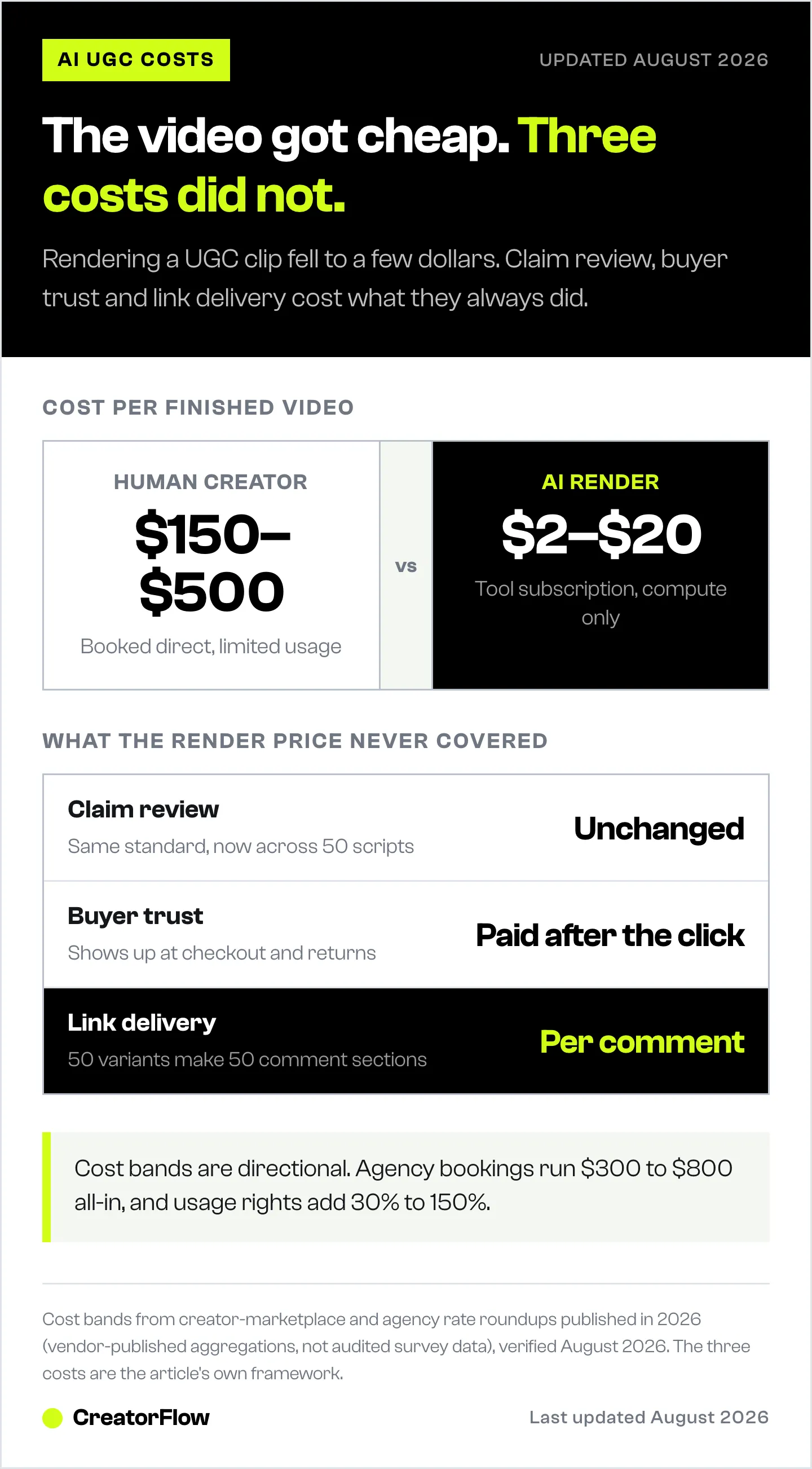
- Three costs did not fall: the cost of a defensible claim, the trust discount a buyer applies after the click, and the cost of delivering a link to everyone who asks.
- Four disclosure regimes apply: the FTC Consumer Reviews and Testimonials Rule, Meta’s AI labelling, New York’s synthetic performer law from June 9, 2026, and EU AI Act Article 50 from August 2, 2026.
- A generated presenter cannot testify. A first-person testimonial from someone who does not exist is the exact thing the FTC rule bans, with civil penalties up to $53,088 per violation.
- Category fit is mechanical. Products the camera can demonstrate carry well. Fit, drape and high-consideration purchases put the trust load on the presenter, which is the weakest part.
- Cheap video multiplies attention, not answers. Fifty variants produce fifty comment sections. Comment-to-DM automation is what converts those into clicks while the post is still warm.
What Is AI UGC for Ecommerce?
AI UGC is short-form product video in the user-generated style where the presenter, the voice, or both are generated rather than filmed. The output looks like a creator holding your product in a kitchen. The production is a script, a locked face, a cloned voice and a render. Brands use it for paid social creative, organic Reels, and product page video, usually to test many hooks against one SKU before committing budget to a human creator.
What AI UGC Costs Versus a Human Creator
The cost gap is the one part of this market that multiple independent sources agree on. Rate roundups published across creator marketplaces and agency price lists in 2026 put a single human UGC video in a fairly tight band, with rights and management stacked on top.
| Approach | Cost per finished video | What the price covers | Turnaround |
|---|---|---|---|
| Human creator, booked direct | $150 to $500 | One to three clips, product sample, limited usage | 5 to 14 days |
| Human creator through an agency | $300 to $800 all-in | Sourcing, revisions, broader usage rights | 1 to 3 weeks |
| Usage rights and whitelisting | Adds 30% to 150% of base | The right to run the clip as a paid ad | Negotiated |
| AI UGC tool subscription | Roughly $2 to $20 per render | Compute only. Script, claims review and rights stay with you | Minutes to hours |
(Creator-marketplace and agency rate roundups, August 2026. These are vendor-published aggregations rather than audited survey data, and the bands are directional.)
The line that matters sits in the last column of row four. An AI render price buys you compute. It does not buy a reviewed claim, a usage licence, or anyone standing behind what the presenter says. Those costs move to you, and they scale with the number of videos rather than staying flat.
Every AI UGC Benchmark You Will Find Was Published by a Vendor
Search for AI UGC conversion data and you will get precise-looking numbers: click-through lifts on Meta, conversion rates by DTC category, a percentage gap that opens on high-consideration products. Chasing those figures back to a primary source in August 2026 returns the same result almost every time. The publisher sells AI UGC software, sells AI UGC as a service, or sells the agency retainer around it. There is no independent, audited study.
That is not a reason to avoid the format. It is a reason to refuse to plan around a number you cannot verify, and to treat your own first thirty days of data as the only benchmark that applies to your SKU. Two things follow from that. Measure clicks and checkouts rather than views, because view counts are the metric that flatters cheap video. And keep at least one human-creator variant running as a control, so you have something honest to compare against inside your own ad account.
The Three Costs That Did Not Fall
Production got cheap. Three costs sat still, and they are where AI UGC campaigns break.
Claim cost. Somebody still has to decide what the script is allowed to say about the product, and that review now runs against fifty scripts instead of five. Generated video does not lower the standard of proof for a claim. It multiplies the number of times you have to meet it.
Trust cost. A buyer who clocks the presenter as generated applies a discount. That discount is paid after the click, at the checkout or at the returns desk, which is precisely where cheap top-of-funnel video is invisible. A campaign can post a strong click-through rate and a worse contribution margin at the same time.
Delivery cost. Fifty videos produce fifty comment sections full of people typing “link?” and “how much?”. Nothing about cheaper rendering makes you faster at answering them. This is the cost that quietly caps the whole exercise, because attention that goes unanswered for four hours converts like attention you never earned.
Which Products AI UGC Can Carry
The fit question is mechanical rather than aesthetic. It depends on whether the buying decision rests on the product or on the person holding it.
| Category | Fit | Why |
|---|---|---|
| Home, kitchen, tools, accessories | Strong | The product demonstrates itself on camera and the presenter narrates |
| Digital products, courses, templates | Strong | There is no physical claim for the viewer to verify |
| Supplements and skincare | Highest legal exposure of any category | Health claims plus testimonial rules, and the fake-testimonial trap is easiest to fall into here |
| Apparel and footwear | Weak on fit and drape | Buyers judge how a garment moves on a real body |
| Considered purchases above roughly $300 | Weak on its own | The trust load sits on the presenter, which is the thinnest part of a generated video |
This table is a judgment about risk and mechanics, not measured conversion data. Test it against your own SKU before you believe it.
For the persona side of this work, from consistent faces through to voice, our rundown of AI avatar generators covers which tool does which job, and the walkthrough on building a consistent AI persona covers locking a face you can reuse across a campaign.
The Four Disclosure Rules That Apply in 2026
This is the part the tool marketing skips. Four separate regimes now touch a photorealistic generated presenter selling a product, and three of them arrived or took effect inside the last two years.
| Rule | Who it covers | What it requires | Exposure |
|---|---|---|---|
| FTC Consumer Reviews and Testimonials Rule, 16 CFR Part 465, in force since October 21, 2024 | Anyone advertising to US consumers | No testimonial from a person who does not exist, and no review from anyone with no real experience of the product | Civil penalties up to $53,088 per violation (16 CFR 1.98, 2026) |
| Meta AI labelling on Instagram and Facebook | Organic posts and ads using photorealistic AI video or realistic synthetic audio | Disclose through Meta’s own AI labelling tool at upload | Meta applies its own label and can reduce distribution of undisclosed photorealistic content |
| New York General Business Law section 396-b, effective June 9, 2026 | Visual and audiovisual ads shown to a New York audience, wherever the advertiser sits | Conspicuous disclosure when the ad features a synthetic performer | $1,000 for a first violation, $5,000 for each one after (nysenate.gov, S.8420-A) |
| EU AI Act Article 50, applying from August 2, 2026 | Anyone deploying AI-generated or manipulated image, audio or video that would appear authentic | Disclose to the viewer at first exposure, clearly and perceivably | Up to EUR 15 million or 3% of worldwide annual turnover (digital-strategy.ec.europa.eu, August 2026) |
Two practical notes. The New York law reaches advertisers outside the state, so a Shopify store in Lisbon running Meta ads to a US audience is inside its scope. And the FTC rule is about the testimonial, not the technology, which means it applies even to an AI video that carries a perfect platform label.
Creator-side disclosure sits alongside all of this. The FTC disclosure rules for creators still govern any paid relationship in the same post.
What an AI Presenter Cannot Say
The line is cleaner than most people expect. A generated presenter can describe the product, demonstrate it, and state a claim the brand can substantiate. A generated presenter cannot testify.
Anything shaped as “I have used this for twelve weeks and my skin cleared up” is a testimonial from a person who does not exist. That is the specific thing 16 CFR Part 465 prohibits, and each non-compliant post counts separately. Fabricated before-and-after imagery on skincare and body products sits in the same category. So does dressing a generated presenter as a doctor or a pharmacist, which adds an implied-expertise problem on top of the testimonial problem.
Three script rules keep you out of it. Write claims in the third person about the product. Keep every claim inside what your own label or lab results already support. Route real customer proof through real customers, with their permission, rather than through the avatar.
From Comment to Checkout: The Delivery Half
An AI UGC pipeline solves supply. It creates a demand problem on the other side, because every extra variant is another post collecting comments you have to answer while the post is still warm.
Comment-to-DM automation closes that gap. A viewer types your keyword under the video, and the DM with the product link arrives in seconds rather than in the evening. CreatorFlow runs that path on Instagram through Meta’s official API as a Meta Tech Provider (since December 2025), with keyword triggers on comments, story replies and direct messages, and sends paced at around 200 automated DMs per hour to stay well inside Meta’s limits.
Three pieces matter for an ecommerce test specifically:
- Link tracking per automation. Fifty creative variants are only worth running if you can see which one produced clicks and which produced applause. Tracking each automation separately turns the variant test into a measurement rather than a guess.
- The Email Gate. Meta closes the messaging window 24 hours after a conversation starts. An email address collected inside the DM is the buyer you can still reach on day three, which is where most considered purchases close.
- Geographic analytics. Clicks by country tell you whether the audience buying from a variant sits inside a market whose disclosure rules you have already met.
CreatorFlow’s Pro plan is $15 per month flat, with the Free plan covering 500 DMs a month for a first test. For the wider setup on a store, see Instagram automation for a Shopify store, and for the paid side, Click-to-DM ads put the same DM path behind ad spend.
How to Test AI UGC Without Betting the Brand
Three phases, each with one decision at the end. Do not run the next phase until the previous one answers its question.
Phase 1: one SKU, one claim, three presenters. Organic only. Pick the product you already sell most of, so demand is not the variable. Write one claim your label supports. Render the same script with three different presenters, age-matched to your actual buyer rather than to a mood board. Label every upload with Meta’s AI tool. The question this phase answers is whether any presenter holds attention on your product. If none do, the format is wrong for the SKU and no amount of budget fixes it.
Phase 2: add the keyword and measure clicks, not views. Put one keyword in every caption and wire it to a DM carrying the product link. Run for two weeks. Compare comment-to-click rate across the three presenters, and compare all three against a single human-creator clip running as a control. The question is which presenter produces buyers rather than viewers.
Phase 3: put paid behind one winner only. Take the single variant with the best click-to-checkout and nothing else. Scale the spend, not the variant count. The temptation with cheap rendering is to push all fifty into the ad account, which produces a budget spread too thin to read and a compliance surface fifty posts wide.
The same monetization logic applies to any high-volume AI content pipeline, which is covered in more depth in the funnel that monetizes AI-generated Reels.
If the question is whether to commission a synthetic persona instead of producing your own assets, our decision guide on whether brands should use AI influencers sets out what each option actually buys.
FAQ
Is AI UGC allowed on Instagram and in Meta ads?
Yes. Meta permits AI-generated content and requires disclosure for photorealistic video and realistic synthetic audio through its own labelling tool at upload. Meta also applies its own AI label when it detects generated media, and content it assesses as deceptive can be labelled more prominently and shown to fewer people.
Does AI UGC convert as well as real creator UGC?
No independent, audited study answers this. Every performance comparison found in an August 2026 search was published by a company selling AI UGC tools or services. Treat those figures as marketing and run your own control: one human-creator clip against your AI variants inside your own ad account, measured on checkouts rather than views.
How much does AI UGC cost per video?
Roughly $2 to $20 per render on a tool subscription, against $150 to $500 for a human creator booked direct and $300 to $800 all-in through an agency, with usage rights adding 30% to 150% (creator-marketplace rate roundups, August 2026). The render price covers compute only. Script review and usage rights stay with you.
Do I have to disclose that a UGC video is AI-generated?
In most cases yes, and from more than one direction. Meta requires labelling for photorealistic AI video and realistic synthetic audio. New York requires conspicuous disclosure for synthetic performers in ads reaching a New York audience from June 9, 2026. EU AI Act Article 50 requires disclosure at first exposure from August 2, 2026.
Can an AI presenter say “I used this product”?
No. A first-person testimonial from a person who does not exist is what the FTC Consumer Reviews and Testimonials Rule prohibits, with civil penalties up to $53,088 per violation and each non-compliant post counted separately. Keep the script in the third person and inside what your label supports.
Which ecommerce products work best with AI UGC?
Products the camera can demonstrate: home goods, kitchen items, tools, accessories, and digital products where there is no physical claim to verify. Apparel is weaker because buyers judge fit and drape on a real body, and considered purchases above roughly $300 put the trust load on the presenter.
Do I need a following before AI UGC can sell anything?
No. Most AI UGC for ecommerce runs as paid creative or as a brand-account post rather than as an influencer play, so audience size is not the input. What decides the outcome is whether the person who watches can get the product link quickly, which is a delivery question rather than a follower-count question.
Cost bands, disclosure requirements and penalty figures verified from the Federal Trade Commission (16 CFR Part 465 and 16 CFR 1.98), the New York State Senate (S.8420-A), the European Commission’s Article 50 guidance, Meta’s published AI content policy and 2026 creator-rate roundups, as of August 2026. Cost and category figures are directional rather than audited. Individual results vary.