
AI video for Instagram works as the front of a 3-step funnel: an AI-generated Reel sparks demand, a comment keyword triggers an automated DM, and the DM delivers the link. The new models (Seedance 2.0, Veo 3.1, Sora 2, Kling 3) cut production cost so you ship 10x more Reels. DM automation captures the 80%+ open rate that views alone never convert.
Most AI-video coverage stops at “look how realistic this is.” That’s the easy part. The hard part is what happens after the clip is generated. A creator team that used to ship four Reels a week can now ship forty. Forty Reels with no funnel attached is forty Reels driving traffic to a single bio link with a 1-3% click rate. The compute is cheap. The wasted attention is not.
This guide covers the AI video stack creators are using in 2026, why distribution alone is the wrong bottleneck, how to wire AI Reels into a comment-to-DM funnel that actually converts, and the disclosure rules you need to stay on the right side of. Built for affiliates, e-commerce operators, and coaches monetizing Instagram, not for filmmakers chasing cinematic prestige.
Key Takeaways
- AI video changed production economics, not conversion. Seedance 2.0 generates 720p clips at roughly $0.24/second on fal.ai (fal.ai/seedance-2.0, May 2026). Cheap clips with no funnel still convert at bio-link rates.
- The conversion stack is a 3-step funnel. AI Reel sparks demand, comment keyword triggers DM, DM delivers the link. Same mechanics as organic Reels, scaled to higher Reel volume.
- Reels reach is still 2x other formats. Average reach rate sits at 30.81%, with Reels accounting for over half of time spent on Instagram (vidico.com, 2026).
- DM automation hits 80-100% open rates vs ~20% for email, with comment-to-DM CTR examples reaching 31% on segmented audiences (manychat.com, 2025).
- Disclose AI-generated video. Meta’s “AI Info” labels auto-trigger on C2PA metadata; manual disclosure is required when tools don’t embed it (transparency.meta.com, 2026). The EU AI Act enforces mandatory labeling from August 2, 2026.
- Distribution is solved. Conversion is not. Tools like Postiz cross-post AI Reels to 28+ channels. Tools like CreatorFlow turn the resulting comments into DMs and sales.

AI Video Changed What Gets Posted, Not What Earns
Every AI-video conversation in 2026 sounds the same: which model is best, who shipped what feature, when 4K lands. None of it changes the fundamental fact that an Instagram Reel earns money when someone clicks a link, books a call, joins an email list, or buys a product. AI video changes the cost of producing the asset. It does not change the conversion mechanic that turns the view into revenue.
The math is brutal once you write it down. A creator producing four Reels a week manually maybe drives 200 comments per Reel on a hit. A creator producing forty AI-generated variations per week drives 800 comments per hit, across more hits. Forty Reels generating 8,000 monthly comments routed through a “click my bio link” CTA leak 90%+ of intent. The same 8,000 comments routed through a comment-to-DM trigger convert 12-30% of commenters into actual link clicks, based on practitioner ranges across affiliate creators.
The bottleneck moved. It used to be: “I can’t shoot enough content.” Now it’s: “I’m shipping more content than my funnel can handle.” AI video without DM automation is high-volume content production strapped to a low-conversion delivery system. It works, sort of. It does not compound.
The 3-Step AI Reel to DM Funnel
The funnel is identical to the one creators use on hand-shot Reels. AI changes the input volume, not the conversion path.
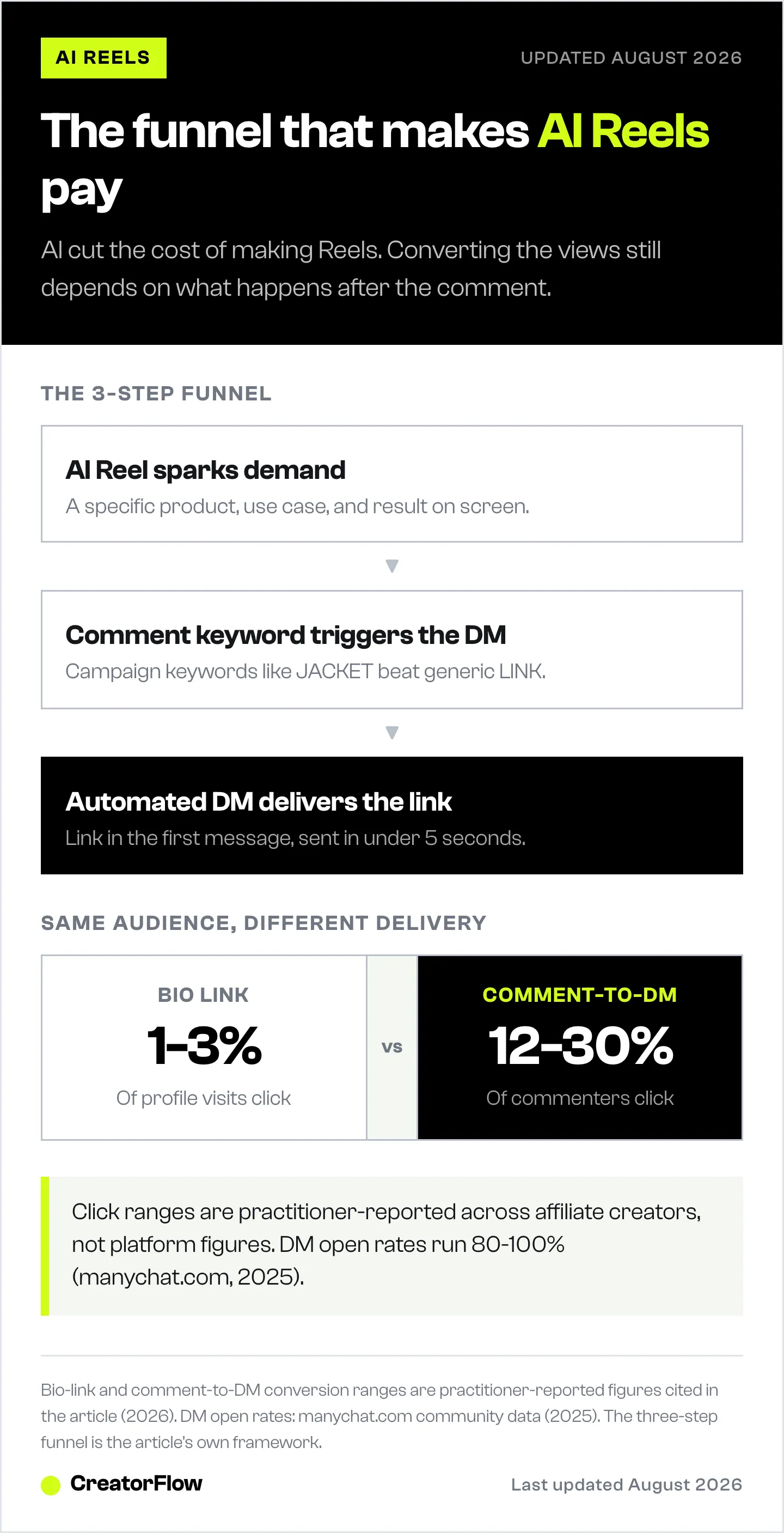
Step 1: AI Reel generates demand for a specific product or outcome.
The Reel must be specific. A Seedance-generated try-on of a winter jacket creates demand for that jacket. A Veo-generated home workout demo creates demand for that resistance band. Generic lifestyle Reels generate generic comments and convert badly, whether they’re AI-generated or shot on iPhone. The new models reward specificity: a clear product, a clear use case, a clear result on screen.
Step 2: Comment keyword triggers the DM.
Caption and voiceover both ask for a specific keyword: “Comment JACKET and I’ll DM you the link.” Generic keywords like LINK get ignored because every creator uses them. Campaign-specific keywords (JACKET, BAND, SAUCE, WORKOUT, COURSE) feel personal, are easier to remember, and let you run different campaigns from the same account without overlap.
Step 3: Automated DM delivers the link, fast.
Tools like CreatorFlow listen on the specific Reel for the specific keyword via Meta’s official Instagram Graph API. The match triggers the DM in under 5 seconds. Send the link in the first message, not after a follow-up question. Friction kills conversion. For the wiring details see the comment-to-DM automation setup guide.
The conversion delta is the whole reason this matters. Bio links convert at 1-3% of profile visits. Comment-to-DM converts 12-30% of commenters into clicks (practitioner range across affiliate categories). Same audience. Different delivery channel. 4-10x improvement.
The 2026 AI Video Stack
You don’t need to commit to one model. Treat them as specialist tools, then pick the daily driver. For each one priced and ranked by creator use case, see the best Higgsfield AI alternatives for creators.
| Model | Maker | Approx. Pricing | Best For |
|---|---|---|---|
| Seedance 2.0 | ByteDance | ~$0.24/sec at 720p (fal.ai) | Multi-input editing: swap models, swap backgrounds, translate ads (fal.ai/seedance-2.0, May 2026) |
| Veo 3.1 | ~$0.15/sec (fast mode) | Physics simulation, camera control for filmic shots | |
| Sora 2 | OpenAI | ~$0.15/sec | Prompt accuracy on complex scenes |
| Kling 3.0 | Kuaishou | Native 4K, multi-shot cinematic sequences | |
| Runway Gen-4 | Runway | ~$0.31 per 5-sec clip (Pro) | Established creator tooling and editing suite |
Pricing aggregated from third-party comparisons (lushbinary.com / rizzgen.ai, 2026); confirm on each vendor’s pricing page before committing budget.
Seedance 2.0 is the most relevant model for funnel work because it accepts up to 12 reference files (text, images, audio, video) in a single generation (seed.bytedance.com/en/seedance2_0, May 2026). That matters for a DM funnel because you can hold the source footage, the camera move, and the product placement constant while varying only the model, the language, or the outfit. You’re A/B testing creative without running 40 separate shoots. Each variation feeds the same comment-to-DM trigger.
Kling and Veo win when you need a cinematic feel. Sora wins on prompt-following for complex scenes. Use them when Seedance’s “look” is wrong for the brand. None of them change the funnel architecture. For each of these tools compared for organic Reels rather than paid funnels, see the best AI video generators for creators.
Why Distribution Alone Is the Wrong Bottleneck
The dominant story right now is: AI generates the clip, a scheduler ships it to 28+ channels, you win. Distribution to TikTok and YouTube and LinkedIn is real value, but it’s the wrong place to put your scarce attention if your goal is revenue per view.
Two reasons.
Reach is not revenue. Reels average 30.81% reach rate, more than 2x photos and carousels (vidico.com, 2026). The creator who ships 40 AI Reels per week and posts them across five channels is not constrained by reach. They’re constrained by the conversion mechanic at the end of every Reel. A bio link doesn’t scale with content volume. A DM funnel does.
Each platform’s DM-conversion mechanic is platform-native. Cross-posting an Instagram Reel to TikTok and YouTube is fine for awareness. The actual money on Instagram comes from the DM, which only Meta’s API can trigger. The actual money on YouTube comes from descriptions, end screens, and subscribe rates. The “one upload, every channel” pattern misses that conversion is platform-specific and requires platform-specific automation.
The right pattern: distribute the awareness asset broadly with a scheduler. Run the conversion engine natively on the channel that pays. On Instagram in 2026, that means comment-to-DM. See the full DM funnel guide for the architecture.
Build the DM Half First, Then Turn On the AI Tap
The mistake most creators make in May/June 2026: spend a week learning Seedance, generate 30 Reels, post them all, then realize none of them have a DM trigger wired up. They get views. They get comments. The comments rot in the inbox.
The order matters. Build the funnel before you scale production.
- Pick one product or outcome you want to monetize. Start narrow. One affiliate offer. One coaching package. One physical product.
- Wire the comment-to-DM trigger first. Choose a campaign-specific keyword. Set up the DM template with the link in the first message. Test on a single non-AI Reel.
- Verify the open rate and click rate. You want >70% DM open rate (ManyChat reports 80-100% range, with 65.5% on a tracked example) and >5% link CTR before scaling content (manychat.com / unkoa.com, 2025).
- Now turn on AI generation. Use Seedance or Veo to produce 5-10 variations of the same product, same intent, same CTA. Same keyword.
- Measure per-variation conversion. AI gives you the rare gift of holding everything constant except creative. Read the data, double down on winners, kill losers.
The discipline of building the funnel first is what separates creators who use AI to compound from creators who use AI to make more noise. The same logic applies whether you’re a UGC creator or an affiliate scaling one offer.
Comment Hook Templates for AI-Generated Reels
The hook in the caption and voiceover is non-negotiable. Match the keyword to the Reel content. Avoid LINK.
| Reel Topic | Suggested Keyword | CTA Phrasing |
|---|---|---|
| AI try-on, fashion | OUTFIT | ”Comment OUTFIT and I’ll DM the exact pieces.” |
| AI product demo, e-commerce | PRODUCT | ”Comment PRODUCT for the link and current discount.” |
| AI workout / fitness | PLAN | ”Comment PLAN for the full workout split sent to your DMs.” |
| AI recipe / food | RECIPE | ”Comment RECIPE and the full breakdown lands in your DMs.” |
| AI tool demo, SaaS or affiliate | TOOL | ”Comment TOOL and I’ll send the link plus my discount code.” |
| AI coaching teaser | COACH | ”Comment COACH for the call link, no pitch.” |
The hook works because AI removes the production friction but the human-feeling DM creates the trust. The viewer sees a polished Reel, comments, and gets a fast personal-feeling reply with the thing they asked for. The Reel can be 100% AI; the DM should sound like you wrote it.
For more on what makes a hook actually pull comments, see Instagram comment hooks psychology.
AI Disclosure: Stay on the Right Side of Meta and the EU
Two rules to know in 2026, both real, both enforceable.
Meta’s “AI Info” label. Meta applies the label on two triggers: it detects industry signals such as C2PA or IPTC metadata and invisible watermarks, or you self-disclose. Metadata is embedded by default on output from some tools and not others, so when your tool does not embed it, disclosure is on you.
Meta’s Community Standards require disclosure when you post organic content with photorealistic video or realistic-sounding audio that was digitally created or altered, and state that Meta “may apply penalties” if you do not. Note the scope: the mandatory duty is written around photorealistic video and realistic audio, and Meta publishes no equivalent mandatory rule for still images, no strike ladder, and no suspension schedule. Treat “may apply penalties” as exactly what it says, and do not assume a documented enforcement path exists (transparency.meta.com, July 2026).
EU AI Act, Article 50(4). From August 2, 2026, deployers of an AI system that generates or manipulates image, audio, or video content constituting a “deep fake” must disclose that the content is artificially generated or manipulated (EU Regulation 2024/1689, Article 50(4)).
Read the exemptions carefully, because they are widely misreported. Article 50(4) has two separate parts. The image, audio, and video obligation is relaxed only where the content forms part of an evidently artistic, creative, satirical, or fictional work, and even then you must still disclose its existence “in an appropriate manner that does not hamper the display or enjoyment of the work.” The human review or editorial control exemption, which several summaries wrongly apply to video, belongs to the second subparagraph and covers only AI-generated text published to inform the public on matters of public interest (artificialintelligenceact.eu/article/50, July 2026).
In plain terms: adding a human edit step does not exempt your AI video. If you publish AI-generated video to an EU audience, disclose it.
Practical approach: add “AI-generated” or “Made with AI” in the first line of the caption when the model didn’t embed C2PA. Add it to your DM template if the link drives to a product page making AI-content claims. Disclose once, clearly, and move on. The reach cost of disclosure is real but small. The cost of a non-compliance enforcement action is your account.
What This Stack Actually Looks Like in Practice
A working setup for an affiliate creator in mid-2026, end to end:
- Source asset: one clean iPhone shoot of you talking to camera, plus 10 product reference images.
- Generation: Seedance 2.0 produces 12 variations per week. Different product, different background, same talking head. Cost roughly $30-50 per week at 720p.
- Editing: 5-second top-and-tail in Adobe or CapCut, captions baked in, AI disclosure added.
- Distribution: scheduler ships each variation to Reels, TikTok, YouTube Shorts. Each Reel has a unique campaign keyword in the caption.
- Conversion: CreatorFlow listens for each keyword on its assigned Reel via Meta’s Graph API. Each comment fires the matching DM in under 5 seconds. The DM contains the affiliate link in the first message.
- Measurement: per-keyword reporting tells you which AI variation drove the most comments, opens, and clicks. Kill the losers, generate more variations of the winners.
This is the AI video stack that actually pays. The model name on the front matters less than the funnel underneath. AI video without DM automation is a content factory with no shipping department.
For benchmarks on what conversion looks like by funnel type, see course launch DM funnel benchmarks.
FAQ
Is AI-generated video allowed on Instagram?
Yes. Meta does not block AI-generated content. It requires labeling under its “AI Info” policy. Auto-detection happens when the source tool embeds C2PA metadata; manual disclosure is required when it doesn’t (transparency.meta.com, 2026). Your account is fine as long as you disclose.
Do I need to disclose AI video on Instagram?
For fully AI-generated video where the source model doesn’t embed C2PA Content Credentials, yes, manually. For AI-edited footage where you shot the source and used AI to enhance, the rule is murkier but the safe play is disclosure. The EU AI Act adds mandatory disclosure for EU audiences from August 2, 2026, with a human-review exemption (weventure.de, 2026).
Which AI video model is best for Instagram Reels?
Seedance 2.0 for editing-heavy work like try-ons, model swaps, and ad translation. Veo 3.1 for physics-aware cinematic shots. Sora 2 for complex prompt-following. Kling 3.0 for native 4K. Most creators end up using two: a daily driver (usually Seedance) and one specialist for the look the daily driver can’t get.
How much does AI video cost per Reel?
Seedance 2.0 runs roughly $0.24/second at 720p on fal.ai, so a 10-second Reel costs about $2.40 in raw generation (fal.ai/seedance-2.0, May 2026). Add multiple takes and post-production and a polished AI Reel typically runs $3-15 in compute, depending on model and resolution. Kling and Veo land lower per-second on some tiers.
Can AI Reels actually convert to sales?
The conversion mechanic is the comment-to-DM funnel, not the AI generation. AI changes the cost and volume of the Reel; the DM funnel does the converting. Practitioner data shows comment-to-DM funnels convert 12-30% of commenters into link clicks regardless of whether the Reel was hand-shot or AI-generated, as long as the Reel is specific to the product.
Do AI Reels get less reach than regular Reels?
There’s no public Meta confirmation of an algorithmic reach penalty for labeled AI content as of mid-2026. Anecdotal creator reports vary. The bigger reach hit comes from low-quality AI content that viewers swipe past in the first 2 seconds, which suppresses the Reel via watch-time signals. A specific, well-prompted AI Reel performs comparably to a hand-shot one.
Can I run a DM funnel on AI-generated Reels using CreatorFlow?
Yes. The trigger is keyword-based on the comment, not on the source of the Reel. Whether the Reel was shot, edited, or fully AI-generated, the comment-to-DM automation runs identically through Meta’s Instagram Graph API.
AI video model details verified from fal.ai/seedance-2.0, seed.bytedance.com, lushbinary.com, and rizzgen.ai as of May 2026. Reels reach data from vidico.com (2026). DM open-rate ranges from manychat.com community data (2025). AI disclosure rules from transparency.meta.com (2026) and EU Regulation 2024/1689. Individual results vary.


