
Instagram comment hooks are opening lines or captions designed to trigger a specific reply, not just stop the scroll. They use behavioral psychology — open loops, low-effort prompts, identity statements, and social proof — to convert passive viewers into commenters. Comments matter because they are the only engagement type a creator can convert into a DM, an email, and a sale through Meta’s Private Replies API.
Most creators chase viral hooks. The wrong fight. Instagram’s own algorithm, per Adam Mosseri’s January 2025 update, ranks Reels using watch time, likes per reach, and sends per reach. Comments are not in the top three signals (Social Media Today, January 2025). Going viral does not require comments, and comments do not guarantee virality. So why care about comment hooks at all?
Because comments are the only engagement type that converts to revenue. A like is dead. A view is dead. A comment is a hand raised in public. A creator running comment-to-DM automation can reply with a link, lead magnet, or booking calendar in under 8 seconds (developers.facebook.com, May 2026). Every comment is a qualified lead.
This guide covers the behavioral psychology behind comment hooks, the five trigger patterns that drive replies, the hook-to-DM bridge, niche examples, and the mistakes that quietly kill comment volume.
Key Takeaways
- Viral hooks and comment hooks are not the same: Mosseri’s 2025 algorithm signals are watch time, likes per reach, and sends per reach. Comments are not a top-3 ranking factor (Social Media Today, January 2025), so chasing comments for reach is the wrong goal.
- Comments are the only monetizable engagement: likes and views cannot be replied to. Comments trigger DM automation in under 8 seconds via Meta’s Private Replies endpoint (developers.facebook.com, May 2026).
- Open loops drive replies: the Zeigarnik effect (Zeigarnik, 1927) shows incomplete tasks stick in memory roughly twice as much as completed ones. Captions that leave a blank get filled in by commenters.
- Low-effort prompts beat clever questions: ”🔥 or 🥱?” gets more replies than “what’s your favorite morning routine and why?” because cognitive cost predicts reply rate.
- Identity statements out-pull questions: “tag a friend who still uses Linktree” works because it lets the commenter perform an identity, not answer a request.
- The hook-CTA bridge is the funnel: the hook earns the comment, the trigger word in the caption converts it into a DM with your link.
- Test in batches of three: ship three hook variants of the same content idea on the same day at similar times. The comment-count gap reveals which psychological trigger your audience responds to.

Why “Viral Hooks” Don’t Pay
Most hook advice teaches you to stop the scroll. Stops do not pay. Watch time pays Mosseri. Likes per reach pay Mosseri. Sends per reach pay Mosseri. Revenue pays you. None of those are the same number.
Adam Mosseri’s January 2025 algorithm update named the three top signals for Reels reach: watch time, likes per reach, and sends per reach (Social Media Today, January 2025). Comments rolled into watch time indirectly, because composing a reply takes time on the post. So comments help reach a little, but they are not the lever.
Then why bother? Because the comment is the only public hand-raise on Instagram you can answer with software. Likes are mute. Saves are private. Shares go to inboxes you cannot see. A comment is the one engagement type Meta’s API lets you reply to with a Private Reply DM (developers.facebook.com, May 2026). That changes the goal of the hook. Stop writing for views. Start writing for replies.
The Behavioral Psychology of Why People Comment
Three psychological forces drive Instagram comments. Most creators write hooks that ignore all three.
1. Open loops (Zeigarnik effect). Bluma Zeigarnik’s 1927 study found that interrupted tasks are remembered roughly twice as well as completed ones (Zeigarnik, 1927). On Instagram, that translates into captions that leave a sentence unfinished, a list with one missing item, or a comparison without the punchline. Viewers feel a low-grade itch to close the loop. Closing the loop in a comment scratches it.
2. Cognitive cost. Reply rate falls as the effort to reply rises. “What is your favorite morning routine and why?” demands a paragraph. “Coffee or tea?” demands a word. Emoji prompts (”🔥 or 🥱?”) demand a tap. Cost predicts volume. The fastest way to lift comment count is to drop the cost of replying, not to ask better questions.
3. Identity performance. Commenters do not just answer questions. They perform identity in front of an audience. “Tag a friend who still uses Linktree” lets the commenter signal “I am the kind of person who knows better than Linktree.” That is more rewarding than answering “what link tool do you use?” because it is public, social, and tribal. The same logic powers “comment ‘late’ if you watched this past midnight” prompts.
A fourth force, mild controversy, also drives comments but burns trust if overused. Outrage bait gets replies the same way arson gets a crowd. Treat it as a stove, not a strategy.
Five Comment-Trigger Hook Patterns
Most patterns map to one of the three forces above. Here are the ones that consistently drive replies in creator content. Use trigger words in the caption to feed the comment into your DM funnel.
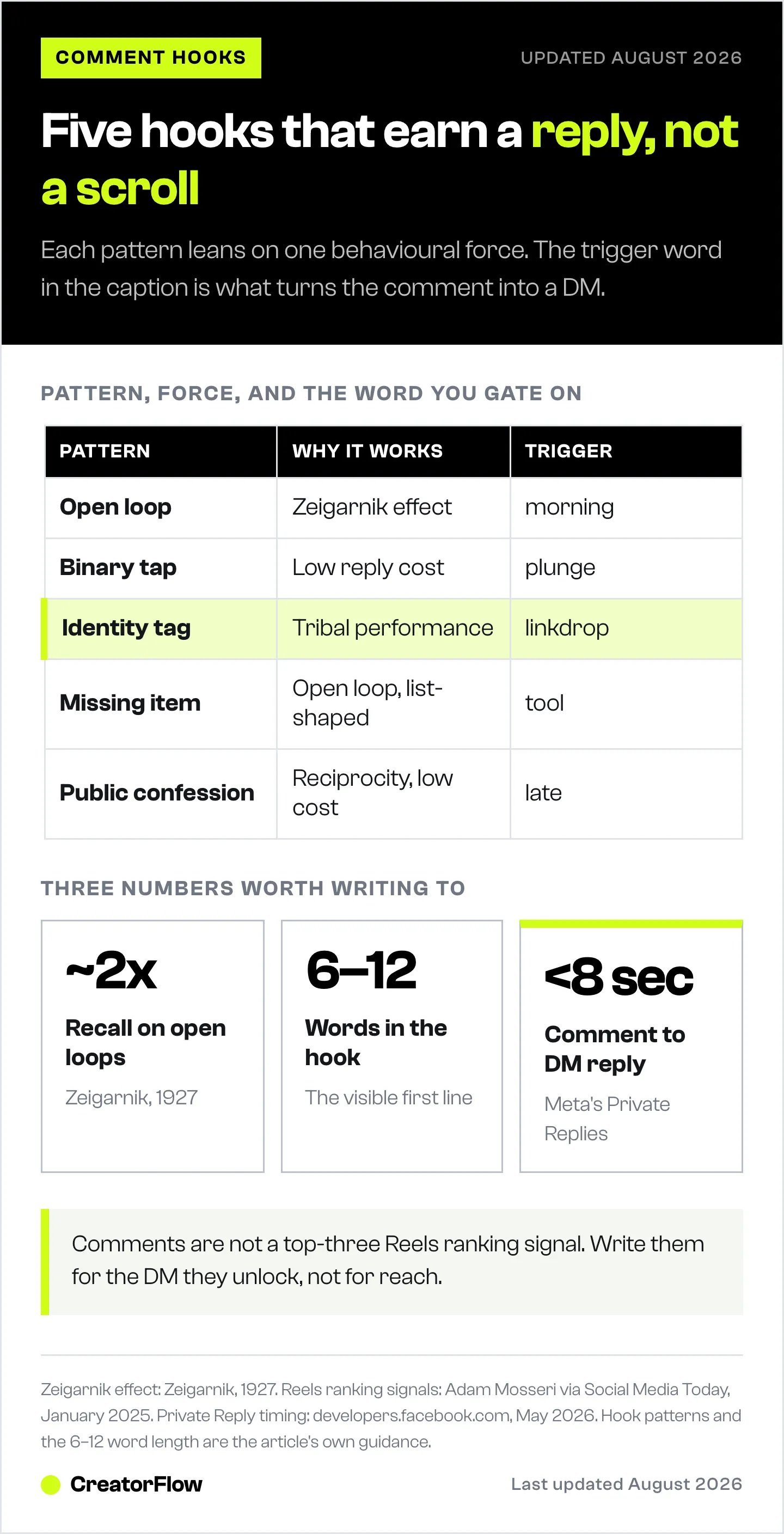
| Pattern | Psychology | Example hook | Example trigger word |
|---|---|---|---|
| Open loop | Zeigarnik effect | ”I tested 7 morning routines for 30 days. The winner surprised me." | "morning” |
| Binary tap | Cognitive cost | ”Cold plunge or sauna? Comment your pick and I will DM the protocol." | "plunge” or “sauna” |
| Identity tag | Tribal performance | ”Tag a friend who still uses link in bio in 2026." | "linkdrop” |
| Missing item | Open loop, list-shaped | ”5 affiliate tools every creator needs. I left the most important one off the carousel on purpose." | "tool” |
| Public confession | Reciprocity, low cost | ”Comment ‘late’ if you watched this past midnight. I will send you the script." | "late” |
The pattern is the engine. The trigger word is the funnel. Without the trigger word in the caption, every comment is unbillable.
The Hook-to-CTA Bridge
A great hook with a missing CTA is a leaky bucket. A weak hook with a clean CTA still pays. The hook earns the comment, the caption’s trigger word converts it.
Three structural rules:
- Name the trigger word twice. Once in the caption (“comment ‘tool’ and I will DM the affiliate list”), once in the on-screen text or voiceover. Followers who read captions are roughly half your audience. Speak to both halves.
- Tell them what they will get. “I will DM you the link” is fine. “I will DM you the 11-tool affiliate list” is better. Specificity raises comment intent.
- Match the DM payload to the hook. If the hook is an open loop (“the winner surprised me”), the DM should close the loop with the same energy. If the DM is a generic Linktree dump, the comment was wasted.
For the mechanics of converting the comment into a DM in under 8 seconds, see the comment-to-DM automation setup guide and the 6-step Reels-to-DM formula.
Comment Hook Examples by Niche
The pattern is universal. The wording is not. Voice and trigger word should fit the niche.
| Niche | Hook | Trigger word | DM payload |
|---|---|---|---|
| Fitness coach | ”I trained 3 fat-loss clients with the same protocol. The one who lost 18 lbs did one thing the others didn’t." | "fatloss” | PDF protocol + booking link |
| Amazon affiliate | ”5 kitchen gadgets I use every day. The most useful one is under $20." | "kitchen” | Affiliate links, ranked |
| Course creator | ”Tag a friend who said 2026 was the year they would launch a course." | "launch” | Free pre-launch checklist |
| Skincare creator | ”Retinol or peptides? Comment your pick and I will DM my routine." | "retinol” or “peptide” | Linked product list |
| Real estate agent | ”First-time buyers in Austin: comment ‘list’ and I will DM the 7 mistakes I see weekly." | "list” | PDF + Calendly link |
Notice that none of the hooks above are questions. They are statements with a small open loop or a tap-cost prompt. Statements out-perform questions on Instagram because they imply expertise, and expertise is what gets DM’d back.
For a deeper template library, see 50 Instagram hook templates that stop the scroll and more comment-driving CTA examples.
Mistakes That Quietly Kill Comment Volume
These are the recurring failures we see in creator audits. Each one looks small. Each one halves replies.
- Asking too much. “Tell me about a time when…” is a journaling prompt, not a comment hook. Lower the cost.
- No trigger word. Comments without a trigger word in the caption cannot fire automation. The comment becomes a vanity number.
- Trigger word that is too common. “Yes” or “info” matches accidental comments. Pick a word your audience would not type by accident. “Late,” “tool,” “playbook,” “protocol.”
- Hook promises one thing, DM delivers another. Mismatch is the fastest way to teach an audience to ignore your hooks. Match the loop and close it cleanly.
- Replying manually instead of automating. Manual replies arrive 2-6 hours late. By then the commenter has scrolled into another creator’s funnel. Auto-DM in under 8 seconds, then follow up by hand if you want to nurture (see why slow DM responses kill sales).
- Reusing the same hook 5 weeks in a row. Pattern fatigue. The first “tag a friend who still uses Linktree” lands. The fifth one feels lazy. Rotate hook patterns weekly.
How to Test Which Hooks Work for Your Audience
Instagram does not have native A/B testing for organic posts. You have to build it manually. The cleanest method:
- Pick one content idea. The same Reel can carry three different captions.
- Write three caption variants, each using a different hook pattern (e.g. open loop, binary tap, identity tag).
- Post the same Reel three times across three weeks at the same day-of-week and time. Same hashtags, same trigger word category.
- Compare comment count after 48 hours, not views. Views are confounded by reach randomness. Comment rate is the truer signal of hook quality.
- Keep the winning pattern. Rotate the runner-up into your second slot. Drop the loser.
Three rounds is enough to see a pattern. Most creators find one hook type their audience reliably responds to. Then the job becomes recombining that pattern with new content ideas, not rewriting hooks from scratch.
Where the DM Funnel Closes the Loop
Comments without automation are vanity. Automation without good hooks is empty pipes. The system runs only when both halves work.
CreatorFlow handles the second half: it watches your posts for the trigger word, fires the DM in under 8 seconds via Meta’s official API, and (on paid plans) gates the link behind a follow or email capture. The first half — the hook — is on you. Use the patterns above. Match payload to loop. Test in threes. Rotate weekly.
For the full distribution stack, see the Instagram DM automation guide and the comment-to-DM funnel for affiliates.
Generate more angles to test with the free hook generator.
FAQ
Do Instagram hooks need to be questions to drive comments?
No. Statements with an open loop or a low-cost prompt out-perform questions. Questions ask. Statements imply expertise, which followers reward by replying for the answer.
What is the best length for an Instagram comment hook?
Six to twelve words for the visible hook (caption first line or on-screen text). Longer hooks lose the cognitive-cost battle. The full caption can be longer, but the first line has to earn the comment.
Why isn’t my Reel getting comments despite high views?
Reach and reply rate are different metrics. High views with low comments usually means the hook is optimized for stop-the-scroll (visual or curiosity gap) but does not give the viewer a job to do in the caption. Add a binary tap or trigger-word prompt.
Are comment-bait posts penalized by Instagram?
Comment baiting that demands engagement to win something has been penalized in Meta’s News Feed historically. Reels and Instagram’s current creator-content ranking signals do not penalize trigger-word prompts (“comment X to get Y”) at the time of writing (Social Media Today, January 2025). Asking for tags and shares to win prizes is the riskier territory.
How fast should I reply to comments to maximize conversion?
Under 8 seconds via automation is the benchmark, because that is the window where the commenter is still on the post. Manual replies that arrive 2-6 hours later land after the viewer has moved on. Speed is the conversion multiplier.
What’s the difference between a viral hook and a comment hook?
A viral hook optimizes for watch time and shares (the algorithm levers). A comment hook optimizes for replies (the revenue lever). They overlap, but they are not the same. A creator who only writes viral hooks will get reach without revenue. A creator who only writes comment hooks will get DMs without scale. The best content does both: a strong visual hook earns the watch, a strong comment hook earns the reply.
Can I use AI to write comment hooks?
For variation, yes. For pattern selection, no. AI tools can generate 20 variants of an open-loop hook fast, but they cannot tell you which pattern your specific audience responds to. That answer comes from posting and measuring, not from prompting.
Do hashtags affect comment volume?
Marginally. Hashtags shape who sees the post, which shapes who is in the comment pool. They do not change reply rate per viewer, which is what hook quality controls. Spend the optimization budget on the hook, not the hashtag set.
Algorithm and API behaviors verified from Mosseri’s January 2025 update (Social Media Today) and Meta’s Instagram Platform Private Replies documentation as of May 2026. Engagement rates and comment behavior vary by niche, audience, and content quality.


