
To find your real Instagram audience, track 7 behavioral signals: DM senders, story repliers, saves, shares to DMs, comment-to-DM claimers, profile visit conversions, and repeat engagers. Your followers are not your audience. Your audience is the smaller group inside that follower count that saves your posts, replies to your Stories, and DMs you for links. Skip the age and gender charts in Instagram Insights. These signals tell you who buys, not who watches.
You spent six months building to 18,000 followers. You read every “find your target audience” guide. You filled out an ideal-customer worksheet. You picked a niche. The audience tab in Instagram Insights tells you they’re 25-34, based in the US, mostly women. You post what that “audience” supposedly wants. Your engagement rate sits at 1.4%. Your link clicks are flat. Something is off.
The problem is that demographic dashboards describe your followers, not your buyers. This guide shows the 7 behavioral signals that separate the two, the free Instagram tools that surface them, and how to use comment-to-DM automation to actively test who in your audience is willing to raise a hand. Built for creators, affiliates, coaches, and small e-commerce brands who want a working audience, not a vanity audience.
Key Takeaways
- Followers and audience are not the same: Your follower count is reach. Your audience is the subset that performs buyer-intent actions like saves, shares, story replies, and DM claims.
- Demographics are surface, behavior is truth: Instagram Insights’ age/gender/location data describes who follows you. Engagement signals reveal who would pay you (sproutsocial.com, May 2026).
- The 2026 algorithm reranked everything: DM shares now carry roughly 15x the distribution weight of likes, and saves carry roughly 10x. Likes drive only about 5% of reach (Buffer, gonetech.net, May 2026).
- 7 signals matter most: DM senders, story repliers, saves, shares-to-DM, comment-to-DM claimers, profile-visit converters, and repeat engagers across 30 days.
- Comment-to-DM is the audience research tool nobody talks about: Asking followers to comment a trigger word and tracking who claims it is the fastest way to test audience hypotheses for free.
- Tools that surface buyer signals: Instagram Professional Dashboard for free demographics, CreatorFlow ($15/month) for DM-trigger and click data, and Insights Top Fans for repeat engagers.
- Bottom line: Stop optimizing content for the average follower. Optimize for the behavioral cohort that takes action — they are 5-10x more likely to convert.

Why Your Follower Demographics Are Misleading
Instagram’s audience insights are accurate. They are also nearly useless for monetization on their own. The Audience section of the Professional Dashboard shows age, gender, location by city and country, active times, and primary language for accounts with at least 100 followers (help.instagram.com, May 2026). That data answers the question “who follows me?” It does not answer “who buys from me?”
The gap between those two groups is huge. A creator with 30,000 followers might see their audience tab report “70% female, 25-34, US, English.” But when they post a Reel with a comment-to-DM trigger for an affiliate link, the people who actually claim the link could skew older, more international, and more male than the demographic chart suggests. The follower demographic is a passive signal. The DM claim is an active one. Which people answer also decides who Instagram shows you to next, covered in niching down on Instagram.
In 2026 Instagram benchmarks, micro-influencers (10K-100K followers) average a 2-4% engagement rate (sproutsocial.com, May 2026). That means 96-98% of your followers are not engaging with any given post. Targeting “your followers” in the abstract is targeting people who scroll past you. Targeting your engaged subset is targeting people who already raised a hand.
The 7 Behavioral Signals That Reveal Your Real Audience
These signals are ordered by buyer intent, low to high. The further down you go, the closer the user is to paying you.
1. Saves — Bookmarking Intent
A save means a user wants to come back to your content. The 2026 Instagram algorithm treats one save as roughly equal to 10 likes in distribution weight (Buffer, May 2026). Saves correlate with practical value: tutorials, recipes, product reviews, checklists, frameworks.
How to find them: In Instagram Insights, sort your top posts by “Saves” over the last 30-90 days. The topics that get saved are the topics your audience actually wants to act on later. Those topics define your real content niche.
What to do with it: Make more of what gets saved. Cut the topics that get likes but no saves — those are entertainment, not value.
2. Shares — Trust Plus Reach
Shares signal that a user trusts your content enough to attach their name to it in front of friends. Shares to feed and shares to DMs are both ranking signals, but DM shares carry the heaviest weight in the 2026 algorithm — roughly 15x a like (gonetech.net, May 2026).
How to find them: Insights → Post → “Shares” metric. Filter the last 90 days and look at which post types and topics drive the highest share-to-view ratio.
What to do with it: Sharable content is “sticky.” Replicate the format. If a 7-step carousel got 800 shares, build more 7-step carousels in adjacent topics.
3. Story Replies — Conversational Intent
Story replies are private, short, and almost always sent by a small but loyal subset of followers. Reply senders are 5-10x more likely to be your buying audience than passive Story viewers because they have already opened a 1-on-1 conversation with you.
How to find them: Open your DMs and filter by “Story replies” if you have the labels feature, or scroll the most recent inbox window. List the 30-50 unique handles that have replied to a Story in the last 60 days. That is a tier-1 audience cohort.
What to do with it: Cross-reference those handles with your follower list. Look for patterns — niche, location, bio language. That is the persona to write for.
4. Profile Visit Conversions — Curiosity to Action
Profile visits are weak by themselves. Profile visits that convert into a follow, link tap, or DM are strong. The 2026 algorithm now treats profile clicks as one of four buyer-intent signals it ranks distribution against (Later, May 2026).
How to find them: Insights → Reach breakdown → Profile activity. Compare the ratio of profile visits to follows or link taps. Posts with a high conversion ratio are the ones pulling the right people to your page.
What to do with it: Audit the post format and hook. The hook that drives profile-to-action conversions is your most valuable acquisition copy. Use it in ad creative, bio, and pinned posts.
5. Comment-to-DM Claimers — Hand-Raisers
This is where audience research stops being passive and becomes active. When you post a Reel and write “Comment LINK for the product list,” every person who comments LINK is publicly self-identifying as in-market for what you offer. The DM trigger captures their handle and ships them the link automatically.
How to find them: Run a comment-to-DM automation on at least 4 posts over 30 days using Instagram comment-to-DM automation. Pull the list of unique commenters who claimed each trigger.
What to do with it: That list is your warm audience. They are 3-5x more likely to convert than a generic follower. Segment them by which trigger they claimed (a “RECIPE” claimer is different from a “PRICING” claimer) and build separate content tracks for each.
6. DM Senders — Direct Demand
Anyone who sends you an unsolicited DM has crossed the highest engagement threshold Instagram has. The DM inbox is the single most under-analyzed audience research tool on the platform. Read it like a research transcript, not an inbox to clear.
How to find them: Pull the last 200 DMs. Categorize by intent — “asking for product link,” “asking how I do X,” “complimenting content,” “asking for collab.” The first two categories are your buying audience.
What to do with it: Every recurring question in DMs is a content topic. If 12 different people DM “where did you get the camera bag,” that is a Reel. If 30 people DM “how much is your course,” that is a DM funnel.
7. Repeat Engagers — Your Top 1%
Instagram now surfaces “Top fans” or repeat engagers in some account types as part of audience insights. Your top engagers are the cohort that liked, commented, saved, shared, or replied across multiple posts in 30 days. They represent roughly 1-3% of your followers but generate the bulk of your monetizable behavior.
How to find them: Manually — scroll the like list on your last 10 posts and note handles that appear 3+ times. Programmatically — use a tool like CreatorFlow to pull DM-engaged users over time. The overlap of “saves my content” plus “DMs me” plus “claims comment triggers” is your top cohort.
What to do with it: Treat these handles like a private list. DM them first when you launch. Send them sneak peeks. Ask them what they want next. They will tell you.
Behavioral Signal Strength Compared
| Signal | Buyer Intent | Algorithm Weight (2026) | Effort to Track |
|---|---|---|---|
| Likes | Low | ~5% of reach driver | Low |
| Profile visits | Medium | High (one of 4 ranking signals) | Medium |
| Saves | High | ~10x a like | Low |
| Shares to feed | High | ~10-12x a like | Low |
| Shares to DMs | Highest | ~15x a like | Medium |
| Story replies | High | Direct conversation signal | Medium |
| Comment-to-DM claims | Highest (active) | Drives shares + saves | Low (with automation) |
| DM senders | Highest (active) | Direct intent | High (manual review) |
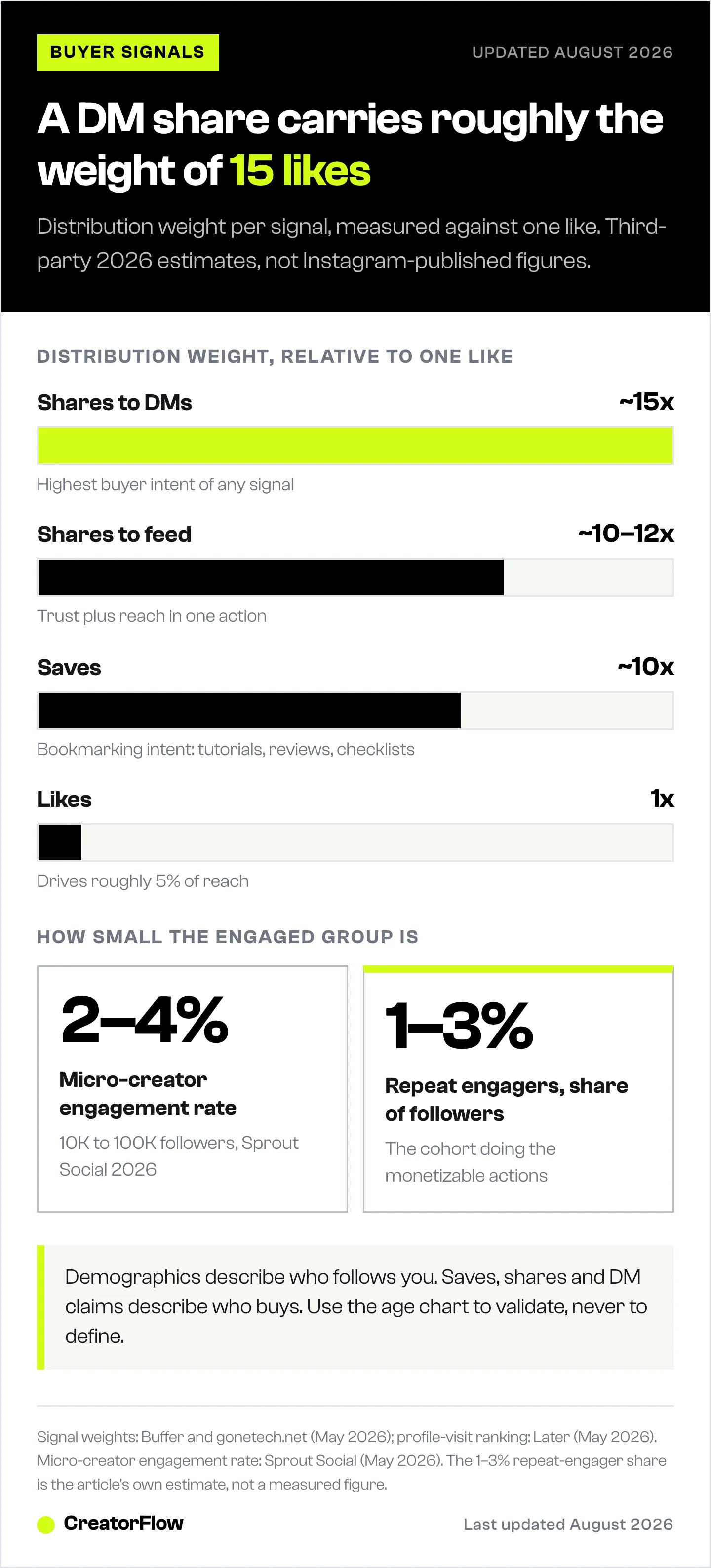
Source: Buffer (May 2026), gonetech.net (May 2026), Later (May 2026).
How to Run an Audience Discovery Test in 14 Days
This is the simplest behavioral audience-research protocol that works. It costs nothing if you already have a Creator or Business account, and it produces a real audience profile in two weeks.
Days 1-3 — Baseline. Pull your last 90 days of post insights. Sort by saves, shares, comments. Note the 5 top-performing topics. Pull last 200 DMs and tag the recurring questions.
Days 4-7 — Hypothesis. Pick the strongest topic from your saves data. Write 3 content angles inside that topic. Schedule one Reel per angle. In the caption, set a comment-to-DM trigger that ships a free resource (PDF, checklist, link round-up). Use comment-to-DM automation so claims convert into a tracked list.
Days 8-14 — Read the data. Compare claim rate (claims / total comments) across the 3 angles. The winning angle is your audience signal. The handles that claimed are your seed audience cohort. Cross-reference with your “saved my last 5 posts” list and your DM senders. The overlap is your real Instagram target audience — behaviorally defined, not demographically guessed.
You can repeat this protocol every 60-90 days. Audiences shift. Topics decay. The signal stays the same.
Tools That Surface Buyer Signals
You only need three things to run this analysis.
Instagram Professional Dashboard (free). Native demographics, top posts by metric, content interactions over 7-90 day windows. Available to Creator and Business accounts. Required minimum: 100 followers for audience demographics (help.instagram.com, May 2026).
Comment-to-DM automation (CreatorFlow, $15/month). Captures every user who claims a trigger word, ships them a tracked link, and exports the list as CSV. This is the single fastest way to convert passive followers into a behaviorally identified audience. Compare options in our best Instagram DM automation tools breakdown.
Spreadsheet (free). A simple Google Sheet with columns for Handle, First seen (post URL), Trigger claimed, Saves count, DM sent (Y/N), Story reply (Y/N). Update weekly. After 60 days you have a real CRM-style view of your engaged audience — something Instagram itself does not provide.
Demographics Still Matter — But Use Them Last
Demographic data is not worthless. It is just the wrong starting point. Use it to validate, not to define.
After you build a behavioral audience cohort using the 7 signals above, pull demographics on that cohort. If your behavioral audience skews older or more international than your follower demographics, that gap is the most important strategic insight Instagram will ever give you. It tells you that your monetization audience is different from your reach audience — and your content, paid ads, and product positioning should follow the monetization side.
US Instagram audiences average a 2.5% engagement rate, EU 2.1%, and APAC 3.2% (influenceflow.io, May 2026). If your behavioral cohort skews APAC but your demographic chart says US, your ad targeting is currently wasted — and your content should reflect that mismatch.
Common Mistakes to Avoid
Optimizing for the average follower. The average follower is, by definition, not engaged. They will never buy. Optimizing for them dilutes your content and shrinks your buying audience.
Treating audience insights as a one-time exercise. Audiences shift quarterly as your content shifts. Run the 14-day protocol every 60-90 days.
Starting audience research with zero audience. If you are brand new, you need a baseline of followers before behavioral signals mean anything. Build it first with this guide to getting your first 100 Instagram followers, then come back to the 7 signals.
Ignoring DMs because they “don’t scale.” DMs are the highest-signal data source you have. Read them. Even if you use Instagram DM automation for replies, the inbound questions are unfiltered audience research.
Confusing engagement with audience. Engagement bait (puzzles, “tag a friend”) generates likes and comments without buyer intent. A Reel with 500 saves and 80 likes beats a Reel with 80 saves and 5,000 likes for monetization.
FAQ
What is the difference between Instagram followers and Instagram audience?
Followers are anyone who tapped Follow on your profile. Your audience is the subset of followers who take buyer-intent actions — saves, shares, story replies, DM claims, repeat engagement. On most accounts, the audience is 1-5% of the follower count.
How do I see who saves and shares my Instagram posts?
You can see counts in Insights but not individual handles. Open Insights → Post → Saves and Shares for each post. To track individuals, use comment-to-DM automation to capture claimers and cross-reference them with your Top Engagers manually.
Are Instagram audience insights free?
Yes. Audience insights are free for any Creator or Business account with at least 100 followers. Open the Professional Dashboard, then Insights → Audience (help.instagram.com, May 2026).
How accurate is the Instagram audience demographics data?
The age, gender, and location data is self-reported by users at signup, so it is directionally accurate but not perfect. Use it to validate behavioral data, not as the primary source.
What is the fastest way to find my Instagram target audience?
Run a 14-day comment-to-DM test. Pick a topic from your top-saved posts. Post 3 Reels with a comment trigger that ships a free resource. The handles that claim the trigger are your behaviorally validated audience cohort.
Do I need a paid tool to find my Instagram audience?
No. Instagram’s free Professional Dashboard surfaces demographics, saves, shares, and reach. A paid tool like CreatorFlow ($15/month) is only needed if you want to capture comment-to-DM claimers automatically and export the list for follow-up campaigns.
Why is my Instagram engagement low even though my follower count is growing?
Most “growth” follows are passive. They were attracted by one viral post and do not match your behavioral audience. Cut content that drives shallow follows and double down on content formats that drive saves and shares. Your engagement rate will rise even if your follower growth slows.
How often should I redo my Instagram audience research?
Every 60-90 days. Audience cohorts shift as your content niche evolves and as the algorithm reranks formats. The 14-day protocol can be re-run anytime.
Audience signals and algorithm weights verified from Instagram Help Center, Sprout Social, Buffer, Later, and gonetech.net as of May 2026. Engagement rates and signal weights vary by niche, geography, and account size. Individual results vary.


