
An Instagram hook is the opening line or first frame that decides whether someone watches or swipes. Since August 2025, Instagram scores it for you: Reels Insights now reports a skip rate, the share of viewers who leave inside the first 3 seconds, alongside a retention curve (Social Media Today, August 2025). Your hook is no longer a matter of taste. It has a number attached to it.
That changes what a hook template is for. A template is a starting guess. The skip rate tells you whether the guess was right, on that Reel, for your audience, within a day of posting.
This guide gives you 50 copy-paste hook templates across six hook types, then the part most hook guides skip: how to read Instagram’s own numbers to find out which of them stop the scroll for your audience, and what separated winning hooks from losing ones when we took eight Reels apart frame by frame.
Key Takeaways
- Instagram grades your hook now: Reels Insights shows skip rate (viewers lost in the first 3 seconds) and a retention curve. Instagram’s guidance on the curve is blunt: “the flatter the line, the more engaged your audience is” (Social Media Today, August 2025)
- Ignore the skip-rate benchmarks circulating online: the “20% is good, 35% is average” figures on competing pages have no primary source. Instagram publishes no target, and your own median is the only benchmark worth measuring against
- Watch time is the signal the hook feeds: Adam Mosseri named watch time, sends per reach, and likes per reach as the three ranking signals that matter most. The hook is the only thing standing between your Reel and the first of those
- A hook has three layers, and one number grades all of them: what viewers read on screen, what they see move, and what they hear. Skip rate cannot tell you which layer failed, but it tells you that one did
- 6 hook types cover every scenario: Problem/Pain, Curiosity, Contrarian, Transformation, Question, and List/Number, with 50 templates below
- Open on the payoff, not the pain: in our own eight-Reel teardown, payoff-first openings beat the account’s median while pain-first openings fell below it
- Editing speed is not the variable: winners and losers in that teardown cut at the same pace. What differed was whether the hook was followed by something worth staying for
- Bottom line: pick a template, post it, read the skip rate, keep what holds viewers past 3 seconds. Two weeks of measuring which hooks stop the scroll beats any list used blind
What Makes a Hook Stop the Scroll
A hook stops the scroll when it gives the viewer a reason to stay before they finish deciding to leave. That decision happens inside the first 3 seconds, which is exactly the window Instagram measures as skip rate. Effective hooks do one of four things in that window: name a problem the viewer has, break an expected pattern, promise a visible transformation, or set up a countable list.
Hooks fail for a narrower set of reasons than most creators assume. Poor delivery is rarely the issue. The common failure is an opening that describes something instead of showing it, which asks the viewer to spend attention on faith.
Why the first 3 seconds carry so much weight
Instagram ranks Reels primarily on watch time, sends per reach, and likes per reach, the three signals Adam Mosseri identified as most important across surfaces in January 2025 (Social Media Today, January 2025). Watch time is the one the hook controls directly. A viewer who leaves at second two contributes nothing to any of the three, and the Reel’s distribution is capped before the content has been seen.
This is why hook work outperforms almost any other edit you can make to a Reel. Improving the middle of a video helps the people who stayed. Improving the hook changes how many people there are.
How to Write a Hook That Stops the Scroll
Write the hook last, after you know what the Reel proves. Pick the one moment a viewer would want if they only got three seconds of the video, and open there. Say it in under ten words, show it on screen at the same time, and check that your first shot can actually display what the line promises. Then post it and read the skip rate.
That sequence matters more than the wording, because most weak hooks are written first and then handed a video that cannot support them. Working backwards from the payoff removes that failure mode before you film.
- Find the payoff. Finish the Reel in your head, then name the single most convincing second in it. That is your opening frame.
- Write five versions, not one. The first hook you write is the one you already had in mind. Versions three through five are where the specific ones show up.
- Cut it to ten words or fewer. Anything longer runs past the 3-second window Instagram measures, so the viewer decides before you finish the sentence.
- Check the camera can show it. If the opening claims a result your first shot cannot display, cut the claim rather than narrating over it harder.
- Post, wait 48 hours, read the skip rate. That number, not the view count, tells you whether the hook did its job.
Step 1 is the one most creators skip. A hook written before you know what the Reel proves is a hook the footage was never built to keep, and no amount of rewriting the line fixes that.
The Three Layers of a Hook: Text, Visual, and Spoken
Every Reel opens with three hooks running at once: the on-screen text a viewer reads, the movement they see, and the words they hear. Skip rate grades all three as one number. It cannot tell you which layer failed, only that the combination did not hold. Strong openings point all three at the same promise, which is also the cheapest fix available when skip rate is high.
| Layer | What it does | Practical constraint |
|---|---|---|
| On-screen text | Reaches viewers scrolling with sound off, and viewers who read faster than you speak | 5 to 8 words, first frame, high contrast, clear of the caption and UI overlays |
| Visual | Breaks the scroll pattern before any word is processed | The first shot has to show the subject, not a title card or a slow push-in |
| Spoken | Carries nuance and voice that text cannot fit | Under ten words, delivered inside the 3-second window |
Meta’s own creator guidance recommends captions for accessibility (creators.instagram.com, July 2026), and the same text does double duty as a hook for anyone watching in a queue or an office. Widely quoted figures for what share of viewers watch muted trace back to marketing blogs rather than a Meta source, so treat the exact percentage as unknown and add the text anyway. It costs one step in the editor.
The layers fail most often by contradicting each other. When the on-screen text promises one thing and the voiceover promises another, the viewer receives two competing offers in three seconds and resolves the conflict by scrolling.
Instagram Now Scores Your Hook For You
Most hook advice was written for a time when you could not tell a good hook from a bad one except by watching the view count and guessing. In August 2025, Instagram added two metrics to Reels Insights that closed that gap (Social Media Today, August 2025).
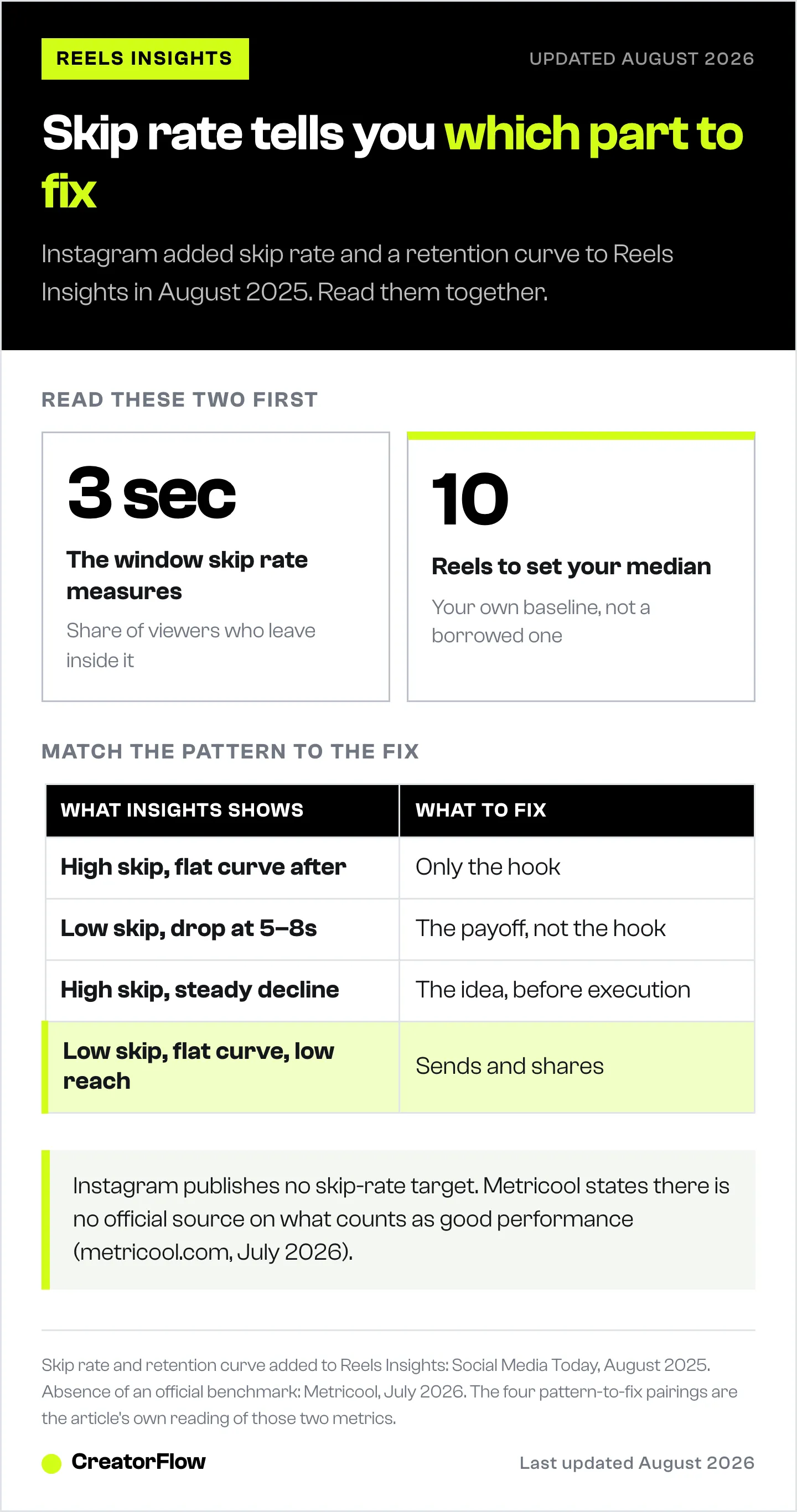
Skip rate replaced the older view rate. It reports the percentage of viewers who skipped within the first 3 seconds. This is a direct grade on your hook and nothing else, because nothing else has happened yet.
Retention is a curve showing where viewers drop off across the whole playback. Instagram’s own framing: the flatter the line, the more engaged the audience.
Read together, they separate two problems that used to look identical from the outside:
| What you see | What it means | What to fix |
|---|---|---|
| High skip rate, flat curve after | The hook is losing people, but whoever stays is satisfied | Only the hook. Leave the rest alone |
| Low skip rate, curve falls off a cliff at 5-8s | The hook wrote a cheque the content did not cover | The payoff, not the hook |
| High skip rate, curve falls steadily | Topic or format mismatch for this audience | The idea, before the execution |
| Low skip rate, flat curve, low reach | Hook and content are working; distribution is the constraint | Sends and shares, not the opening |
What counts as a good skip rate
Instagram publishes no target for skip rate, so there is no platform-wide number to hit. Several hook guides now quote a “25 to 35% average” with “under 20% is strong” attached to it. None of them cite a primary source, and the analytics vendor Metricool states plainly that “there is no official Instagram source (so far) on what percentage equals good performance versus room for improvement” (metricool.com, July 2026).
Treat those circulating figures as guesses that acquired decimal points on the way round. Skip rate varies enormously by niche, Reel length, and how much of your reach is followers rather than recommendations, which is exactly why a cross-account average would be useless even if one existed.
The benchmark that works is your own. Record skip rate across ten Reels, take the median, and judge every new hook against that line. A creator whose median is 44% and drops a Reel at 31% has learned something real. The same creator chasing a borrowed 20% target learns nothing, because the number was never measured on an account like theirs.
A creator who checks skip rate on every Reel for a month learns more about their own audience than any hook list can teach them. The templates below are the input to that loop. Your Insights tab is the output. If you want the wider metric picture around it, our guide to the Instagram metrics that actually predict growth covers where skip rate sits among the rest.
What Separated Winning Hooks From Losing Ones
In July 2026 we took apart eight Reels from a single creator account, five that beat the account’s median engagement and three that fell below it, reading every frame rather than the captions alone. Holding one account constant removes the usual confounders: same face, same niche, same editing style, same follower base. Multiples below are against that account’s own median.
This is eight Reels from one account. It is directional, not a law. It lines up with what the skip rate metric rewards, which is why it is worth reporting.
Opening on the payoff beat opening on the pain. The clearest pair sat 11 days apart, same creator, same format. The Reel that opened on the finished result took 1.12x the account’s median. The one that opened by describing the problem took 0.73x. Showing the outcome inside 3 seconds gives the viewer a reason to find out how. Describing the problem asks them to sit through discomfort on the promise of relief later.
Editing speed was not the variable. Winners and losers cut at the same median gap of roughly one second. Fast cutting is the most commonly recommended hook fix and it did nothing to separate these two groups. What separated them was what the cuts were showing.
Every long hold sat on something verifiable. In the winners, any shot held longer than 3.5 seconds was showing a receipt: a legible screen, a before-and-after with a real difference, a side-by-side. Hold quality sorted the engagement multiple in order across the talking Reels. A long hold on something the viewer cannot read or verify is where a Reel dies.
Winners talked slower. The Reels that beat the median ran 2.76 to 3.4 words per second and went quiet during the demonstration. The ones below median ran 3.4 to 3.7 words per second continuously, narrating over footage the viewer was trying to read. Silence over a payoff is not dead air. It is the room to notice what you are showing.
One ask per Reel. The weakest performer in the set stacked three requests into its final seconds. Engagement split across all three and landed below median on each.
The practical translation: if your hook makes a claim your camera cannot show, cut the claim rather than narrating it harder.
The 6 Types of Hooks
Every filled-in example below is placeholder copy. The numbers in them are there to show the shape of the line, not to describe a result anyone got. Put your own real figures in, because the FTC treats an unsubstantiated earnings or results claim in promotional content as deceptive even when it sits inside a hook.
Six openings cover almost every Reel worth making: Problem/Pain names something the viewer is already struggling with, Curiosity opens an information gap, Contrarian contradicts advice the viewer accepts, Transformation shows a visible before and after, Question addresses the viewer directly and leaves a loop open, and List/Number promises a countable amount of effort. Each carries a different risk, and each shows up differently in your retention curve.
1. Problem/Pain Hooks
Start with the exact problem your audience faces. Use these when the problem is one your viewer already knows they have. They underperform when the audience has not yet named the problem for themselves.
Templates:
- “If you’re still [doing X], you’re wasting [time/money]…”
- “Stop [common mistake] before it’s too late”
- “The reason you can’t [achieve goal] isn’t what you think”
- “I wasted [X years/dollars] before learning this”
- “Nobody tells you that [painful truth about topic]”
Examples:
- “If you’re still manually responding to DMs, you’re wasting 10+ hours per week…”
- “Stop posting without a strategy before you burn out completely”
- “The reason you can’t gain followers isn’t your content quality”
2. Curiosity/Pattern Interrupt Hooks
Make them think “Wait, what?” These carry the highest ceiling and the highest risk: an unmet curiosity gap shows up as a cliff in your retention curve around 5 to 8 seconds.
Templates:
- “I made $[X] with only [small number] followers. Here’s how:”
- “Everyone does [X]. I do [opposite]. Here’s why:”
- “The [industry/platform] doesn’t want you to know this…”
- “What nobody tells you about [topic]”
- “I ignored this advice. Made $[X] instead.”
Examples:
- “I made $3K/month with only 800 followers. Here’s how:”
- “Everyone posts daily. I post 3X per week. Made more money.”
- “Instagram doesn’t want you to know this about the algorithm…“
3. Contrarian Hooks
Contradict something the viewer already believes. These work on cognitive dissonance: a claim that clashes with an accepted rule creates discomfort the brain wants resolved, and the only way to resolve it is to keep watching. They carry the sharpest downside of the six, because a contrarian opening you cannot defend in the body reads as bait and shows up as a retention cliff plus an argumentative comment section.
Templates:
- “[Common advice] is why you’re stuck at [current state]”
- “Everyone does [X]. I stopped, and [result]”
- “[Popular tactic] is a waste of time for [audience]”
- “The advice that worked in [year] is now costing you [outcome]”
- “You don’t have a [assumed problem] problem. You have a [real problem] problem”
Examples:
- “Posting daily is why your reach is falling”
- “Hashtags are a waste of time for accounts under 10K”
- “You don’t have a content problem. You have a follow-up problem”
Only run a contrarian hook when you can show the evidence inside the same Reel. The rule this hook breaks is the one your footage has to disprove.
4. Transformation Hooks
Show the journey from before to after. These are the strongest fit for the payoff-first finding above, provided the “after” is visibly different from the “before” on camera. A transformation the viewer cannot see is a pain hook wearing a costume. For hooks you deliver by speaking rather than showing, see how to open a talk-to-camera Reel.
Templates:
- “From [bad situation] to [good situation] in [timeframe]”
- “How I went from [struggle] to [success]”
- “Before: [pain]. After: [gain]. Here’s what changed:”
- “I was [struggling]. Now I [succeeding]. What happened:”
- “[Timeframe] ago I [bad state]. Today I [good state].”
Examples:
- “From 200 followers to 10K in 90 days”
- “How I went from $0 to $5K/month as a creator”
- “Before: Spending 3 hours on DMs daily. After: 10 minutes with automation.”
5. Question Hooks
Address the viewer directly, then leave the answer open. A question does two jobs in one line: the direct address pulls a scrolling viewer into second person, and the open loop gives them a reason to stay for the answer. Ask something your audience genuinely does not know. A question they can answer instantly closes the loop before it opens, and they scroll.
Templates:
- “Do you know why [common outcome] keeps happening?”
- “What would you do if [scenario your audience faces]?”
- “Ever wonder why [X] works for them and not you?”
- “Which of these [number] mistakes are you making?”
- “Can you tell which of these [two things] performed better?”
Examples:
- “Do you know why your Reels get views but no sales?”
- “Which of these three caption mistakes are you making?”
- “Can you tell which of these two hooks got 4x the reach?”
Question hooks sit closest to the line between stopping the scroll and driving a reply, and those are different jobs measured by different numbers. A question written for watch time keeps the answer inside the video. A question written for comments hands the answer to the comment section instead. Decide which one you want before you write the line, because a Reel that tries both usually loses on both.
6. List/Number Hooks
The brain likes lists because they promise a known amount of effort. These are the safest hook type and the least likely to produce an outlier.
Templates:
- “[Number] things I wish I knew before [starting X]”
- “[Number] mistakes keeping you from [goal]”
- “The only [number] [things] you actually need”
- “[Number] signs you’re ready for [next level]”
- “I tested [number] [things]. Here’s what actually worked:”
Examples:
- “5 things I wish I knew before starting my creator business”
- “3 mistakes keeping you from your first 1,000 followers”
- “The only 4 automation tools you actually need”

50 Ready-to-Use Instagram Hook Templates
Problem/Pain Hooks (1-12)
- “If you’re still [X], stop immediately…”
- “This is why [X] isn’t working for you…”
- “Stop doing [X]. Do this instead:”
- “You’re losing [money/time/followers] by doing [X]”
- “The biggest mistake [audience] make with [topic]”
- “I spent [X time/money] learning [topic]. Save yourself:”
- “Your [result] is stuck because you’re doing [X]”
- “This one thing is killing your [growth/sales/engagement]”
- “Nobody tells you that [painful truth]”
- “This is costing you [specific loss]. Here’s why:”
- “Struggling with [problem]? You’re not alone. Here’s the fix:”
- “Stop wasting time on [X]. Focus on this instead:“
Curiosity Hooks (13-22)
- “What [X successful people] won’t tell you about [topic]”
- “The [industry] secret nobody shares”
- “This changed everything for my [business/content/growth]”
- “What I learned after [impressive number/timeframe]”
- “The one thing that 10X’d my [result]”
- “I tested [X things]. Only this worked:”
- “Here’s what happened when I [unexpected action]”
- “Forget everything you know about [topic]”
- “The real reason [common outcome happens]”
- “I made $[X] with only [small number] followers. Here’s how:“
Contrarian Hooks (23-30)
- “I did [opposite of common advice]. Here’s what happened:”
- “Everyone says [X]. I say [Y]. Here’s why:”
- “Why [unpopular opinion] is actually true”
- “The [topic] strategy that feels wrong but works”
- “Plot twist: [X] doesn’t matter. This does:”
- “[Number] reasons why [X] is overrated”
- “[Common advice] stopped working in [year]. Here’s what replaced it:”
- “You don’t have a [assumed problem] problem. You have a [real problem] problem”
Transformation Hooks (31-38)
- “From [bad number] to [good number] in [timeframe]”
- “How I went from [struggle] to [success] with [method]”
- “6 months ago: [pain]. Today: [gain].”
- “Before I [discovered X]: [bad situation]. After: [transformation]”
- “When I started: [low point]. Now: [high point].”
- “My [business/account/life] before vs after [discovery]”
- “I was [negative state]. Then I learned [X]. Now I’m [positive state].”
- “Where I started vs where I am now (and how you can too)“
Question Hooks (39-44)
- “Do you know why [common outcome] keeps happening?”
- “What would you do if [scenario your audience faces]?”
- “Ever wonder why [X] works for them and not for you?”
- “Which of these [number] mistakes are you making?”
- “Can you tell which of these [two things] performed better?”
- “How much is [problem] actually costing you?”
List/Number Hooks (45-50)
- “[Number] things that actually matter for [goal]”
- “The only [number] [tools/strategies] you need for [result]”
- “[Number] lessons from [timeframe/experience]”
- “I tried [number] [things]. Here’s what worked:”
- “[Number] mistakes I made so you don’t have to”
- “The [number] step process that [result]“
Where to Find Hooks Your Audience Already Wants
The strongest hooks are not written. They are transcribed. Four sources hand you the exact wording your audience uses, and three of the four are already sitting inside your own account.
Your comment section. Every question a follower types is a hook with the punctuation moved. “Wait what app is that” becomes “The app nobody in my comments can name.” Read the last hundred comments and write down every question asked more than once. Those repeats are demand you have already measured.
Your DM requests. When someone messages you asking for a link, a price, or a recommendation, they have told you what your content promised but did not deliver. That gap is a Reel. Creators running keyword automations have this in structured form already, because every trigger word someone sends is a logged, timestamped request.
Saves and sends on old posts. A post with high saves relative to its likes was useful enough to keep. Whatever made it useful is a hook waiting to be reopened on a newer Reel. This is also the quickest read on why your Reels stopped pulling the reach they used to.
Search autocomplete. Type your niche into the Instagram search bar and into Google and read the suggestions. Those are queries with real volume behind them, phrased the way people actually type. A hook built from an autocomplete phrase is pre-validated language.
Competitor content is the fourth source most guides list first, and it is the weakest of the set. Copying a hook that worked on someone else’s audience skips the only step that matters, which is checking whether your audience asks that question at all. Use competitors to spot a format. Use your own comments to write the line.
The same sourcing works for the written version of the hook, since a first line that stops the scroll in a feed and a first line that survives the caption cutoff are close cousins. Our library of caption openers built around a specific engagement goal covers that half.
How to Customize These Hooks for Your Niche

Step 1: Pick a hook template that matches your content type Step 2: Replace [brackets] with your specific details Step 3: Check that your first shot can show what the hook promises Step 4: Add your voice, then post and read the skip rate
Step 3 is the one creators skip. A hook that promises a result the camera never shows is the pattern that produced the retention cliffs in our teardown.
Example customization:
Template: “From [bad number] to [good number] in [timeframe]”
Fitness niche: “From 180 lbs to 140 lbs in 90 days” Business niche: “From $0 to $10K MRR in 6 months” Instagram niche: “From 200 to 5K followers in 8 weeks”
To spin up dozens of variations in seconds, feed a template into our library of AI prompts for captions and hooks.
How to Test Hooks Against Skip Rate
Templates give you candidates. This loop tells you which candidates belong to your audience.
- Pick six hooks, one from each type. Run the full set once before you decide anything. Testing three types tells you which of three won, not which of six works.
- Hold everything else steady. Same topic family, same length, same posting window. If two variables move, the result explains nothing.
- Wait 48 hours, then open Insights on each Reel. Record the 3-second drop-off and the shape of the retention curve, not the view count. Views are downstream of both and lag by days.
- Sort by that number, lowest first. The lowest figure marks your strongest hook regardless of which Reel got the most likes. Likes reward the whole video. This metric isolates the opening.
- Run the winner four more times with different topics. A hook that survives four topics is a format you own. One that only worked once was a good topic wearing a hook’s clothes.
Two things worth watching as you go. An opening that holds viewers past 3 seconds but produces a cliff at 5 to 8 seconds is over-promising, so fix the payoff rather than rewriting the hook. And a hook that stops the scroll while flattening engagement is usually broad enough to hold everyone and specific enough to move nobody.
This is the same discipline applied to whole formats in our Instagram Reels testing system, and it compounds faster when the winning hook becomes a recurring content series rather than a one-off.
What Happens After the Hook Works
A hook that stops the scroll produces a specific problem: a comment section full of people asking for the thing you showed. That window is short. The viewer who typed “link?” is still scrolling and will keep scrolling.
This is where hooks meet the two ranking signals a hook cannot reach on its own. Sends per reach and likes per reach both depend on what happens after the viewer stays. A hook that earns attention and then hands the viewer nowhere to go converts watch time into nothing.
Two moves close that gap. Write the ask into the caption’s first line rather than the final seconds of the video, and give it a single job. In our teardown, the Reel that stacked three asks landed below median on all of them. Then let the reply happen without you: Instagram DM automation sends the link, the recipe, or the booking calendar the moment someone comments your trigger word, so a hook that lands at 2am still turns into a conversation.
If your goal is replies rather than watch time, the hook itself changes shape. We cover that split in the psychology behind hooks built to trigger comments, which optimizes for a different signal than the templates on this page.
Short on openers? The free Instagram hook generator produces variations you can test.
Turn the attention your hook earns into a conversation. CreatorFlow sends your link automatically to anyone who comments your trigger word, on Meta’s official Instagram API.
FAQ
What is a good Instagram skip rate?
Instagram publishes no official target, and the “under 20% is good, 25 to 35% is average” figures circulating on hook guides have no primary source behind them. Metricool, an analytics vendor working with the data directly, confirms there is no official Instagram source on what counts as good (metricool.com, July 2026). Record your own skip rate across ten Reels, take the median, and judge new hooks against that.
What are the 6 types of Instagram hooks?
Problem/Pain names something the viewer is already struggling with. Curiosity opens an information gap. Contrarian contradicts advice the viewer accepts. Transformation shows a visible before and after. Question addresses the viewer directly and leaves the answer open. List/Number promises a countable amount of effort. Most Reels use one. The strongest usually combine two, most often a number with one of the other five.
How long should an Instagram hook be?
Five to eight words on screen and under ten spoken for a Reel, five to twelve for a caption. The constraint is the 3-second measurement window rather than a word count rule. If your spoken hook cannot finish inside 3 seconds, the viewer decides before you reach the point. In our teardown the Reels that beat the median spoke at 2.76 to 3.4 words per second, which puts a practical ceiling around ten spoken words.
Should I stick to one hook type or mix them?
Rotate types, with one exception. If your Insights show one type outperforming across four or more topics, use it for roughly half your content and keep testing the rest. A hook type that wins on one topic is not yet a pattern. Combining two types in a single opening usually beats either alone, as in “5 things I wish I knew before starting,” which is a list hook and a regret hook at once. Stop at two. Three competing promises in three seconds reads as noise and shows up as a high skip rate.
Do these hooks work for captions and Reels?
Yes, with different mechanics. In a Reel the hook competes against the swipe and is measured by skip rate. In a caption it competes against the “more” cutoff and is measured by whether people expand and reply. Reel hooks should be visual and spoken at the same time. Caption hooks carry the ask.
Why do my Reels get views but no comments?
Views and comments answer to different things. Views follow watch time, which the hook drives. Comments follow the ask, which usually sits in the caption or the final seconds. A Reel with strong views and no comments generally has a working hook and a missing or buried ask. Move the ask to the caption’s first line and make it one thing.
Does an on-screen text hook work if I do not say it out loud?
It works, and it is worth doing both. On-screen text reaches viewers watching without sound, and a spoken hook reaches those who scroll without reading. Matching them costs nothing. Where they conflict, the viewer gets two different promises and skip rate rises.
Instagram Reels metrics verified from Instagram’s August 2025 Reels Insights update and Adam Mosseri’s January 2025 ranking-signal comments, both reported by Social Media Today, as of July 2026. The absence of an official skip-rate benchmark verified against Metricool’s Instagram Reel analytics documentation and Meta’s creator best-practice guidance, July 2026. Teardown figures come from an eight-Reel within-account analysis conducted in July 2026 and are stated as multiples of that account’s own median; they are directional rather than predictive. Individual results vary by niche, audience size, and content quality.
Disclaimer: Performance results mentioned in this article are based on aggregated user data and industry research from 2025-2026. Individual results vary based on audience size, content quality, engagement rates, and niche. CreatorFlow uses Instagram's official Graph API as of July 2026. Instagram/Meta may change features, rate limits, or terms at any time. Instagram is a trademark of Meta Platforms, Inc. CreatorFlow is not affiliated with, endorsed by, or sponsored by Meta Platforms, Inc. Users are responsible for complying with Instagram's Terms of Service and Community Guidelines.