
A working AI influencer stack costs roughly $36 to $212 per month in 2026 across five layers: stills, video, voice, talking head, and distribution. At a normal publishing rate of 20 posts a month, that lands between $1.80 and $10.60 per published post. Subscription credits expire at the end of each billing cycle, so generations you never use are money already spent.
The number most tool lists quote is the subscription total. That is not the number you pay. You pay for retries, and identity drift makes retries the largest hidden line item in the build. Generating five stills to keep one turns a $0.04 image into a $0.20 image, and a 3,000-credit video plan into a third of the clips its credit sheet implies.
This guide prices each layer from the vendors’ own pages, converts the totals into a cost per published post, and covers the two rules that landed in August 2026 and changed which spend is worth making at all.
Key Takeaways
- Budget $36 to $212 per month for a solo AI persona, depending on how much video you publish and whether you need a talking head
- Price the stack per published post, not per generation. Credits expire monthly with no rollover on every major platform, so your real unit cost is the plan price divided by what you shipped
- Identity lock is a cost control. A character reference or trained model cuts retries, and retries are where the budget goes
- Model churn is a live risk. OpenAI announced the end of Sora on March 24, 2026, closed the app on April 26, and set the API to sunset on September 24 (Forbes and eMarketer, March 2026). Any stack built around a single video model carries that risk
- Labeling is free and skipping it is expensive. Instagram now limits reach for profiles featuring an AI-generated person without its label, and applying the label carries no penalty (creators.instagram.com, August 2026)
- The cheapest layer is the one that earns. Distribution costs $0 to $30 a month and is the only layer that turns published posts into clicks and email addresses
- All-in-one platforms trade price for portability. Bundling every layer under one subscription means the persona lives inside that vendor’s account
How Much Does an AI Influencer Cost Per Month?
An AI influencer costs $36 per month at the minimum viable end and around $212 per month for a volume setup that publishes daily video. The spread comes almost entirely from video, which is metered in credits and consumes 10 to 20 times what stills cost. Voice and distribution are close to fixed. Stills are cheap. Video is the bill.
Those figures assume a solo operator running one persona. Agency setups with multiple personas multiply the video layer and little else, because a still model, a voice plan, and a distribution plan usually cover several characters at once.
What Do You Pay For in an AI Influencer Stack?
Five jobs, and no single tool does all five well.
Stills and identity. The face, the body, the wardrobe, the canon look. This layer also holds identity lock: a character reference, a trained model, or a platform character feature that keeps the same face across hundreds of images.
Video. Turning stills into Reels. Almost always image-to-video rather than text-to-video, because text-to-video reinvents the face on every clip.
Voice. A cloned or synthetic voice for voiceover and for lip-sync.
Talking head. Lip-synced delivery to camera, which is a different product from image-to-video and priced separately.
Distribution and conversion. The layer that turns a view into a click, an email address, or a sale. Generation without this layer produces content and no revenue.
Skipping a layer is a legitimate way to cut cost. A persona that never speaks to camera does not need the talking-head layer. A persona posting stills only does not need video. Cut a layer on purpose, not by accident.
AI Influencer Tool Prices in 2026
Every figure below comes from the vendor’s own published page unless noted, verified in August 2026. Ranges run from the cheapest paid tier to the top self-serve tier.
| Tool | Job | Monthly price | What that buys |
|---|---|---|---|
| Midjourney | Stills, character reference | $10 to $120 | 3.3 to 60 fast GPU hours |
| Higgsfield | Stills, video, character lock | $19 to $129 | 270 to 3,000 credits |
| Google AI Pro | Nano Banana Pro stills, Veo video | $19.99 | 1,000 Flow credits |
| Kling | Image-to-video | $10 to $180 | 660 to 26,000 credits |
| Runway | Image-to-video | $15 to $95 | 625 to 9,500 credits |
| ElevenLabs | Voice cloning | $6 to $99 | 30,000 to 600,000 credits |
| HeyGen | Talking head | $29 to $149 | 600 to 1,500 credits |
| Synthesia | Presenter video | $29 to $89 | 10 to 30 minutes per month |
| CreatorFlow | Comment-to-DM distribution | $0 to $30 | Flat rate, no per-contact tiers |
Sources: elevenlabs.io/pricing, heygen.com/pricing, synthesia.io/pricing and runway.com/pricing, all August 2026; higgsfield.ai/pricing, July 2026; Midjourney and Kling tiers corroborated across independent pricing trackers, August 2026; Google AI plan pricing reported at $19.99 for AI Pro with 1,000 Flow credits, August 2026; creatorflow.so, August 2026.
Three details that change the arithmetic more than the headline price does.
Annual billing is a real discount, not a rounding error. Midjourney drops 20% on annual. Runway Standard goes from $15 to $12 and Pro from $35 to $28. HeyGen Creator goes from $29 to $24. Synthesia Starter goes from $29 to $18. On a $100 stack that is $20 a month back, which is the entire distribution layer.
Free tiers are for testing, not for running. Runway’s free plan is 125 one-time credits, not monthly. HeyGen’s free plan caps at three videos a month of one minute each. Kling’s free credits expire daily.
Credit units are not comparable across vendors. Runway Gen-4.5 costs 60 credits per five seconds of video, so a 2,250-credit Pro plan is about three minutes of finished output. A Kling credit and a Runway credit and a HeyGen credit are three different things. Compare seconds of usable video, never credit counts.
How to Price Your Stack Per Published Post
Divide the monthly bill by the number of posts you published, not by the number of generations the plan allows. Vendors advertise the second number. Only the first one is real.
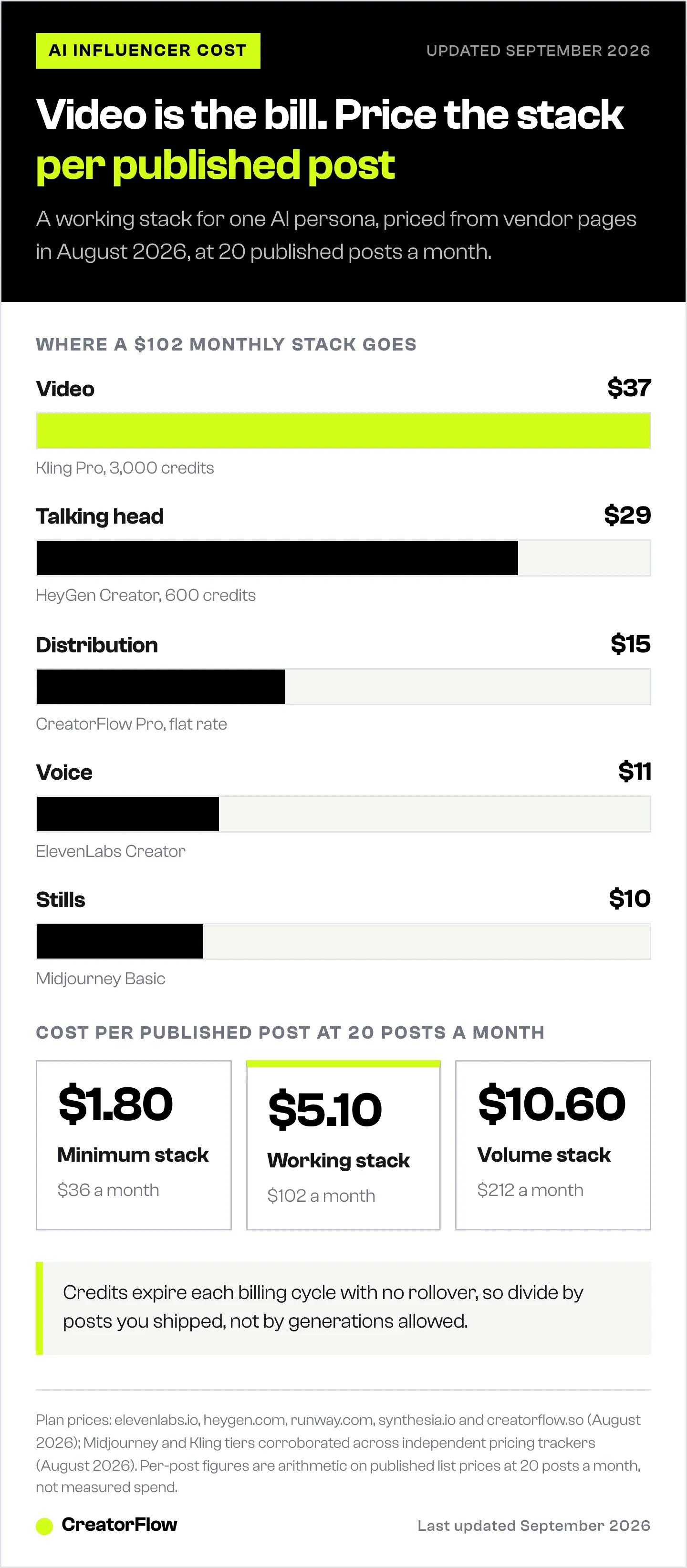
The gap between them is large and predictable. A creator on a 3,000-credit video plan who ships eight Reels in a month paid $4.63 per Reel on a $37 plan, regardless of what the credit sheet says a clip costs. Credits expire at the end of the billing cycle on every major platform in the table above, so the unused balance is not carried forward and not refunded.
This changes which plan is correct for you. The cheaper tier is usually the right one until you are consistently exhausting it, because an unused allowance is a 100% loss and an exhausted allowance costs a top-up. Most creators overbuy the video layer for six months before they publish enough to justify it.
Two numbers make the decision. Count your published posts last month. Divide the plan price by that count. If the result is under about $6 per post, the plan is sized correctly for your output. If it is $15 or more, drop a tier and buy top-ups on the months you need them.
Three AI Influencer Stacks, Priced
Worked examples using the verified list prices above, all on monthly billing, all assuming 20 published posts a month. These totals are arithmetic on published prices, not measured spend.
| Stack | Tools | Monthly | Per post |
|---|---|---|---|
| Minimum | Google AI Pro, ElevenLabs Starter, Kling Standard, CreatorFlow Free | $35.99 | $1.80 |
| Working | Midjourney Basic, Kling Pro, ElevenLabs Creator, HeyGen Creator, CreatorFlow Pro | $102 | $5.10 |
| Volume | Midjourney Standard, Runway Pro, Kling Pro, ElevenLabs Creator, HeyGen Pro, Google AI Pro, CreatorFlow Growth | $211.99 | $10.60 |
The minimum stack ships stills and short image-to-video with a synthetic voice, and it is enough to test whether a persona holds attention in a niche before you spend more. It has no talking head and no redundancy on the video model.
The working stack adds a character reference for identity lock, a talking-head layer, and professional voice cloning. This is the shape most solo operators settle on. On annual billing the same stack runs about $84.
The volume stack carries two video models on purpose. That is insurance rather than indulgence: a persona that publishes daily cannot afford to be offline for a week because one vendor changes a model, raises a price, or shuts down. Sora’s closure in 2026 is the reference case.
Move a stack up only when the layer below is saturated. Adding a second video model while your first one still has unused credits raises cost per post without raising output.
Why Identity Lock Cuts Your Bill
Identity lock reads like a quality feature. It is a cost feature, and it is the single largest lever on the whole budget.
Here is the arithmetic. Without a locked face, a usable still takes three to five generations, because the face drifts and most outputs are discarded. With a character reference, a trained model, or a platform character feature, the keep rate rises sharply and the same output costs a fraction of the generations. On a $30 stills plan, moving from a one-in-five keep rate to one-in-two cuts the effective cost per usable image by around 60%.
The same effect compounds downstream. Every discarded still is a video clip you did not make, a voiceover you did not need, and an hour you did not spend reviewing outputs. Video is the expensive layer, and a bad still wastes video credits before you notice.
Three ways to lock a face, in ascending order of cost and portability. A character reference inside your image tool is the cheapest and stays inside that tool. A platform character feature such as Higgsfield’s Soul ID keeps identity stable across shots on that platform. A trained model that you own is the most portable, and it is the only version that survives a vendor shutting down. Our guide on how to create an AI influencer on Instagram walks through the identity step in order.
What Costs Do Not Appear on Any Pricing Page?
Four, and together they usually exceed the subscriptions.
Retries. Covered above. Assume your effective cost per usable asset is two to five times the sticker price until you have identity lock working.
Your time. Prompting, reviewing, discarding, re-rendering, editing, captioning, and posting. A persona publishing five times a week is a part-time job. If you value that time at anything, it is the largest number on the page.
Vendor churn. OpenAI announced on March 24, 2026 that it was discontinuing Sora, closed the consumer app on April 26, and scheduled the API to stop accepting requests on September 24 (Forbes and eMarketer, March 2026). Sora appeared as a core recommendation on AI influencer tool lists for months after that announcement. Any list still naming it as a 2026 video option is quoting a product that is closing. Check that every tool on any list you read is still selling subscriptions before you plan a stack around it.
Compliance. The cheapest line item, and the one that decides whether the rest of the spend returns anything.
Instagram announced its AI-generated profile label on August 31, 2026. Profiles that feature an AI-generated person and skip the label may see limited reach, and profiles Instagram detects as unlabeled become ineligible for recommendations. Creators who apply the label are not penalized for featuring an AI-generated person (creators.instagram.com, August 2026). For a synthetic persona, recommendation eligibility is the entire growth engine, so an unlabeled account is a stack you paid for and cannot distribute. The full rules are in our guide to Instagram’s AI-generated profile label.
Two more obligations sit outside Instagram. In the EU, Article 50 of the AI Act has applied since 2 August 2026 and requires deployers of deepfake content to disclose that it was artificially generated, clearly and at first exposure, with statutory maximum fines reaching 15 million euros or 3% of worldwide annual turnover (digital-strategy.ec.europa.eu, August 2026). In the US, the FTC’s Endorsement Guides apply to virtual endorsers exactly as they apply to human ones, with maximum civil penalties of $53,088 per violation (16 CFR 1.98, 2026). Neither is satisfied by the Instagram toggle. Our breakdown of FTC disclosure rules for Instagram covers the post-level wording.
Where Does the Spend Come Back?
Nowhere in the generation stack. Stills, video, voice, and talking head are all cost. The return happens at distribution, which is the layer AI influencer tool lists spend the least time on and the layer that costs the least to run.
The mechanic is simple. A persona posts a Reel, viewers comment a keyword, and an automation sends each of them a DM with the link, the download, or the offer. That converts attention that already exists into a click you can measure and an email address you keep. It also survives the reach limits described above, because a DM triggered by a comment does not depend on recommendation surfaces at all.
CreatorFlow runs that layer for a flat $15 a month on Pro, with a follow gate, an email gate, CSV export of collected contacts, and clicks broken out by country and city. The Free plan covers testing on one workspace. It connects through Meta’s official Instagram API and CreatorFlow has been a Meta Tech Provider since December 2025.
Set the distribution layer up before the persona publishes rather than after. Every post that goes out without a keyword and a DM waiting behind it is generation spend with no path to revenue attached. The same arithmetic decides whether a second character is worth generating, which our guide to running multiple AI influencer accounts works through. If you are still choosing a niche, which AI influencer niches convert sorts them by whether the buyer needs a real body, and AI avatar generators for Instagram compares the generation tools themselves on output rather than on price.
FAQ
How much does it cost to start an AI influencer?
Around $36 per month for a minimum stack that produces stills, short video, and a synthetic voice, using Google AI Pro at $19.99, ElevenLabs Starter at $6, Kling Standard at $10, and a free distribution plan. Add a talking-head tool and a character reference and the working figure is closer to $102 per month (vendor pricing pages, August 2026).
Can you run an AI influencer for free?
You can test one. Free tiers exist at ElevenLabs, HeyGen, Kling, Synthesia, and Runway, but they are capped tightly: HeyGen allows three one-minute videos a month, Runway gives 125 one-time credits rather than a monthly allowance, and Kling’s free credits expire daily (vendor pricing pages, August 2026). Publishing consistently means paying for at least the video layer.
What is the most expensive part of an AI influencer stack?
Video, by a wide margin. Stills, voice, and distribution together often cost less than a single mid-tier video plan. Runway Gen-4.5 consumes 60 credits per five seconds of output, so a 2,250-credit Pro plan yields roughly three minutes of finished video for $35 a month (runway.com/pricing, August 2026).
Do AI influencer credits roll over month to month?
No. Subscription credits expire at the end of each billing cycle on every major platform in this guide, with no rollover. Purchased top-up packs sometimes last longer than the billing month, which is why buying a smaller plan plus occasional top-ups is often cheaper than a larger plan you do not exhaust.
Is an all-in-one AI influencer platform cheaper than a stack?
Sometimes on price, rarely on portability. Bundles that cover stills, video, and voice under one subscription can undercut four separate plans. The trade is that the persona’s identity lives inside that vendor’s account, so a price change or a shutdown takes the character with it. A separately trained model that you own is the version that survives.
Does the Instagram AI label cost you money?
Applying it costs nothing, and Instagram says creators who use it are not penalized for featuring an AI-generated person. Skipping it is what costs money: profiles featuring an AI-generated person without the label may have their reach limited, and detected unlabeled profiles become ineligible for recommendations (creators.instagram.com, August 2026).
How many posts a month does an AI influencer need to justify the cost?
Work backwards from cost per post rather than from a post count. Divide your monthly stack cost by the posts you published. Under roughly $6 per published post, the plans are sized correctly for your output. At $15 or more, drop a tier and buy top-ups in the months you need them.
Tool pricing verified from elevenlabs.io, heygen.com, synthesia.io, runway.com and creatorflow.so as of August 2026; higgsfield.ai/pricing as of July 2026; Midjourney, Kling and Google AI plan pricing corroborated across independent pricing trackers as of August 2026, not from a vendor page. Sora discontinuation dates verified from Forbes and eMarketer reporting, March 2026. Instagram’s AI-generated profile label verified from Instagram’s creators blog, August 2026. EU AI Act Article 50 obligations verified from European Commission guidance, August 2026. FTC penalty figure from 16 CFR 1.98 (2026). Stack totals are arithmetic on published list prices, not measured spend. Prices change often; verify before subscribing.