Running multiple AI influencer accounts means one production pipeline feeding several separate Instagram profiles, each with its own persona, keyword, offer, and DM flow. Instagram shares no audience and no messaging permission between accounts, so every character builds its opted-in list from zero. Add a second character when the first one’s offer is saturated, not when your rendering capacity is spare.
That distinction is the whole decision. Generating a second face costs a few dollars. Midjourney’s Standard plan is $30 a month for 15 hours of fast GPU time and covers any number of characters (docs.midjourney.com, September 2026). A single image on fal.ai runs $0.03 to $0.04 (fal.ai, September 2026). The marginal render cost of character two rounds to nothing, which is exactly why so many operators add one and then watch both accounts stall.
This guide covers what a second account actually costs, why permission and reach do not transfer between profiles, how Instagram’s AI-generated profile label applies to each one separately, the production stack a roster can share, and the stop rule that tells you when another character is a mistake.
Key Takeaways
- The bottleneck is permission, not production. Instagram lets an account message only people who commented, replied to a Story, or sent a DM to that account. None of that carries to a second profile.
- Software cost barely moves; attention cost doubles. Most tools in the stack are priced per seat or per generation, so the second account adds roughly $5 to $25 a month in scheduling plus its share of render spend.
- Each persona profile needs its own AI-generated profile label. Instagram limits reach and removes recommendation eligibility for unlabeled profiles that feature an AI-generated person (creators.instagram.com, August 2026).
- One keyword, one offer, one flow per character. Shared keywords across a roster destroy your own attribution before they confuse anyone else.
- The comment layer breaks first, usually at three accounts. Every persona account gets the same “is this real?” question, and answering it is the step no pipeline automates for you.
- Published roster numbers are mostly unaudited. Treat any operator’s revenue claim about their own accounts as marketing until a second source confirms it.
How Do You Run Multiple AI Influencer Accounts?
You run them as separate businesses that happen to share a factory. Each account gets its own Instagram login, its own persona and voice, its own niche, its own trigger keyword, its own destination link, and its own AI label. What they share is upstream: the character sheet method, the prompt library, the video pipeline, the editing templates, and the offer infrastructure behind the link.
Splitting on that line is what keeps a roster manageable. The shared half scales for free because a prompt template works as well for character five as for character one. The unshared half does not scale at all, because Instagram treats each profile as a stranger to the others.
Studios that operate this way build the pipeline first and the characters second. TIME reported in November 2025 that Blur Studios, which runs the Granny Spills account along with a Bigfoot character, a street interviewer, and a fitness instructor, generates concepts and scripts with an AI model trained on its past videos, then feeds them into video prompt templates, producing a clip in roughly five to ten minutes (time.com, November 2025). The characters differ. The factory does not.
What a Second Account Actually Costs
The honest answer is that the second account costs very little in software and a great deal in attention. Nearly every tool in an AI persona stack is priced per seat, per credit, or per generation, so adding a character raises spend only in proportion to how many extra posts you publish. Scheduling is the one line that is usually priced per account.
Here is what the stack costs at published rates, verified in September 2026:
| Layer | Tool and plan | Price | How it scales |
|---|---|---|---|
| Stills | Midjourney Standard | $30/mo | Per GPU hour, shared across characters |
| Stills, pay per use | fal.ai image models | $0.03 to $0.04 per image | Per image, no subscription |
| Video, pay per use | fal.ai video models | $0.07 to $0.40 per second | Per second of output |
| Video, subscription | Runway Standard | $15/mo, 625 credits | Per credit, shared |
| Voice | ElevenLabs Starter | $6/mo, 30k credits | Per credit, shared |
| Talking avatar | HeyGen Creator | $29/mo, 600 credits | Per credit, shared |
| Scheduling | Buffer Essentials | $5 per channel/mo | Per account |
| Scheduling | Metricool Advanced | $53/mo for 15 brands | Per brand bracket |
| DM automation | CreatorFlow Pro | $15/mo, 2 Instagram accounts | Per workspace |
| DM automation | CreatorFlow Growth | $30/mo, 5 Instagram accounts | Per workspace |
Prices from docs.midjourney.com, fal.ai, runway.com, elevenlabs.io, heygen.com, buffer.com, metricool.com and creatorflow.so, all September 2026.
Run the arithmetic for five characters posting daily and the software bill lands somewhere between $120 and $250 a month, most of it independent of how many faces you have. Kling and Higgsfield are common in these stacks too, but neither publishes a price in a page that can be read and cited, so no figure for them appears here. For the full layer-by-layer breakdown on a single persona, see our AI influencer cost analysis.
What the table cannot price is the part that actually limits you. Every account produces comments that need reading, DMs that need answering within Instagram’s messaging window, a label that needs to stay accurate, and a voice that needs to stay recognisable. That work is linear in the number of characters and it lands entirely on one person.
Why the Permission Pool Does Not Transfer
Instagram grants messaging permission per account and per action. An account may send an automated DM to someone who commented on one of its posts, replied to one of its Stories, or messaged it directly, and Meta’s 24-hour messaging window starts from that person’s action, not from your schedule. A second profile inherits none of it.
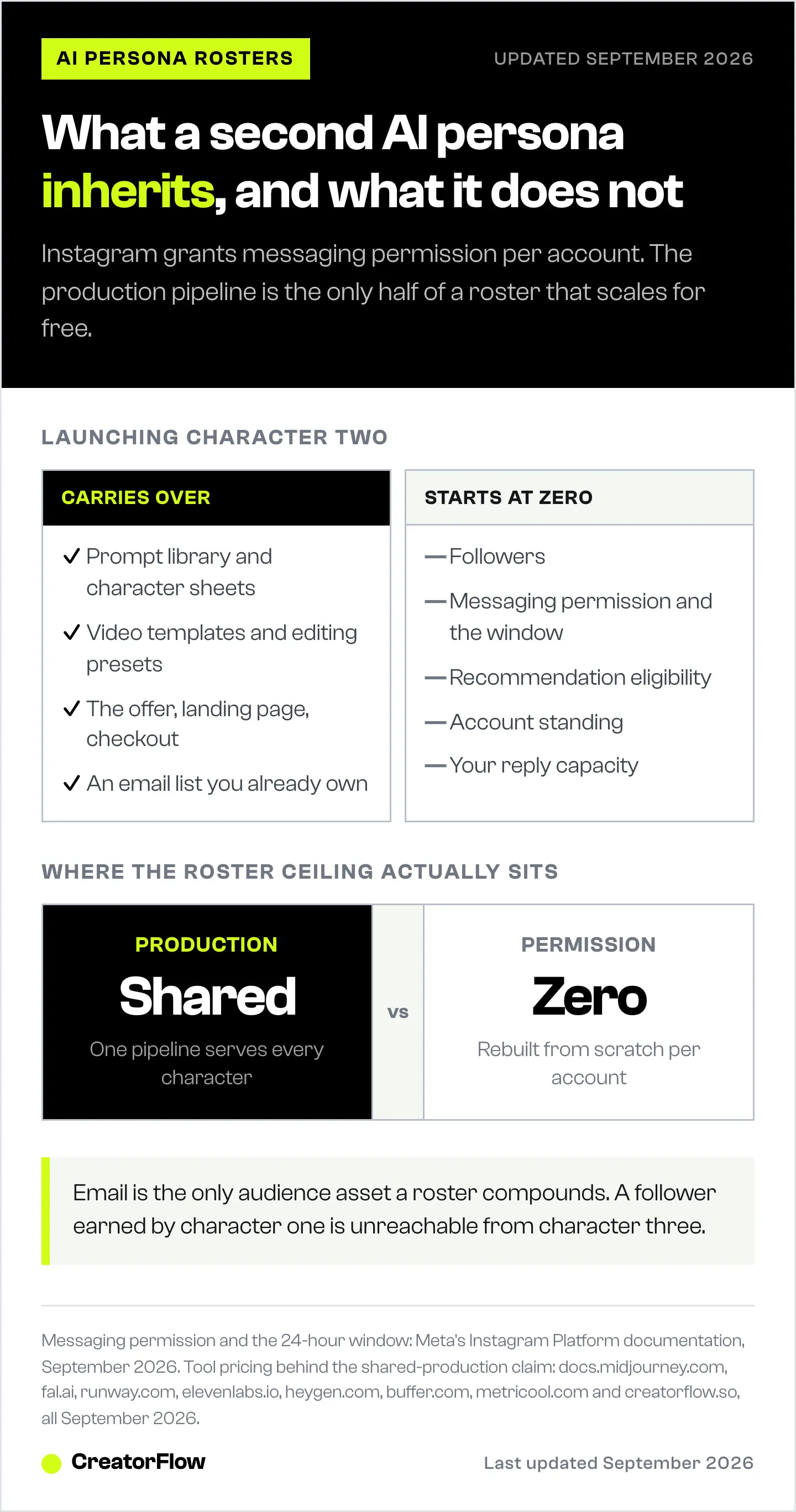
That is the sentence to reread before launching character two. Followers do not move. Comment history does not move. Recommendation eligibility and account standing do not move. The audience you spent four months earning is attached to one username.
| Asset | Moves to a second account |
|---|---|
| Prompt library and character sheet method | Yes |
| Video templates and editing presets | Yes |
| The offer, landing page, and checkout | Yes |
| An email list you collected and own | Yes |
| Followers | No |
| Messaging permission and the 24-hour window | No |
| Recommendation eligibility and account standing | No |
| Your reply capacity | No |
The practical consequence is that email is the only audience asset a roster genuinely compounds. A subscriber collected through character one is reachable when character three launches. A follower is not. Operators who run several personas well tend to push hard on collecting emails inside Instagram DMs for exactly this reason, because it is the one layer that survives a character retiring.
Meta’s published rate limits sit above all of this and apply per account as well. On the Instagram API with Instagram Login path the limits are 100 calls per second for text and links, 10 per second for audio and video, and 750 per hour for private replies to comments on posts and Reels (developers.facebook.com, September 2026). Automation tools pace sends at roughly 200 DMs an hour as a conservative behavioural convention, well under those ceilings. For a roster this matters less than people expect, because five small accounts rarely approach a limit built for one large one.
One Keyword, One Offer, One Flow Per Character
Give every account its own trigger word, its own destination, and its own flow. The reason is attribution rather than platform mechanics. Instagram will happily let two accounts run the same keyword, since they are separate profiles with separate audiences, but the moment both send traffic to one link you lose the ability to tell which character earns.
Keep the mapping visible in a single table you maintain by hand: account, persona, keyword, destination, and the metric you judge it on. When character four goes quiet, you want to see which of those five columns changed.
There is a second reason to keep flows separate. A persona’s DM copy is part of its voice. A fitness character and a finance character should not send the same three sentences, and readers notice faster in a DM than in a caption, because a DM reads as a personal message. Our guide to Instagram DM automation covers the trigger types and the setup order that apply to each account individually.
Instagram’s AI Label Applies Per Profile
Every account in a roster that features an AI-generated person needs the AI-generated profile label switched on separately. Instagram announced the label on August 31, 2026, replacing the earlier AI creator label, and attached a distribution consequence for the first time. Profiles that feature an AI-generated person without the label may see limits to their reach, and profiles Instagram detects become ineligible for recommendations (creators.instagram.com, August 2026).
Applying it costs nothing. Instagram says creators who add the label themselves will not see a change to their profile’s reach (creators.instagram.com, August 2026). Skipping it costs the Reels and Explore surfaces, which is the only distribution a new character has before it has followers. TechCrunch and Engadget both reported the recommendation consequence on the day of the announcement.
For a roster this changes the launch order rather than the strategy. Set the toggle before the first post, not after the account finds traction, because the surface at risk is the one that supplies the traction. The full ruling, including which accounts are exempt and how to appeal a restriction, is in our guide to Instagram’s AI-generated profile label.
Two other disclosure regimes sit on top of the toggle and neither is discharged by it. The FTC applies its Endorsement Guides to virtual endorsers on the same terms as human ones, with maximum civil penalties of $53,088 per violation (ftc.gov, 2025 adjustment, still current in 2026). Article 50 of the EU AI Act has applied since 2 August 2026 and requires deployers to disclose artificially generated content clearly and at first exposure (digital-strategy.ec.europa.eu, 2026). Both attach per post, and both attach to every account you run.
The Production Stack a Roster Shares
The shared half of a roster is where the economics actually work. Build these once and reuse them across every character:
- A character sheet per persona. Front, three-quarter and profile references on a plain background, plus a fixed description of build, hair, skin and wardrobe palette. This is what keeps a face consistent across months of posts.
- A prompt library keyed by shot type. Establishing shot, mirror selfie, product hold, walking clip, talking head. Swap the character reference, keep the prompt.
- Video templates with locked timing. Same cut rhythm, same caption position, same safe area. Only the subject changes.
- A caption and DM voice sheet per persona. Five sentences of the character’s speech pattern plus three things it never says. This is the artifact that stops voice drift at scale.
- One offer infrastructure. Landing pages, checkout, and email capture live outside Instagram and serve every character.
The build steps for a single persona, from face generation through Reels and voice, are covered in our guide to creating an AI influencer on Instagram. A roster is that process run in parallel with the first four items above extracted into a shared folder.
What Breaks First at Three Accounts
The comment layer. Not rendering, not scheduling, not the Instagram app’s five-account switching limit, which is a per-device convenience cap rather than a business one. Comments break first because they are the only part of the operation that cannot be templated in advance and cannot be deferred past the messaging window.
Three specific failures show up in order. Reply latency slips first, because a comment answered eleven hours later is outside the window where an automated DM can follow it. Voice drift comes second, when you write character three’s reply in character one’s cadence because you wrote forty of those this week. Third, and largest, the identity question arrives on every account at once. A share of every AI persona’s comments ask whether the account is a real person, and those comments are not buying signals, they are sorting work.
Automating the first response is what makes three accounts survivable. When someone comments a keyword or replies to a Story, the DM goes out immediately with the right link for that character, and you spend your reading time on the replies that need a human. Our breakdown of sorting an AI persona’s comments by intent splits the incoming volume into the three types worth different responses.
Run every persona from one place. CreatorFlow sends each character’s link the moment someone comments or replies, with separate flows and separate click data per account. Start free.
When Not to Add Another Character
Four conditions, and failing any one of them means the answer is no for now.
- Character one’s offer is not saturated. If link clicks and email signups are still rising month over month, the cheapest growth available is another post on the account that already has permission, not a new account with none.
- You cannot name a different buyer. Two personas selling the same thing to the same person compete with each other for the same recommendation slots. If you cannot write down who buys from character two and would not buy from character one, they are the same account with different hair.
- The label and the disclosure are not written. Launching an unlabeled persona account trades its Reels and Explore reach for a secret Instagram says it is detecting anyway.
- Comments on the current account are not answered inside 24 hours. Adding a second inbox to an inbox you are already behind on produces two neglected accounts rather than one working one.
The stop rule reads the same way from the other direction. Add a character when the existing account’s audience has stopped converting at the margin, when a distinct buyer exists that the current persona cannot credibly reach, and when the reply work on account one has been reduced to something a template plus fifteen minutes covers. Choosing what that second character sells is a separate decision, and our analysis of which AI influencer niches convert is the test to run before you generate anything.
Operating several personas also has nothing to do with running several client accounts, which is a different discipline with different tooling. If you manage Instagram profiles for other businesses rather than characters you own, the workflow in our guide to Instagram automation for agencies is the closer match.
FAQ
How many AI influencer accounts can one person run?
The limit is reply capacity rather than software. Most solo operators handle two or three persona accounts before comment and DM volume outruns them, because that work scales linearly with the number of characters while production does not. Instagram’s app allows five simultaneously logged-in accounts per device, but that is a switching convenience, not a business ceiling. Teams split the constraint by assigning characters to people.
Do I need a separate Instagram account for each AI persona?
Yes, if you want each one to have its own audience, its own trigger keywords, and its own attribution. Instagram grants messaging permission per account, so one profile cannot DM the audience of another. Running two personas from one profile also means one AI-generated profile label describing two characters, and one keyword namespace for two offers.
Can I use the same AI face across two Instagram accounts?
Technically yes, and it usually backfires. Two accounts showing the same person read as duplicate profiles to viewers who find both, and neither builds a distinct reason to follow. The reusable asset in a roster is the pipeline that produces a consistent face, not the face itself. Generate a new character sheet per account.
Does every AI persona account need the AI-generated profile label?
Every profile that features a person generated or substantially created with AI needs it, and the setting is per profile. Instagram limits the reach of unlabeled profiles it detects and removes them from recommendations, while labeled profiles see no reach change (creators.instagram.com, August 2026). Accounts that show no AI-generated person, such as faceless pages using B-roll and voiceover, are outside it.
How much does it cost to run five AI influencer accounts?
At published September 2026 rates, roughly $120 to $250 a month for a daily-posting roster of five. Most of that is fixed: Midjourney Standard at $30, Runway Standard at $15, ElevenLabs Starter at $6, and DM automation at $30 on CreatorFlow Growth, which covers five Instagram accounts. Scheduling is the line that scales per account, from about $5 to $25 each depending on the tool.
Can I automate DMs on several Instagram accounts at once?
Yes. Tools built on Meta’s official Instagram API connect each account separately and run its automations independently. CreatorFlow Pro covers two Instagram accounts at $15 a month and Growth covers five at $30, with DMs counted per workspace (creatorflow.so, September 2026). ManyChat prices by active contacts instead, from $17 a month for 250 contacts to $199 for 25,000, or $14 to $139 billed annually (manychat.com, September 2026).
Is running multiple AI influencer accounts against Instagram’s rules?
Owning several accounts is allowed, and Instagram’s own help pages describe adding multiple accounts to one device. What carries consequences is failing to disclose that a profile features an AI-generated person, which now costs reach and recommendation eligibility. Paid posts need FTC-compliant disclosure in the post itself on top of that, and EU viewers bring Article 50 obligations, regardless of how many accounts you run.
Instagram’s AI-generated profile label verified from Instagram’s creators blog announcement and reporting by TechCrunch and Engadget, August 31 2026. Meta rate limits verified from Meta’s Graph API rate-limiting documentation, September 2026. Tool pricing verified from the vendors’ own pricing pages in September 2026; Kling and Higgsfield publish no machine-readable price and are excluded for that reason. Blur Studios workflow details from TIME, November 18 2025. FTC civil penalty figure from the FTC’s 2025 inflation adjustment, unchanged for 2026. Prices and platform policies change; verify before acting on them.