
An AI DM agent can qualify a course lead, answer questions about the syllabus, and capture an email inside Instagram’s messaging window. It cannot own the enrollment. Meta gives an app 24 hours to reply after a user’s last message (developers.facebook.com, September 2026), and a course offer is usually decided on a longer runway than that. The agent’s measurable job is what it collects before the window shuts.
Search “AI agent Instagram DM course creator” and every result on the first two pages promises the same thing: comment to enrolled student, on autopilot, while you sleep. Vendor use-case pages, YouTube builds, n8n workflow templates. None of them mention the one Meta rule that decides how much of that sentence is true.
This guide covers what the 24-hour window does to a course sale, where the “reply in five minutes” statistic in every one of those pages actually comes from, what an AI agent is genuinely good at inside the window, and how to build an enrollment flow that survives the moment the thread closes.
Key Takeaways
- The window is 24 hours, and it is measured from the buyer’s last message. Meta’s Instagram documentation states an app has 24 hours to respond to a message from an Instagram user. Every reply the agent sends restarts nothing; only a new message from the buyer does.
- A webinar launch breaks the window by design. Register someone on Monday for a Thursday session and the thread is closed by Tuesday, two days before the offer is made. No agent quality fixes an arithmetic problem.
- The “five minutes” statistic is three studies welded together. The 100x and 21x figures come from a 2007 MIT Sloan and InsideSales paper that says outright it did not address close ratios. The separate 400% figure comes from a 2013 vendor white paper. All of them measured phone calls to web-form leads.
- An AI agent’s real strength is qualification, not closing. Reading a messy free-text reply, sorting a beginner from a returning student, and routing each to a different next step is work a keyword trigger cannot do.
- The email address is the only asset in the DM that outlives the window. It is the one thing you keep when the thread closes, the algorithm shifts, or the account changes hands.
- Judge an agent on capture rate, not on conversation quality. The metric that predicts enrollments is what percentage of DM conversations end with an email address, measured before the window expires.
Can an AI DM Agent Enroll Students on Autopilot?
An AI DM agent can carry a course conversation from a comment to a qualified lead with an email address attached, automatically and at any hour. It cannot carry that person to a completed enrollment on its own, because Instagram’s messaging window closes 24 hours after the buyer’s last message and most course decisions are not made in a single sitting. The agent starts the sale. Something with a longer memory finishes it.
Here is the split, which is the part the vendor pages leave out:
| Job | Finishes inside 24 hours? | What it needs |
|---|---|---|
| Answer “how much is it?” | Yes | Agent replies while the window is open |
| Sort beginner from advanced | Yes | Free-text reading, one or two questions |
| Deliver a free lesson or PDF | Yes | Link plus a capture step |
| Collect the email address | Yes | An email gate before the link |
| Send a webinar reminder 3 days later | No | Email or SMS, not the DM thread |
| Follow up after a cart opens | No | Email sequence |
| Re-engage a lead who went quiet for a week | No | Email, new content, or paid retargeting |
Four of those seven jobs live outside the DM. That ratio is the reason a course funnel built entirely inside an AI agent stalls, and it holds regardless of which tool runs the agent.
What Instagram’s 24-Hour Window Does to a Course Sale
Meta’s documentation for the Instagram API with Instagram Login is direct about it: an app has 24 hours to respond to any message an Instagram user sends (developers.facebook.com, September 2026). The clock starts on the buyer’s message, not on yours. Sending three more automated messages does not extend anything.
There is one documented exception, and the wording of it matters. Meta’s Instagram Platform overview states that the Human Agent feature lets a human agent respond using the human_agent tag within seven days of a user’s message, and names the allowed usage as cases where the issue cannot be resolved inside the standard window, giving the example of a business being closed for the weekend (developers.facebook.com, September 2026). The extension exists for a person typing a reply. It is not a licence to run an automated sequence for a week.
One more window is worth knowing, because it is often confused with the first. A private reply to a comment can be sent within seven days of that comment (developers.facebook.com, September 2026), and only one message is allowed. Once it lands and the person answers, you are back on the 24-hour clock.
The practical shape of this is covered in more depth in our explainer on Instagram’s 24-hour reply window, including what the Error 10 response means when a tool tries to write into a closed thread.
The Webinar Gap: Why the Thread Closes Before the Offer
The most common course launch shape on Instagram runs a Reel, collects comments, DMs a webinar registration link, and makes the offer live on the webinar. Put dates on that and the problem becomes arithmetic rather than opinion.
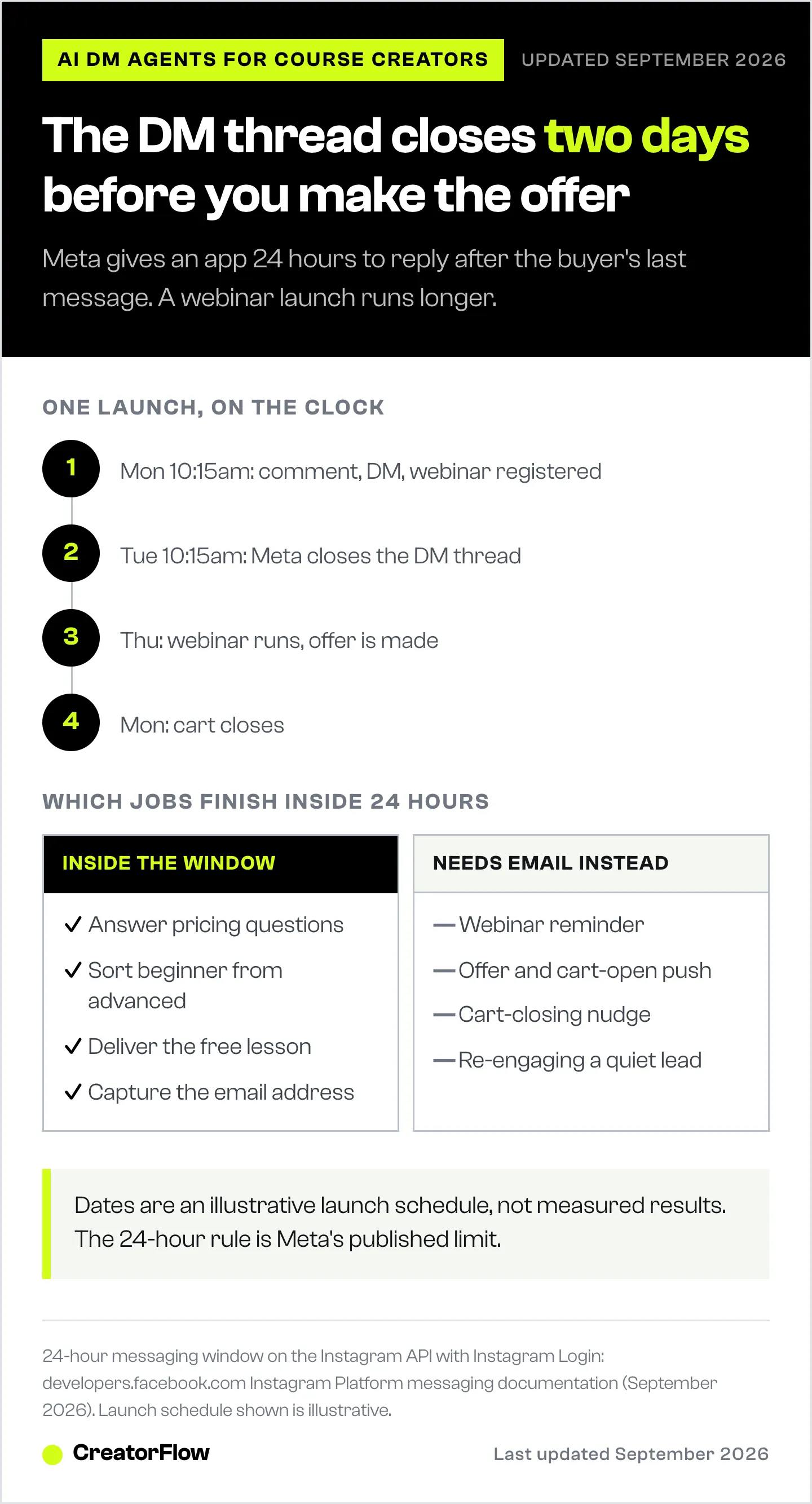
Someone comments on Monday morning. The agent replies within seconds, has a short exchange, and registers them for Thursday’s session. Their last message lands Monday at 10:15am. The window closes Tuesday at 10:15am. The webinar is Thursday. The offer is Thursday. The cart closes the following Monday.
By the time anything worth buying is on the table, the DM thread has been closed for two days. A reminder cannot be sent through it. A cart-closing nudge cannot be sent through it. The entire back half of the launch, which is where enrollments are actually decided, happens in a channel the agent has no access to.
This is not a flaw in any particular product. It is what happens when a 24-hour channel is asked to carry a seven-day decision. The fix is not a better agent. The fix is making sure the agent hands off before the clock runs out.
Where the “Reply in Five Minutes” Number Actually Comes From
Nearly every page selling AI DM agents cites a version of the same statistic: reply within five minutes and conversions rise by 400%, or 100 times, or 21 times, depending on the page. Those numbers come from three separate papers with three different clocks, and not one of them measured a sale.
The 100 times and 21 times figures come from a 2007 study by Dr. James Oldroyd, then a faculty fellow at MIT’s Sloan School of Management, using data supplied by InsideSales.com across roughly 15,000 leads and 100,000 call attempts at six companies. It found the odds of contacting a lead called at five minutes rather than thirty dropped by 100 times, and the odds of qualifying one dropped by 21 times. The paper states its own boundary in a single line: this study did not address close ratios.
The 400% figure comes from somewhere else. It appears in a 2013 Velocify white paper built on 3.5 million leads generated in the first half of 2012, which reported that calling within one minute raised likelihood of conversion by nearly 400%.
The 2011 Harvard Business Review piece people cite alongside them, by Oldroyd, McElheran and Elkington, audited 2,241 US companies and found firms responding within an hour were about seven times more likely to qualify a lead. It defined qualifying as having a meaningful conversation with a key decision maker, which is still a conversation rather than a purchase.
Three things hold across all of them. Every lead was a web form submission answered by a human picking up a telephone, so the direction of contact is the reverse of a DM, where the buyer messages you first. Every study was funded or supplied by a vendor selling response-speed software, including the HBR piece, whose third author was InsideSales’ chief executive. And the most recent of the three runs on data from 2012.
Speed still matters, and instant replies genuinely beat replies four hours later. The honest version of the claim is that fast replies get you more conversations with qualified people, which is exactly what an AI agent is good at. Stretching it into a promise about revenue is where launch plans start being built on the wrong number. Our piece on what a course launch DM funnel realistically converts at has the conversion figures that do apply at 5K to 50K followers.
What an AI DM Agent Is Genuinely Good At
Strip out the autopilot claim and a capable agent still earns its cost, because it does one thing a keyword trigger structurally cannot: it reads what the person actually wrote.
A keyword flow fires when someone types the exact word you registered. Everything else falls through. In a course audience, the replies that matter are rarely the keyword. They are “is this ok if I’ve never coded before”, “do I get the recordings”, “is there a payment plan”, and “what’s the time commitment each week”. Those are qualification signals in free text, and an agent can read them, answer them, and sort the person into the right next step in one exchange.
That sorting is the highest-value thing happening in the DM. A beginner and a returning student who both comment the same word want different pages, different lead magnets, and different email sequences. An agent can tell them apart before the window closes. A keyword cannot.
The same applies to the questions that come up right before a purchase decision. Handling those well in the thread is a real skill, and we cover the specific replies that work for price objections inside a DM separately.
The One Thing in the DM That Outlives the Window
Everything an agent produces inside those 24 hours evaporates when the thread closes, with a single exception. The email address stays.
That is the asset. Not the conversation, not the tags, not the qualification score. Those are useful while the window is open and inert after it shuts. An email address is a channel you own that keeps working on day three, day nine, and day thirty, which is where a course purchase is actually decided.
Which reframes what to build. The agent’s job is not to talk someone into a course. Its job is to get an email address attached to a qualified person before the clock expires, and to know enough about that person to put them in the right sequence. Everything after that is email’s job.
Practically, that means putting the capture step before the link rather than after it. An email gate asks for the address in exchange for the resource, inside the DM, while the person is still engaged and the window is still open. CreatorFlow includes this on Pro at $15 a month, along with CSV export so the list moves into whichever email platform you already run. The mechanics of doing this well are covered in our guide to collecting emails inside Instagram DMs.
Building a Window-Aware Enrollment Flow
The design principle is simple to state: finish the capture inside 24 hours, then get out of the DM.
- Trigger on the comment. The Reel or post carries a keyword. The comment opens the thread and starts the clock.
- Qualify in one or two questions, not six. Every question you ask burns clock and drops people. Ask only what changes which sequence they land in.
- Gate the resource on the email. The free lesson, the syllabus PDF, the webinar seat. The address comes before the link, not after.
- Confirm and stop. Send the link, confirm the registration, and end the DM sequence deliberately rather than letting it trail off.
- Hand off to email the same day. The reminder, the runway content, the offer and the cart-close messages all ship from email, which has no window.
- Leave the thread open for a real reply. If the person writes back with a question, the window reopens and a human or an agent can answer. Treat that as a bonus, not as the plan.
Steps one through four should complete in a single sitting. If your flow needs the buyer to come back tomorrow for the next automated message, it is already outside what the platform allows.
AI Agent or Keyword Automation for a Course Launch
Both run through Meta’s official API, so this is a question about fit rather than safety.
Keyword automation is predictable. You write the message, it sends that message, and you know exactly what every person received. For a lead magnet delivery or a webinar registration link, that predictability is the feature. It is also cheaper and faster to set up, and it fails in obvious ways you can see and fix.
An AI agent handles the free-text middle. When your audience asks varied questions before they will hand over an email, and when sorting them correctly changes which sequence they enter, the agent earns its place. It costs more, and it needs review time, because a generated reply about your refund policy is a claim you are making to a buyer.
On current pricing: CreatorFlow runs $15 a month flat for Pro with the follow gate, email gate, CSV export and geographic analytics. ManyChat covers Instagram, Facebook, WhatsApp, SMS, TikTok, Telegram and email, priced by active contacts from $17 a month for 250 contacts up to $199 for 25,000, or $14 to $139 a month billed annually (manychat.com/pricing, July 2026). InstantDM lists Legend Pro at $12 a month, or $9.99 a month billed annually, and Trendsetter at $29.99 a month, or $24.99 billed annually, and states it is trusted by 30,000+ creators and brands (instantdm.com/pricing, September 2026).
For most course launches the useful combination is keyword automation carrying the delivery path, with an agent handling the replies that do not match a keyword. Our walkthrough of Instagram DM automation for course creators covers the six setups that path is usually built from, and our comparison of AI agents handling Instagram DMs sets out what each approach is built for.
Whichever you pick, measure it on one number: the percentage of DM conversations that end with an email address before the window closes. Conversation quality is pleasant to read. Capture rate is what shows up in enrollments.
FAQ
Can an AI DM agent enroll students without me?
It can take someone from a comment to a qualified lead with an email address attached, without you. It cannot complete an enrollment that gets decided after Instagram’s 24-hour messaging window closes, which covers most course offers made on a launch runway. Plan for the agent to start the sale and for email to finish it.
What happens when the 24-hour window closes mid-conversation?
The thread stops accepting automated messages. Meta’s API returns an error rather than delivering, and nothing you send lands. The window reopens only if the person messages you first. This is why the email capture has to happen in the first exchange rather than being saved for a later step.
Do I need an AI agent, or will keyword automation sell my course?
Keyword automation is enough when the path is linear: comment, get the link, register. An agent is worth it when people ask varied questions before they will give you an email, and when the answers change which sequence they should enter. Most launches use keyword automation for delivery and an agent for the free-text replies around it.
Can an AI agent handle price objections in a DM?
It can answer them while the window is open, and the quality depends entirely on what it has been given about your pricing, payment plans and refund terms. Treat generated pricing answers as claims you are making to a buyer and review them before going live. Scripted replies are the safer default for anything involving money.
Is using an AI DM agent against Instagram’s rules?
Not when the tool connects through Meta’s official Instagram API with OAuth rather than logging into your account with your password. That path is sanctioned, respects the messaging window, and does not require password sharing. Tools that ask for your Instagram login are the category to avoid.
How do I follow up after the DM window closes?
Through a channel that does not have one. Email is the usual answer, which is why the address is the thing worth capturing. New content that prompts the person to message you again also reopens the window, as does paid retargeting to an audience you built from the list.
What should the agent collect before the window shuts?
An email address, first. Then the one or two qualification details that determine which email sequence the person enters, such as experience level or which outcome they are after. Anything beyond that costs you clock and completion rate for information you can gather later by email.
Messaging window, human agent tag and private reply limits verified from Meta’s Instagram Platform documentation (developers.facebook.com, September 2026). Lead response figures verified against the source papers: the 2007 MIT Sloan and InsideSales.com Lead Response Management study by Dr. James Oldroyd, the 2011 Harvard Business Review article by Oldroyd, McElheran and Elkington, and the 2013 Velocify white paper that is the origin of the 400% figure. Competitor pricing verified at manychat.com/pricing (July 2026) and instantdm.com/pricing (September 2026), where prices default to the annual rate. Individual results vary.