
The reason most course creators feel disappointed by their first Instagram DM funnel isn’t the tool, the keyword, or the copy. It’s the benchmark they walked in with. Public case studies in this category almost always come from creators with five-to-ten years of audience compounding behind them, and the conversion rates published from those campaigns are not reproducible at smaller scale because they aren’t measuring the same thing.
The model still works. Comment-to-DM consistently outperforms landing-page links for course launches across audience sizes. The lift is just smaller and more grounded than the headline figures suggest, and planning around the wrong number is what turns a perfectly good launch into a perceived failure.
Here are the conversion benchmarks we actually see across course-creator accounts in the 5K-50K follower range, the design choices that move those numbers, and the assumptions in big-creator case studies that quietly fall apart at smaller scale.
Key Takeaways
- The published conversion rates from celebrity DM funnel campaigns measure already-warm commenters, not cold reach. They are not comparable to landing-page benchmarks, even when presented side by side.
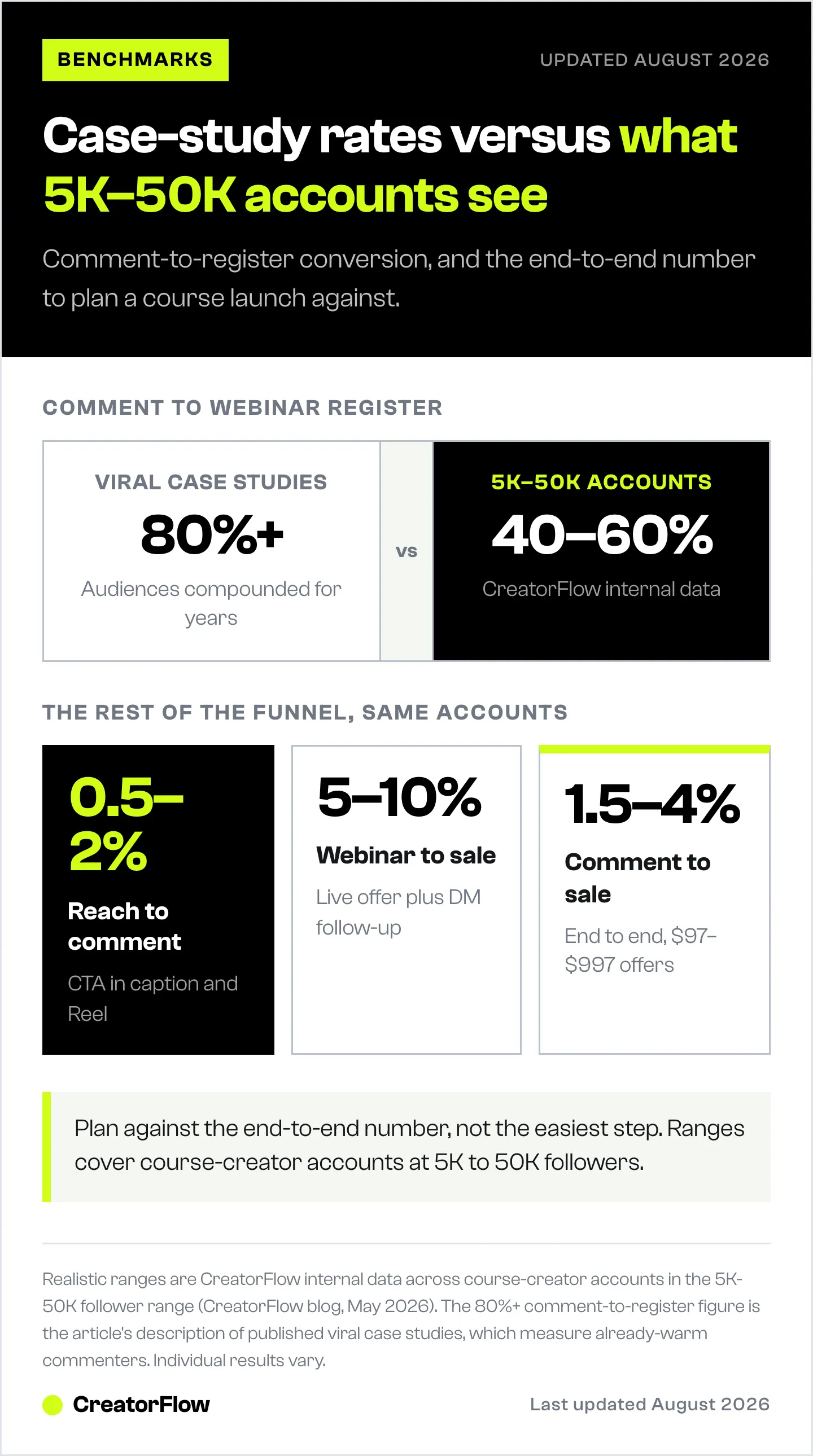
- Realistic comment-to-register conversion at 5K-50K followers sits between 40% and 60%, not the 80%+ figures circulated in viral case studies.
- End-to-end comment-to-sale conversion lands between 1.5% and 4% for course offers priced $97-$997 with a competent funnel behind them.
- The single highest-ROI play in this category is pinned-comment triggers during Instagram Live. Live commenters are deep in the funnel already and capturing them costs nothing extra.
- Tool choice barely matters as long as it runs through Meta’s Graph API. Pricing model matters more, because per-contact pricing spikes during the launch window when revenue hasn’t landed yet.
- Volume of small campaigns beats one big launch. A dozen modest comment-to-DM Reels across a year consistently outperforms two tentpole launches absorbing the same effort.

What a Course Launch DM Funnel Converts At
A course launch DM funnel turns a comment on a launch Reel into an enrollment: the comment triggers an automatic DM, the DM captures an email, the email registers them for a webinar, reminder DMs pull them to the session, and a follow-up carries the offer. On accounts between 5,000 and 50,000 followers, that chain converts 1.5% to 4% of comments into sales for offers priced $97 to $997.
Why the Big-Creator Numbers Don’t Transfer
Conversion in a comment-to-DM funnel is a function of audience temperature, not automation quality. A creator whose audience has been compounding for years through a podcast, an email list, and a back catalog of products has commenters who are already 5-10x more qualified than the same number of comments on a smaller account. Before any automation runs, the warmer creator is starting at a different point on the funnel. The real work sits upstream: warming up your audience before you launch raises everyone’s starting temperature.
That gap then compounds at every step. Warm commenters click links inside DMs at higher rates. They submit email gates without abandoning. They show up to webinars they registered for. They buy at the live offer. Each step is a small multiplier, and four small multipliers stacked end-to-end produce the wide gap between published benchmarks and what most creators see in practice.
The benchmark number that gets circulated is almost always the easiest step of the funnel measured against the hardest step of a different funnel. Comparing comment-to-register conversion to cold landing-page conversion is comparing the warmest possible audience (people who already typed a comment) to traffic that just clicked a link. The numbers aren’t wrong, they just aren’t measuring the same population. For documented results across account sizes, see these comment-to-DM automation case studies.
Realistic Benchmarks at 5K-50K Followers
Across the course-creator accounts we’ve measured, this is what a comment-to-DM launch funnel actually produces with a competent setup:
| Funnel Stage | Mechanism | Realistic Conversion |
|---|---|---|
| Reel impression to comment | CTA in caption + spoken in Reel | 0.5-2% of reach |
| Comment to DM delivery | Auto-reply via Graph API | 80-95% (rate-limit dependent) |
| DM to email gate complete | Single-field opt-in | 40-60% |
| Email gate to webinar register | Pre-filled link | 70-85% |
| Webinar attend rate | 3-4 reminder DMs + email | 30-50% of registrants |
| Webinar to sale | Live offer + 24-48hr DM follow-up | 5-10% |
| End-to-end comment to sale | All steps multiplied | 1.5-4% |
The math is more interesting than it sounds. A 1,000-comment Reel converting at 2% end-to-end produces 20 sales. At a $497 price point, that’s around $10K from a single piece of content with the automated funnel sitting behind it. Run that play three or four times during a launch window and the totals get respectable without needing six-figure case study numbers to do it.
The number to plan against for a course launch in this audience range is 1.5-4% end-to-end comment-to-sale, not the celebrity-case-study figures.
What Actually Moves These Numbers
The mechanics underneath these numbers, including where a link is tappable and where it is not, are laid out in our guide to selling an online course on Instagram.
Four design choices have the largest measurable impact on funnel performance. The other variables matter, but in the noise rather than the signal.
Email gate, no exceptions
The strongest temptation in this funnel is to remove the email step to “boost conversion.” Skipping it does increase short-term DM-to-link clicks, and consistently produces worse end-to-end results. The reason is Instagram’s 24-hour messaging window: once it closes, you have no follow-up surface unless you captured an email. Every reproducible result in this category routes commenters into an email list before asking for a sale, because the email is the only asset that survives the platform’s constraints. We covered the messaging window mechanics in the Instagram DM automation complete guide if that’s new.
A real, time-limited bonus on launch posts
Pairing the comment trigger with a specific bonus that expires beats generic “comment for info” CTAs by roughly 1.5-2x in our data. The mechanism is straightforward: an early-bird code that disappears Friday is the math doing the persuading, not the parasocial relationship. This is the play that scales most cleanly from large creators to small ones, because the bonus structure does the heavy lifting regardless of audience temperature.
Live capture as a permanent fixture
Pinned-comment triggers during Instagram Live are the cheapest, highest-ROI play in this category. Live commenters are already several steps into your funnel before the automation touches them, and the cost of capturing them is zero incremental effort. A 200-viewer Live with a 50% capture rate adds 100 emails in 60 minutes, and the play works identically at any follower count. Most course creators we’ve worked with treat Live capture as the launch warmup that consistently fills the registration list before any tentpole post runs. The mechanics are walked through in Instagram DM waitlist pre-launch guide.
High frequency, low stakes
The pattern that produces real revenue across a launch year is volume of small bets, not one big one. Twelve modest comment-to-DM campaigns running across twelve months consistently outperform two large ones absorbing the same total effort, because each campaign is a sample that informs the next, and the algorithm rewards consistent in-app engagement signals over single bursts. A quarterly cadence built on this principle is detailed in course creator Instagram launch funnel guide.
What Doesn’t Transfer From Big-Creator Campaigns
A few things in viral case studies look replicable and consistently aren’t:
Trigger keyword virality. A short branded keyword works on a large account because the volume of comments creates social proof in the comment section. On a 5K-follower account, the keyword sits in five comments and reads as a request, not a movement. Use the keyword anyway, but don’t expect it to do persuasion work.
Multi-product launch sequencing. A creator with an existing course catalog can run a comment-to-DM funnel for a new product that benefits from prior products’ audiences. A creator with one offer cannot. The compounding effect is doing real work in case studies and doesn’t exist for first-time launches.
Live-audience benchmarks at small scale. Conversion rates measured during a Live with thousands of viewers are not reliable predictors at 80 viewers. Small samples produce noisy results, and a Live with 80 viewers should be planned as a list-building exercise, not a sales channel.
The agency multiplier. Big-creator case studies are usually the result of a specialized agency running 10+ campaigns over many months. That work is real and worth the budget if you have it, but the conversion rates published from those campaigns include the agency’s iteration cycle. A creator running their own first launch is at iteration 1 of N.
Tool Selection: Less Important Than You Think
A reasonable amount of post-mortem ink gets spent on which tool a particular case study used. In practice, tool choice is the least important variable in this category. Any platform that connects through Meta’s official Instagram Graph API runs the same comment trigger, email gate, link delivery, and follow-up logic. The flows are functionally identical.
The choice that does matter more than the brand is whether the flow captures an email before Meta’s messaging window closes, which is the constraint behind what an AI DM agent can actually enroll. After that, pricing model matters. Tools that charge by contact count cost more as you add contacts during a launch, because a launch is the exact moment you’re adding thousands of contacts at once. CreatorFlow holds at $15/month flat regardless of contacts. Other flat-rate options exist; we compare them in best ManyChat alternative for Instagram creators. Per-contact pricing tools work fine for steady-state automation but tend to spike right when your launch revenue hasn’t landed yet, which is the worst possible cash-flow timing for a small business.
The other thing worth caring about is whether the tool runs on Meta’s official Graph API. Browser-extension or login-scraping tools occasionally promise the same flow at lower prices. They are also the category that gets accounts banned. Stick to Graph API tools, which is most of the established names in the space.
How to Plan a Launch Around These Numbers
The practical version of all of this comes down to four planning decisions:
- Set the target on end-to-end comment-to-sale conversion, not on any single step. 2% is a reasonable working number for a $97-$997 offer with a competent funnel. Optimize the whole funnel, not the one step that’s easy to measure. If you’re assembling that funnel from scratch, our guide to the end-to-end Instagram sales funnel covers each stage.
- Size the launch around comment volume, not follower count. A 50K account with 200 comments per launch Reel is in a different funnel than a 50K account with 2,000 comments per launch Reel. Your past comment volume is a better predictor than your follower number.
- Build the email gate into every funnel from day one. Not as an upsell. As the primary conversion event. The webinar, the sale, and the entire next launch all depend on what’s in the list. The mechanics for how to collect emails from Instagram DMs automatically cover the trigger-to-gate sequence in detail.
- Run more campaigns, not bigger ones. Treat each Reel as a controlled experiment. Iterate on hooks, bonuses, and trigger keywords across the year rather than betting everything on one launch week.
If you want a quarter-by-quarter version of this plan with specific Reel structures, bonus mechanics, and follow-up sequences, the course creator Instagram launch funnel guide walks through the version we recommend for accounts in this size range.
FAQ
What conversion rate should I expect from a comment-to-DM course launch?
For a course priced $97-$997 launched to a warm-but-not-celebrity audience in the 5K-50K follower range, plan for 1.5-4% end-to-end comment-to-sale conversion. Comment-to-register sits at 40-60%, which is below the 80%+ figures in viral case studies because those numbers describe a different population.
Why don’t viral case study conversion rates apply to my launch?
Because they’re measuring already-warm commenters from a creator with years of audience compounding behind them. A “comment to register” conversion rate measures a population that’s already opted into the funnel by typing a comment, while a “landing page conversion rate” measures cold traffic. The two numbers are not comparable, even when published side by side.
What’s the highest-ROI play to copy?
Pinned-comment triggers during Instagram Live. Live commenters are already deep in your funnel, and capturing them costs zero incremental effort. A 200-viewer Live with a 50% capture rate adds 100 emails in 60 minutes, and the mechanic works identically at any follower count.
Should I skip the email gate to boost conversion?
No. Removing the email step does increase short-term DM-to-link clicks and consistently produces worse end-to-end results. Instagram’s 24-hour messaging window closes whether you have an email or not, and once it does, the email is the only asset that lets you follow up. Every reproducible result in this category captures an email before asking for a sale.
Do I need a specific tool to run this funnel?
No. Any tool that connects through Meta’s official Instagram Graph API runs the same flow. CreatorFlow, LinkDM, and other established Graph API tools all support comment triggers, email gates, link delivery, and follow-up sequences. Pick on pricing model and contact volume, not on which one a case study used. Avoid browser-extension tools that log into your account, which are the category that gets accounts banned.
Is comment-to-DM automation against Instagram’s rules?
No, when it runs through Meta’s official Graph API with an approved tool. Most tools pace sends at around 200 DMs/hour as a behavioral safety cap, and Meta enforces a 24-hour messaging window for new conversations. Tools operating inside these limits with OAuth authentication do not violate platform rules.
How many launches per year should I run?
Volume of small campaigns beats one big launch. A dozen modest comment-to-DM Reels across twelve months consistently outperforms two tentpole launches absorbing the same total effort. Each campaign is a sample that informs the next, and the algorithm rewards consistent engagement signals over single bursts.
Conversion benchmarks reflect CreatorFlow internal data across course-creator accounts in the 5K-50K follower range. Instagram API limits verified from developers.facebook.com (May 2026). Individual results vary with audience size, niche, and offer.


