

Warming up your audience means building trust and demand in the 30 to 90 days before you open your offer, so people are ready to buy on day one instead of asking “who are you?” You move followers from cold, where they barely know you, to hot, where they are asking when you open. It happens through consistent visibility, a free offer, a nurture sequence, and a waitlist.
Here is the pattern that sinks most launches: the creator goes quiet, builds the offer, then posts “it’s live, buy now” to an audience that forgot they existed. The offer might be great. Nobody buys, because the trust was never built. Purchasing decisions get made before doors open, not on launch day.
This guide breaks the warm-up into four phases you can run before any launch, whether you are selling a course, a coaching package, a digital product, or a service. You will learn how to read your audience temperature, how far ahead to start, and how to automate the whole thing with Instagram DMs so the work scales without you living in your inbox.
Key Takeaways
- Launches are won before doors open: most buying decisions happen during the warm-up, so a cold audience on launch day means a flat launch no matter how good the offer is.
- Read your audience temperature: cold (posting into the void), lukewarm (inconsistent sales), warm (people reference your content), and hot (people ask when you open). Warm and hot audiences are the ones that buy.
- Give yourself 30 to 90 days: reverse-engineer from your launch date. A cold audience needs 60 to 90 days; a warm audience can launch in 30.
- Four phases: get discovered, capture leads with a free offer, nurture people onto a waitlist, then prime the sale with proof before you open.
- All roads lead to the waitlist: a DM waitlist is your hottest segment and converts far better than a general follower count. Build it during the warm-up, not launch week.
- Automation carries the load: comment-to-DM keywords, email capture inside the DM, and CSV export to your email tool let one person run a warm-up that used to need a team.
What Does It Mean to Warm Up Your Audience?
Warming up your audience is the pre-launch work of turning passive followers into people who trust you enough to buy. It covers everything between “a stranger clicks follow” and “that person joins your waitlist,” which is where trust is actually built. The goal is simple: by the time you open your offer, a chunk of your audience already wants it and is waiting for the link.
Think of it as raising temperature. A cold follower needs proof you exist and can help. A hot lead needs an invitation and a reason to buy now. The warm-up is the sequence of touches that moves someone up that scale.
This matters more in 2026 than it used to. Buyers are more guarded. Many have been burned by an offer that did not deliver, the market is saturated with people selling the same thing, and AI has made surface-level information free. The old marketing “Rule of 7,” the idea that someone needs roughly seven exposures before they act, started as a 1930s rule of thumb rather than hard science, but the point holds: people rarely buy on first contact. Trust is the bottleneck, and the warm-up is how you build it on purpose.
Why Most Launches Flop: You’re Selling to a Cold Audience
Most creators start launching the day the offer goes live. They post “doors are open,” and the audience reacts with “wait, what is this?” The trust step got skipped. That is not an offer problem or a pricing problem. It is a warmth problem.
A launch has two jobs, and they run in a specific order. First you build demand, then you capture it. Skip the first job and there is nothing to capture. The creators who sell out are not the ones with the biggest followings. They are the ones whose audience already knew the offer was coming and already decided they were in.
You do not need a huge audience or an ad budget to make this work. You need a warm audience and a plan. A few hundred genuinely warm people out-convert tens of thousands of cold followers, because warm traffic converts several times higher than cold traffic across almost every channel (getwaitlist.com, June 2025). The rest of this guide is how you build that warm group before you ever ask for the sale.
The Four Audience Temperatures (Cold to Hot)
Before you warm anyone up, you need to know how cold they are. Here is how to read where your audience sits and what each temperature needs from you.
| Temperature | What it looks like | What they need next |
|---|---|---|
| Cold | You feel like you are posting into the void. Rare, random inquiries. People are not sure what you do. | Discovery and a clear reason to pay attention |
| Lukewarm | Some DMs come in. Sales are up and down. A little momentum, but nothing consistent. | Consistent value and a free offer to opt into |
| Warm | People reference your content. Steady interest. You are becoming known for one thing. | Nurturing, proof, and a waitlist to join |
| Hot | People ask when you are opening. Your waitlist is growing. Your community is rallying around you. | An invitation and a reason to buy now |
Most audiences are a mix. You will always have a few hot leads who would buy today if you invited them, alongside a large cold group that forgot they followed you. That is normal, and it is why the warm-up runs on multiple tracks at once. You keep pulling new strangers in at the top while nurturing warm people toward the waitlist at the bottom.
The practical read: if your audience is mostly cold and lukewarm, you have more warming to do and need a longer runway. If people already reference your content and ask about your work, you are close to launch-ready.
How Long Before a Launch Should You Warm Up?
The warm-up usually runs 30 to 90 days before you open doors. The exact number depends on how cold your audience is, not on a fixed formula. Reverse-engineer it: pick the launch date first, then count backward to set the start of your warm-up.
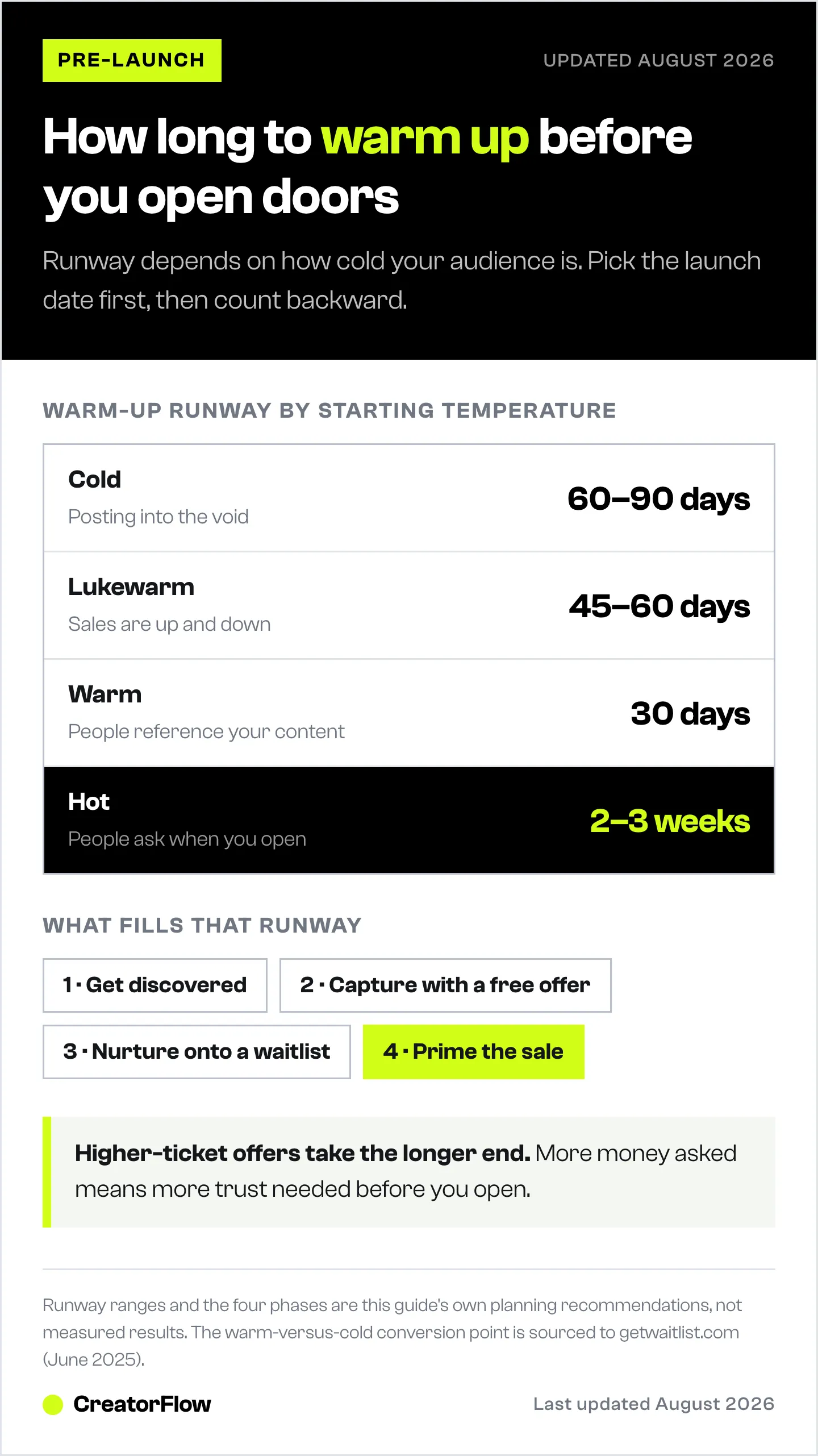
| Starting temperature | Warm-up runway | Why |
|---|---|---|
| Cold | 60 to 90 days | You are building recognition from close to zero |
| Lukewarm | 45 to 60 days | Some trust exists, but sales are still inconsistent |
| Warm | 30 days | People already know you; you are converting interest to commitment |
| Hot | 2 to 3 weeks | Mostly waitlist-building and priming the sale |
Lower-ticket offers can sometimes warm up faster because the decision is smaller, but they often need more volume of people to hit the same revenue, which pushes more effort to the top of the funnel. Higher-ticket offers need more trust, so give them the longer runway.
Whatever the length, the sequence is the same: warm-up period, then the waitlist opens, then public launch. The four phases below fill that runway.
Phase 1: Get Discovered (Win New Attention)
Before you can warm anyone up, they need to know you exist. Phase 1 is top-of-funnel: showing up where your audience already is and providing value around the one problem you solve. You are trying to reach strangers, not just the people who already follow you.
The channels that reliably surface new people:
- Collaborations. Guest on podcasts, swap newsletters, go live with peers, co-create posts. This borrows a warm audience instead of building one from scratch, which is the fastest way to get in front of the right strangers.
- Trial Reels. Reels set to reach only non-followers act like a free ad at the very top of the funnel. Short, hook-forward clips do the job here, even if they look different from your usual feed.
- Feed carousels and Reels. Content that lands on the Explore page reaches beyond your followers. Carousels that break down the problem your offer solves tend to travel.
- Referrals and word of mouth. Your existing warm audience and peers are your best distribution. Make it easy for them to point people to you.
- Search and AI answers. Being the person who clearly explains your topic gets you surfaced in Google and in AI tools when someone asks how to solve the problem you solve.
Every one of these should point to a single next step: a keyword people can comment to start a conversation. That is the bridge from Phase 1 to Phase 2. Attention you do not capture evaporates. Pair each discovery play with a clear call to action, and use comment CTAs that actually get responses so new viewers know exactly what to do.
Phase 2: Capture Leads With a Free Offer
A lead magnet is the bridge between a new follower and an eventual buyer. It should solve one small problem, the thing someone needs before they are ready for your main offer. A checklist, a short workshop, a template, a mini-guide. One problem, one clean win.
Here is the capture flow that runs entirely inside Instagram:
- You post a Reel or carousel with a CTA: “Comment WORKSHOP and I’ll send it to you.”
- Someone comments the keyword. Automation sends them an instant DM with the details.
- They confirm they want it. You ask for their email right there in the DM.
- They reply with the email. It is saved to your contact list, ready to move into your email platform.
The detail that matters: collecting the email inside the DM converts better than sending people to a separate landing page. Every extra step, leaving the app, loading a page, filling a form, loses a share of interested people. Keeping it in the chat removes that friction.
CreatorFlow runs this with keyword triggers and an email gate that asks for the address before delivering the link. The whole thing is comment-to-DM automation built for exactly this handoff. Captured emails land in CreatorFlow’s built-in contact list, which you export by CSV into Mailchimp, Kit, Flodesk, or whatever email tool you use. Once the email is captured, you have moved someone from a one-time viewer into a channel you control. For turning those DMs into a durable email list, see the newsletter growth playbook for Instagram.
Phase 3: Nurture People Onto Your Waitlist
Once someone joins your free offer, your job is to nurture them toward the waitlist. During the warm-up, all roads lead to the waitlist, because it is your highest-converting asset when you finally open doors. It is where your hottest, most interested people gather.
The capture and the first waitlist invite happen inside Instagram: the DM that delivers the freebie can point people straight to your waitlist. The multi-day nurture that follows runs in your email platform, not inside CreatorFlow, which handles capture and hands the contacts off. The cart-open emails come later, as dated broadcasts instead of a drip. A simple sequence, sent from your email tool:
- Deliver the freebie, then invite them to the waitlist for the paid offer you are building toward.
- Remind them 48 hours later to make sure they joined, with a second waitlist call to action.
- Send one more value piece, a resource plus a little about why you are the person to learn this from, and another waitlist invite.
Keep posting on the feed and in Stories the whole time so you stay top of mind. Stories are underrated here: only your followers see them, so they are ideal for deepening trust with people who already know you.
Segment by behavior once contacts are in your email tool. CreatorFlow’s link tracking shows you who clicked, so anyone who clicked your links or opens every email is a hotter lead worth a more direct invite. A DM waitlist consistently outperforms a general email list on open and conversion rate, which is why it is worth building deliberately. For the full mechanics, message templates, and segmentation, follow the Instagram DM waitlist guide.
If your offer is evergreen and you do not want to pause sales, build an interest list instead of a formal waitlist. Same idea: capture the hottest leads on a separate list and keep nurturing them, then give them a reason to buy now when you run a promotion.
Phase 4: Prime the Sale Before Doors Open
By now you have a warm waitlist. Phase 4 is the final stretch before launch, where you answer the questions that decide whether people buy. Do this in the days before doors open, not after.
A priming sequence usually covers, in order:
- Welcome and offer details. What is coming, and roughly when.
- Your story. Why you, and why you are the person to buy this from. Answer that directly.
- Social proof. Testimonials and results, shown before you ask for the sale. In a skeptical market, proof that your thing actually works does more heavy lifting than any pitch. Make sure the proof supports the specific promise of the offer, not just “great to work with.”
- The transformation. What life looks like on the other side of the offer.
- Objection-busting. Name the reasons someone might hesitate and address them head-on.
If you are launching a brand-new offer with no testimonials yet, run a small beta first. Invite a handful of people through the process at a reduced price or scope in exchange for honest feedback. That gives you real proof to show before the public launch.
When the priming sequence is done, you open doors. Because you warmed people up, a share of your list already decided they were in before they saw the buy button. That is the whole point of the warm-up.
How to Automate the Warm-Up With CreatorFlow
The warm-up used to require a team. Comment-to-DM triggers, email capture, contact export, and link tracking now run on automation, so one person can execute the capture side of all four phases while the timed nurture runs in your existing email tool. Here is which CreatorFlow features map to each phase:
| Phase | Job | CreatorFlow feature |
|---|---|---|
| Get discovered | Convert new attention into a conversation | Keyword and comment-to-DM triggers |
| Capture leads | Deliver the freebie, collect the email | Email gate, story reply automation |
| Nurture | Capture contacts and hand them to your email tool | Built-in contact list, CSV export to Mailchimp/Kit/Flodesk |
| Prime the sale | Track who is clicking and where they are | Link tracking, geographic analytics |
A few practical notes. CreatorFlow runs on Meta’s official Instagram API, so the warm-up stays within Instagram’s rules. Meta’s published limits are per-second (100 per second for text and links on the Instagram Login path, 750 per hour for private replies to post comments), and there is a 24-hour window to respond after someone’s last message (developers.facebook.com, July 2026). Tools pace automated sends at around 200 DMs per hour as a conservative buffer, which is a tool-side convention and not a Meta-published number.
On cost, CreatorFlow is a flat $15 per month regardless of how big your list gets. That matters during a warm-up, when your whole goal is to grow the list. ManyChat, by comparison, runs $17 to $199 per month across its paid tiers, or $14 to $139 per month billed annually, and prices by active contacts, so the bill climbs as your audience grows (manychat.com/pricing, July 2026). Both connect through Meta’s official API; the difference is scope and pricing model, and ManyChat also covers channels beyond Instagram if you need them.
Once the waitlist is warm, the launch itself is a separate system. When you are ready for launch-day and post-launch automation, use the Instagram product launch playbook, and set realistic targets with these course launch DM funnel benchmarks.
FAQ
How long should I warm up my audience before a launch?
Between 30 and 90 days, depending on how cold your audience is. Reverse-engineer from your launch date. A cold audience that barely knows you needs 60 to 90 days to build recognition and trust. A warm audience that already references your content can launch in about 30 days. Higher-ticket offers need the longer end of the range because they require more trust.
What if I have a small audience?
A small warm audience beats a large cold one. Warm traffic converts several times higher than cold, so a few hundred engaged people who joined your waitlist can out-sell tens of thousands of passive followers. Focus Phase 1 on collaborations and Trial Reels to bring in new people, and warm them up properly rather than chasing raw follower count.
Do I need a waitlist to launch?
Not strictly, but it is the single highest-converting asset in a warm-up, so it is worth building. If your offer is evergreen and you do not want to pause sales, build an interest list instead. Either way, capture your hottest leads on a dedicated list so you can nurture them separately and give them a reason to buy when you promote.
How do I warm up a cold audience fast?
You cannot fully skip the trust-building, but you can speed it up. Borrow warm audiences through collaborations, guest spots, and newsletter swaps instead of building from zero. Run a free offer to capture leads quickly, then nurture that smaller group hard. It is faster to deeply warm a few hundred people than to lightly touch thousands.
Can I warm up an audience for an evergreen offer?
Yes. Build an interest list instead of a formal waitlist so people can still buy at any time. Keep nurturing that list with value and proof, then run a periodic promotion with a real reason to buy now, a bonus, a limited cohort, or a discount, to convert the warmest leads in a burst.
What is the difference between warming up and just posting more?
Posting more builds visibility but does not automatically build trust or capture leads. Warming up is a directed sequence: get discovered, capture the email, nurture to a waitlist, then prime the sale. Every step moves a specific person closer to buying and gives you a way to reach them directly, which random posting does not.
How does DM automation help with warming up?
It carries the repetitive capture work so one person can run the whole warm-up. Automation delivers your freebie the instant someone comments a keyword, collects their email behind an email gate, and stores every contact so you can export the list to your email tool. The timed nurture then runs in that email platform. Together, that lets you capture and nurture hundreds of leads during a warm-up without living in your inbox.
Instagram API limits and ManyChat pricing verified from developers.facebook.com and manychat.com as of July 2026. Waitlist and conversion figures are directional ranges, not guarantees. Individual results vary.


