

Newsletter growth marketers use Instagram DM capture to convert engaged comments into subscribers without spending paid acquisition budget on the same audience twice. A comment-to-DM trigger fires when a follower comments a keyword, the DM asks for an email, and the address moves to the newsletter platform. Run alongside paid ads, the channel pulls subscriber acquisition cost down because organic engagement converts at near-zero marginal spend.
Most newsletter teams already pay to drive Instagram traffic. They run Reels promotion, boost the account, sponsor creators, then send everyone to a bio link that converts at 1-3%. The same comment thread that produced 800 “where do I sign up?” replies sits unanswered while the paid CAC keeps ticking. That gap is the channel.
This playbook is for in-house growth marketers, agency leads running newsletter accounts, and operators who report a blended subscriber acquisition cost (SAC) every month. It covers the channel economics, capture-rate benchmarks, the pipeline build, attribution tagging, and the paid-plus-organic mix that lets you defend the line item.
Key Takeaways
- The bio-link gap is real money: Paid Instagram drives the impression; the bio link converts 1-3% of clicks. DM capture catches the comments that paid traffic generates but the link does not (Inro, April 2026).
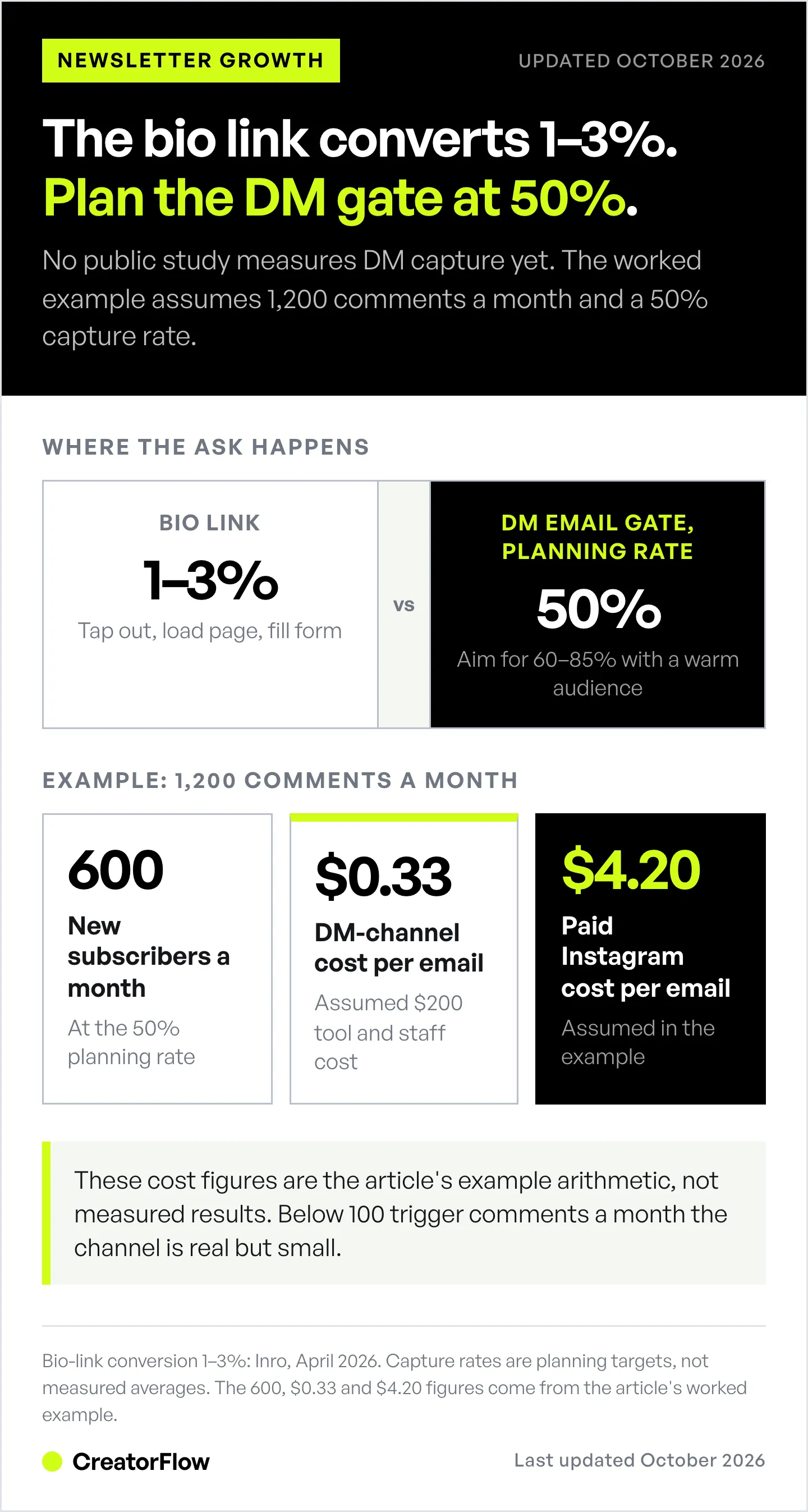
- Plan with a 50% DM capture rate and aim for 60-85% when the lead magnet is specific and the gate copy is clean. No public study measures DM capture yet, so your own tagged numbers are the benchmark.
- A reasonable paid-social SAC for newsletters sits at $1-$5 per email for general-interest audiences and $5-$15 for niche B2B (Prospeo, 2026). DM capture from organic comments runs at near-zero marginal cost, which pulls the blended number down fast.
- LTV:SAC of 3:1 is the standard newsletter growth marketers should defend; if you cannot show that ratio, the line item is at risk (Prospeo, 2026).
- Attribution requires tagging at capture: Every DM-sourced subscriber should land in the ESP with a “source:instagram-dm” tag and a campaign tag so paid and organic credit do not collide.
- The channel works alongside paid, not instead of it: Paid drives the reach that produces commenters; DM capture monetizes the comment thread that paid generated.
- Pipeline takes about 30 minutes to set up end-to-end including the comment trigger, the DM gate, and the handoff into your newsletter platform.

Where Instagram DMs Fit in Newsletter Growth Marketing
Instagram is already in the newsletter stack for most growth marketers. It sits in the channel mix as a brand and reach play, with paid spend pointed at Reels, account boosting, or creator collaborations. The output is impressions, follows, and traffic to the bio link.
The bio link is the bottleneck. Industry data puts bio-link conversion at 1-3% (Inro, April 2026), which means the gap between Instagram engagement and newsletter signup is structural. People who comment “send me the link” rarely make it through the bio-tap, page-load, form-fill, double-opt-in chain. They drop, and the paid CAC for that impression converts to nothing.
DM capture closes the gap. The follower comments a keyword. An automation tool sends a DM in under 10 seconds. The DM asks for an email inside Instagram, and the follower types it into the chat. Meta’s Instagram platform changelog shows that email quick-reply buttons stopped working in Instagram messaging on 5 October 2026, so typing is the only way in. The email then reaches the newsletter platform by CSV export, Zapier, or a native integration, depending on the tool. The capture step happens in the app while intent is hot.
For a newsletter, that matters because the same Instagram impression already paid for in the budget produces two signups instead of zero, and the second signup costs the time it took to write the DM template.
The Subscriber Acquisition Cost Math
The decision growth marketers actually have to defend is whether the DM channel earns the $15-30 per month a tool like CreatorFlow costs and the staff time to maintain it. The math is straightforward.
Inputs you need:
- Average subscriber LTV (newsletter revenue per subscriber over their active life)
- Current blended SAC across all paid and organic channels
- Monthly Instagram comments on relevant posts (proxy for capture volume)
- A planning capture rate (the model below uses a conservative 50%; swap in your measured rate after two weeks)
Worked example:
A SaaS newsletter has 30,000 Instagram followers, posts three Reels weekly, and gets roughly 1,200 trigger-eligible comments per month. Paid Instagram CAC sits at $4.20 per email subscriber. Newsletter LTV is $42 (a 10:1 LTV:SAC the team is happy with).
| Metric | Value |
|---|---|
| Monthly trigger-eligible comments | 1,200 |
| Conservative capture rate | 50% |
| New DM-sourced subscribers | 600 |
| Tool + staff cost (monthly) | $200 |
| DM-channel SAC | $0.33 |
| Paid-Instagram SAC (existing) | $4.20 |
| LTV per subscriber | $42 |
| LTV:SAC (DM channel) | 127:1 |
| LTV:SAC (paid Instagram) | 10:1 |
The comparison is not “is DM cheaper than paid?” Of course it is, because organic engagement that already happened costs nothing on the margin. The question is whether the channel earns its slot in the stack, and at any plausible capture rate it does.
Where the model breaks:
- Low-comment accounts: If your account produces fewer than 100 trigger-eligible comments per month, the channel is real but small. Defend it on completeness, not impact.
- Wrong-fit audience: If the lead magnet does not match the audience that comments, capture rate falls below 30% and the math compresses. Test the offer.
- Over-counting: Not every captured email is a deliverable address. Build a 5-10% bounce buffer into the model.
For a deeper comparison of the two delivery layers, see DM funnel vs email funnel.
Capture Rate Is the KPI Most Growth Marketers Don’t Track
Newsletter growth marketers track open rate, click rate, churn, LTV, and SAC. They rarely track DM capture rate, which is the conversion from commenter to deliverable subscriber.
Definition: Capture rate = (subscribers added to ESP) / (commenters who triggered the DM flow).
Three things move it:
- Lead magnet specificity. “Newsletter signup” captures at the floor. “The 12-page playbook with the spreadsheet template” captures higher because the value exchange is concrete.
- Gate copy. A first DM that asks for the email immediately captures lower than a first DM that delivers value, then asks. The order matters.
- Asset delivery. If the email submission triggers a delayed or broken delivery, word spreads in the comments. Capture rate falls within 48 hours.
A reasonable target is 60-70% for warm newsletter audiences and 75-85% for tightly niche audiences with high-intent lead magnets. Anything below 40% is a copy problem, not a tool problem.
Track it weekly in the same dashboard you use for paid SAC. The number is the channel’s pulse.
The DM-to-Newsletter Pipeline
The pipeline has four pieces. Build them in this order.
1. The trigger post. A Reel or post with a clear keyword CTA in the caption. Examples: “Comment GROWTH for the playbook” or “Reply WORKBOOK and I’ll send the spreadsheet.” The keyword is the trigger word the automation listens for.
2. The comment-to-DM flow. A DM automation tool listens for the keyword, sends the first DM in 1-8 seconds, and presents the email gate. CreatorFlow runs this on Pro for $15/month flat, per its pricing page (checked October 2026), with Email Gate as a Pro feature. Setup runs about 5 minutes per flow.
3. The email gate. The user submits an email inside Instagram. The DM acknowledges, then sends the lead magnet link. Email Gate and CSV export both live on Pro and above.
4. The handoff to the ESP. The captured emails move into the newsletter platform. With CreatorFlow, you export contacts to CSV on Pro and import them into the ESP; tools that publish a Zapier connection, such as ManyChat, can push each address as it lands. Tag the subscriber at that point (more on attribution next).
For ESP-specific setup, the Klaviyo, Kit, and Mailchimp integration guide covers tagging, double opt-in, and welcome triggers per platform. For Beehiiv specifically, the Beehiiv newsletter growth playbook walks through the Zapier recipe and welcome flow.
Attribution: Tagging Instagram-Sourced Subscribers
The attribution problem is simple in theory and broken in practice. Every DM-captured subscriber should land in the ESP with at least three tags:
- source:instagram-dm (channel)
- campaign:[reel-id-or-post-name] (which post produced this)
- lead-magnet:[asset-name] (which offer converted)
These tags let you do three things growth marketers actually need:
- Calculate channel SAC. Add tool cost plus staff time, divide by tagged subscribers. The number is defensible.
- Track LTV by source. Most ESPs let you segment open and click rate by tag, and most newsletter platforms can pipe revenue back to the subscriber record. Instagram-sourced subscribers already follow you, so compare their open rates against cold paid signups once the tags are in place.
- Run channel-mix analysis. When paid Instagram and DM capture both touch the same subscriber, you need first-touch and last-touch logic. Tagging at source is the input.
Without tags, paid and organic credit collapse into one number and the line item becomes indefensible. Tag at capture, not later.
For the gate-and-tag setup specifically, see the email gate guide.
Paid Plus Organic Channel Mix
The channel works best when paid and organic feed each other.
Paid drives reach. Boosted Reels, account promotion, and creator partnerships put the trigger post in front of more eyes. More eyes means more comments, which means more triggers, which means more captures.
Organic captures the harvest. The DM flow runs identically whether the comment came from a $50 boosted Reel or an organic post. Capture is channel-agnostic at the comment layer. Subscribers captured this way can then be uploaded as a Custom Audience to make the paid side cheaper, the second direction in an integrated email and social strategy.
The mix that works:
| Spend bucket | Allocation | Output measured by |
|---|---|---|
| Paid Reels promotion | Existing budget | Comment volume on trigger posts |
| Creator collaborations | Existing budget | Saved/shared content with keyword caption |
| DM tool + staff time | $200-500/month | Capture rate, channel SAC, tag completeness |
There is no separate paid-DM line item. The DM channel rides on top of every other Instagram dollar. That is the structural argument for funding it: it is a multiplier on existing spend, not a competing channel.
For the broader strategy frame on capturing email inside Instagram, see Instagram-to-email funnel.
Newsletter Platforms: Where DM-Captured Emails Land
The choice of newsletter platform affects sync speed and tagging, not capture rate. Pick based on the rest of the stack.
Beehiiv is the default for creator-led newsletters. Its Free plan covers up to 2,500 subscribers, and the paid Lite plan is $59/month, or $49/month billed yearly, per beehiiv’s pricing page (checked October 2026). DM tools with a Zapier connection can add each email to Beehiiv as it lands; from CreatorFlow, export a CSV and import it.
Substack is where storytelling-led newsletters live. Its supported route for adding emails in bulk is a CSV import from your dashboard, so plan a weekly import of DM-captured emails.
Kit (formerly ConvertKit) is the long-running creator ESP. ManyChat publishes a native Kit integration. With CreatorFlow, contacts move into Kit through the CSV export on Pro (creatorflow.so, July 2026).
Klaviyo is the choice for newsletters with an attached e-commerce store. Tag-based segmentation is strong; the Zapier recipe is a one-step.
Mailchimp is the entry default. Native and Zapier sync both work; tag depth is shallower than Klaviyo or Kit.
The principle: pick the ESP that fits the broader business model, then sync DM captures to it. Do not pick the ESP based on the DM tool.
Pre-Launch Checklist for Growth Marketers
Before the first DM-capture campaign goes live, verify the following:
- The trigger keyword is uncommon enough that organic comments do not fire false positives
- The first DM responds in under 10 seconds during a load test
- The email gate copy includes consent language for GDPR and CAN-SPAM
- The ESP receives the capture with all three tags applied
- The welcome sequence triggers within 5 minutes of capture
- Paid Instagram boost is queued for the first trigger post
- The dashboard tracking capture rate is built before launch, not after
The gap between a DM capture campaign that runs as a side project and one that earns a defensible line item is whether the dashboard is built first.
FAQ
What is the average cost to acquire a newsletter subscriber via Instagram DMs?
The marginal cost per DM-captured subscriber is near zero because organic comments cost nothing. Add tool cost ($15-30/month for CreatorFlow Pro or Growth) and staff time, say $200 a month in total. At a 50% capture rate, channel SAC works out to $2 at 200 trigger comments a month and $0.33 at 1,200. Compared to the $1-$5 paid-social SAC benchmark for newsletter subscribers (Prospeo, 2026), the channel pulls blended SAC down materially.
How does DM capture differ from a bio link?
A bio link asks the user to leave the post, tap into the profile, tap the link, load a page, and fill a form. Conversion runs 1-3%. DM capture asks for an email inside Instagram, where the user types it into the chat while still in the app. No public study measures DM capture rates yet, so plan with 50% and aim for 60-85% with a warm audience and a specific lead magnet.
Can Instagram DM automation push subscribers directly to Substack, Beehiiv, or Mailchimp?
It depends on the DM tool. Tools that publish a Zapier or native connection, such as ManyChat, can push each email to Beehiiv, Mailchimp, Klaviyo, or Kit as it arrives. With CreatorFlow, you export contacts as a CSV on Pro or Growth and import the file into your newsletter platform. Substack takes new emails through a CSV import from its dashboard.
Is Instagram DM automation safe for accounts running paid traffic?
Yes when the tool uses Meta’s official Instagram API. CreatorFlow, ManyChat, and LinkDM all run through the sanctioned Graph API with OAuth and no password sharing. Tool-side pacing keeps sends under per-second rate limits. Browser-based automation tools that log into the account are unsafe and put paid-account spend at risk.
What capture rate should a newsletter growth marketer expect?
Conservative model: 50%. Realistic for warm newsletter audiences: 60-70%. High end for tight-niche audiences with specific lead magnets: 75-85%. Below 40% indicates a copy or asset problem, not a tool problem.
Do I need a Pro plan to use email gates for newsletter signup?
Yes. CreatorFlow’s Email Gate (the feature that asks for an email before delivering the link) sits on Pro at $15/month and Growth at $30/month (creatorflow.so, October 2026). The Free plan covers the comment-to-DM trigger, and the gate starts on Pro.
Can I attribute paid Instagram ad spend to DM-captured subscribers?
Yes if you tag at capture. Apply source:instagram-dm, campaign:[reel-id], and lead-magnet:[asset] tags inside the ESP at the moment of sync. From there, run first-touch or last-touch attribution against the paid spend that drove the impression. Without tags, paid and organic credit collide in the blended SAC and the line item becomes indefensible.
Beehiiv plans, CreatorFlow pricing and Meta’s email quick-reply change checked October 2026. Subscriber acquisition cost benchmarks from Prospeo (2026). Capture rate ranges are planning targets, not measured averages. Individual results vary by audience, lead magnet, and ESP setup.


