

Across LTK, ShopMy, Mavely, and Amazon Influencer in 2026, commission rates run 1% to 30% with wildly different cookie windows, payout thresholds, and approval bars. ShopMy and LTK pay highest per fashion sale (averages from 10% to 30%), Mavely covers a wide brand mix with rates and cookies set per brand, and Amazon pays lowest per click but converts at scale. The right platform depends on your niche, not your follower count.
The $200/Month LTK Question
You are doing $200 a month on LTK. You post Reels, share storefront links, copy-paste outfit details into 40 DMs a day, and watch the commissions trickle in. A friend tells you ShopMy pays weekly. Another says Mavely converts better. A third swears Amazon Influencer beats all three on volume.
Who is right? All of them, partly. None of them, completely.
This guide walks through the actual economics of each platform in 2026, not the marketing pitch. You will see the commission ranges, the cookie windows, the application bars, and the payout mechanics that decide whether you make $200 or $2,000 a month from the same audience. By the end, you will know which platform fits your niche and why stacking two or three usually beats picking one. New to this? First, learn to create and place your affiliate links the right way.

Key Takeaways
- LTK says its average commission rate is between 10% and 25%, and can reach up to 30%, on its creator page (checked October 2026). Cookie windows vary by brand.
- ShopMy says rates typically run from 10% to 30%, with payouts every Friday and an $11 minimum, on its payment guide (checked October 2026).
- Mavely, now Later Creator, sets rates and cookie durations per brand across thousands of brands. Each Brand Card shows them (checked October 2026).
- Amazon Influencer pays 1-10% depending on category, with 10% on Luxury Beauty, according to Amazon’s commission statement (checked October 2026).
- Application bars: LTK reviews each application, and one of its pages lists over 5,000 followers, ShopMy typically activates at about 1,000 followers, Mavely has no application or follower minimum, and Amazon reviews followers and engagement.
- Stacking platforms by category usually outperforms picking one.
- A flat-fee delivery layer like CreatorFlow Pro at $15/month sends links via DM regardless of which platform you use (creatorflow.so, May 2026).
Affiliate Platform Payout Comparison (Side by Side)
LTK averages 10-25% and can reach 30%. ShopMy typically pays 10-30% and pays weekly. Mavely sets rates and cookies per brand. Amazon Influencer pays 1-10% by category on a 24-hour window. Every figure below was re-read on the vendor’s own page in October 2026.
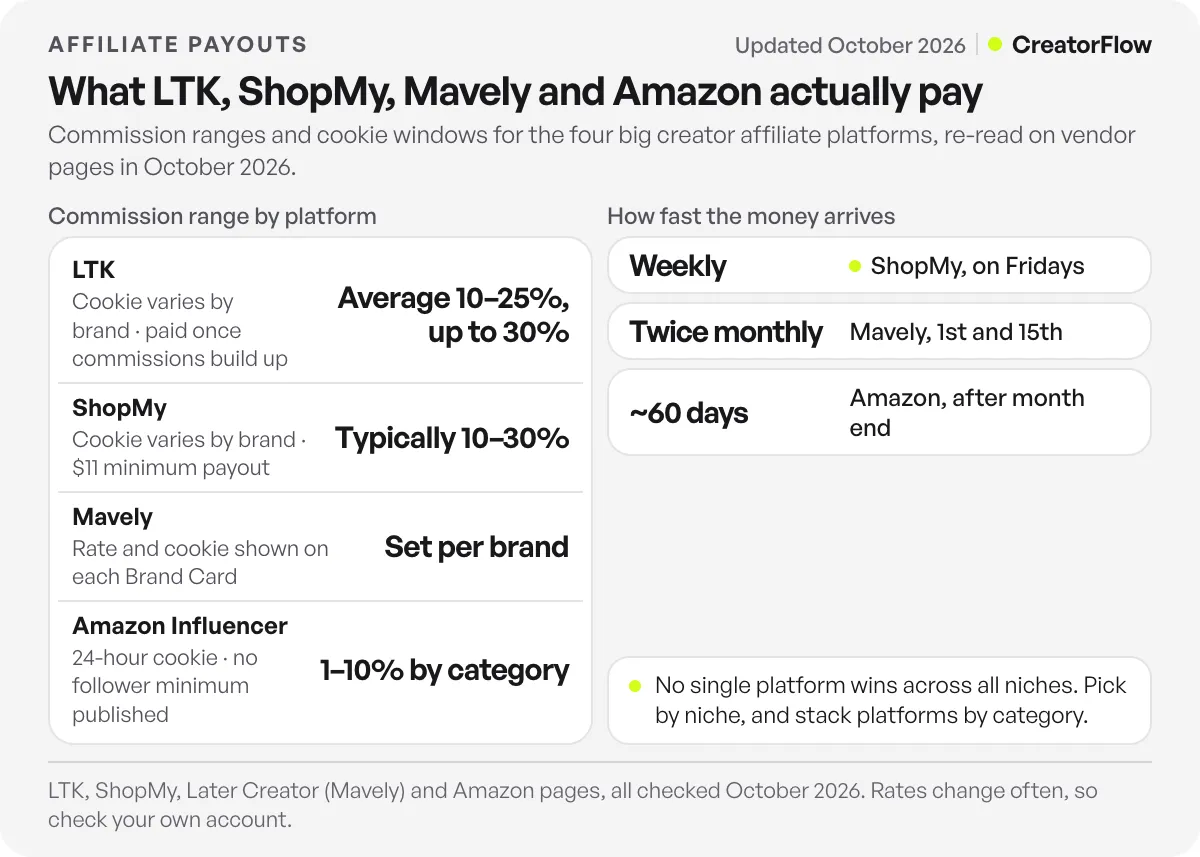
| Platform | Commission Range | Cookie Window | Payout Schedule | Min Followers | Best For |
|---|---|---|---|---|---|
| LTK | Average 10-25%, up to 30% | Varies by brand | Paid regularly once commissions build up (see your account) | LTK reviews each application; one page lists over 5,000 | Established lifestyle, fashion, home creators |
| ShopMy | Typically 10-30% | Varies by brand | Weekly on Fridays, $11 minimum | About 1,000 (reviewed case by case) | Per-sale maximization, premium fashion, beauty |
| Mavely | Set per brand | Set per brand | Twice a month (1st and 15th) | None | Multi-brand creators, deal-driven content |
| Amazon Influencer | 1-10% by category | 24 hours | About 60 days after month end | None published (Amazon reviews followers and engagement) | Tech, home, books, high-volume niches |
Sources: LTK, ShopMy, Later Creator and Amazon (all checked October 2026).
LTK: Best for Established Lifestyle Creators
LTK is the default for fashion and lifestyle creators who built audiences around outfit inspiration. Commissions sit in the 10-30% range across most brand partners, with cookie windows running 1 to 3 weeks depending on the retailer (stackinfluence.com, May 2026). That long window matters: a follower who sees your Reel on Monday and buys the dress on Friday still credits you.
Strengths:
- High average commissions in the fashion category
- Long referral windows compared to Mavely or Amazon
- Built-in app discovery (millions of shoppers browse the LTK app)
- No follower minimum since the 2024 application opening
Limitations:
- The LTK app is a walled garden. Followers need the app for some flows, which kills conversion on Instagram-native traffic.
- Brand approval takes time. Newer creators wait weeks for top-tier brand acceptance.
- Payouts are monthly. Verify the current minimum threshold in your LTK creator account.
If you sell mid-priced fashion ($40-200 items), LTK probably out-earns ShopMy and Mavely on commission per sale. If your audience does not download the app, you leak conversions. See our deeper LTK vs ShopMy comparison for the head-to-head breakdown.
ShopMy: Best for Per-Sale Maximization
ShopMy says commission rates typically range from 10% to 30%, depending on the brand or retailer, in its payment guide (checked October 2026). Retailers usually take 30 to 120 days to pay before a commission locks, so plan your cash flow around that.
The structural advantage is weekly payouts. Where LTK and Amazon make you wait 30-60 days, ShopMy moves money fast, which compounds for creators reinvesting in content production.
Strengths:
- Weekly payouts (vs monthly elsewhere)
- Curated premium brand catalog (especially fashion and beauty)
- Mobile and link-in-bio tools built for creators
- Faster cash flow than LTK (weekly cycles)
Limitations:
- Commissions lock only after a retailer wait of 30 to 120 days
- Smaller brand pool than Amazon
- Application required (typically wants 1K+ followers and aesthetic alignment)
ShopMy wins when you sell fewer high-ticket items per month and want cash flow speed. LTK usually wins on volume in mid-priced fashion.
Mavely: Best for Multi-Brand Diversity
Mavely’s SmartLinks aggregate thousands of brands into a single trackable link, with commission rates set per brand (Later, checked October 2026). The model targets creators who recommend across categories: a Target haul, a Walmart find, a beauty drop, a kitchen gadget.
The detail to check: cookie duration is set per brand, and each Brand Card shows it. A short cookie hurts slow-converting categories (furniture, electronics) and rewards impulse buys.
Strengths:
- Single platform covers hundreds of brands
- Commission rates set per brand, plus monthly bonuses
- Payouts twice a month, on the 1st and 15th
- Strong fit for deal-of-the-day, hauls, and try-on content
Limitations:
- Cookie duration varies by brand, so check it before you promote high-consideration purchases
Mavely is the right second platform for most creators already on LTK or ShopMy. See our Mavely creator guide for setup specifics.
Amazon Influencer: Best for High-Volume Niches
Amazon Influencer pays 1-10% commission depending on product category, with 10% on Luxury Beauty, 1% on grocery and 2% on televisions, according to Amazon’s commission statement (checked October 2026). Per-sale commission is usually the lowest of the four platforms.
The trade-off is Amazon’s conversion rate. Followers already have accounts, payment methods, and Prime shipping. The friction from click to purchase is roughly zero, which tends to turn more clicks into sales.
Strengths:
- Massive product catalog (effectively any product exists)
- Highest click-to-purchase conversion rate
- Storefront page acts as a permanent shoppable hub
- No strict follower minimum (Storefront approval required)
Limitations:
- 24-hour cookie window
- Low commissions on big-ticket categories (2% on TVs, 1% on grocery)
- Must build Storefront content to qualify and stay active
Amazon dominates for tech reviewers, book creators, kitchen and home content, and any niche where conversion volume beats commission rate. See our Amazon Influencer DM automation guide for delivery mechanics.
When to Stack Multiple Platforms
Most $5K+ per month affiliate creators run 2 to 3 platforms in parallel:
- LTK + Amazon: Premium fashion via LTK, accessories and lifestyle via Amazon
- ShopMy + Mavely: Premium beauty via ShopMy, deal-driven content via Mavely
- All four: Heavy hitters split posts by intent (inspiration vs deal vs niche)
The risk is cannibalization. If you post the same product link from two platforms in two posts, you compete with yourself for credit. The fix is content separation: dedicate Reels to one platform, Stories to another, comment-to-DM keywords to a third. Many creators go further and give each program its own account, which is the case for running multiple Instagram accounts for affiliate marketing in separate workspaces. See our scaling playbook for the segmentation framework.
The other risk is disclosure fatigue. Every platform requires affiliate disclosure. Test that your captions and DMs flag commissions clearly to stay compliant.
Stacking also works across models, not just platforms. The shopping platforms above pay per sale; software programs pay recurring commissions on every payment. The honest math of recurring affiliate income covers when a recurring layer is worth adding.
How to Deliver These Links via Instagram DM
Whatever platform you pick, the bottleneck in 2026 is delivery. Instagram suppresses link clicks in captions, link-in-bio scatters intent across 8 options, and manual DMs cap your scale at maybe 50 conversations a day.
The dominant 2026 mechanic is comment-to-DM automation: a follower comments a keyword on your post, and your tool sends them the link in DM within seconds. CreatorFlow Free covers most affiliate setups with 500 DMs per month, and CreatorFlow Pro at $15 per month flat adds the Follow Gate, Email Gate, and CSV export (creatorflow.so, May 2026).
The math: if your average commission is $5 and automation captures 100 extra sales a month, you net $500 in revenue from a $15 tool. That ratio is what makes link delivery the highest-ROI lever for affiliate creators.
For micro-influencers under 50K followers, this matters even more. See why micro-influencers convert affiliate links better for the engagement math, and compare the best affiliate programs for micro-influencers before you pick one.
Which Platform Pays Most for YOUR Niche
The honest answer depends on what you sell:
- Fashion (mid-priced, $40-200): LTK first, ShopMy second
- Premium fashion and beauty ($200+): ShopMy first, LTK second
- Multi-category hauls and deals: Mavely first, Amazon second
- Tech, electronics, gadgets: Amazon first (volume beats rate)
- Books, kitchen, home goods: Amazon first, Mavely second
- Health, wellness, supplements: Amazon (or Awin for niche brands)
- Fitness apparel: LTK first, ShopMy second
- Travel gear: Amazon first, LTK second
- Hotels and trips: Booking.com’s program, covered in the Booking.com affiliate playbook for travel creators
If you are below $500 per month in affiliate revenue, pick one platform that matches your strongest content category and go deep. If you are above $500 per month, add a second platform in a different category to diversify.
The biggest mistake is picking platforms by what other creators use. Your niche, your conversion mix, and your audience’s buying behavior decide payout, not anyone else’s screenshot. Market matters too: creators selling outside the US face a different platform mix, like the Mercado Livre and Amazon.com.br setup in the Brazilian affiliate playbook.
Cookie windows deserve as much weight as rates here, since a 24-hour window sets how fast you have to reply.
For a version of this tailored to Amazon affiliates, see CreatorFlow for Amazon affiliates.
FAQ
What affiliate platform pays creators the most in 2026?
No single platform wins across all niches. ShopMy and LTK pay highest per fashion sale (averages from 10% to 30%), Mavely covers a wide brand mix with rates set per brand, and Amazon Influencer pays 1-10% by category and usually converts well because shoppers already have accounts (vendor pages, checked October 2026).
How does ShopMy compare to LTK on commission?
ShopMy says rates typically run from 10% to 30% (payment guide, checked October 2026). LTK says its average is between 10% and 25%, and can reach up to 30% (creator page, checked October 2026). The rate on a given product is what decides it, so compare the same brand on both. ShopMy publishes a weekly payout day, and LTK says creators are paid regularly once commissions build up.
Is Mavely better than Amazon Influencer?
For multi-brand deal content, often yes. Mavely SmartLinks cover thousands of brands with rates set per brand (Later, checked October 2026), while Amazon pays 1-10% by category (Amazon, checked October 2026). For tech, books, kitchen, and home, Amazon’s checkout trust can matter more than the rate.
What follower count do I need for each platform?
LTK reviews each application, and its application page lists over 5,000 followers on at least one platform, so the bar may differ by country. ShopMy typically activates creators at about 1,000 followers. Mavely has no application, fee or follower minimum. Amazon’s Influencer FAQ says it looks at follower count and other engagement metrics (all checked October 2026).
Can I use multiple affiliate platforms at once?
Yes, and most $5K+ per month creators do. The risk is cannibalization if you post the same product from two platforms. Segment by content type (Reels vs Stories vs DMs) or by category (fashion on LTK, deals on Mavely, tech on Amazon) to avoid competing with yourself.
How fast do these platforms pay out?
ShopMy pays every Friday with an $11 minimum. Mavely, now Later Creator, pays twice a month, on the 1st and 15th. LTK says creators are paid regularly once commissions build up, and does not state a schedule on that page. Amazon pays roughly 60 days after the close of the month, with a $10 minimum for direct deposit (stackinfluence.com, joinmavely.com, referazon.com, May 2026).
What is the best way to send affiliate links to followers on Instagram?
Comment-to-DM automation. A follower comments a keyword on your post, and a tool like CreatorFlow sends the affiliate link in DM within seconds. CreatorFlow Free covers most setups with 500 DMs per month; Pro at $15 flat per month adds the Follow Gate and Email Gate (creatorflow.so, May 2026).
Sources and checks
LTK, ShopMy, Later Creator and Amazon terms re-read on their own pages in October 2026. Commission rates and platform terms change frequently. Verify on each platform’s site before making commitments.