
Seven platforms sell online courses, paid 1:1 coaching and digital downloads from a single account: Payhip, Podia, Teachable, Kajabi, Thinkific, SamCart and Stan Store. Entry prices run from $0 to $179 a month billed monthly. Sellfy and Gumroad cover downloads and memberships, but neither lists appointment booking on its feature pages. A plan limit, not a missing feature, usually decides which one fits.
Most comparisons in this category rank platforms by audience label. You get “best for beginners” and “best for scaling” and a price column, then you sign up and find that the plan you chose caps active students at 100, or that the booking calendar you needed sits two tiers up. The question that actually matters is narrower and almost never answered directly: which single account will take payment for a PDF, run a multi-lesson course, and let a client book and pay for an hour of your time.
This guide answers that first, with a capability table before anything else. Then it covers what each platform charges in September 2026, why the “0% transaction fees” badge nearly always carries a condition, which plan limits bite before the feature list does, and who is legally on the hook for VAT on a sale to a buyer in Germany.
Key Takeaways
- Seven of nine platforms carry all three product types. Payhip, Podia, Teachable, Kajabi, Thinkific, SamCart and Stan Store each publish downloads, courses and 1:1 booking. Sellfy lists none of the course or coaching features on its own comparison table, and Gumroad does not describe booking anywhere on its feature pages.
- Cheapest route to all three: Payhip’s free plan at $0 plus 5% per sale. It carries every feature on every tier, including the free one, and charges no monthly fee (payhip.com, September 2026).
- “0% transaction fees” is conditional almost everywhere. Teachable’s 0% applies on Builder and above and only through its own gateway. Kajabi publishes a 2%, 1% or 0.5% fee by plan when you use an outside payment provider. Sellfy charges 0% but caps annual sales, with a 2% overage fee above the cap.
- Free plans have mostly disappeared from this category. Teachable and Thinkific both now state plainly that they have none. Payhip’s free plan and Gumroad’s no-subscription model are the two remaining ways in at $0.
- Four pricing pages show you the annual column by default. Podia, Kajabi and Teachable all load with the discounted annual figure pre-selected, so the number you read is not the month-to-month price. Compare like for like or a platform looks 20% cheaper than the plan you sign up for.
- Only three platforms remit your tax for you. Gumroad acts as merchant of record worldwide, Payhip collects and remits EU and UK VAT, and Teachable states it remits global VAT and GST. Kajabi states in writing that it does not.
- The platform is the easy decision. Checkout, file hosting and a booking calendar are a one-afternoon setup. Getting a buyer from a Reel to that checkout link is the part that decides whether any of it earns.
What Is an All-in-One Platform for Courses and Coaching?
An all-in-one platform for courses and coaching is a single hosted account that takes payment for more than one kind of offer. Instead of a file host for downloads, a separate course tool, and a booking calendar wired to a payment link, one login carries the storefront, the lesson player, the calendar and the checkout. You pay one monthly fee, or one percentage per sale, and the buyer sees one brand.
The category splits on how it charges. Some platforms take a percentage of every sale and charge nothing monthly. Others charge a flat monthly fee and take nothing per sale. A third group does both, with the percentage falling as the monthly fee rises. That shape matters more than any single feature once you are selling regularly, which is covered in detail in our comparison of digital product platform fees.
Which Platforms Sell Courses, Coaching and Downloads From One Account
Seven of the nine platforms below publish all three. The two exceptions are Sellfy, whose own plan comparison lists no course builder or booking tool, and Gumroad, which sells courses as a product type but does not describe appointment booking on any feature page.
| Platform | Digital downloads | Online courses | Paid 1:1 booking | Memberships | Built-in email |
|---|---|---|---|---|---|
| Payhip | Yes | Yes | Yes, via Zoom, Skype and Calendly | Yes | Yes |
| Podia | Yes | Yes | Yes, clients book and pay | Yes | Yes |
| Teachable | Yes | Yes | Yes | Yes | Yes |
| Kajabi | Yes | Yes | Yes | Yes | Yes |
| Thinkific | Yes, 5 on Basic | Yes | Yes, from Start | Yes, from Start | Yes |
| SamCart | Yes | Yes | Yes, booked in the checkout | Yes | Cart emails only |
| Stan Store | Yes | Yes | Yes | Yes | Creator Pro only |
| Gumroad | Yes | Yes, as a product type | Not stated | Yes | Yes |
| Sellfy | Yes | Not listed | Not listed | Yes | Yes |
Sources: payhip.com, podia.com, teachable.com, kajabi.com, thinkific.com, samcart.com, help.stan.store, gumroad.com and sellfy.com, all accessed September 2026.
Three cells need a note, because a plain “yes” would overstate them.
Thinkific meters downloads and coaching on its entry plan. Basic allows 5 digital downloads and 5 coaching or webinar sessions. Both go unlimited from the Start plan up, and paid memberships are absent from Basic entirely (thinkific.com, September 2026). If you want all three product types on Thinkific, the entry tier is not the plan you want.
SamCart handles email differently. Cart-abandonment emails are built in, and broadcast email to a list runs through integrations with tools like ActiveCampaign, Mailchimp and HubSpot rather than a native newsletter (samcart.com, September 2026). Its booking feature is the tightest in the set: the call is sold and scheduled inside the same checkout.
Gumroad’s course depth is not published. Courses are a sellable product type, and Gumroad’s pages do not describe multi-lesson structure, drip release or student progress tracking the way the course-first platforms do. Treat it as a way to sell a course rather than a way to run one.
What Each Platform Costs in September 2026
Every figure here was read from the vendor’s own pricing page or help centre on September 3, 2026. Where a page defaults to annual billing, the monthly column was recovered from the page source or the vendor’s own JSON, because the visible number on load is the discounted one.
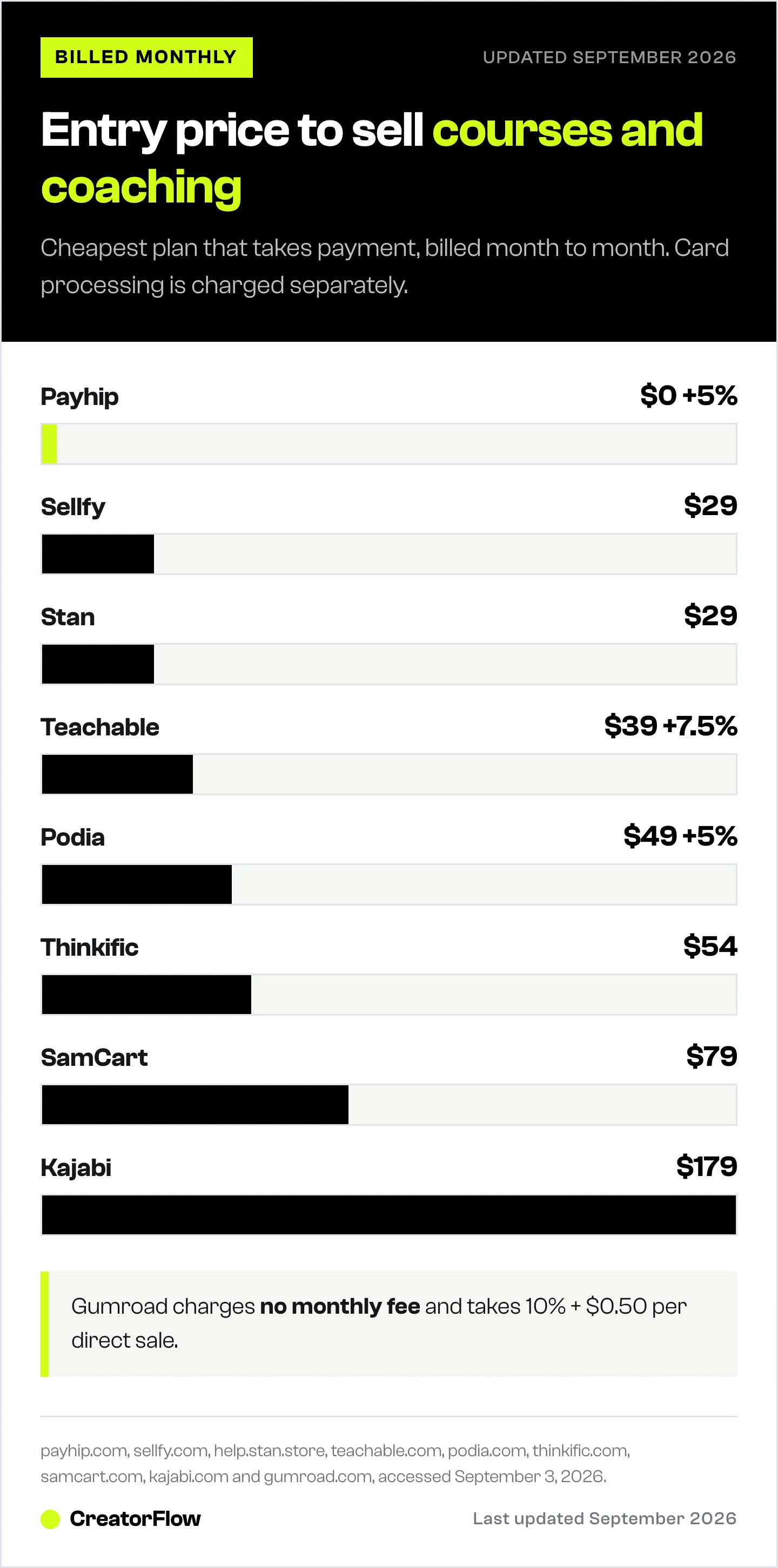
| Platform | Entry plan, billed monthly | Annual, per month | Platform cut per sale | Free plan |
|---|---|---|---|---|
| Payhip Free | $0 | No annual billing | 5% | Yes |
| Payhip Plus | $29 | No annual billing | 2% | n/a |
| Payhip Pro | $99 | No annual billing | 0% | n/a |
| Sellfy Starter | $29 | $22 | 0%, annual sales capped | No, 14-day trial |
| Stan Store Creator | $29 | $300 per year | 0% | No, 14-day trial |
| Teachable Starter | $39 | $29 | 7.5% | No, 7-day trial |
| Podia Mover | $49 | $42 | 5% | No, 30-day trial |
| Thinkific Basic | $54 | $40 | 0% on its own processor | No, 30-day trial |
| SamCart Core | $79 | Not published | 0% on SamPay | No, 7-day trial |
| Kajabi Basic | $179 | $143 | 0% on Kajabi Payments | No, 30-day trial |
| Gumroad | No subscription | n/a | 10% + $0.50 | Free to join |
Sources: payhip.com/pricing, sellfy.com/pricing, help.stan.store, teachable.com/pricing, podia.com/pricing, thinkific.com/pricing, samcart.com/pricing, kajabi.com/pricing and gumroad.com/pricing, accessed September 3, 2026.
Payment processing is a separate bill on most of these. Payhip, Podia, Sellfy and Stan Store all connect your own Stripe or PayPal account, and those processors charge on top. Stripe’s standard US online rate is 2.9% + $0.30 per successful charge (stripe.com, August 2026). Payhip states the position plainly: PayPal and Stripe still charge their standard rates on every plan.
Two pages could not be pinned down and are marked accordingly. SamCart’s pricing page carries a “Yearly (25% OFF)” toggle, but no annual figure for the Core plan appears in the page source or in any reachable checkout, so no Core annual price is published above. Its Pro annual plan is verifiable at $1,790 a year. Thinkific publishes prices in the currency your location implies, so the USD figures above came from a US route and are worth confirming from where you actually are.
Gumroad has a volume tier most write-ups omit. Once paid sales in a calendar month reach $20,000, new direct sales that month drop from 10% + $0.50 to 5% + $0.50, resetting on the first of each month with no application needed. That sits in Gumroad’s help centre rather than on its pricing page (gumroad.com, September 2026).
The Nine Platforms Compared
Each entry below leads with what the platform publishes as its strength, then the factual differences that decide fit. Prices are month-to-month unless stated.
Payhip
Payhip is the only platform in this set that puts every feature on every plan, including the free one. Its own FAQ says there is no feature gating, and the plan you pick changes the percentage it takes rather than what you can build. Downloads, courses with quizzes and assignments, drip release, certificates, memberships and coaching through Zoom, Skype or Calendly integrations are all available at $0.
Pricing is Free at $0 plus 5% per sale, Plus at $29 plus 2%, and Pro at $99 with 0%. No annual billing exists, so every figure is month to month. Products and revenue are uncapped on all three. Payhip states it collects and remits EU and UK VAT automatically on your behalf, on every plan. Paid tiers carry a 15-day trial, and Payhip reports over 130,000 creators (payhip.com, September 2026).
Suits: anyone who wants all three product types without a monthly commitment, and sellers with EU or UK buyers who would rather not register for VAT themselves.
Podia
Podia builds the storefront, courses, community spaces, email and coaching into one account, with topic-based spaces, group chats and direct messages for the community layer. Clients book and pay for sessions inside the platform.
Mover is $49 a month, or $42 billed annually, and carries a 5% transaction fee. Shaker is $99, or $84 annually, at 0%. Earthquaker is $179, or $150 annually, at 0%. Your own Stripe or PayPal charges roughly 2.9% + $0.30 on top, which Podia states is not its fee. There is no free plan, and the 30-day trial does not ask for a card. Podia reports 15,000 creators and $900 million earned on the platform (podia.com, September 2026).
The structural point on Podia is that plans are capped by email subscribers, not by revenue. Mover allows 100 subscribers, 50 products, 500 videos and 25 spaces. Extra contacts are a priced ladder on top, starting at $10 a month for 500 and reaching $400 a month for 100,000. Budget the contact tier alongside the plan.
Suits: creators who want a community and an email list in the same account as the course, and who will grow that list gradually enough to plan for the contact ladder.
Teachable
Teachable is course-first with coaching and downloads alongside, and it counts all three against one product allowance. Its own definition is that a product is any course, coaching offering or digital download you make live, while memberships and bundles do not count. Community arrives on Builder and above.
Starter is $39 a month, or $29 annually, with a 7.5% transaction fee. Builder is $89, or $69 annually. Growth is $189, or $139 annually. The 0% on Builder and above applies to sellers using teachable:pay or the Monthly Payment Gateway, and standard processing may still apply. There is no free plan. Teachable states it collects and remits global sales tax, VAT and GST automatically, and reports over 150,000 experts and businesses (teachable.com, September 2026).
Active students are the limit that surprises people: 100 on Starter, 1,000 on Builder, 5,000 on Growth. Products run 5, 10 and 50 across the same tiers.
Suits: course sellers who want the tax handled and can live inside a student cap, and anyone whose main offer is a course with coaching attached rather than the reverse.
Kajabi
Kajabi is the most feature-dense platform here, bundling courses, coaching, communities, websites, email and funnels with a metered AI credit allowance. Marketing email is unlimited on every plan.
Basic is $179 a month, or $143 annually. Growth is $249, or $199. Pro is $499, or $399. Products run 5, 50 and unlimited; contacts 2,500, 25,000 and 100,000; communities 1, 1 and 3; admin users 2, 11 and 26. Kajabi Payments charges 2.9%, 2.8% or 2.7% plus $0.30 by plan for US entities. There is no free plan, and the trial runs 30 days.
Two details deserve care. The page headline reads “No hidden fees. No revenue sharing”, and its own comparison table carries a row for third-party payment provider fees of 2%, 1% and 0.5% by plan, excluding PayPal and Kajabi Payments. Both statements are Kajabi’s; quote them together or the picture is wrong either way. Separately, Kajabi’s help centre states that Kajabi Sales Tax does not file or remit sales taxes on your behalf and that you are responsible for filing and remitting what you collect (kajabi.com and help.kajabi.com, September 2026).
Suits: established businesses replacing several tools at once, where a $179 floor is smaller than the stack it retires.
Thinkific
Thinkific is built around the course experience, with bookable calendars, unlimited Zoom sessions and attendance tracking for coaching from the Start plan up, and communities on every tier.
Basic is $54 a month, or $40 annually. Start is $109, or $82. Grow is $219, or $164. Plus is quoted by sales. Its own processor, Thinkific Payments, takes 0% and prices in line with Stripe and PayPal at 2.9%. Using an outside processor adds a platform fee that varies by plan, and the rate is not published on the pricing page. There is no free plan; Thinkific says so explicitly and offers a 30-day trial instead. Current students cap at 10,000 across all self-serve tiers, video bandwidth runs 100, 200 and 400 GB a month, and a branded mobile app is a $199 monthly add-on. Thinkific reports 20,000 teams (thinkific.com, September 2026).
Suits: teaching-led businesses that care about the learner experience, provided you start at Start rather than Basic if downloads and coaching both matter.
SamCart
SamCart is a checkout and conversion platform that grew a course and coaching layer, and the checkout is where it concentrates. Its booking feature sells the call and schedules it in the same transaction, which removes the gap between paying and picking a time.
Core is $79 a month and Pro is $199, with Pro also available at $1,790 a year. Pages, products and checkouts are unlimited on both, and team seats run 1, 10 and unlimited across Core, Pro and the Done For You tier. SamPay charges 2.9% + $0.30 and SamCart adds no fee of its own on it. Tax collection is a priced service at 0.50% on Core and 0.35% on Pro. There is no free plan behind the “Get Started for Free” button; the features page states a 7-day trial at $79 a month afterwards. SamCart reports over 75,000 businesses (samcart.com, September 2026).
Note that SamCart has consolidated to Core and Pro. Older Launch, Grow and Scale figures still circulating in comparisons are out of date.
Suits: sellers whose bottleneck is checkout conversion rather than course delivery, and coaches who want payment and scheduling to happen in one step.
Stan Store
Stan Store is a mobile-first storefront designed for social traffic, with a course builder, calendar and booking tools, recurring subscriptions and community features. Products and customers are unlimited on both plans.
Creator is $29 a month or $300 a year. Creator Pro is $99 a month or $948 a year. The platform cut is 0%, with processing through Stripe at roughly 2.9%. Email broadcasts, email flows and contact import sit on Creator Pro only. There is no free plan, and the trial runs 14 days. Tax runs through Stripe Tax, which collects only in regions where you are registered, so remittance stays with you.
One practical note for research: stan.store/pricing is not a live page. It resolves as a creator username and redirects, so the authoritative figures come from Stan’s help centre, last updated June 23, 2026 (help.stan.store, September 2026).
Suits: creators selling to Instagram and TikTok audiences who want a storefront that reads well on a phone, with the email layer only if you take Creator Pro.
Gumroad
Gumroad is the fastest way in this set to get a paid link live, with no subscription and no plan ladder. Since January 1, 2025 it has acted as merchant of record and states it manages sales tax collection and remittance worldwide, which removes the largest piece of admin from a cross-border seller’s desk.
Direct sales cost 10% + $0.50, dropping to 5% + $0.50 on new direct sales once a calendar month passes $20,000. Selling through its Discover marketplace costs 30% flat, which includes processing. On direct sales, card processing of 2.9% + $0.30 is additional. PayPal payouts carry a 2% fee. Memberships and email broadcasts are supported (gumroad.com, September 2026).
Courses are sellable, and Gumroad’s pages do not describe lesson structure, drip or progress tracking. Booking is not mentioned on its feature pages.
Suits: a first paid product, and sellers who value zero fixed cost and handled tax over course-delivery depth.
Sellfy
Sellfy covers digital downloads, subscriptions, physical products and print-on-demand from one storefront, with 0% transaction fees on every plan and email built in.
Starter is $29 a month or $22 annually, Business $79 or $59, and Premium $159 or $119. What separates the tiers is an annual sales cap rather than a feature set: $10,000, $50,000 and $200,000 respectively. Sellfy states that an account which has not upgraded may be charged a 2% overage fee on revenue above the plan limit, so growth changes the bill whether or not you change plans. Processing through Stripe or PayPal is additional at roughly 2.9% + $0.30. Email credits run 2,000, 10,000 and 50,000 a month, and maximum file size runs 10, 15 and 20 GB. Sellfy reports 75,000 creators (sellfy.com, September 2026).
A course builder and a booking tool do not appear in Sellfy’s product list or its full plan comparison, which is why it sits at the bottom of the capability table above.
Suits: sellers whose catalogue is files and physical goods rather than teaching, especially with print-on-demand in the mix.
Why “0% Transaction Fees” Usually Carries a Condition
A 0% badge in this category almost always means zero of the platform’s own cut, on its own payment rails, within a boundary set elsewhere on the page. Five of the nine platforms advertise 0% and four attach a condition to it. Reading the badge without the condition is how a plan that looked cheap turns out not to be.
Here is what the condition is in each case, in the vendor’s own terms.
Teachable’s 0% depends on the plan and the gateway. Starter carries 7.5%. Builder, Growth and Custom are 0% for sellers using teachable:pay or the Monthly Payment Gateway, and standard processing may still apply.
Kajabi’s 0% depends on whose processor you use. Kajabi Payments and PayPal carry no Kajabi fee. Any other payment provider carries 2% on Basic, 1% on Growth and 0.5% on Pro.
Thinkific’s 0% applies to Thinkific Payments. An outside processor adds a platform fee that Thinkific says varies by plan, and it does not publish the rate on the pricing page.
Sellfy’s 0% sits under a revenue ceiling. The cut is genuinely zero, and the plan caps annual sales, with a possible 2% overage above the cap for accounts that have not upgraded.
Payhip Pro at $99 and Stan Store at both tiers are the two unconditional 0% offers here, and in both cases your own Stripe or PayPal still charges its standard rate. No platform in this set absorbs card processing on a normal sale. The one exception is Gumroad’s Discover marketplace at 30%, where processing is included.
The Plan Limits That Decide For You
Feature checklists tend to look similar across these platforms once you are above the entry tier. The limits do not. In practice the ceiling you hit first is a count of something, and it is usually not the count you expected.
| Platform, entry plan | The limit that bites first |
|---|---|
| Teachable Starter | 100 active students, 5 products |
| Podia Mover | 100 email subscribers, 50 products |
| Kajabi Basic | 5 products, 2,500 contacts, 1 community |
| Thinkific Basic | 5 downloads, 5 coaching sessions, no paid memberships |
| Sellfy Starter | $10,000 in annual sales |
| Stan Store Creator | No email broadcasts until Creator Pro |
| SamCart Core | 1 team seat |
| Payhip Free | None published on products or revenue |
Sources: vendor pricing and comparison pages, September 2026.
Two of those deserve calling out because they are counted in a way that catches people. Teachable’s 100 active students on Starter is a live headcount rather than a lifetime total, and its product allowance covers courses, coaching offers and downloads together while memberships and bundles sit outside it. Podia’s subscriber cap governs the plan, so a list that grows faster than your revenue can move you up a tier or onto the paid contact ladder before your sales justify it.
The reverse case is worth naming too. Payhip publishes no product, revenue or student cap on any plan, including the free one, which is unusual in this set and is most of why it sits at the top of the value question for a new seller.
Who Remits the VAT on Your Sales
This is the line item that quietly costs money, and it is missing from most comparisons in this category. Digital products sold to consumers in the EU are taxed at the rate of the buyer’s country rather than yours. A seller established in the EU can charge their own country’s rate while cross-border sales stay under EUR 10,000 a year, and above that threshold the buyer’s local rate applies. A seller established outside the EU gets no threshold and registers through the Non-Union One Stop Shop scheme (europa.eu, August 2026).
Three platforms take that work off your desk, and they say so in writing.
| Platform | Collects tax | Remits on your behalf |
|---|---|---|
| Gumroad | Yes | Yes, merchant of record worldwide since January 1, 2025 |
| Payhip | Yes | Yes, EU VAT and UK |
| Teachable | Yes | Yes, via Teachable Payments |
| Kajabi | Yes | No, stated in its help centre |
| Stan Store | Yes, via Stripe Tax | No, you register per region |
| Podia | Yes, 230 countries | Not stated on its pages |
| Thinkific | Yes, automated sales tax | Not stated on its pages |
| SamCart | Yes, priced at 0.50% or 0.35% | Not stated on its pages |
| Sellfy | Yes, VAT and tax settings | Not stated on its pages |
Sources: gumroad.com, payhip.com, teachable.com, help.kajabi.com, help.stan.store, podia.com, thinkific.com, samcart.com and sellfy.com, September 2026.
The distinction between the last two groups matters. “Collects” means the platform can calculate and charge the right tax at checkout. “Remits” means it files and pays it. Kajabi is explicit that it does the first and not the second, and four platforms describe tax tooling without making a remittance claim either way. Where a platform does not publish that it remits, assume the registration, the returns and the liability are yours, and confirm your own position with a tax adviser.
One Platform or Three: When Consolidating Saves Money
The case for one platform is usually made on tidiness. The number that decides it is the total you already pay for the tools it would replace.
A common coaching and course stack runs a course host, a scheduler and an email tool, plus the payment processor everything sits on. At published September 2026 rates, a mid-tier version of that comes to roughly $150 a month before a single client signs. Podia Shaker at $99 or Thinkific Start at $109 carries all three jobs in one account, so consolidating is cheaper on the monthly line as well as simpler.
Run the comparison against what you pay now rather than against a platform’s headline price, and count three things the pricing page will not add up for you.
- The contact or student ladder. Podia’s subscriber caps and Teachable’s active-student caps mean the true monthly figure is the plan plus whatever tier your list or roster forces.
- The processor underneath. Roughly 2.9% + $0.30 per sale applies on nearly every platform here regardless of a 0% badge, so it belongs in every total.
- The migration. Moving existing products, files and paying members is the cost nobody quotes. Files and checkout links move in an afternoon. Active subscriptions and student records do not, and a mid-flight migration of paying members is the one switch worth timing carefully.
If your monthly tool bill is already above the plan that replaces it, consolidating wins on both counts. If you are pre-revenue, the opposite holds: Payhip’s free plan carries all three product types at $0 plus 5%, and a month with no sales costs nothing. Our coaching tech stack audit works the same question from the other direction, scoring each tool on cost per active client.
Which Platform Is Right for You?
Work down this list and stop at the first line that describes you.
- You have not sold anything yet. Payhip’s free plan. All three product types, no monthly fee, 5% per sale, and no product or revenue cap.
- You sell to EU or UK buyers and do not want tax registrations. Payhip, Gumroad or Teachable. All three publish that they remit on your behalf.
- Coaching is your main offer, not a course add-on. SamCart, where the call is sold and booked in one checkout, or Podia, where booking sits alongside a community.
- You want a community and an email list in the same account. Podia or Kajabi. Budget the contact tier with the plan, because both price on contacts.
- The course experience is the product. Thinkific from the Start plan, or Teachable if you would rather have the tax handled than the deepest learner tooling.
- You are replacing four tools at once and already pay for them. Kajabi. The $179 floor only makes sense against a stack it retires.
- Instagram or TikTok is where your buyers are. Stan Store for a phone-first storefront, with Creator Pro if you need email.
- Your catalogue is files and physical goods, not teaching. Sellfy, with print-on-demand, watching the annual sales cap on your tier.
Switching costs less than the choice suggests. These are checkout pages, file hosts and calendars. Pick what fits the revenue you have now, and re-run the comparison when it doubles.
Getting Buyers From Instagram to Your Checkout
Every platform above ends at the same place: a URL. Its job stops there, and the part that decides your revenue starts.
The gap most sellers never close sits between a Reel that performs and a checkout nobody reaches. Someone watches, comments “link”, and waits. Four hours later a reply arrives, and by then they have scrolled past two hundred posts. The checkout was never the problem, and neither was the platform.
Instagram DM automation closes that gap by sending the link the moment the comment lands. A follower comments your trigger word, the DM arrives in seconds with your Podia, Teachable or Payhip URL inside it, and the buying impulse is still live. CreatorFlow does this at $15 a month flat, with click tracking on every link, geographic analytics on who is clicking, and an email gate that collects the address before the link goes out. It runs on Meta’s official Instagram API, and CreatorFlow has been a Meta Tech Provider since December 2025.
Practical next steps once your checkout link exists:
- Sell an online course on Instagram covers the three surfaces where a link is actually tappable, and how to move buying signals into a DM.
- Coaches booking calls rather than selling files can turn call requests into booked calls with the same trigger-word mechanic.
- If the product does not exist yet, launch a first digital product in seven days is the shortest path from idea to a live link.
- For a service sold before it is scheduled, you can take deposits directly in DMs without a checkout platform at all.
FAQ
What is the best platform to sell courses and coaching?
For a new seller, Payhip’s free plan is the cheapest way to sell courses, coaching and downloads from one account: $0 a month plus 5% per sale, with every feature available on the free tier and no product or revenue cap. For an established business replacing several tools, Kajabi at $179 a month or Podia Shaker at $99 carries courses, coaching, community and email together (vendor pricing pages, September 2026).
Can I sell 1:1 coaching sessions on a course platform?
Yes, on seven of the nine platforms compared here. Payhip connects Zoom, Skype and Calendly. Podia, Teachable, Kajabi and Stan Store include booking natively. Thinkific includes bookable calendars with attendance tracking from its Start plan. SamCart sells the call and schedules it inside the same checkout. Sellfy and Gumroad do not list appointment booking on their feature pages.
Is there a free platform to sell courses and coaching?
Payhip’s free plan is the only one in this set that carries courses, coaching and downloads at $0 a month, charging 5% per sale instead of a subscription. Gumroad is also free to join with no monthly fee, at 10% + $0.50 per direct sale, though it does not describe booking. Teachable and Thinkific both previously ran free tiers and now state that they have none, offering trials instead.
Which course platform has the lowest transaction fees?
Payhip Pro at $99 a month and Stan Store at $29 or $99 a month both charge 0% with no conditions attached. Teachable, Kajabi, Thinkific and Sellfy all advertise 0% with a qualifier: the plan tier, the payment gateway you use, or an annual sales cap. Your own card processor still charges roughly 2.9% + $0.30 on nearly every platform here.
Do these platforms handle EU VAT for me?
Three publish that they remit it. Gumroad has acted as merchant of record worldwide since January 1, 2025. Payhip collects and remits EU and UK VAT automatically on all plans. Teachable states it collects and remits global VAT and GST through Teachable Payments. Kajabi states in its help centre that it does not file or remit on your behalf. Podia, Thinkific, SamCart and Sellfy describe tax tooling without a remittance claim.
How many students or products do these plans allow?
The caps vary more than the prices. Teachable Starter allows 100 active students and 5 products. Podia Mover allows 100 email subscribers and 50 products. Kajabi Basic allows 5 products and 2,500 contacts. Thinkific Basic allows 5 downloads and 5 coaching sessions. Sellfy caps annual sales rather than counts, at $10,000 on Starter. Payhip publishes no product, revenue or student cap on any plan.
Should I use one platform or separate tools for courses, coaching and email?
Compare the one-platform price against what you already pay, not against zero. A mid-tier course host, scheduler and email tool runs roughly $150 a month at published September 2026 rates, which is more than Podia Shaker at $99 or Thinkific Start at $109. Below that spend, separate tools or Payhip’s free plan usually cost less, and the migration of active subscriptions is the switching cost nobody quotes.
Pricing, transaction fees, plan limits, product-type support and tax handling verified from payhip.com, podia.com, teachable.com, kajabi.com, help.kajabi.com, thinkific.com, samcart.com, help.stan.store, gumroad.com, sellfy.com and stripe.com on September 3, 2026, and EU VAT rules from europa.eu in August 2026. Where a vendor does not publish a figure it is marked as not stated rather than estimated. Several pricing pages display annual billing by default; monthly figures above were taken from the month-to-month column. Pricing changes without notice, so confirm current rates before choosing a platform. Individual results vary.